
Letter from a Palestinian Political Prisoner in Louisiana Dictated over the phone from ICE Detention March 18, 2025

Moderator’s Note: Below is a letter from Mahmoud Khalil in its entirety, dictated over the phone from Immigrations and Customs (ICE) detention in Louisiana. A permanent resident taken by the government for his political speech. The phrase “who has the right to have rights?” was coined by Hannah Arendt who escaped Nazi Germany and wrote poignantly and pointedly about the rise of fascism. While on the surface, this letter doesn’t have an obvious link to FAR’s mission, we feel it is deeply intertwined. Who has the right the have rights? Women once had no rights and it appears we are losing them again at breakneck speed. Immigrant’s rights in this country are being stripped also at breakneck speed. And that is just the tip of the iceberg. If we can’t answer “EVERYONE” to Arendt and Khalil’s question, then human rights mean nothing for any of us.

Wikimedia Commons: Protests in Thomas Paine Park against the detention of Palestinian activist and Columbia student Mahmoud Khalil. [SWinxy]

My name is Mahmoud Khalil and I am a political prisoner. I am writing to you from a detention facility in Louisiana where I wake to cold mornings and spend long days bearing witness to the quiet injustices underway against a great many people precluded from the protections of the law.

Who has the right to have rights? It is certainly not the humans crowded into the cells here. It isn’t the Senegalese man I met who has been deprived of his liberty for a year, his legal situation in limbo and his family an ocean away. It isn’t the 21-year-old detainee I met, who stepped foot in this country at age nine, only to be deported without so much as a hearing.

Justice escapes the contours of this nation’s immigration facilities.

On March 8, I was taken by DHS agents who refused to provide a warrant, and accosted my wife and me as we returned from dinner. By now, the footage of that night has been made public. Before I knew what was happening, agents handcuffed and forced me into an unmarked car. At that moment, my only concern was for Noor’s safety. I had no idea if she would be taken too, since the agents had threatened to arrest her for not leaving my side. DHS would not tell me anything for hours — I did not know the cause of my arrest or if I was facing immediate deportation. At 26 Federal Plaza, I slept on the cold floor. In the early morning hours, agents transported me to another facility in Elizabeth, New Jersey. There, I slept on the ground and was refused a blanket despite my request.

Continue reading “Letter from a Palestinian Political Prisoner in Louisiana Dictated over the phone from ICE Detention March 18, 2025”
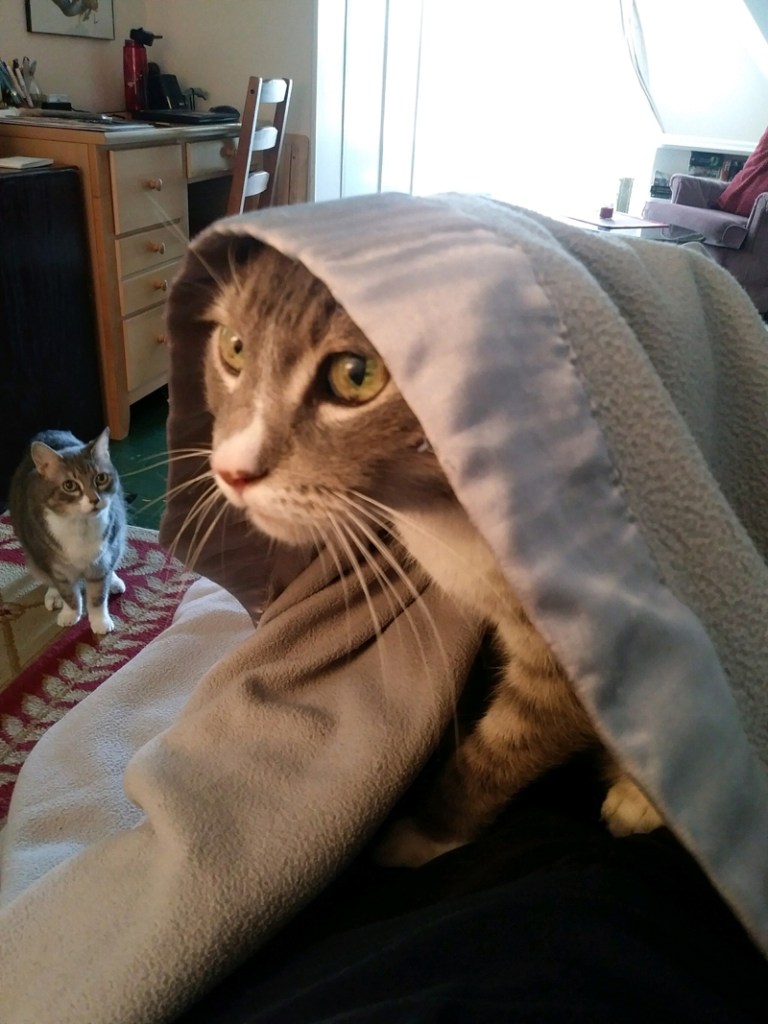
Dear Mr. Vance, Love, A Childless Cat Lady

I am a writer, one who sometimes touches on personal issues. But this is the first time I elaborate on why I don’t have children, no doubt, provoked by your “childless cat lady” jibe. 

I am childless or childfree; to me, it is a matter of semantics. I have two cats whom I consider my children. In many ways, I am like most Americans; I love my job, I love my students, I love my colleagues. 

And I love my cats.

Continue reading “Dear Mr. Vance, Love, A Childless Cat Lady”

To Childless Cat Ladies by Janet Maika’i Rudolph

I feel you. In a patriarchy where women’s reproductive abilities determine our worth, to be childless is a curse. We can thank VP candidate JD Vance for revealing this truth in all its ugly fullness. He is a walking billboard for patriarchy. Bottom line: Patriarchy is all about women’s bodies, our reproductive abilities and men’s desire to control them. We saw this in the Dobbs decision where it was declared that women have no constitutional right to the basics of healthcare, in Texas where it’s pretty much illegal to have a poor pregnancy outcome, and in Ohio where raped children are expected to give birth to their abuser’s child. Its endless 

But it is JD who made it plainer than plain what this is all about. Besides childless cat ladies being an old trope, just think of the judgement involved. Who is JD to decide on anyone’s family constellation? Or their pets? He also made disparaging remarks about the “childless left,” who have no “physical commitment to the future of this country.” That is a statement that only a person who totally lacks empathy can make. He is making a sweeping generalization that people without children don’t care about the future. This statement is more confession than truth. He reveals that until he had children, he had no care about the future of our world. It’s beyond egocentric. If only his kids are the center of his “caring,” that shuts out most of the world’s other children.

Continue reading “To Childless Cat Ladies by Janet Maika’i Rudolph”

Well-Behaved Women Seldom Make History, But Obedient Ones are Rewarded in Heaven: An Examination of the Re-Invention of the Bengali Tradition of Sati By Michele Stopera Freyhauf

Well-Behaved Women Seldom Make History is a book authored by Laurel Thatcher Ulrich.  This has become a well-known phrase used by most feminists to imply a meaning of disobedience or stance against the patriarchal structure of society.  Often in error, the credit of the invention of this phrase is attributed Eleanor Roosevelt and Marilyn Monroe.  Their image, and especially the image of Monroe, will often appear with the slogan on merchandise as a means of marketing and raising revenue.  Ironically, reinvention or reuse is prevalent in history when it comes to tradition or ritual for the same reason – monetary gain.  This practice is common and the benefit of reinventing or reinterpreting an old tradition is an automatic connection to the past giving continuity, which, according to Eric Hobsbaum, instills strong “binding social practice,” (p. 10) including loyalty and duty in the members of the group.  This is especially effective in manipulating the poor and uneducated who usually display strict obedience and blind acceptance of tradition. The Bengali reinvented tradition of satî is an example of this. Continue reading “Well-Behaved Women Seldom Make History, But Obedient Ones are Rewarded in Heaven: An Examination of the Re-Invention of the Bengali Tradition of Sati By Michele Stopera Freyhauf”