This post was originally published on March 17th, 2014.
As I think about the incarceration of young black men for relatively minor drug crimes, and the murders of Trayvon Martin and Jordan Davis, I cannot help but compare the astonishing progress that Americans have made in overcoming prejudice against gays and lesbians to the astounding lack of progress we have made in overcoming prejudice against black Americans.
It is often repeated that the reason for changes in attitudes about gays and lesbians is the process of coming out—most people in America now know a lesbian or gay family member, friend, or co-worker. On the other hand, I would dare to speculate that many—perhaps most—Americans who are not African-American do not know a boy like Trayon Martin or Jordan Davis. If you do—count yourself lucky! Our society remains divided by race and class divisions (many of them a legacy of racism) that prevent many non-black Americans from knowing a single young black man. Continue reading “Legacy of Carol P. Christ: Segregation”
This post was originally published on Oct. 7th, 2011
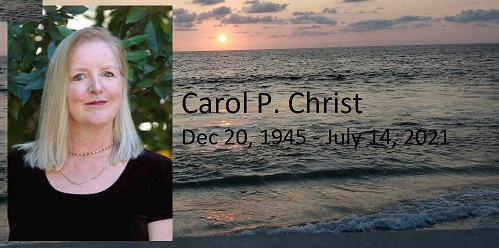
Carol P. Christ, a founding mother in the study of Women and Religion and Feminist Theo/a/logy, has been active in anti-racist, anti-poverty, anti-war, feminist, pro-gay and lesbian, anti-nuclear, and environmental causes (in that order) for many years. All of these issues have informed her teaching, her scholarship, and her politics.
The recent posting of Mary Daly’sletter to Audre Lorde on the Feminism and Religion blog is a correction of a piece of feminist history that is important in its own right and because of the way Lorde’s letter has shaped feminist discourse and politics up to the present day. Knowledge of the existence of Daly’s letter and the facts surrounding Lorde’s distortion of history has been in the public domain since the 2004 publication of Alexis DeVeaux’sWarrior Poet, but when I searched the internet for a copy of “Mary Daly’s letter to Audre Lorde” a few days ago, what came up was Lorde’s letter to Daly — not Daly’s letter to Lorde.
I often hear younger feminists say that “all white feminists” of the older generations “were racist.” Sometimes Mary Daly is mentioned. Finding the more detailed record about Mary Daly is one step in retelling the history of feminism in a more complex way.
Nicole stared at the blue water in the pool. It was so wet and so blue—Virgin Mary blue. It was so hot in Texas, she thought that over and over, ever since her parents moved the family to Fort Worth for her dad’s job.
They were living at the Naval Air Station. It was 1965 and they did not have air conditioning in their apartment: with its one bathroom, two parents and four kids. The heat was an animal. To escape it she played in the mud between the buildings. This was nothing like the woods of New Hampshire, but here they were and they weren’t going home—maybe ever. That’s what her mother said.
In spite of organizations such as “Black Lives Matter” and the three or four waves of feminism over the past century, both racism and misogyny remain stubbornly alive. We’ve made positive strides on both fronts, yet much remains to be done. Curiously enough, I’ve noticed more sensitivity in our current society regarding racism than misogyny. People claiming to be “woke” seem more inclined to be woke to the manifestations of racism—not so much to misogyny.
According to Merriam-Webster, the term woke is about being “aware of and actively attentive to important societal facts and issues (especially issues of racial and social justice).” Merriam-Webster’s second definition of the term is “politically liberal (as in matters of racial and social justice) especially in a way that is considered unreasonable or extreme.”
“The pictures that line the halls speak volumes about the history of racism and sexism and they shape the future in powerful ways.”–Simon Timm
The author of these words recently posted a short video on Youtube entitled “Mirror Mirror on the Wall: The Legacies of Sexism and White Supremacy at Yale Divinity School.”* The video begins with a catchy little ditty with the words, “God is not a man, God is not a white man.” It tracks paintings and photographs of professors and other luminaries in the field of theology on the walls of the Yale Divinity School. By Timm’s count: 99 white males, 6 women, and 3 blacks. The single black woman is counted in both categories.
We have to thank a woman named Natalie M. Kalmus for her contributions to the development of color on screen. Being a woman and the executive head of the Technicolor art department in the 1930’s was nothing short of extraordinary, and, in 1935 she released a document titled Color Consciousness in which she explored color theory and the use of color on screen. And, while this was illuminating and groundbreaking at a time, we also have some serious problems with the document that need to be re-examined from an anti-racist and feminist perspective.
Kalmus tells us how and when to use color given that particular color’s moral and psychological associations. She tells us that different colors evoke emotional reactions from the audience because these colors paint a realistic worldview. This presents a problem because, if, as Kalmus suggests, the usage of color and its associations represent a realistic worldview then the worldview Kalmus presents is an inherently racist one. Kalmus writes that black “… has a distinctly negative and destructive aspect. Black instinctively recalls night, fear, darkness, crime. It suggests funerals, mourning. It is impenetrable, comfortless, secretive.” In stark contrast to the color black, Kalmus writes that white “… reflects the greatest amount of light, it emanates a luminosity which symbolizes spirit. White represents purity, cleanliness, peace, marriage… White uplifts and ennobles, while black lowers and renders more base and evil any color.” To put it simply: black is evil and white is good. What does any of this have to do with spirituality? Well, the way we think and feel about color and how characters are depicted on screen taps into our psychological understanding of how “good” or “bad” a color is. This trickles over into our magical and spiritual practices with the notions of “Black Magic” vs. “White Magic.” We often associate someone who practices black magic as someone who works with dark or evil forces, and white magic with someone who practices magic for the good of others.
For every American concerned with Civil Rights this indeed is a sad day. It means states and municipalities—particularly those in the former Confederacy—will in the days following the decision be introducing new legislation which will have the effect of disenfranchising black voters. Those of us who consider the right to vote fundamental in a democracy must rise up, with time, with money, and if necessary with our bodies in peaceful protest.
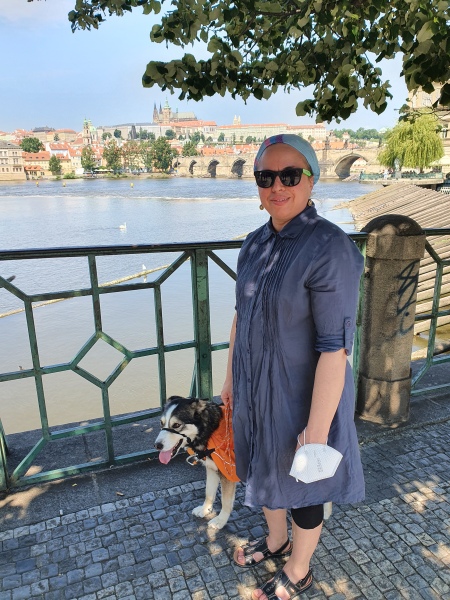
This month more than most, I feel like I have so much to say that I don’t really know where to begin. It doesn’t help that next door they are remodelling an apartment and, outside my window, there is a crew drilling up the sidewalk and another roofing the house across the street. The noise and its echoing are overwhelming on Prague’s narrow streets.
Perhaps the best place to start is with a similarly loud occurrence. On June 27th, Prague commemorated the 70th anniversary of the execution of Milada Horáková using the city-wide intercom system. Minute-long excerpts from her trial and execution were broadcast throughout the day. Horáková, the only woman to be executed during the Communist regime in Czechoslovakia, was a long-time proponent of democracy and women’s rights. In the field of women’s rights, she focused on the status of women and children, spending considerable effort on women in the workplace and reconciling their work with family responsibilities. She was also an outspoken critic of the Nazi Regime, having spent time as a political prisoner in Terezin. When the war ended, she joined parliament, but resigned right after the communist take-over. After continuing to speak out against the Communists, she was arrested in September of 1949 and charged with attempting to overthrown the government. She along with 12 others were interrogated and tried. Four of them, including Horáková were sentenced to death. She was publicly hanged on the 27th of June 1950. Eighteen long years later, she was posthumously exonerated, and in 2000, the Czech Republic unveiled a commemorative tombstone for her in the National Cemetery at Vyšehrad Castle. In 2017, a film was made about her life and legacy.Continue reading “Listening to the Noise: The Connections between Milada Horáková, Anti-Semitism, and the Black Lives Matter Movement by Ivy Helman.”
Following the murders of Trayvon Martin and Tamir Rice, Kelly Brown Douglas released her book, Stand Your Ground: Black Bodies and the Justice of God. In this critical work, she details the embedding of structural violence within the doctrine of American Exceptionalism and the deep rooted racial injustice that our nation was founded upon.
Over the last several months, our world has changed. We’ve witnessed great tragedy and there is so much to grieve. COVID-19 intruded upon our lives abruptly forcing the realization of our misplaced priorities. However, systemic racism has always been here, tightly woven into the fabric of our society; yet privileged voices have failed to answer the call for justice.
As so many risk their health and safety to march for racial justice; to exclaim that Black Lives Matter and that George Floyd’s life was indeed sacred (as was Raychard Brooks, Breonna Taylor, Freddie Gray, Sandra Bland, Philandro Castile, Alton Sterling, Eric Garner…#SayTheirNames), we must consider our own responsibility in perpetuating oppressive structures that condone the trend of public lynchings.
Following the murders of Trayvon Martin and Tamir Rice, Kelly Brown Douglas released her book, Stand Your Ground: Black Bodies and the Justice of God. In this critical work, she details the embedding of structural violence within the doctrine of American Exceptionalism and the deep rooted racial injustice that our nation was founded upon. She explains it was not a book that she wanted to write; rather, as a mother of an African American son, it is a book she was compelled to write. In doing so, Kelly has laid bare the sin of our nation. Five years later, her witness continues to demand our attention.
I reached out to Kelly and asked if she would be willing to talk with me about her book and she graciously agreed. Thus, for this post, I am sharing the wisdom of Kelly Brown Douglas, vlog style, knowing that, in this moment, it is her words that we all need to hear.
Gina Messina, Ph.D. is an American feminist scholar, Catholic theologian, activist, and mom. She serves as Associate Professor and Department Chair of Religious Studies at Ursuline College and is co-founder of FeminismAndReligion.com. She has written for the Huffington Post and is author or editor of five books including Women Religion Revolution. Messina is a widely sought after speaker and has presented across the US at universities, organizations, conferences and on national platforms including appearances on MSNBC, Tavis Smiley, NPR and the TEDx stage. She has also spoken at the Commission on the Status of Women at the United Nations to discuss matters impacting the lives of women around the globe. Messina is active in movements to end violence against women and explores opportunities for spiritual healing. Connect with her on Twitter @GMessinaPhD, Instagram: @GinaMessinaPhD, Facebook, and her website ginamessina.com.
There’s magic in hiking alone, but as women, we’ve been taught to worry about venturing far on our own. In fact, we’ve been taught to worry about a lot more than that.
Though once I merely shrugged off the warnings and the horror stories, confident that I was wrapped in some sort of “not me” protective veil, I don’t usually take my safety for granted anymore. Maybe it’s because I’ve outgrown the belief that I’m invincible. Maybe it’s because I’m a mother and have a different understanding of the fragility of life and the female body. Maybe it’s because that murderer on the Appalachian Trail went by the nickname “Sovereign,” appropriating the powerful, beautiful word that is so essential to my life’s work.
This particular day, however, my desire to be outside was more compelling than my new bend toward caution. I called my husband to tell him just where I’d be, joking that he needed to know where to look for me if I didn’t pick up the girls from camp on time.





 This month more than most, I feel like I have so much to say that I don’t really know where to begin. It doesn’t help that next door they are remodelling

 Feminism and Religion