
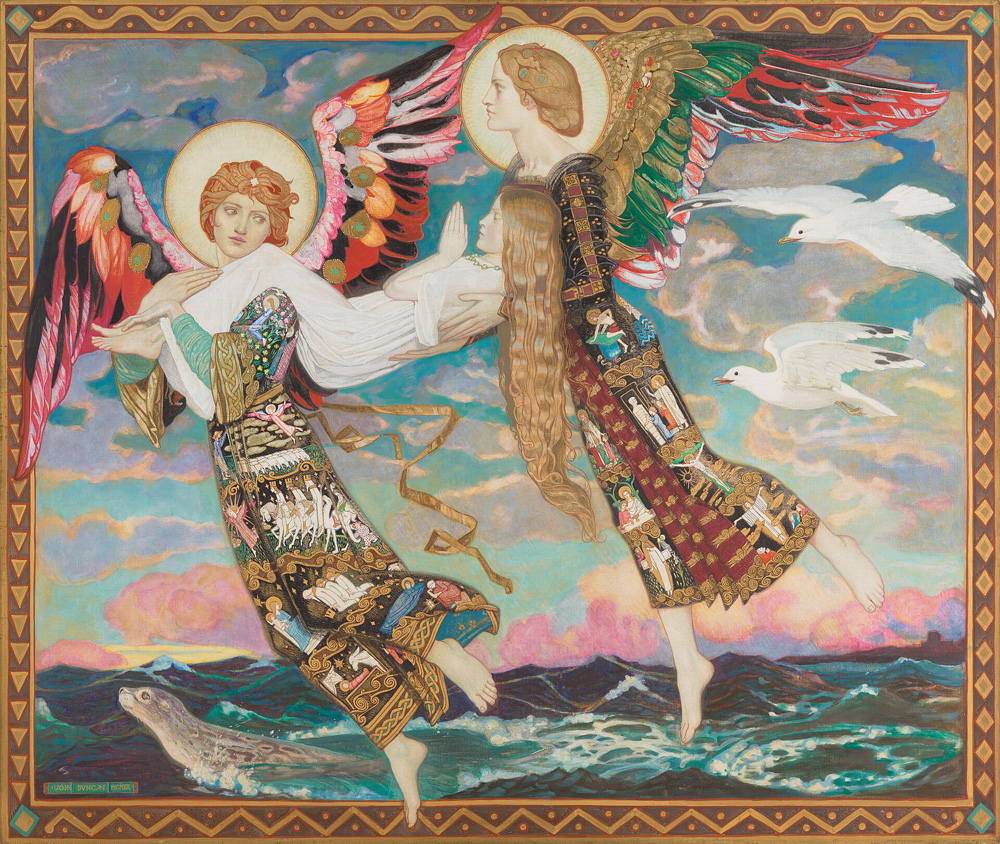
St. Brigid: Reproductive Justice and the Realms of the Miraculous by Elanur Williams

St Brigid being carried away by angels, in a painting by John
Duncan (1913)

One of my favorite saints is St. Brigid of Kildare, the patroness of poetry, learning, healing and protection. She is frequently called upon during childbirth. Brigid’s hagiographies are noteworthy for her remarkable abilities to heal and perform miracles—including her ability to make pregnancies vanish, for those who ask. In Vita Prima and Vita Brigitae (Life of Saint Brigit) published around 650 C.E. by Cogitosus, an Irish monk from Kildare, it is claimed that “Saint Brigid, by the very powerful strength of her faith, blessed a woman who had fallen [pregnant]…and the conception in the woman’s womb decreased and she restored her to health…without childbirth and its pangs.” The pregnant people in Brigid’s tales turned to Brigid to help them reclaim and restore their dignity. Consequently, their abortions served as catalysts for change. “Abortion miracles” have narrative and theological functions: they expose constructs of sexuality, chastity, purity, and sin. In addition, they test our understandings of healing—physical and spiritual—by revealing the intersectionality between medicine, pregnant people, power, and personal agency. Scholars have theorized the presence of “abortion miracles” in hagiographies, and whether they are to be read as a kind of defiance towards early Christian morality, or as a demonstration of chastity’s role and value in early medieval Irish Christianity. Some Irish penitentials view medieval abortions as malefic acts or as a kind of malevolent magic; however, according to Arica Roberts (2020), it can be argued the abortion miracles found in Irish hagiography can instead be read as “medicines of penance” and as contributing to healing.

Continue reading “St. Brigid: Reproductive Justice and the Realms of the Miraculous by Elanur Williams”

Women’s Bodies As Battlefield by Janet Maika’i Rudolph

Elizabeth Cady Stanton wrote in the introduction to her book The Women’s Bible:

The Bible teaches that woman brought sin and death into the world, that she precipitated the fall of the race, that she was arraigned before the judgement seat of Heaven, tried, convicted and sentenced. Marriage for her was to be a condition of bondage, maternity, a period of suffering and anguish, and in silence and subjection, she was to play the role of a dependent on man’s bounty for all her material wants . .

We are facing the long-term results of these biblical writings. This upcoming election is so unsettling because it is showing patriarchy in all its ugliness. We see how this is being played out, especially regarding abortion, but in all areas of the functioning of women’s bodies. The reason abortion is at the foundation of it all is that the drive to police women’s bodies is the crux which justifies all sorts of cruelties. It is the same with racism. These are issues that span the pantheon of rights; human, economic, healthcare, bodily autonomy. It takes a police state to quell all of these.

Continue reading “Women’s Bodies As Battlefield by Janet Maika’i Rudolph”

Can Feminist Christians Hasten the Advent of Reproductive Liberation? by Elizabeth M. Freese, PhD

Wikimedia Commons, Servite Church in Hungary

The collision of the 2023 Christian liturgical season of Advent with American reproductive politics has been jarring. Feminist religious critique and transformative activism are imperative.

With the Texas Supreme Court decision on a dire abortion case, alongside increasing criminalization of women having miscarriages, we are witnessing the principle of patriarchal dominance of female reproductive capacity and the denigration of women’s full, equal personhood pushed to the extreme. In part, this barbarity is perpetuated by Christianity. Even though this tradition often challenges social systems of injustice, and it does not actually support their hollow theology of “life at conception,” misogynist oppressors have plenty of Christian religiosity to stand on.

Continue reading “Can Feminist Christians Hasten the Advent of Reproductive Liberation? by Elizabeth M. Freese, PhD”

The Real Reasons America Hates “Octomom” by Tricia Pethic

Tricia PethicMany of us participate in dehumanizing Nadya Suleman, depriving her even of her own name by virtue of using the term ‘Octomom.’ Suleman has few people on her side of the ring, partly because she embodies what both conservatives and liberals hate most. Suleman recently made news again on charges of welfare fraud; she may spend up to eight years in prison. If Suleman does go to prison, I hope she ends up where I work so I could tell her what I really think: that America’s hatred of her has more to do with them than it does with her. And I’d remind her of God’s mercy and compassion: something I think has been absent from this discussion.

We recognize the name Nadya Suleman, yet how many people recognize the name Michael Kamrava? Kamrava was the doctor who injected Ms. Suleman with twelve embryos which earned him a suspension of his medical practice. Why is Ms. Suleman not known primarily as a victim of medical malpractice? Continue reading “The Real Reasons America Hates “Octomom” by Tricia Pethic”