From the Archives: “Be the Donkey: On Parshah Balak” by Ivy Helman

Author’s note: This post was originally published on this website on July, 10, 2022. This year, Balak was read in synagogues yesterday.

The Torah portion for July 16, 2022 is Balak (Numbers 22:2 -25:9).  Some of what happens in Balak is familiar: idolatry, divinely-sanctioned death penalties, and a plague.  But, did you know that this parshah has a talking female donkey who stands up to abusive behavior?  Perhaps not.  That talking donkey and the larger story of Balak’s attempt to curse the Israelites raises questions about gender, how we treat animals, choices, free will, violence, courage, and having one’s eyes open to what is really happening around one’s self. All of which is what we will be looking at today.

Balak begins with this story about Balaam.  The Moabite king, Balak, wishes to curse the Israelites because he is worried about their size and their impact on the land and its current inhabitants (22:3-4).  He sends representatives to bring  Balaam, a powerful man whose curses and blessings have tangible effects on their recipients (22:6), to him.  Balaam meets with those representatives and tells them to wait; he has to talk to the deity in order to know what to do.  The deity commands Balaam to stay put and to not curse the Israelites, for they are blessed (22:12). Indeed, a first in quite a while. 

Continue reading “From the Archives: “Be the Donkey: On Parshah Balak” by Ivy Helman”

The Place of All Possibility: Cultivating Creativity Through Ancient Jewish Wisdom by Rabbi Adina Allen

In her book Pentimento, author and playwright Lillian Hellman describes a phenomenon that often occurs when we return to a piece of art we once worked on after much time has passed: “Old paint on a canvas, as it ages, sometimes becomes transparent. When that happens it is possible, in some pictures, to see the original lines: a tree will show through a woman’s dress, a child makes way for a dog, a large boat is no longer on an open sea.” Hellman speaks of the way the aging paint allows for older layers to show through, offering an opportunity to see, in her words, “what was there for me once, what is there for me now.”

Like the painting Hellman describes, Torah, too, is a work in process. Layers and layers of interpretation have been added to it over time, according to the needs, desires, fears, and longings of those who devoted their lives to making meaning out of these sacred words. Some layers add to the beauty and power of the overall piece, strokes and shapes that bring the picture more clearly and compellingly into focus. And some accrue like varnish, making the painting hard and impenetrable. Each one of us is invited into this process of excavation, of peeling back layers of what we have been taught or what we think we know, and seeing, as Hellman writes, what is there for us now. And each of us is called to our creativity — to bring our brush back to the canvas anew, reencountering and reworking the stories, ideas, and images that lie at the very foundation of who we are and who we could be.

Continue reading “The Place of All Possibility: Cultivating Creativity Through Ancient Jewish Wisdom by Rabbi Adina Allen”

Nitzavim-Vayeilech: Inspiration for a More Egalitarian Judaism.

The Torah portion for yesterday was a double one: Nitzavim-Vayeilech (Deuteronomy 29:9-31:30).  I have already written about Vayeilech here, yet as with any parshah there is always more to say. Nonetheless, I will mainly focus on the motifs that are more particular to Nitzavim (Deut. 29:9-30:20).  Some we have seen before like an obsession with idolatry, threats and punishments in the forms of disease, plagues, destructions, and annihilations, the Israelites’ persistent betrayal, and this-worldly rewards for good behavior.  Yet, there are some ideas we haven’t seen yet.  I want to focus on three: the Torah referring to itself; the idea of the Torah being heard; and the freedom of people to choose their own heart’s inclinations.

Deuteronomy 29:20 refers to the book of the Torah.  However, it is only in verse 31:9, that we learn that Moses is the author of the Torah.  More orthodox versions of Judaism adhere to this belief that Moses wrote the Torah (except for perhaps the last 8 verses or so since he had died), but according to biblical historians, the Torah was compiled out of a myriad of sources during the Babylonian exile.  Nonetheless, I find it interesting that in Vayeilech-Nitzavim, the Torah refers to itself eight times (29:20, 21, 27, 30:10, and 31:9, 12, 24 and 26).  To some extent, it seems to be setting itself up to be an equal to the ten commandments within Israelite temple worship as there are also instructions to put this book of Moses next to the ark of the covenant within the tent of meeting (31:26).  While Moses may not have written the Torah, it is clear that its authors intended for it to be a religiously significant book within Israel.  And, it has become for Jews, the religiously significant book.

Continue reading “Nitzavim-Vayeilech: Inspiration for a More Egalitarian Judaism.”

Be the Donkey: On Parshah Balak by Ivy Helman.

The Torah portion for July 16, 2022 is Balak (Numbers 22:2 -25:9).  Some of what happens in Balak is familiar: idolatry, divinely-sanctioned death penalties, and a plague.  But, did you know that this parshah has a talking female donkey who stands up to abusive behavior?  Perhaps not.  That talking donkey and the larger story of Balak’s attempt to curse the Israelites raises questions about gender, how we treat animals, choices, free will, violence, courage, and having one’s eyes open to what is really happening around one’s self. All of which is what we will be looking at today.

Balak begins with this story about Balaam.  The Moabite king, Balak, wishes to curse the Israelites because he is worried about their size and their impact on the land and its current inhabitants (22:3-4).  He sends representatives to bring  Balaam, a powerful man whose curses and blessings have tangible effects on their recipients (22:6), to him.  Balaam meets with those representatives and tells them to wait; he has to talk to the deity in order to know what to do.  The deity commands Balaam to stay put and to not curse the Israelites, for they are blessed (22:12). Indeed, a first in quite a while. 

Continue reading “Be the Donkey: On Parshah Balak by Ivy Helman.”

From the Archives: “Home: A New Pesach Reflection” by Ivy Helman

Author’s note: This post originally published on this website on March 11, 2018. How prescient it is. I live in Prague, about an 8 hour car-ride to the Ukrainian border. Over 300,000 Ukrainian refugees have arrived here, with more arriving daily. They need homes, and this need is overwhelming our small country. Yet, we are doing all we can each and everyday to help those fleeing the war. Yet, this housing is not home, not when war still rages and when families are still separated. We need peace. Everyone deserves a home.

In ancient times, Pesach was one of three pilgrimage holidays, the others being Sukkot and Shavuot.  According to the the Torah, Israelite men were required to travel to Jerusalem to bring offerings to the temple. Supposedly, this reconnected these Israelites to their religion, to each other and to the deity.  Participating in these pilgrimages brought about a deeper sense of community. In short, three times a year, Jerusalem became a home away from home.

Continue reading “From the Archives: “Home: A New Pesach Reflection” by Ivy Helman”

Of an Anniversary, a Methodology and the Parshah Yitro by Ivy Helman.

This month’s blog post marks my 10-year anniversary writing for feminismandreligion.com (FAR) and my 122nd post.  I would just like to take a moment to acknowledge this milestone and thank the community for both its dialogue with me and support over these years.  I look forward to writing for FAR for years to come.

Speaking of dialogue and support, this post is structured in the form of an answer to Barbara Ardinger’s question on my last post.  She asked in what language I read Torah.  I found that intriguing.  To me, what I do is obvious.  Yet, for the reader, I have never explicitly walked through the steps of how I create these Torah commentaries.  In this walk-through, the reader is getting a rather unedited look into my process.

Continue reading “Of an Anniversary, a Methodology and the Parshah Yitro by Ivy Helman.”

Ha’azinu and Models of the Divine by Ivy Helman.

This week’s Torah parshah, as you can tell from the title, is Ha’azinu, or Deuteronomy 32:1-52.  This is Moses’ final speech to the Israelites before he ascends Mount Nebo to die.  It is traditionally associated with Yom Kippur and read somewhere very close to it (when exactly depends on the year).  The reasons for this association should become obvious as we continue.  

In the parshah, Moses describes how, even in the Promised Land, the Israelites will continue to be idolatrous, thus disobeying their deity and bringing divine wrath upon themselves.  From what I have already discussed in past blogs about the history of the Torah’s composition, clearly the exiled Israelites in Babylonian sought reasons for that exile; in traditional Isrealite fashion, they made sense of their current circumstances by reasoning whose disobedience was to blame.   

Continue reading “Ha’azinu and Models of the Divine by Ivy Helman.”

On Devarim: From a Feminist Perspective Problematic, but not Irredeemable by Ivy Helman

This week’s Torah portion is Devarim (Deuteronomy 1:1-3:22).  In it, the Isrealites are preparing to enter the Promised Land, as the last of the sinful generation have died.  Most of the parshah consists of Moses recalling the divinely sanctioned wars they undertook and the mass murder they committed in order to possess the land.   

Needless to say, this emphasis on war is difficult from a feminist perspective. Starhawk argues, in “Why We Need Women’s Actions and Feminist Voices for Peace,” that, “Patriarchy finds its ultimate expression in war.” In other words, a parshah ripe with war is ripe with patriarchy.

Yet, it is more problematic than that. The deity is understood to be a warrior as are the Israelites. Verses 1:30 reads, “The L-rd, your G-d, Who goes before you… will fight for you, just as G-d did for you in Egypt before your very eyes.” In addition, this warrior mentality requires the Israelites to fight as well. G-d hardens the hearts of Sihon which requires the Israelites to fight (1:27). Thus, war and mass murder become divinely sanctioned methods which G-d and the Israelites use to further the sacred promise of the Land.

Continue reading “On Devarim: From a Feminist Perspective Problematic, but not Irredeemable by Ivy Helman”

Monotheism and the Shema: Lessons on Oneness and Unity by Ivy Helman

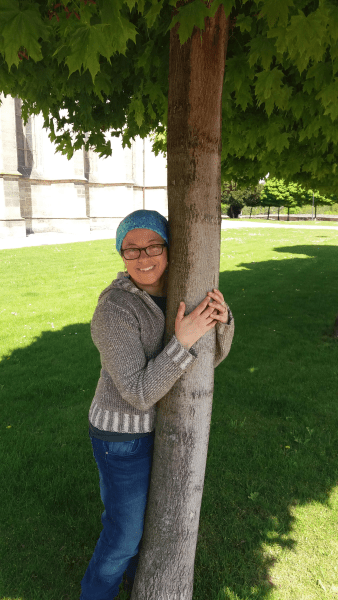
ivy tree huggingIn my last blog post, I explained what we lost when the Israelites became monotheists.  That post looked at the move to monotheism from a more historical, feminist perspective.  In this post, I want to understand monotheism from a more modern, feminist lens.  Using the Shema as a starting point for modern Jewish monotheistic thinking, my question is: how do we honor the deity based on who we understand that deity to be?  In my opinion, Jewish monotheism requires we honor G-d by moving away from one-sided gendered depictions of the deity and think about how we act in light of the interconnectedness of life.

Judaism highlights the Shema as the description of the divine.  It reads, “Hear, O Israel! The L-rd is Our G-d, The L-rd is One!,” (Deut. 6:4).  The key aspect of this verse is twofold. First, we have a relationship with the deity hence the description of the deity as “our,” and, second, this deity is one. 

Oneness used to imply that no other deities count, and perhaps also that no other deities literally exist.  For example, if one were to read the Torah, one would understand the deity differently.  On the one hand, the deity is one of many possible deities one could worship. On the other, it is quite clear that no matter what the deity is called, there is one specific deity that chose to help the Israelites.  In the Torah, the divine is always referred to as he, using only masculine pronouns for the deity. In addition, he is often called king, lord, and master. G-d is depicted as powerful, wrathful, jealous, and even scary.   Continue reading “Monotheism and the Shema: Lessons on Oneness and Unity by Ivy Helman”

Vayeitzei: Rachel and the Practice of Niddah by Ivy Helman

29662350_10155723099993089_8391051315166448776_oThis parshah contains the account of Jacob’s marriages to Leah and Rachel, (who happen to be his cousins) as well as the birth of his 11 sons and one daughter.  It describes the long amounts of time Jacob worked for Laban in order to marry Laban’s daughters, and recounts the trickery of Laban giving first Leah, the older daughter to Jacob, before allowing Jacob to marry who he wanted to, Rachel.

Like the relationship between Hagar and Sarah, there is animosity between Leah and Rachel over Jacob’s love as well as the ability to bear children.  This animosity spreads to the maids of Leah and Rachel, Zilpah and Bilhah respectively, as they are used by the sisters to conceive children on their behalf.  One can see also this animosity in how Leah and Rachel name their sons.  Yet, the parshah also contains two aspects that seem at odds with such a patriarchal perspective.  First, there are five named women who play key roles in the goings-on.  Second, Rachel is an active agent.  Continue reading “Vayeitzei: Rachel and the Practice of Niddah by Ivy Helman”