

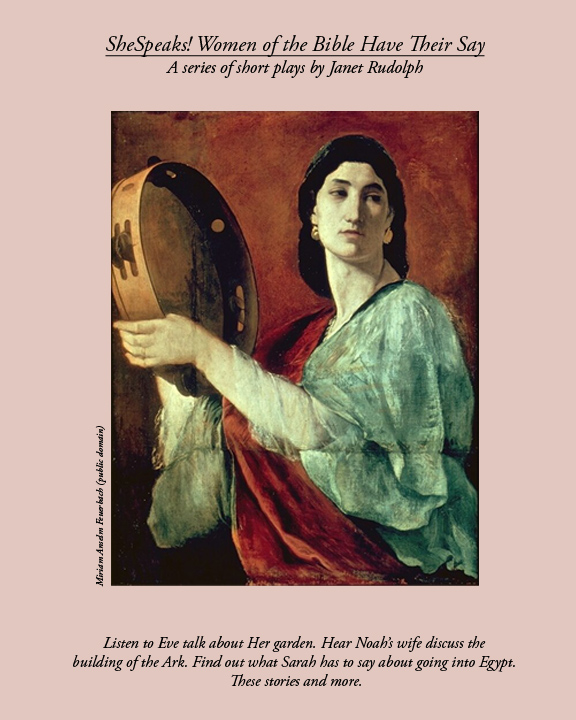
Author’s Note: I have been working on this project for about 3 years now. It is based on almost 30 years of research. I have written about some of the vignettes here on FAR before. With each re-telling and each performance the story deepens and comes more alive. On Thursday, Sept. 24th at 11:00 am NY time, the SheSpeaks!Ensemble will be doing a one hour live/zoom, free performance of the arc called EveSpeaks! You can access the zoom link on the 24th through this webpage. (Scroll to the bottom of the page for the link.)
The storyteller holds great power to both reflect the culture and to give it further shape and form. This is especially true for stories of the Bible which are foundational to our world. Whether we see them as mythological, historical, divinely inspired, wisdom teachings or simple folktales, they have shaped our beliefs and values. People see all different faces of God. If we look to the movies, God has looked like George Burns (Oh God, 1977), a vengeful John Huston (The Bible, 1966), Morgan Freeman (Bruce Almighty, 2003) and even Groucho Marks (Skidoo, 1968). There aren’t a lot of women although Alanis Morrisette did play a silent God (Dogma, 1999). If most people were asked to describe God, they would most likely picture a Charlton Heston-like figure (The Ten Commandments, 1956) when he played Moses reflecting the vehemence of God’s anger.
But . . . alas . . .biblical women’s history is most like Alanis – mute. Women’s voices have been diminished and even silenced. Female deities, female voices have either been translated out of reach or turned into purveyors of “evil” or curses.
Continue reading “SheSpeaks! Women of the Bible Have Their Say by Janet Rudolph”




 This week’s Torah portion, or parshah, is Shemot (Exodus 1:1-6:1). This parshah sets the scene for the liberation of the Israelites from slavery both by introducing main characters and elaborating on just how difficult life was for the Isrealites under Pharoah’s rule. The parshah contains many noteworthy aspects: the death of Joseph and the multiplication of the Isrealites in Egypt; the increasing wrath of the Egptians; the birth and adoption of Moses; Moses’ encounter with the Divine in the form of a burning, yet unconsumed, bush; the revelation of the divine name, G-d’s plan for Moses’ role in the liberation of the Israelites from slavery; Moses’ attempts to get out of his assigned role; and Moses’ first confrontation with Pharoah.
  The Torah parshah for this week (to be read on 15 September) is Vayelech (Devarim/Deut. 31:1 – 30). September 15th is also Shabbat Shuvah (return), the Shabbat that falls between Rosh Hashanah and Yom Kippur. It is the time of the year when we focus on repentance for all of the ways in which we have failed to live up to G-d’s standards.
