 One of my favourite tasks is translating works from various Indian languages into English. I developed a love for this while enrolled in a graduate seminar on translation theory. The challenge of it all was mind-boggling – how do I reduce the jaggedness of despair running within the depths of someone’s soul into two-dimensional, Times New Roman, 12-point font? How do I convey an intangible phenomenon such as a believer’s union with god without losing the intensity of his or her experience? I loved the exercises, but it is only now I realize how much the concept of translation had also been intertwined with my own fiber of being.
When I lived in India and for many years afterwards, I went by Vib-ha, the usual pronunciation of my Indian name. I didn’t realize then that I didn’t identify with Vibha. A few years ago, I reverted to the Vee-bah of my childhood, the Anglicized pronunciation. It wasn’t so much as being picky, as it was about getting involved in the search for who I really was.
Growing up in an English environment since not quite the age of two, I automatically internalized the label of Vee-bah that my teachers and friends addressed me by, along with developing a “foreign” set of ideals and sense of self. “I’m Veebah,” would be a natural extension of myself; without thinking I had adjusted the complexities of being a little brown girl into one neat word: Veebah.
But by the sixth grade something wonderful was happening. I began to literally feel more comfortable in my skin – I no longer felt like I had to hide my Indian snacks from the rest of the class. I no longer felt I had to apologize for looking different or having a weird sounding, albeit Anglicized, name. And by the time I turned twelve, my changing mind and body soon began to embrace Veebah. It was like I had finally begun to own Veebah.
A year later, however, I moved to India, the land of my birth. My parents had come back “home,” but I had just acquired newly found status of “alien.” Could years of growing up abroad simply be undone by a one-way ticket and an unsigned contract between my father and Zamefa Pvt Ltd.? It got worse as time progressed. There were too many things to deal with. I sounded different; my ideas about music and movies were different; I was too outspoken; I looked much older than I was, and worst of all, I had a certain precociousness about me when it came to the birds and the bees. By the time I was fifteen, however, I managed to figure it all out. With a bit of help from others, I smoothened myself, rough edges, “over-smartness” and all into a two-dimensional being who, in turn, was soon transformed into an echo of everyone around her. An echo called Vib-ha. I was now in India, and had to go by Vib-ha, was what I told myself. With that label, I found myself pushing Veebah more and more into the background; I smothered her with my Indian sounding name and all the Indianness I thought ought to go with it. Continue reading “Translating the Self by Vibha Shetiya”



 Very early in Henri Bosco’s 1948 novel Malicroix, a young man, Martial de Mégremut, living placidly amid fruitful orchards in a tame Provençal village, receives a letter informing him he has inherited “some marshland, a few livestock, a ramshackle house” from a reclusive great-uncle, Cornélius de Malicroix. Against his family’s strenuous objections–with alarm they speak of “marshes, mosquitoes, miasmas”–Mégremut resolves to travel alone to the remote Camargue to claim his “wild” Malicroix inheritance. The house is on an island, and to reach it Mégremut must cross a rough river, at night, in a frail wooden boat piloted by a taciturn old man who meets him at dusk in the middle of a vast plain.
 I wake up each morning in a simple bedroom lit by the rising sun: a wardrobe, a bookshelf, a small wooden table, and a chair, arranged on painted plank floors. Just outside the window behind my head are the tallest trees I have ever seen, their grey-brown trunks growing straight up into a sky I cannot quite make out from my warm bed, with its white cotton sheets, white coverlet, and cozy down comforter. The room’s soft yellow walls reflect and amplify the winter light. Part of me wants to luxuriate, to lie here for hours, feeling the sun on my face as I gaze up at the trees and allow my consciousness slowly to return from dreams.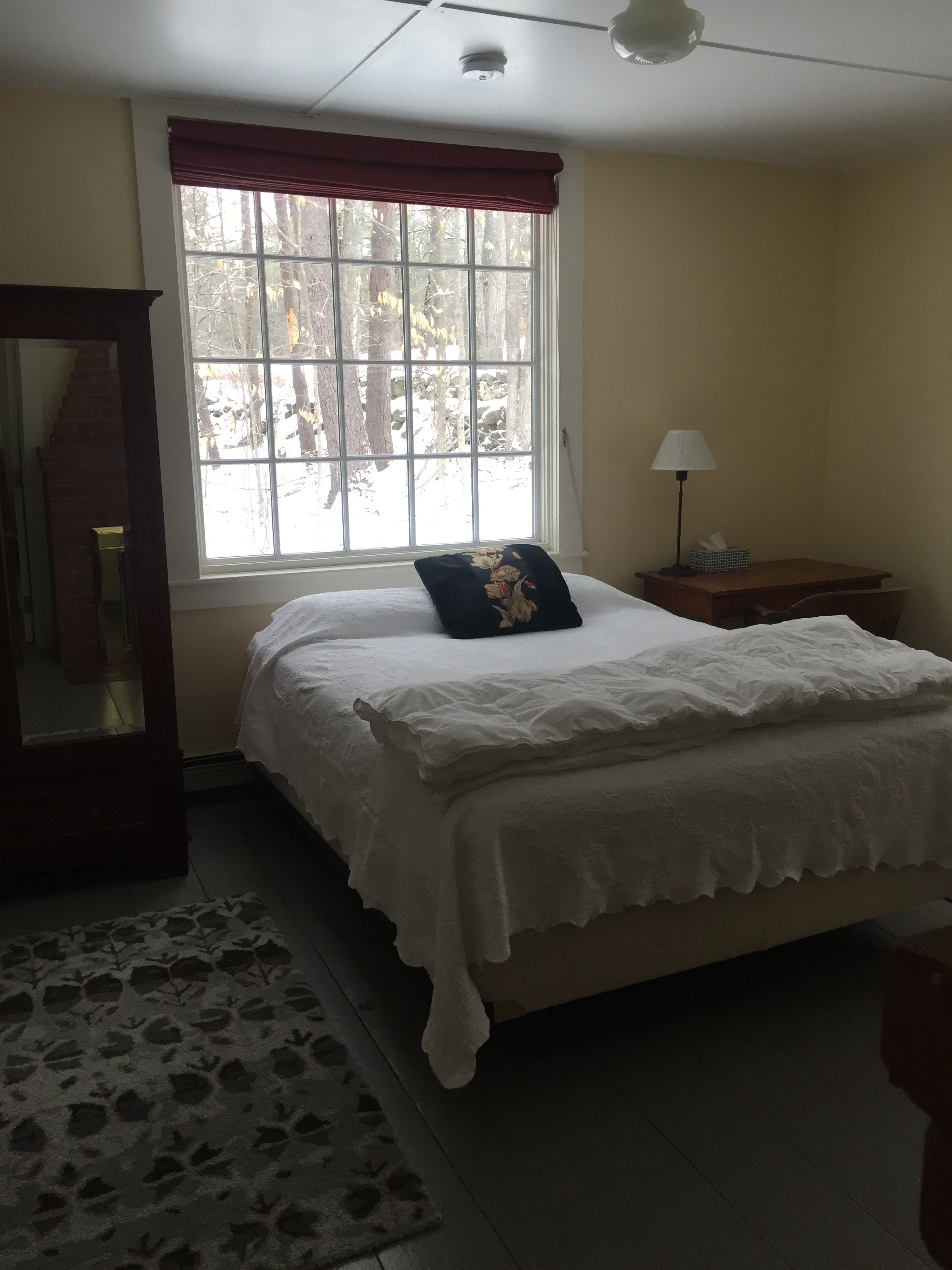
 Feminism and Religion