The Gendered Dimensions of the Water Crisis in Iran: Impacts on Women’s Health, Livelihoods, and Security

Moderator’s Note: This post has been brought to you in cooperation with the NCRI women’s committee. NCRI stands for the National Council of Resistance of Iran. You can learn more information as well as see this original article by clicking this link. A description of their Council can be found at the end of this post.

The water crisis in Iran has moved far beyond a simple environmental issue — it has become a humanitarian, ecological, and economic disaster.

While at first the problem seemed to be the result of drought and declining rainfall, its true causes ran much deeper: entrenched corruption and mismanagement at the heart of the ruling establishment. Until these systemic roots are addressed and removed, Iran’s present — and its future — will only become more precarious.

A significant number of researchers and international observers emphasize that 70 to 80 percent of the current crisis stems from mismanagement, unsustainable policies, lack of transparency, and corruption. As one report notes, “Iran’s water crisis is not a crisis of resources; it is a crisis of decisions—decisions that have made the land thirstier and the future darker. This crisis, alongside the erosion of public trust in governance, is a symptom of structural and managerial failure.” (Newsweek, August 1, 2025; The Times, December 8, 2022; Reuters, April 27, 2021)

Continue reading “The Gendered Dimensions of the Water Crisis in Iran: Impacts on Women’s Health, Livelihoods, and Security”
Samhain and the Waters of Hurricanes Helene and Milton, part 2 by Susan Foster

Part 1 was posted yesterday

On Samhain we are given the opportunity to come together in community to grieve our losses. We grieve for all those we have known personally who have passed over. But this year we also grieve for all those who lost their lives and homes in Hurricanes Helene and Milton and in the many other disasters around the world. We grieve as well for the other losses that occurred—of homes, of jobs, of community, of pets (many of whom also died or were separated from their owners). The losses are so enormous and overwhelming that we need the support that community provides to cope with them. We need to bind together in the strength of community to express our sorrow. Being aware of the death from so many natural disasters helps us to listen to the earth to see what She is telling us, to hear Her crying because She is weakened and out of balance, breaking apart under the strain.

 Feeling the earth’s grief from the hurts inflicted upon Her enables us to take stock of our policies, to change our course while we still can. As we float downstream on our raft, we can ignore what we see around us until we see the rapids ahead and say to ourselves, before we plunge over them, “Why didn’t we change course earlier?”

Continue reading “Samhain and the Waters of Hurricanes Helene and Milton, part 2 by Susan Foster”

Samhain and the Waters of Hurricanes Helene and Milton, part 1 by Susan Foster

Moderator’s note: While Samhain is past for this year, we are still in the section of the Celtic calendar which makes this blogpost, and its part 2 which will be posted tomorrow, relevant.

Samhain is an ancient Celtic festival, in fact the most sacred celebration in the Celtic year. Samhain is the New Year of the Celtic calendar. It is one of the eight holidays of the Celtic year—the solstices, equinoxes, and cross-quarter days—all of which mark the turnings of the seasons. Samhain is a time when the harvest had been completed; all the grains and late-maturing vegetables have been gathered in; the fields have been cleared, the old cast off, the fields lying fallow over the cold and dark of winter in order to make room for the eventual springing forth of new life. The New Year, begins in darkness at Samhain, is a reminder that all life emerges from the darkness, that death precedes rebirth. It is a time when the veil between the worlds of the dead and the living thinned, so that the presence of those who have gone before us is more clearly felt or even seen. It is a time to remember the ancestors as well as those newly departed—to grieve our losses, to let go so that we can move forward.

Samhain is the precursor of our Halloween. It was brought to this country by Irish immigrants during the potato famines in the 19th century. They brought their Celtic customs with them, but by that time Samhain was known as Hallows Eve, since the Irish were good Catholics. It struck a responsive chord with the American people, who called it Halloween. They adopted many of its customs, including lighting candles in gourds or pumpkins and dressing in costume. Today Halloween is celebrated as a spooky and fun time, observed with trick-or-treating and mischief-making, but originally it was a solemn holiday—a time to commune with the beloved dead, to honor the ancestors with food and drink, and to acknowledge death as part of a never-ending cycle of birth, death, and rebirth.

Continue reading “Samhain and the Waters of Hurricanes Helene and Milton, part 1 by Susan Foster”

Water, Activism, and Thirsting for Change by Xochitl Alvizo

XA yellowMike Wilson’s persistent replacement of water sources in the desert for those who may be dying of thirst is part of his affirmation that we are all inextricably connected…the affirmation that our individual well-being cannot be separated from our collective well-being.

I carry two water bottles with me at all times, one for water and one for change – quarters, nickels, dimes, and pennies, as well as the occasional dollar bill. I carry the first bottle because, here in the U.S., I have the luxury of accessing potable drinking water, from which I am able to refill my reusable water bottle, almost everywhere I go. I don’t go anywhere without it. Even at a friend’s house or out to eat at a restaurant, when offered a glass of drinking water I simply pull out my water bottle and if needed refill it from the tap. No need to wash an extra cup. I especially find it necessary to have my water bottle with me when I am at conferences or business meetings where the default is to provide people with brand new single-use disposable water bottles that more often than not end up in the trash can instead of the recycling bin – which is often not even available. I carry my water bottle with me at all times.

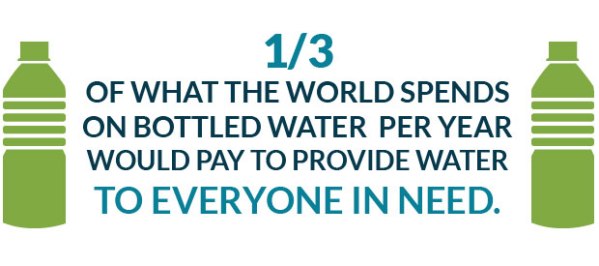
Sadly (and, criminally, really), people in the U.S., 90% of whom have access to perfectly good drinking water from their tap, are the top consumers of store bought bottled water – and unnecessarily so. The great irony is that 40% of bottled water comes directly from public water supplies – from the city’s public works for which tax-payers are already paying. Meanwhile, in many parts of the world people are literally dying of thirst and access to fresh drinking water continues to be a growing crisis. Single-use bottled water makes me angry, for unless water is being bottled in order to be transported to people in places that have no access to it, buying bottled water is unnecessary, indulgent, and willfully uninformed.blue planet, water crisis, Mike Wilson Continue reading “Water, Activism, and Thirsting for Change by Xochitl Alvizo”