Winter Solstice – When Darkness Nurtures Light by Judith Shaw

Judith Shaw photoIn the Northern Hemisphere Winter Solstice, usually December 21,  heralds both the time of deepest darkness and the beginning of the return to light.  It is a liminal day offering a transformation from darkness to light.

In the mid-latitudes in the ten days after the winter solstice the hours of sunlight increase by only a few seconds up to a minute or so.  The world slows down allowing a time to relish the quiet of long nights and the inspiration of winter dreams.

Continue reading “Winter Solstice – When Darkness Nurtures Light by Judith Shaw”

Let’s Celebrate the Holiday Shopping Season by Barbara Ardinger

We’ve recently celebrated Thanksgiving, when I hope that, like me, you gave thanks to the deity of your choice for the wise and thoughty blogs we’ve been reading on this site. Now we’re well into the holiday season, which seems (at least in the malls) to start earlier every year. No matter what you call the December holiday, its origin lies in the winter solstice, which is the tipping point of the year’s dark season. The solar gods—Adonis, Amon-Ra, Apollo, Attis, Baal, Horus, Jesus the Christ, Lugh, Marduk, Mithra, Shamash, Sol Invictus, and the rest—are born or reborn now. These are the gods who live for a season or a year in great honor, after which they’re sacrificed, spend a season underground, and are then reborn. This happens every year at the winter solstice. (Just so you know: if Jesus was a real man, he was probably born in the spring or fall between 7 and 4 B.C.E. In 354 C.E., Bishop Liberius of Rome moved his official birth date to December 25 to match the birth date of the popular Roman god Mithra.)

Also born and reborn at the winter solstice is the light itself, the solar light and the temple light, too. We can think of the reborn light as literal light—a lamp in a temple that burns for eight days when it has fuel for only one—or metaphorical light, that is, learning, wisdom, and generosity. Hanukkah (which usually comes in December but which coincided with Thanksgiving this year) embraces both literal and metaphorical light. Continue reading “Let’s Celebrate the Holiday Shopping Season by Barbara Ardinger”

Happy Birthday, Solar Gods By Barbara Ardinger

Throughout history and all around the world, people have celebrated midwinter and the rebirth of the sun. My favorite night of the solstice-Hanukah-Christmas season is December 24, Modranicht. If we have Mother’s Day in the springtime, it seems only fair that we should celebrate Mother’s Night in the winter. We get the term Mothers’ Night from the English monk, Bede, who said that the Angles began their year on the night of December 24–25.

The winter solstice this year falls on December 21, though it can also occur on December 22 and December 23. The word “solstice” means “sun stand still.” No, it’s not Joshua’s long day again. On the solstice, the sun rises from the same point on the horizon for a couple days (this is the standing still), is at its lowest point in the sky at noon, and (in the Northern Hemisphere) is at its southernmost point. It’s the longest night of the year, and when the sun is reborn, it moves across the sky for six months to the summer solstice, where it’s at its northernmost point.

Continue reading “Happy Birthday, Solar Gods By Barbara Ardinger”

Cailleach, The Queen of Winter by Judith Shaw

judith shaw photoThe Cailleach (KAL-y-ach), which literally translates as the “Veiled One” is an ancient Goddess whose origins are unknown.  When the Celts arrived in Ireland and Scotland she was there. Over time Her name came to mean “old wife” or “old woman”.  And yet she was thought to never grow old, an all powerful, ageless, Goddess of transformation.

In one of her stories, Cailleach, as an old hag, seeks love from the hero.  If he accepts Her, She then transforms into a beautiful young woman, symbolizing the transformation occurring in the depths of winter when the seeds lay dormant in the earth.  Yet alive within this dormancy is the promise of rebirth in the spring.  She is the guardian of the life force, finding and nourishing the seeds, commanding the power of life and death.  As the final phase of the Triple Goddess, she rules the eternal wheel of reincarnation. Cailleach personifies death and the transformative power of darkness.  She leads us through death to rebirth. Continue reading “Cailleach, The Queen of Winter by Judith Shaw”

Honoring the Older Women of December’s Darkness by Carolyn Lee Boyd

carolyn portrait

Winter’s hungry hand has taken another powerful and precious older woman. No one knew Ellen beyond her family and friends, her church and her neighbors. She was 90, a nurse, faithful to her church and of service to her community, and quiet in manner and tone. In my work in elder services over 25 years, I have come to know many Ellens, older women who have labored relentlessly in their homes or in the outside world for little recognition or financial recompense but who have made a tremendous difference in the lives of other.  For reasons that may have to do with the harshness of New England winters, or maybe just coincidence, or maybe only perception, winter  seems to be the time when they leave the Earth and we are bereft.

Ellen and the many older women I have known like her do not fit into any standard or feminist image of a powerful woman.  They do not generally challenge the status quo, except with occasional complaints about unfairness to women in comments to friends.  They may not feel comfortable labeling themselves as “feminist.”

Continue reading “Honoring the Older Women of December’s Darkness by Carolyn Lee Boyd”

Solstice Comes But Once A Year, Now It’s Here! by Carol P. Christ

carol p. christ 2002 colorActually it comes twice, once in midsummer, the longest day of the year, and once in midwinter, the longest night.  Winter Solstice is also known as the first day of winter.
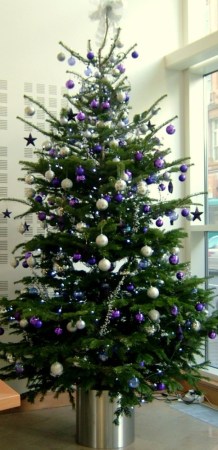
For those of us attuned to the cycles of Mother Earth, Winter Solstice is a time to celebrate the dark and the transformations that come in the dark. Many of the customs associated with Christmas and Hannukah, including candles, Yule logs, and trees decorated with lights were originally associated with Winter Solstice.  The extra pounds put on during winter feasting were insulation against the cold winter nights.

Those who fear that many of the customs of the Christmas season might be pagan are right.  As we learn again to honor our place within the cycles of birth, death, and regeneration, we can return these customs to their roots in the circle of life.

ChristmasTrees20060001

Continue reading “Solstice Comes But Once A Year, Now It’s Here! by Carol P. Christ”

Songs We Sing By Barbara Ardinger

Even though I’m a spiritual feminist—and a pretty cranky one—I like the old familiar Christmas carols. I’m listening to a CD of Christmas songs in my car. One of the songs on the CD has the line, “God is watching us from a distance.”

There’s a reason Plato banned music from the Republic. Music gets into our heads and it stays there. Not only the tune and the rhythm, but the lyrics, too. So what idea does this song plant in our heads? God is out there. Watching us like we’re being baby-sat From a distance. So if we should happen to fall down, maybe he’s only watching and he doesn’t have long-enough arms to reach down and pick us up.

Passive watching is a key difference, of course, between the standard-brand religions (also called the religions of the book) and the Goddess religion. They’ve got a transcendent god somewhere up in heaven, up in outer space, up on the mountain, sitting up in the judge’s throne. Keeping an eye on us so if we misbehave, he can slam some thunderbolts down at us. Continue reading “Songs We Sing By Barbara Ardinger”

The Dark Half: Reflections on the Winter Solstice By Xochitl Alvizo

Photo by Chris Pinkham

I’m a Capricorn. People seem not to be surprised when they find out. I’m also the oldest of three siblings and a keeper of people’s secrets. Stories and secrets – my family’s included – I hear them all, take them all in. Sometimes someone will share something with me that involves another and afterward say, Now, don’t you go telling so and so that I said this. And of course I always reply, I don’t tell no one nothin’. And it’s true, I don’t tell – I simply take it in. I listen and I take it all in. The stories shared, stories of joy and of love, excitement and disappointment, of hurt feelings and misunderstandings, all of them inform me. They all cause me to reflect and consider the fragility of us all, the precariousness of life. We affect each other so much, from the smallest moment to the largest system, all of it makes such a difference to us.

Tonight we celebrate the Winter Solstice – it marks the boundary of darkness and light – it is the shortest day and longest night of the year.  Continue reading “The Dark Half: Reflections on the Winter Solstice By Xochitl Alvizo”