Legacy of Carol P. Christ: EASTER OF THE GODDESS: A VIEW FROM GREECE

This was originally posted on April 16, 2012

On Good Friday, Easter Saturday, Easter Sunday, and Easter Monday the blogs on feminismandreligion.com celebrated mothers and God the Mother.*

 This is my body, given for you.
This is my blood, given for you.

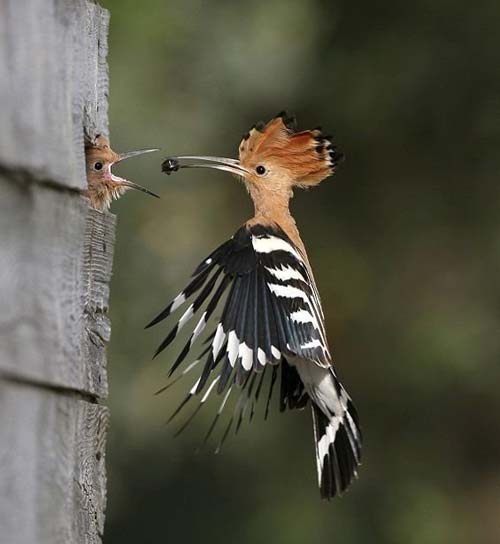
While these words are the center of a Christian liturgy celebrating the sacrifice of Jesus as the Christ, they are more appropriately spoken of our own mothers. Your mother and my mother and all mothers, human and other than human, mammalian, avian, and reptilian, give their bodies and blood so their offspring might have life. True, mothers do not always make conscious choices to get pregnant, but almost all mothers affirm life in their willingness to nurture the young who emerge from their bodies and from their nests. Had mothers—human and other than human–not been giving their bodies and their blood from time immemorial, you and I would not be here.
Continue reading “Legacy of Carol P. Christ: EASTER OF THE GODDESS: A VIEW FROM GREECE”

Legacy of Carol P. Christ: To a Friend, on the Loss of her Daughter

This was originally posted on April 23, 2012

One test of a thealogy is whether it can help us “make sense” of our lives—even the senseless parts of them.

Recently a friend told me that the teen-aged daughter of a friend of hers had committed suicide. “What would your thealogy say to that?” she asked me. Here is what I might say to a friend who lost her daughter:

I am so sorry for your loss. This never should have happened.

I remember times when I wanted to commit suicide. My pain was intense and my mind was stuck. All I could think was: this hurts too much to go on, and it will never change, so I might as well die. I am so sorry if your daughter felt that way, because I know it is a horrible way to feel. I am sorry she was not able to understand that it could have–and probably would have–changed. Don’t blame her. Sometimes pain is so overwhelming you really cannot see beyond it. Don’t blame yourself either. I am certain you did everything you could think of to help her. I know that if you could have prevented her, you would have. It really was not your fault. I don’t blame you, and no one else should either.

Continue reading “Legacy of Carol P. Christ: To a Friend, on the Loss of her Daughter”

Legacy of Carol P. Christ: I am Beginning to Understand

This was originally posted on Feb. 13, 2012

Elizabeth Kelly Inglis died in 1927 at age 62 from complications of a stroke. Secondary causes were malnutrition and exhaustion.

When I was a child, my father, though he was very close to his own parents and sister, spoke very little about his ancestors. I knew that both of his parents lost their fathers when they were small children. I was told that the Christs were German and the Inglises were Scottish and Irish. My grandmother Mary Inglis Christ was as Irish as the day is long. She prayed to the blessed Virgin and took me to church with her in the early mornings where she lit candles and whispered the rosary while fingering faceted lavender beads. She voted for Kennedy because he was Irish and Catholic—to the horror of my father and his father who had no use for the Democrats. My grandmother sometimes cried when she showed us photographs of her family, especially when she pointed to her sister Veronica, called Very. I sensed that my grandmother felt sad to have left her family in New York when she moved with her husband and children to California during the depression, but I was too young to understand fully. As far as I know, I never met any of the relatives from her side of the family, even when I moved to “back east.”

Continue reading “Legacy of Carol P. Christ: I am Beginning to Understand”

Legacy of Carol P. Christ: “AS WE BLESS THE SOURCE OF LIFE, SO WE ARE BLESSED”

This was originally post May 7, 2012

Blessing the Source of Life harks back to the time when shrines were built near springs, the very literal sources of life for plants, animals, and humans.

The prayer “As we bless the Source of Life, so we are blessed,” based on a Hebrew metaphor which refers to a water source and set to music in a Jewish feminist context by Faith Rogow, has become one of the bedrocks of my Goddess practice.

In Minoan Crete, seeds were blessed on the altars of the Goddess and the first fruits of every crop were returned to Her. The ancient Minoans piled their altars high with barley, fruits, nuts, and beans, and poured libations of milk and honey, water and wine, over the offerings they placed on altars. Evidence of these actions is found in the large number of pouring vessels stored near altars.

Continue reading “Legacy of Carol P. Christ: “AS WE BLESS THE SOURCE OF LIFE, SO WE ARE BLESSED””

Legacy of Carol P. Christ: Is It Essentialist To Speak Of Earth As Our Mother?

This was originally posted on November 25, 2013

The charge of “essentialism” has become equivalent to the “kiss of death” in recent feminist discussions. In this context it is taboo to speak of Mother Earth.  Yet, I would argue there are good reasons for speaking of Mother Earth that do not add up to essentialism. What if the values associated with motherhood are viewed as the highest values? What if the image of Mother Earth encourages all of us to recognize the gift of life and to share the gifts we have been given with others?

For those not familiar with the “essentialism” debate in feminist theory, it might be useful to define “essentialism.”  In philosophy, essentialism is the idea that every “thing” has an “essence” which defines it.  In its pure form, essentialism is a by-product of Platonic “idealism” which states, for example, that the “idea” of table is prior to every actual table and that every actual table is an embodiment of the idea of table.

Continue reading “Legacy of Carol P. Christ: Is It Essentialist To Speak Of Earth As Our Mother?”

From the Archives: Brigid, Goddess of Healing, Poetry, and Smithcraft by Judith Shaw

This was originally posted on January 31, 2013

Brigid, the Celtic Goddess of Healing, Poetry, and Smithcraft, begins her reign on Imbolic, February 2, the midpoint between winter solstice and spring equinox. On this day the ancient Celts held their Fire Festival in honor of Brigid and the growing light. In Scotland, as recently as the mid-twentieth century, houses were cleaned and the hearth fires rekindled on February 2, to welcome in  Brigid.  Remnants of this festival are found in America today on Groundhog Day.

Like the Cailleach, She existed in many places and  was known by many names.  The Irish called her Brighde; she was Bride in Scotland,  Brigantia in Northern Britain, and Brigandu in France.  Some called her Brid, Brig or Brighid.  Later she was transformed by Christianity into Saint Bridget.  Her older name was BREO SAIGHEAD.   Her name has various interpretations, many relating to fire – “Power,” “Renown” “Fiery Arrow of Power ” “Bright Arrow”, “The Bright One”, “The Powerful One”, “The High One” and “The Exalted One”.

Continue reading “From the Archives: Brigid, Goddess of Healing, Poetry, and Smithcraft by Judith Shaw”

It’s Called Practice For a Reason by Kay Bee

My daily practice isn’t what I’d like it to be these days what with working two jobs, raising three teenagers, and going to grad school. I am clocking about 60 hours of work and school every week, which doesn’t leave very many spare hours for formal ritual, prayer, or meditation.

During previous phases of my life, I’ve had a daily devotional practice that’s taken on many different forms as my spiritual studies  deepen. I’ve learned to use new tools, and gone from singing other people’s chants to writing my own and creating my own prayers. As my path unfolded, my practice evolved. But last autumn, life shifted when I went back to school and shifted again a couple of months ago when I added a second job to the mix. My spiritual practice over the last month has been sporadic, random moments stolen from other obligations to say a rushed prayer, a chant sung on the drive to work, or an energy center balancing done in the shower before bed.

Meanwhile, in the back of my mind was the fact that I had committed to attending a 4-day training intensive within the Avalonian Tradition, followed immediately by a 4-day leadership retreat for the Sisterhood of Avalon. A couple of weeks ago, with my daily practice in what felt like utter shambles, I suffered an bout of extreme self-doubt. What was I thinking committing to this training intensive and leadership work when I couldn’t even manage to find 15 minutes every day to engage the practice of my faith? How on earth could I think I was ready for this? Should I even still go? Continue reading “It’s Called Practice For a Reason by Kay Bee”

Epona, Celtic Horse Goddess by Judith Shaw

judith shaw photoEpona, Celtic Horse Goddess was worshipped by the Gauls (the Celtic French). Her worship spread to Britain and Rome from Western Europe. Hundreds of statues and shrines dating from between the first and third centuries CE have been found in France alone.

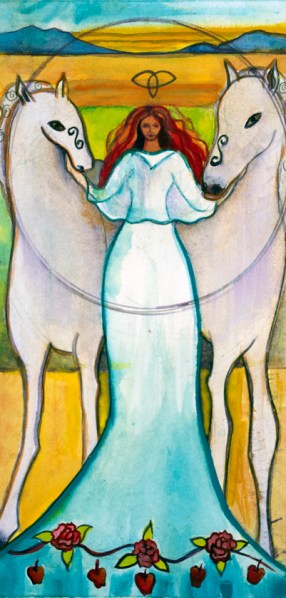
Today we can understand Epona mainly from her images, as few stories of her have survived.  She is often shown either riding a white horse side saddle or standing or sitting between two horses.  Many images show her feeding mares and foals from a cornucopia or a basket of fruit.

Epona, Celtic Horse Goddess Continue reading “Epona, Celtic Horse Goddess by Judith Shaw”