DO RELIGIONS HAVE AN “ESSENTIAL” “CENTRAL” CORE THAT IS–OR IS NOT–SEXIST? by Carol P. Christ

Carol Eftalou - Michael HonnegerThough often asked, this is the wrong question.  Every statement about the “essential” or “central” teaching of any religion is based on a prior interpretation rooted in a particular standpoint. Thus, the idea that there is a “central” or “essential” core in any religion is not a matter of fact, but rather a matter of interpretation.

In discussions of religions, we often make global statements about our own and other religious traditions, such as: “Christianity is patriarchal to its core,” or alternatively, “The core teaching of Christianity is to love God with all your heart and your neighbor as yourself.” Or: “The true Islam teaches that God is love,” or alternatively, “Islam always teaches the subordination of women.”

These sorts of claims are made from time to time here on Feminism and Religion too. Every global statement that a particular religion “is” or “ is not” oppressive, calls someone to assert the opposite in the comments. I believe that statements about the “true” nature of any religion should should always be qualified. Continue reading “DO RELIGIONS HAVE AN “ESSENTIAL” “CENTRAL” CORE THAT IS–OR IS NOT–SEXIST? by Carol P. Christ”

CROSSING THE SEA OF DEATH by Carol P. Christ

carol p. christ photo michael bakasI am washing wet clothes cast off by refugees who crossed the Sea of Death, the new name for the channel only 4 nautical miles wide that separates Turkey and Lesbos. A tiny pink long-sleeved shirt with a boat neck, for a girl, size 3 months. The channel was relatively safe in the spring and summer, even though people were pushed into black rubber dinghies wearing illegal life jackets that would not float. A pair of leggings with feet, grey with pink, orange, brown, white, and blue polka-dots, to be worn over diapers. North winds have made the journey treacherous.

I am not on the front lines, pulling wet children alive and dead from the sea. I think my heart would break. Tiny black stretch pants with nylon sequined bows at the knees, size 2 years. My friends were in the harbor when an overcrowded fishing boat collapsed, throwing 300 people into the sea. Two pairs of children’s underpants, one navy blue, the other turquoise. They pulled babies from the waves and tried to revive them. Small stone-washed blue jeans decorated with rhinestones, for a little girl. They were wet and cold. Their clothing was removed. They were wrapped in blankets. Red knitted leggings with black hearts and white reindeer. Some survived after spitting out the sea’s water. Blue leggings with feet, blue with white and beige stripes, for a boy. The newly donated ambulances do not carry oxygen. Continue reading “CROSSING THE SEA OF DEATH by Carol P. Christ”

MORE WAR=MORE REFUGEES: OBAMA IN AFGHANISTAN by Carol P. Christ

Carol Eftalou - Michael HonnegerPresident Barack Obama recently decided NOT to withdraw all troops from Afghanistan before his term of office ends in 2016, as he had earlier promised to do. California Congresswoman Barbara Lee—the only member of Congress to vote against the Afghanistan war 14 years ago in 2001—issued a statement against this open checkbook for an endless war, and introduced measures to stop it from continuing.

In contrast, Democratic front-runners Hillary Clinton (not surprisingly) and Bernie Sanders (to my surprise and disappointment) supported the President. The press has treated the announcement of on-going war as a non-issue. A voice crying in the wilderness, John Nichols of the Nation magazine stated that Barbara Lee has the “clearest vision” on the Afghan War, noting that on this and other national defense issues, “Lee keeps being proved right.” Continue reading “MORE WAR=MORE REFUGEES: OBAMA IN AFGHANISTAN by Carol P. Christ”

Dionysian Rites by Carol P. Christ

In today’s blog, I offer an excerpt from A Serpentine Path: Mysteries of the Goddess. The setting is Zaros, Crete, the time of year is mid-October.

We had a scrumptious dinner of fresh fish, salad, fried potatoes, local amber-colored wine, and tiny olives.  Later the two waiters, Themis and Nikos, bearing another pitcher of wine, sat down at our table.

They told us they were best friends and had just gotten out of the army. When they discovered that we were writers, the two young men were intrigued. “Our village has a very interesting history and many interesting customs,” they told us. “If you would like to come back and write about it, we will introduce you to all of the old people.” This conversation was in Greek, but I translated for Naomi. “This must indeed be a very interesting village,” I said to her, “because when they learn that I am a writer, most Greek men will say ‘write about me, I have a very interesting story.’ These men, in contrast, want us to write about their village.”

When we finished our wine, the young men offered to give us a lift back to our hotel on their motorbikes, suggesting we could have a coffee at the hotel bar. When we got to the hotel, they didn’t stop. “What happened?” I asked. “The bar wasn’t open at the hotel, so we’re looking for another place.” I wondered what Naomi, perched on the back of a motorbike and unable to speak Greek, must be thinking—especially since she was afraid of the unknown. We drove through the town and turned down a dirt road, arriving at the Zaros water factory. “We wanted to show you this,” they said sheepishly. “People drink our water all over Crete.” “O.K., “Naomi said, “but then you must take us back.” There were a few workers on the night shift, and the boys told us they had worked there too, before going into the army.

making rakiLeaving the factory, we continued down the dirt road heading away from the town. “Where are we going?” I asked, wondering what we had gotten ourselves into. “Just a minute,” Themis said, as he got off the bike in front of what looked like a small house in the middle of nowhere. “We need to go back,” Naomi said definitively. “Yes, I already said that,” I answered. “Come inside,” Themis beckoned. “We want to show you how they make the raki (the colorless alcoholic drink that had been offered to us in shot glasses us after meals). This is the still,” he continued, as he showed us into a small dark room with a glowing fire. “After the wine is pressed, they put the skins and stems into barrels like those you see in the corner. The mixture takes six weeks to ferment, and then they bring it to a still, where it is heated over a fire. The steam that rises is directed through long curved pipes, and comes out as raki,” he said, pointing to various parts of the mechanism. Continue reading “Dionysian Rites by Carol P. Christ”

Mysteries by Carol P. Christ

Savor an excerpt from A Serpentine Path: Mysteries of the Goddess:

Finding ourselves together in Crete after attending a conference, four friends and I set out to visit the caves of Eilitheia in Amnissos and Agia Paraskevi in Skoteino. As we drove along the coast toward Amnissos, I recalled that caves have been understood as sacred from the dawn of religion. When people knew the earth as their mother, the cave, the opening in the earth was her vagina and womb, the passageway to her deepest mysteries, the secrets of birth and rebirth.
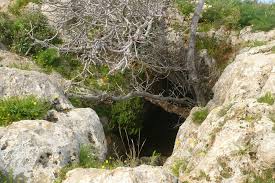
Eilitheia Cave entranceThe Eilitheia Cave is in the hills above the ancient port of Amnissos. We arrived in the morning, accompanied by the guard who came with us to unlock the gate. The cave has one large, long room, with a wide mouth, and a low ceiling. There is a belly stone near the entrance that women rubbed to insure conception. Near the center of the cave, in shadowy darkness, are two stalagmites, one squat and the other tall, surrounded by the remains of ancient walls that enclosed the sacred space. The guard told us that they were worshipped as the Mother, seated, and the Daughter, standing. Their heads were chopped off with the blow of an ax. In the back of the cave there are small pools of water, used for healing
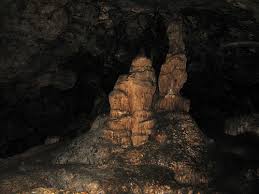
Eilitheia Cave -- StalactitesAs our eyes adjusted to the darkness, we felt that we too had entered into the womb of the Mother. Naomi sat by the Daughter stalagmite, while I leaned against the Mother. We chanted to Her and sang, aware of the bemused but accepting presence of the guard, who retreated to the entrance of the cave. As we turned to leave, Mara crouched at the cave’s entrance to take a picture, her short, full body the image of the Mother Goddess, her wispy blonde hair capturing the light, crowning her like a halo. Slowly, we emerged from the cool depths, the place of ancient mysteries, into the light and warmth of the midday sun.

We visited the Skoteino Cave late in the day, after lunch and a refreshing swim in the sea. To reach the cave, we ascended into the mountains, passed through the small village of Skoteino, and turned right down a dirt road. Above the cave is a small church dedicated to Agia Paraskevi, the patron saint of eyesight. I had been to the cave eleven years earlier with my husband, Roger, on the saint’s name day, July 26th. That day the locals celebrated first in the church, where they decorated the icon of Agia Paraskevi with flowers and lit candles, and then in the cave, where they roasted lamb, sang, and danced. It is likely that this cave has a continuity of worship from ancient times to the present day.

The first time I visited the cave of Skoteino, which means dark, I thought it was a single, huge, high-ceilinged, cathedral-like room, adorned with stalagmites and stalactites. In the meantime, I had learned that beyond the first room, there are three more levels, the final one, totally dark. Mardy offered to lead the way. Two young German men, emerging from the depths, told us the way down was not easy, as there was no clear path.
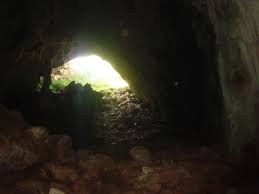
Skoteino Cave EntranceMarie, unsure of her footing, stayed near the entrance. Naomi, afraid of the unknown, perched on a rock at the back of the first room holding her candle. Mara, Mardy, and I braved the descent. We did not know what awaited us in the dark. With candles and small flashlights, we climbed and slid, sensing a way down. The rocks were cool, damp in some places, but not slippery. There were no sharp edges because the rocks had been smoothed by water. Encouraging each other we reached a place where it looked like the next descent would be though a hole or narrow opening. We still had faint light from the mouth of the cave. The final passageway was unknown, frightening, inviting. We paused, eyes fixed on the dark opening. Mardy broke the silence saying that we should turn back because the sun was about to set.

I made the ascent more rapidly than the others, my body urging me on until I reached the first level. As I walked slowly up the path that meandered through the first large room, I could see two women before me with candles, and two behind me coming up from the depths. I could almost see Persephone coming up from the underworld, torch in hand. Surely it was in a place like this that the Eleusinian Mysteries began.
 

A Serpentine Path: Mysteries of the Goddess is available in kindle and paperback.  Carol P. Christ leads the life-transforming Goddess Pilgrimage to Crete. Her books include: Goddess and God in the World: Conversations in Embodied Theology, written with Judith Plaskow and She Who Changes and and Rebirth of the Goddess; also with Judith Plaskow, the widely-used anthologies Womanspirit Rising and Weaving the Visions.

Updated on December 26, 2016.

Argument from “Absence” and Absence of Dialogue by Carol P. Christ

Carol in Crete turquoiseRecently in a conversation with a noted archaeologist and his male graduate student assistant, I proposed that the absence of war and the trappings of war, including images of larger than life-size warrior kings, suggested to me that we should not understand the social structure of ancient Crete on the model of patriarchal kingship. “Kings are always warriors,” I said, “yet there is no clear and convincing evidence of organized warfare in ancient Crete. And,” I continued, “because warrior kingship is not a ‘natural state,’ but one achieved through warfare and domination, kings must legitimate and celebrate their power through larger than life-size images of themselves. Such images were common in ancient Sumer and in ancient Egypt, but are not found in ancient Crete.”

The response I received was unexpected: both archaeologists seemed dumbfounded. “Is kingship always associated with war?” they asked. “Yes,” I responded, “this is a conclusion I reached many years ago while studying the cultures of ancient Greece and ancient Israel, and I have recently elaborated this theory in a series of essays on the blog Feminism and Religion ( See “Patriarchy as a System of Male Dominance Created at the Intersection of the the Control of Women, Private Property, and War”).” Continue reading “Argument from “Absence” and Absence of Dialogue by Carol P. Christ”

The Book Is Finished, Now On to Publicizing It by Carol P. Christ

Carol in Crete turquoiseGoddess and God in the World: Conversations in Embodied Theology by Carol P. Christ and Judith Plaskow, forthcoming from Fortress Press in 2016.

In Goddess and God in the World, two leading theologians model a new method of embodied theology, rooted in experience and tested in dialogue. Christ and Plaskow agree that the God who is dead in our time is the transcendent and omnipotent male God of traditional theology. They believe that we must create new understandings of divinity because theologies not only help us to make sense of the world, but also provide guidance as we face the urgent social, political, and environmental issues of our time. In contrast to traditional views, Plaskow and Christ situate divinity in the world and place responsibility for the fate of the world firmly in human hands. They argue for an inclusive monotheism that affirms the unity of being through a plurality of images celebrating diversity and difference. Carol believes Goddess is the intelligent embodied love that is in all being, a personal presence that can inspire us to love the world more deeply. Judith understands God as an impersonal power of creativity, the ground of being that includes both good and evil. Their intense questioning of each other’s views provides an exciting model for theological conversation across difference.
Continue reading “The Book Is Finished, Now On to Publicizing It by Carol P. Christ”

The Dog Days of Summer by Carol P. Christ

Sirius in the Sky


Sirius rises late in the dark, liquid sky
On summer nights, star of stars,
Orion’s Dog they call it, brightest
Of all, but an evil portent, bringing heat
And fevers to suffering humanity. –Homer, The Iliad


The dog days of summer are associated with the reappearance of the brightest star in the sky, the “dog star,” also known as Sirius, just before dawn from July 23 until August 23. This star heralds the days of the most intense summer heat. Though this is the time of the summer harvest in Mediterranean cultures, it a time of death. Energy wanes. The grasses have dried out on the hillsides, plants in gardens will die too unless they are watered. The healthy “sit out” the heat of the day with closed shutters, while those who are old or very ill often give up the ghost. They say that this is also a time when babies are conceived during long and languid afternoon naps.

The Greater Mysteries of Demeter and Persephone were celebrated at the end of this period, and the Greek Orthodox festival of the Dormition (Death) and Assumption (Rebirth) of the Panagia (the Virgin Mary) echoes an ancient rhythm.

This year I have spent most of the dog days in air-conditioned rooms, feeling little inclination to brave the heat of the day even for a refreshing swim in the sea. During this time, Judith Plaskow and I completed the final draft of the manuscript of Goddess and God in the World and submitted it to our publisher: a midsummer harvest!

To be truthful, I also spent many of the dog days days glued to my computer watching reruns of D.C. Banks and Blue Murder. These days of rest were good for the knee I had injured earlier in the summer, which now is almost healed. They must have been good for my spirit as well, for a friend who had not seen me since late spring told me that I looked refreshed and renewed.

In nature, the death days of late summer are followed by rebirth. At the very time when the sun is at its most intense, the days become shorter—first imperceptibly, and then quickly. While sun “stands still” for several months, setting at more or less the same time before and after the Summer Solstice, all of a sudden (or so it seems), the sun sets half an hour earlier. From then on, it sets several minutes earlier each day: a clear indication that fall is on its way. Before long, the rains come and the hillsides become green again.

beachttime in anaxos by Andrea Saris

For me, August 14, celebrated in Greece as the day of the Dormition of the Panagia, marks the beginning of the end of the intense heat of midsummer. Yesterday, on this day, with some trepidation, I packed my dogs into a hot car and headed for the sea. Our favorite tavern was empty and a light breeze coming from the sea tempered the heat. A friend arrived unexpectedly, and—joined by my intrepid miniature schnauzer—we enjoyed a swim so refreshing we didn’t come out of the water until our fingers became wrinkled. Just before sunset my friend and I met again to ascend the stairs to the shrine Church of the Panagia on the Rock to light candles for Rebirth and Renewal, ending our day with dinner by the sea.

As I write the next morning, I feel poised on the edge of rebirth and regeneration. I don’t yet have new ideas in my mind, nor do I have the fullness of energy I know will continue to return as the heat wanes. I look forward to the coming of fall and await new green shoots of inspiration in my life and my work.

carol mitzi sarah

Carol P. Christ leads the life-transforming Goddess Pilgrimage to Crete (facebook and twitter).  Carol’s books include She Who Changes and and Rebirth of the Goddess; with Judith Plaskow, the widely-used anthologies Womanspirit Rising and Weaving the Visions and forthcoming in 2016 from Fortress Press, Goddess and God in the World: Conversations in Embodied Theology. Explore Carol’s writing. Photo of Carol by Shanti Jones. Photos of beach at Anaxos by Andrea Sarris.

No Longer Moved … by Symbols that Once Moved Me Profoundly by Carol P. Christ

Carol in Crete croppedThis week Judith Plaskow and I submitted the final version of our new book Goddess and God in the World to our publisher at Fortress Press. Just before completion, I added a shorter version of the following passage to my final chapter. In it I tried to describe the odd feeling of not being moved any longer by a religion that once moved me profoundly. Our book, which explores an embodied theological method, will be out in the summer of 2016.

I have never regretted my decision to leave Christianity. Although I have a sentimental attachment to Christmas trees, Christmas dinners, Christmas carols, and some hymns, I miss little else about Christianity. At a distance of several decades, I find that I quite simply have no feeling for the Christian edifice of doctrines and rituals based on the life and death of a single individual. Jesus was a visionary, but there have been many others like him—including Martin Luther King, Elizabeth Cady Stanton, and Gandhi, all of them flawed, as Jesus must have been as well.

A few years ago, I decided to participate in the Greek Orthodox Easter week services, because they are attended by so many of my neighbors. But while enjoying the company of the women who decorated the epitaphios (tomb for Jesus), the procession through the streets of our town on Friday night, and the lighting of candles at midnight on Saturday, I came to a clear understanding that the Easter drama is no longer my drama. During the Thursday night services, I realized that many of the women were openly grieving the death of Jesus. Though intellectually I could understand that the Easter drama allowed my friends to release pent-up and repressed feelings, I found their deeply emotional response to the re-enactment of the death of Jesus bizarre.

P6115475
Idean Cave

In leaving Christianity, I had gained the freedom to name the sacred in my own experience, confirmed my deep inner knowing about the human connection to nature, and found the power to create and participate in rituals that have meaning in my life. For me now, the rituals on the Goddess Pilgrimage to Crete are at the center of my spiritual life. To listen to Alice Walker’s words, “We have a beautiful/mother/Her green lap/immense/Her brown embrace/eternal/Her blue body/everything we know”* on a mountaintop or to repeat Ntozake Shange’s cry, “we need a god who bleeds now/whose wounds are not the end of anything”** at the mouth of a cave, moves me more than any passage from the Bible.

Singing “Light and Darkness” in the depths of caves is an embodied act of reclaiming the womb as a symbol of creation and the darkness as a place of transformation. I still enjoy singing the Doxology (Hymn of Praise)—and doing so connects me to my history. But I now sing it in front of altars laden with summer fruits or winter vegetables and with words that express my spirituality: “Praise Her from whom all blessings flow/Praise Her all creatures here below/Praise Her above in wings of flight/Praise Her in darkness and in light.”***

*Alice Walker, “We Have a Beautiful Mother,” Her Blue Body Everything We Know: Earthling Poems 1965-1990 (New York City and Orlando, FL: Harcourt Books, 1991), 459-460.
**Ntozake Shange, “we need a god who bleeds now,” A Daughter’s Geography (New York: St. Martin’s, 1983), 51.
***See Carol P. Christ, She Who Changes: Re-imagining God in the World (New York: Palgrave Macmillian, 2003), 238, for a discussion of the meaning of the new words.

Carol P. Christ leads the life-transforming Goddess Pilgrimage to Crete (facebook and twitter).  Carol’s books include She Who Changes and and Rebirth of the Goddess; with Judith Plaskow, the widely-used anthologies Womanspirit Rising and Weaving the Visions and forthcoming in 2016 from Fortress Press, Goddess and God in the World: Conversations in Embodied Theology. Explore Carol’s writing. Photo of Carol by Maureen Murphy. Photo of Idean Cave by PJ Livingstone.

ALTERNATIVE IMAGES OF GOD BY CAROL CHRIST AND EMMA TROUT

Carol P. Christ at Alverno College 1
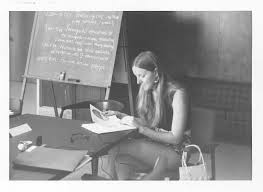
Carol Christ at the Conference of Women Theologians

Today I am publishing an early work on female language for God that I wrote with Emma Trout at the first Conference of Women Theologians in 1971. Highly contested at the conference, this essay is a foreshadowing of my subsequent work on the need for female imagery for divinity.

Rereading this essay more than four decades later, I am gratified to see that though we began our essay with the image of God giving birth (which I still view as an important image), Emma and I were aware of the danger that female imagery for God could reinforce “a false sexual polarity.” We insisted then that female imagery for God must not repeat sex role stereotypes, but rather must shatter them. Continue reading “ALTERNATIVE IMAGES OF GOD BY CAROL CHRIST AND EMMA TROUT”