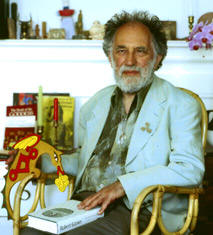
Happy the Land That Needs No Heroes by Daniel Cohen

A story that follows on from my version of Perseus and Medusa…

We are blind now, my sisters and I.

He came to us, the hero, the shining one, Perseus, proud in his strength, bright as the two lightning flashes on his tunic.

There were three of us, three sisters known as the Graiae. We had always had only one eye between us, which we passed from one to another, yet we saw more clearly with that one eye between three than many did with two eyes to themselves.

And we saw him for what he truly was.

“Where is she,” he demanded.

“Who,” I asked, though we knew well what it was he wanted.

“Medusa. She whose snakes creep in and poison our good and wholesome society.”

We laughed at the way he saw the world, and I answered “No.” I spoke for us all, since at the time I had our one tooth.

But then I made a mistake. Wishing my sisters to see him, I took out the eye so as to pass it to one of them. But he grabbed the eye as I tried to hand it on. Continue reading “Happy the Land That Needs No Heroes by Daniel Cohen”
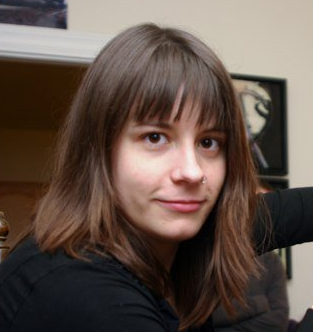
“Eating Our Words” Decoupling Women’s Eating Habits from the Language of Sin: Part 1 by Stefanie Goyette

Any woman who has eaten a big holiday meal with her family or had a weekend brunch with girlfriends has probably heard the following words: “I’m so bad, but I’m going to order…” or “I shouldn’t, but…” or “I’m being good; I skipped dessert.” Foods and the recipes in cookbooks marketed towards women are described as “sinfully delicious,” especially if they are low-carb, or low-fat, or low-sugar. “Sinfully delicious” diet food can be enjoyed “without the guilt.” Further marking the matrix of food, women, and “bad” behavior or sin, is the intimate relationship between food, women, and sex. Recent Carl’s Jr./Hardee’s commercials feature swimsuit model Kate Upton making out with – nearly making love to – a hamburger. This love scene takes place in a convertible, at a drive-in, the classic site of American, teenage, illicit sex. The take-out bag is used as a prop to conceal Upton’s vagina, as she spreads her legs for the camera. Another commercial, for Lay’s potato chips, features a women biting her lip while she slowly peels open the bag, set to Al Green’s “Let’s Stay Together.”

A seeming contradiction emerges between these two discourses: one that persists within and between women, who are expected to be on a diet and who speak, and are spoken to, about food in terms of morality, “good” and “bad.” At the same time, women eating, especially eating greasy, fatty, comfort food, as long as these women are thin and attractive, has become a quintessential symbol for sex, and is used most particularly to market food to men. Continue reading ““Eating Our Words” Decoupling Women’s Eating Habits from the Language of Sin: Part 1 by Stefanie Goyette”

Title IX and Our Future Leaders and Activists by Paula L. McGee

In January, I wrote a blog about my life and Title IX. Perhaps the greatest celebration that speaks to the power of Title IX is represented by the future feminists that attended the jersey retirement, my dissertation defense, and the graduation. I wrote the blog because I wanted to make sure that everyone was aware that this year is the fortieth anniversary of Title IX.  I also knew that very few people would understand the uniqueness and significance of an African American woman from a working class background having a jersey retired and graduating with a Ph.D.—all in the same year.

In February, my sister and I had our jerseys retired at USC. I wanted the day to be special, so I invited my friends and colleagues. All of my worlds (faith, academics, and athletics) that seldom cross collided. The event turned out to be a celebration of diversity with representatives from the world of politics, athletics, and religion. Claremont Graduate University was actually one of the sponsors. Continue reading “Title IX and Our Future Leaders and Activists by Paula L. McGee”

The Crying of an Ant: Finding a Theory of Change by Najeeba Syeed Miller

Qur’an 27:18: Till, when they came upon a valley [full] of ants, an ant exclaimed: “O you ants! Get into your dwellings, lest Solomon and his hosts crush you without [even] being aware [of you]!” – 27:19: Thereupon [Solomon] smiled joyously at her words, and said: “O my Sustainer! Inspire me so that I may forever be grateful for those blessings of Thine with which Thou hast graced me and my parents, and that I may do what is right [in a manner] that will please Thee; and include me, by Thy grace, among Thy righteous servants!” –

This story of the ants and Prophet Sulaiman (Solomon) is often taught to young Muslim children. The story goes on with Prophet Sulaiman hearing the cries of the chief of ants and stopping his army so that the ants may peacefully go along on with their work. Some commentaries include a further conversation between the chief of ants and the Prophet Sulaiman. I am studying this story with my five year old son and as we delved into it and the lessons one might learn as a child, I thought too about the morals I might derive from the story as an adult. Continue reading “The Crying of an Ant: Finding a Theory of Change by Najeeba Syeed Miller”

How a Woman Became a Goddess: Athena by Laura Loomis

A large part of my fascination with Goddesses has to do with images of female power in cultures that were (and are) overtly patriarchal.  Power has a tricky balance:  when it’s being abused, the struggle is to find a way to overcome the oppressor without becoming one yourself.  But to paraphrase Erica Jong, the best oppressors don’t beat you – they get you to beat yourself.  I have been thinking about this as I watch Democrats hand power over to Republicans ever since coming back into control of the government.

Which brings me to Athena.

Athena may have had her origins as a Cretan or North African mother Goddess.  But by classical times in Greece, she was firmly established as the virgin Goddess of wisdom, household crafts, and war and peace.  It’s said that Zeus, like his father and grandfather before him, feared that his child would be more powerful than himself.  So when Metis was pregnant with Athena, he challenged her to a shape-shifting contest.  She took the form of a fly, and Zeus swallowed her.  (I don’t know why he swallowed that fly…)   Continue reading “How a Woman Became a Goddess: Athena by Laura Loomis”

Narrative Textiles and Women’s Stories by Mary E. Hunt

Art, like religion, is a window into cultures. Women’s stories often find expression in narrative textiles, a medium I have long admired but never quite understood. I encountered the fabric art of Esther Nisenthal Krinitz recently. She was a Holocaust survivor who created stunning needlepoint pictures of her and her sister’s escape from Nazis in 1942. They left their Jewish parents behind and pretended to be Catholic girls from the country in order to survive. In 1977, she began to create 36 works of needlepoint in which she stitched the heart-wrenching episode with power and beauty, color and force, the memory of a child now seared in the heart of a woman.

Her daughters, Bernice Steinhardt and Helene McQuade, set up a foundation, Art and Remembrance, to show the “power of personal narrative in various forms of art to illuminate the effects of war, intolerance, and other forms of social injustice on its victims.” Their mother’s story is now available both in a book and a riveting film as well as in the art itself. These are narrative textiles of the most precious sort. Continue reading “Narrative Textiles and Women’s Stories by Mary E. Hunt”

Vatican Lays a Cunning Trap for American Nuns by Mary Johnson

At the end of this month, the Leadership Conference of Women Religious will meet to formulate a response to a Vatican trap whose cunning is best appreciated within the long tradition of religious authorities who craft impossible dilemmas for those they perceive as threats.

Two millennia ago, the chief priests sent someone to ask Jesus, “Should we pay taxes?” If Jesus said yes, he would pit himself against Jewish resistance to Roman occupation and therefore, in Jewish eyes, against God. If he said no, the Romans could execute him for sedition. Instead, Jesus famously replied, “Render to Ceaser what is Ceaser’s and to God what is God’s.”

In the fifteenth century, Joan of Arc’s ecclesiastical inquisitors asked her, “Do you know yourself to be in God’s grace?” If Joan answered yes, she would commit heresy because the Church had long taught that no one could be certain of being in God’s grace; if no, they could interpret her answer as an admission of guilt. Joan looked them in the eyes and replied, “If I am not in God’s grace, may God put me there; if I am, may God so keep me.” Continue reading “Vatican Lays a Cunning Trap for American Nuns by Mary Johnson”

Evolution of My Tallis by Rabbi D’vorah Rose

I have been musing on a presentation I attended at the American Academy of Religion.  Associate Dean Donna Bowman, Ph.D. of the University of Central Arkansas spoke on the prayer shawl ministry.  Traditionally, the prayer shawl (tallis gadol, in Hebrew) is worn by men, based on the commandment to tie fringes (tzitzit) on the corners of their garments (Numbers 15:38-40).  Also traditionally, a man would have one tallis for every day use and a special one for the Jewish New Year and Day of Atonement (Rosh Hashanaha and Yom Kippur). While there is no prohibition in Jewish law against women wearing a tallis there has typically been the understanding that it is a man’s obligation to wear the fringes, so women have not (that whole separation of gender roles thing).  But over time, as women have found entrée into Jewish leadership, the tallis started to be worn by us.  Some Jewish women now have the most delicate talleisim – pink, gold, lace, dancing women, butterflies, ribbons, etc., while others create stories about Jewish text (midrash) on their talleisim, using symbols, pictures, text phrases, and the like.  Continue reading “Evolution of My Tallis by Rabbi D’vorah Rose”

In Honor of All that Gives Life by Ashley Anderson

The depth of life’s interconnection is our greatest vulnerability and our greatest hope. We are beings in relation.

Today we celebrate Mother’s Day. Drenched in some strange amalgam of consumerism and genuine desire to nurture the ones who have nurtured us, we buy flowers and gift cards. We plan Sunday brunches or make that extra-long phone call to our mothers living far from us. My own mother, to whom I owe my courage and creativity, lives two thousand miles away. It was she whose breath gave rise to my own, whose gentle strength and fierce passion made way for my being in the world. It is my mother to whom I trace my beginning, and yet, if life is as Anais Nin imagines it, a “process of becoming” are we not ever-beginning? If all life itself is in process, if the powers of destruction and creation flow, creating and re-creating all that is, I wonder at the wombs that make and re-make us.

This process of becoming is an adventure through the whirlwind, a tour of the chaosmos. Our becoming, wrapped up with the becoming of Creation itself, is an unwinding of the fibers of the universe and our own souls, spiraling toward liberation. And so, on this Mother’s Day, I offer gratitude and honor toward all that gives us birth, to all who take part in our process of becoming.

Wave Womb by Galen Dara

In honor of ourselves. There is a sense that each of our beginnings emerges out of a wound, out of a dying. The day I was born was the day I received my first scar. I was a C-Section baby and the doctor nicked the edge of my forehead narrowly missing my eye. Soon enough, the wound healed and I still have a tiny scar by my right eye. Today, many years and many scars later, I marvel at our ability to heal. We give life to ourselves, after the movements of death have swept through us, after long nights of grief and the collapse of all we knew. In the quiet stillness of a soul razed, creativity moves. Continue reading “In Honor of All that Gives Life by Ashley Anderson”

A RITUAL OF FAITH: SENDING LOVE TO THE CHILDREN OF VETERANS by Stephanie Mines

May is the Month of Mary and the Month of Mothers. With this in my heart I want to ask everyone receiving this newsletter to SEND LOVE to the children in the families of our returning veterans. As vets stream back from Iraq and Afghanistan, many with PTSD (Post Traumatic Stress Disorder) and/or TBI (Traumatic Brain Injury), the children in their families are the most vulnerable to how war comes home.

Children are prime targets for the unnoticed and untreated war wounds of intergenerational shock. As politicians wrangle for power and use the current wars for that purpose, the children absorb the fallout and cannot hide. Their very shelter is a war zone. I am not talking about a few children. I am talking about thousands and thousands of children. The Pentagon itself notes, through Dr. Sonja Batten, Assistant Deputy Chief of Patient Services for the VA, “PTSD and TBI are occurring in unprecedented numbers. At least 320,000 soldiers have been diagnosed with TBI and one in eight returning soldiers has PTSD.” Continue reading “A RITUAL OF FAITH: SENDING LOVE TO THE CHILDREN OF VETERANS by Stephanie Mines”