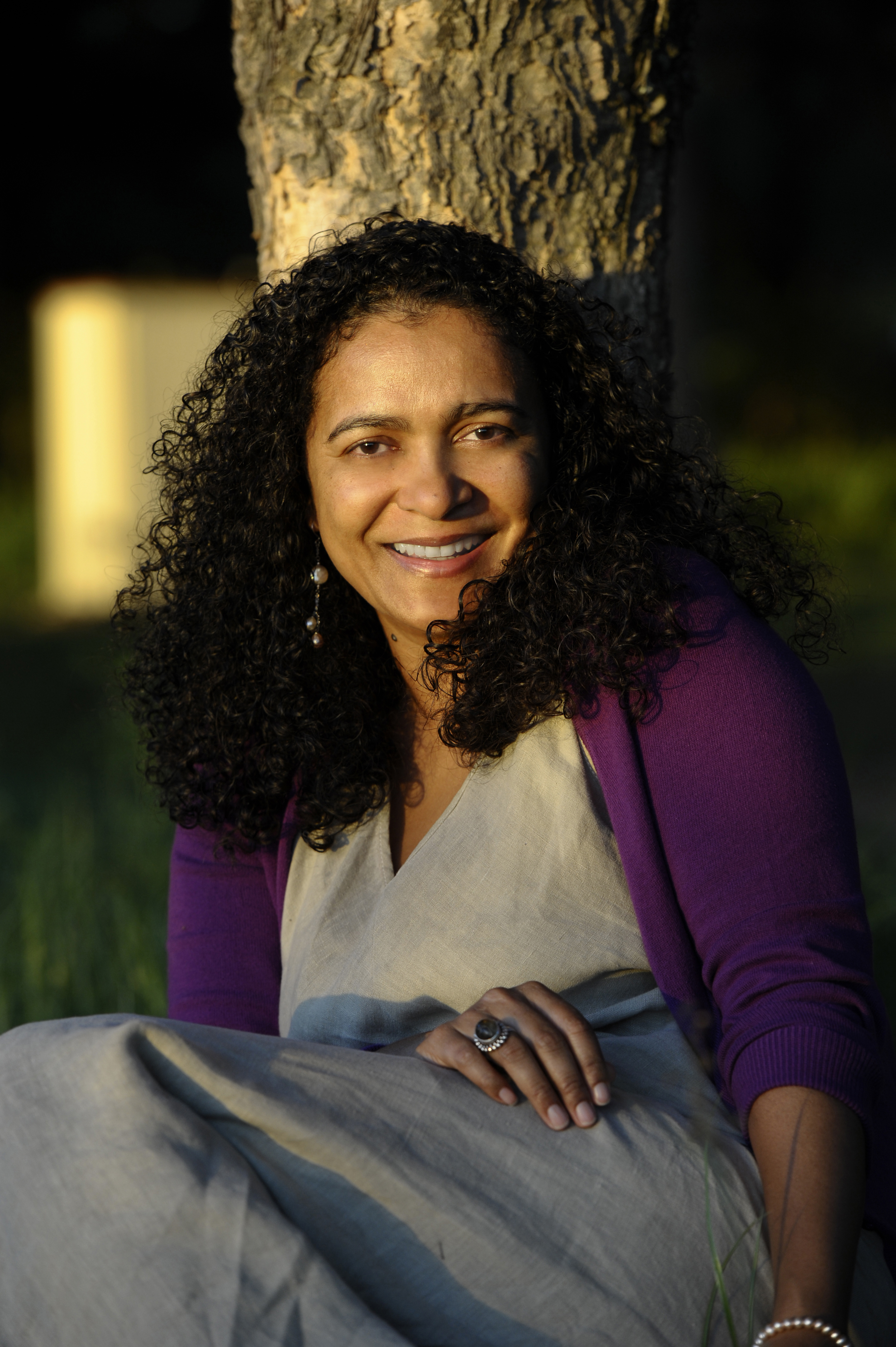
Soror Mystica: New Myth for a Changing Earth by Gael Belden

Once, when my life collapsed around me, as life is wont to do at times, I began creating clay images, placing them near the headwaters of watersheds around the United States. I called this project 100 Clay Buddha’s and it seemed at the time an incantation and a prayer for water, for the planet.  Later, I came to understand that I was also re-figuring my life, image by image, waterway by waterway.

I was also working at the time with particular koans, myths, and fairy tales because they speak not only to the personal, but to the collective –to the ways things have been over time. The hero’s journey monomyth, although genderless in its most distilled terms, seemed, though its imagery, to speak mostly to the theme of the outer quest (slaying dragons, returning from battle, and whatnot). I felt as a woman, however, my journey had to do with a descent into the Great Below and with that a dying into something new. Continue reading “Soror Mystica: New Myth for a Changing Earth by Gael Belden”

A Shaman’s Journey by Kelley Harrell

When I was five years old, I asked my Sunday School teacher–a woman, “What if Jesus had been a girl?”

“But he wasn’t,” she replied.

Unsatisfied, I asked again, only to receive the exasperated, recursive answer.  My mother gave the same empty response later, in private.

It’s no huge surprise that when I was about 14, my many dissatisfactions with the Church overwhelmed my fondness for it, and I began to explore other spiritual paths.  Coinciding with this transition was also the realization that intuitive gifts I’d manifest since childhood demanded open expression, and that the energetic truth of my femininity deserved acknowledgement on my spiritual path.  By the time I was 17 I had separated from the Church and begun crafting my own relationship to shamanism.

That may not seem like a terribly logical leap on the surface, but for me it was sound.  Continue reading “A Shaman’s Journey by Kelley Harrell”

Things That Make Me Cry: The Practice of Unbelief by Leanne Dedrick

I have been doing a lot of unpacking lately, both literally and figuratively. I have recently moved to a different city, and returned to a place I once knew well, many years ago. It hasn’t been a case of ‘going home again’ as much as it has been an expression of self awareness of my preferences, but as with other significant life events, there are surprises waiting around each corner — surprises that carry with them hidden issues that require figurative unpacking. For the purposes of this post, however, I will only address one. It is the one that left my FB friends scratching their heads and sending me comments like, “WTF?” and “Wow. You surprise me!” and “Have you lost your mind?” It also led to the most annoying statement anyone can ever hear, “Obviously, you have issues you aren’t dealing with…” I don’t know about you, and maybe it is just my age, or the fact that I am a philosopher, but it is damn near the biggest insult you can pay me. The way I see it, and live it, my obsessively organized and compulsively compartmentalized mind is constantly on hyper-drive when it comes to analyzing and ‘dealing’ with my ‘issues.’ So after a few days of sitting with (read: doing anything but calmly sitting with) my annoyance and reviewing my own out of character posts, I have gotten to a place where I can begin to unpack the responses of others, rather than perseverate on my own insecurities. Continue reading “Things That Make Me Cry: The Practice of Unbelief by Leanne Dedrick”

A Love Letter to My Body by Amanda Kieffer

My body, my love, how terribly I’ve missed you.  Do you remember the night we wept? The night I touched you for the first time since . . . I can’t remember when. I asked your forgiveness a hundred times. I had to make up for all the nights I spent ignoring you and asking forgiveness from that ridiculous Man in the sky.  I thought you were His.  I thought He was angry because I wanted to know your secrets and your secret places.  I was ashamed of myself and I was ashamed of you . . . of your sensual motions . . . of your dark spaces . . . where only men, well, only one man is supposed to go.  I am forbidden. So they say. If I explore your depths in secret it’s a sin and the Man in the sky will be angry, perhaps for Himself, perhaps for that one man on whose territory I am trespassing.  Never speak of such a transgression!  Everyone will be shocked, embarrassed, horrified. Well . . . Continue reading “A Love Letter to My Body by Amanda Kieffer”

Imaging God by Tiffany Steinwert

There are some words a mother never wants to hear. For me, those words came one evening as I tucked my 3 year old son, G, in to bed. We had just finished reading  God’s Dream, a children’s book by Bishop Desmond Tutu, and were discussing what God might want us to do. The conversation went something like this:

G:           “I think God wants me to share.”

Me:        “I think so too.  God likes sharing.”

G: “        “Yeah, He likes it when I share.”

SCREEEEECH!!! Insert here the sound of the needle suddenly scratching and falling off the record.

He?

Where did G get that? With two theologians as parents, G’s religious world has been carefully and intentionally constructed since birth. Nowhere ever did we refer to God as “He.”

Perhaps it was just a slip of the tongue, a mistaken pronoun, an unintentional lapse. God/dess knows I pride myself on my child’s gender fluidity. I take his vacillating male and female pronouns as a sign of early queer, gender non-conformity. Though, I suspect others might interpret that as part of normal verbal development. You choose.

Whether intentional or unintentional, I decided to nip this in the bud once and for all. Continue reading “Imaging God by Tiffany Steinwert”

A Tale of Power and Beauty, Part II: Snow White by Amanda Kieffer

This is a moment we all face—the moment when we slay the enemy, only to realize we have slain ourselves and the enemy is still at large.   

In Part I of this blog, I analyzed the themes of power and beauty in the film Snow White and the Huntsman in relation to the character of the Queen.  In Part II, I would like to continue exploring these themes in light of Snow White’s character and her relationship with the Queen. That Snow White’s power is her beauty is clear.  True, it is stated right up front that Snow White is admired throughout her father’s kingdom “as much for defiant spirit as for her beauty.” However, it is her beauty that grants her agency and power, not her free and defiant spirit. The battle scene in the climax of the film illustrates this connection between power and beauty well—as Snow White drives her dagger into Ravenna’s heart she repeats the mantra: “By fairest blood it is done; by fairest blood it is undone.”  After Ravenna breathes her last, we see Snow White looking into the mirror on the wall, the victor, the fairest. Her beauty has allowed her to ascend to power. Her beauty has allowed her to defeat Ravenna. We are left wondering—who has won exactly?
Continue reading “A Tale of Power and Beauty, Part II: Snow White by Amanda Kieffer”

OF POWER, GOOD COUNSEL, AND WISDOM by Daniel Cohen

In the Jewish and Christian traditions, Wisdom (Hochma in Hebrew, Sophia in Greek) is a female figure who is an aspect of deity. This has been forgotten for many years, but people are beginning to re-discover Her.

There was a time when Power and Good  counsel walked hand in hand. That was the springtime of the world. In those days men and women honoured each other and honoured also the living world. The sun, moon and stars, the winds, the waters, and even the rocks themselves were known to be alive. In those days Death was no enemy, but a friend to be welcomed when She made the invitation to visit Her country.

But Good Counsel became pregnant, and Power began to be afraid. He feared first that the coming child would take Good Counsel away from him. And then he feared that their child would so well combine the features of the two of them that it would in due course put him down from his place.

Power devised a plan. He opened his mouth to its widest, and pushed Good Counsel in, swallowing her whole. He now felt free of his fears. He began to claim that all the good counsel in the world now belonged to him, and so he declared that it was only fitting he should rule all the world. Though many opposed his claim, he persuaded, and sometimes bullied, others into believing that this opposition was due to bad counsel. And so, though many grumbled and secretly worshipped elsewhere, he set himself up as ruler of the world. Continue reading “OF POWER, GOOD COUNSEL, AND WISDOM by Daniel Cohen”

Storytelling to Restore the Sacred in Our Lives by Najeeba Syeed Miller

I was recently offering a workshop to a group of Muslim educators from all types of ethnic, racial and community backgrounds. One of my points in the training on conflict resolution was the importance of story telling,the many ways that stories are formed, told and uttered in different cultural contexts. Sometimes, the content of the story is less important that the WAY we tell the story. We talked about how to listen to the form of the story being told, its inherent design logic, and what we learn about a person and her community from the way she chooses to tell her story especially in times of conflict. For it is in conflict times that we resort to what is most familiar and sacred to us all.

For years, I have had the honor of being a peacemaker, a mediator who listens to people’s stories. I jokingly told a colleague that I could tell what they were thinking even as they were telling their story just by the way they sat, how their hands moved, whether they looked away at certain points or by what they also did not say. It is important to hear a story being told as a fully embodied experience. The words, the way they are arranged, the flow of the narrative, its resonance with body language give you a more complete vision and experience of the story and insights into the storyteller. Continue reading “Storytelling to Restore the Sacred in Our Lives by Najeeba Syeed Miller”

A Cross-Cultural Feminist Alchemy: Studying Mago, Pan-East Asian Great Goddess, Using Mary Daly’s Radical Feminism as Springboard by Helen Hye-Sook Hwang

Feminist theology was self-transcending to me. I was unafraid of going beyond the boundary of Christianity and its God. 

Mago is the Great Goddess of East Asia and in particular Korea. Reconstructing Magoism, the cultural and historical context of East Asia that venerated Mago as the supreme divine, is both the means and the end. Magoism demonstrates the derivative nature of East Asian religions such as Daoism, Buddhism, and Confucianism while redefining East Asian Shamanism to be the religious expression of Magoism.

I encountered the topic of Mago during my doctoral studies. The topic of Mago fell out of nowhere at the time I was preparing for qualifying examinations. I had never heard the name, Mago. Only when I was able to collect a large amount of primary sources from Korea, China, and Japan, was I awakened to the cultural memory of Mago. I grew up craving the stories of Halmi (Grandmother/Great Mother), a common referral to Mago among Koreans. I had a childhood experience of being in the fairy land unfolded by my grandmother’s old stories. While “Mago” was unfamiliar to most Koreans, she was taken for granted in her many other names such as Samsin (the Triad Deity) and Nogo (Old Goddess) and place-names such as Nogo-san (Old Goddess Mountain) and Nogo-dang (Old Goddess Shrine). Continue reading “A Cross-Cultural Feminist Alchemy: Studying Mago, Pan-East Asian Great Goddess, Using Mary Daly’s Radical Feminism as Springboard by Helen Hye-Sook Hwang”

“Eating Our Words” Decoupling Women’s Eating Habits from the Language of Sin: Part 2 by Stefanie Goyette

This post is the second part of a two-part series. Read Part I here.

In my previous discussion of the language associated with women’s eating habits, I mostly left aside the problem of weight. Weight, and certainly obesity, was hardly a concern in the Middle Ages, whereas I do not think that it would be controversial to suggest that fatness in the modern era is viewed as nothing less than a moral weakness, a failure of self-control. This viewpoint that is emphasized by weight-loss programs on television, in magazines, etc. But this is another matter that deserves a full discussion, which I cannot offer today. Rather, I would like to suggest that gluttony as a moral concern has shifted in meaning between the Middle Ages and the modern era, building on the fact that in medieval Europe, gluttony was an explicitly religious problem, a cardinal sin, even when separated from the related issues of libido and lust.

Despite the intense moralization of alimentary behavior in the Middle Ages, medieval writers often refused constrictive, moralized models of food and eating. Hildegard of Bingen, in her manual of natural medicine, the Physica (twelfth century), recommends different foods that help feed and diminish sexual desire, in order to balance the body rather than to suppress its needs. Continue reading ““Eating Our Words” Decoupling Women’s Eating Habits from the Language of Sin: Part 2 by Stefanie Goyette”