Emergence – Miracle Birth by Sara Wright

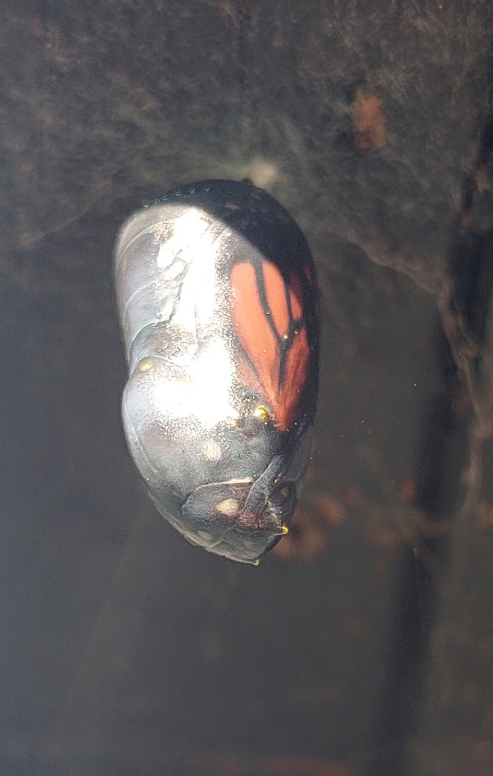
When my ‘good neighbor’ sent me the photo yesterday morning I could see the outlines of the butterfly, so my little dog Coal and I walked up to see for ourselves. It was hot – very hot though only around 9:30 AM. The capsule was already twisted and turning though not even the lightest breeze was in evidence. The outlines of the monarch were clearly etched through the now blackened but still translucent chrysalis.

 Standing under the porch overhang that the caterpillar had chosen for transforming, a miracle was in progress. Before our eyes the capsule split as the butterfly emerged head-first, feelers extended and waving from the bottom of a rapidly shrinking chrysalis that had so recently been lime green tipped in gold. The wings were still quite small, but the butterfly was already pumping fluid into them readying for first flight. As the wings expanded before our eyes I cried out like a child exclaiming in my joy and excitement – “oh a miracle, a miracle”, and of course it was, the birthing of new life.

Continue reading “Emergence – Miracle Birth by Sara Wright”

Legacy of Carol P. Christ: What is the Nature of the Hope that Can Trump Despair in the New Year?

This was originally posed on December 20, 2013
carol-christ“All hope abandon, ye who enter here.” These words posted on the gates of hell in Dante’s Inferno have an eerie resonance in our time. 

Marie Cartier recently posted a blog on children and hunger with facts so devastating I could not finish reading it. Earlier in the month Jassy Watson wrote about her deep feelings of grief on hearing Luisah Teish’s “Prayer for Disappearing Species.” Grief, despair, and sadness about the injustices in our world can be overwhelming.

A friend of mine has recently fallen into a deep depression. When I try to talk her out of it, she repeats that they are threatening to cut down the last remaining old growth forest in her home state of Oregon and that she can no longer eat fish because radioactivity released in the Fukishima nuclear plant disaster is reaching the seacoast of Oregon.

When I tell my friend she should not dwell only on these things and that she must remember that the world is still a beautiful place, she responds, “I do not want to give up my feelings. I know I must find a way to acknowledge my sadness and make a place for joy, but I don’t know how to do it.”

I have been in the grip of deep grief about the planet myself, not once but many times. But this happens less frequently than it used to.  When I think about the differences between how I once felt and how I feel now, I think the difference is that I have come to terms with and accepted the likelihood that “the world as we know it” is “going to hell in a handbasket”—as I put it.

I believe that the most likely conclusion of the choices human beings are making on planet earth today is massive environmental destruction leading to great suffering and probable extinction for human and many other species on planet earth. This is what I believe, but I also remind myself that I cannot know for sure. The earth and its species including human beings may have resources of resistance and survival, transformation and adaptation,that I do not know about and cannot imagine.

When I began to accept that the world I know and love (where spring follows winter, where birds sing, and where there is hope that injustice can be rectified) may not exist in the very near future, I had an astonishing insight. The death of the world I know and love will not mean the death of our planet or the end of the evolution of the universe.

Thinking about the disappearance of species and the death of human beings from starvation often feels too much to bear. None of this should be happening. Still, it can be strangely comforting to remind myself that the world I love is not the only possible world. There have been other worlds on this very planet—the time when the first cells were formed, the time of the dinosaurs, and many others. Evolution will continue on planet earth for several billion more years, and when our sun burns out, other suns will most likely still be shining in the universe.

This insight was followed by another. The reason for hope is not the conviction that we will be able to save the world we love. The reason for hope—and the reason to keep trying to save our world—is the deep knowing that it is right to try. Even if we cannot save the world we love for all time, we can savor the gift of life, and we can continue to try to create a world in which the gift of life is shared widely today and tomorrow.

I have written many times that we must learn to love a life that ends in death. I was speaking about accepting that each one of us will surely die. I do not fear death. Overcoming this fear has opened me to a greater and more clear-sighted love for life.

Can we learn to love life while accepting that the world we love may be dying? Can we continue to work to improve the conditions of life for individuals and species knowing that the world as we love it may not survive? Do we have any other choice?

For me the hope that can trump despair in our time begins in gratitude for a life that has been given to us, a life that has come down to us through the generations, and through billions of years of the evolutionary process on our planet.

Let us bless the Source of Life.

Let us bless the Source of Life, and the cycles of birth, death, and regeneration.

Let us turn back from despair.

Let us embrace the gift of life and share it with as many others as possible in the new year.

Carol P. Christ  learned to be grateful for the gift of life in Crete on the Goddess Pilgrimage to Crete she leads through Ariadne Institute.  It is not too early to sign up for the spring or fall pilgrimages for 2014.  Carol can be heard on a WATER Teleconference.  Carol’s books include She Who Changes and Rebirth of the Goddess and the widely-used anthologies Womanspirit Rising and Weaving the Visions. She wishes you great joy in the new year.

Honeysuckle Jewels and Women with Wings by Sara Wright

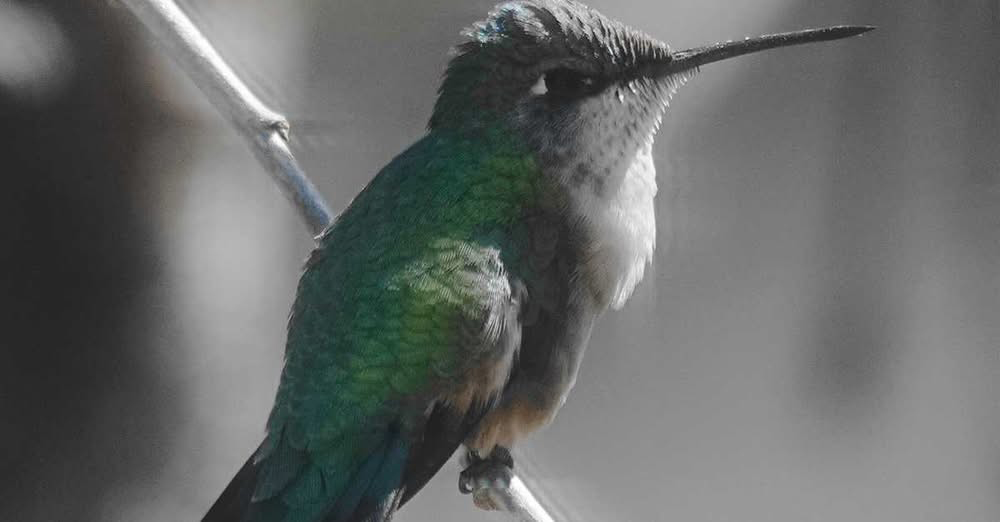
Female Hummingbird in Maine, April 26

Initially I wrote this article for publication at a plant site but was forcibly struck by the reality that what we are doing to plants is exactly the same thing we are doing to humans, women in particular. Separating, Othering, Judging, Dismissing, Eradicating. I could go on here. When you read this article about invasives think about how we are being treated as women. It alarms me that no matter I turn I see the same story played out with humans (women and children suffer most overall), trees, plants, and the animals we are so busy annihilating if not physically then in some other monstrous way. Fill in the blank with your own story.  Then imagine yourself as a bird with wings who carries the seeds of new life into unexpected places.

When I first moved to this area many years ago, I used to spend most of the time in the forests that surrounded my house except in the spring. Then I walked along what used to be a country road to see the wild trilliums, arbutus, lady slippers, bunch berry, violets and columbine that peppered the road edges. 

All the trees and flowers were so plentiful and so beautiful that it took me a few years to pay closer attention to the bushes like the various pussy willows and wild cherries, beaked hazelnut, witch hazel and hobblebush that I also came to love. 

Continue reading “Honeysuckle Jewels and Women with Wings by Sara Wright”

Legacy of Carol P. Christ: ETHICS OF INDIVIDUAL RIGHTS AND CARE SENSITIVE ETHICS IN THE CONTEXT OF THE GAY MARRIAGE DEBATE

This was originally posted on December 9, 2013

carol-christIs care the beginning of ethics? Has traditional western ethical thinking been wrong to insist that in order to reason ethically, we must divorce reason from emotion, passion, and feeling?

In Ecofeminist Philosophy, Karen Warren criticizes traditional ethical thinking–advocating a “care-sensitive” approach to ethics.  Traditional ethics, as Warren says, are based on the notion of the individual rights of rational moral subjects. Like so much else in western philosophy traditional ethics are rooted in the classical dualisms that separate mind from body, reason from emotion and passion, and male from female.  In addition to being based in dualism, western philosophy focuses on the rational individual, imagining “him” to be separable from relationships with others.  Western ethics concerns itself with the “rights” of “rational” “individuals” as they come into relationship or conflict with the “rights” of other “rational” “indiviudals.”

Those who would think ethically are advised to “rise above” the “emotions” and “passions” or “feelings” of the body, in order to reason dispassionately about the rights and responsibilities of rational individuals.  According to this theory, emotions and passions “get in the way” of rational thinking.  Continue reading “Legacy of Carol P. Christ: ETHICS OF INDIVIDUAL RIGHTS AND CARE SENSITIVE ETHICS IN THE CONTEXT OF THE GAY MARRIAGE DEBATE”

My Grandmother’s Pearls are Green by Sara Wright

“That move into mystery
is not an abandonment of
perception
into a cloud of unknowing.
It’s a move
into a different form
of knowing.”

Robert Macfarlane

I stepped outside when the sun was just rising over the horizon and low enough in the sky to create a play of shadow and light. This is my favorite time of the day to witness the astonishing beauty of the earth that is spreading her shimmering cloak around my feet… ‘oh, my grandmother’s hair, the words rose unbidden’. Chartreuse, plum, wine, lime, gold leaf and emerald canopies stretched across the brook blurring the leaves between birch, ash, beech and maples. The silvery water glistened, and I imagined myself flowing around those serpentine moss-covered banks listening to an ancient song  that has been sung by water for more than 4 billion years. How I wish I understood what ‘ki’ was saying but I am no longer able to discern the language.

Continue reading “My Grandmother’s Pearls are Green by Sara Wright”

Diana Beresford-Kroeger: Integrating Celtic Wisdom and Science, part 1 by Theresa Dintino

Moderator’s Note: This post is brought to you by a collaboration by FAR and Nasty Women Writers written and hosted by Maria and Theresa Dintino. This post originally appeared on their website on Sep 12, 2023

In her book To Speak for the Trees: My Life’s Journey from Ancient Celtic Wisdom to a Healing Vision of the Forest, Diana Beresford-Kroeger  shares her origin story, the humble beginnings of the famous scientist, the activist and crusader for the planet she became. We learn on what forge that will, strength, brain and consciousness were smelted. And it is one of beauty, strength and love, one that takes the breath away.

I loved this book. I loved going deeper and deeper into Beresford-Kroeger’s life story, into the rich depths of her Celtic heritage and medicine lineage. To learn the secrets and the wisdom. Beresford-Kroeger offers sacred transmission in this book, revealing another part of herself. It is a vulnerable telling and an irreplaceable gift.

Continue reading “Diana Beresford-Kroeger: Integrating Celtic Wisdom and Science, part 1 by Theresa Dintino”

Empty Nest by Sara Wright

 She fluttered
out of a woven
mossy green
basket
above the door
at dawn
the
nest
had fallen
onto granite
stone.
Oh
my drowning senses
couldn’t
contain such grief
every cell
drilled
deeper
I gasped
this
cavernous
hole
had no
bottom
I continued
to fall
Nature had
Spoken
my silent
plea went
unanswered
Ki’s* message
was clear
I replaced
the nest
added a
cedar shingle
enticing
the phoebes
to return
listened
to a vibrating
body
whose mourning
bell
rang clear
Nature
had Spoken
my beloved
birds
and those
I loved
were gone.

Continue reading “Empty Nest by Sara Wright”

Deep Time and Dreaming by Sara Wright

   I am standing on top of a mountain looking over a landscape of unspeakable wild natural beauty that stretches as far as I can see. This is the ‘long view’ the dream -maker tells me. The trees are stretching out their lush green needles to the sky as if in prayer, and they are whole. The forests, clear waters, the animals, birds, insects. All of Nature has been returned to a State of Grace.

An Old red skinned Indian Man appears. He is a Grandfather. He is on the mountain with me but also stands below (both and). He speaks to me.

 “Sit, listen, this is the Song of Life”.

 A finely crafted flowing red clay seat appears below (it flows like a wave) although it is situated a few inches above the earth. Almost hovering. I also see a drum made from deerskin and red clay sitting on the ground. There is a four directional equilateral black cross on the skin of the drum. The cross is thick and around the cross an intricate design is etched/inked into its skin also highlighted in black.

Continue reading “Deep Time and Dreaming by Sara Wright”

Kinship, the Powers of Place, and Leavetaking by Sara Wright

What do I mean by the word kinship? I believe that kinship is the idea, and the belief that all aspects of nature from photons to galaxies are connected to one another. Practically, I think of kinship as my feeling/sense of being intimately linked to place/landscape. In my mind Kinship and Place are not only related, each is shaped by the other.

The powers of place are invisible threads that work by exerting a kind of physical and psychic pressure, pulling me into relationship. Place acts like an attractor site. My body behaves like a lightening rod or perhaps a tuning fork picking up information from the landscape. Once I have heard the “call” the door opens through my relationship with elements, trees, animals, stars or stones to name a few possibilities.

As this presence manifests through its individuals place begins to teach me what I need to know about an area and how I might best live in harmony with a particular landscape, if not its people. This learning occurs in bursts or very slowly just below the threshold of everyday consciousness. Either way, information seeps in through my body as I listen and pay close attention to what my senses are telling me. I allow animals, trees, plants to speak to me in their native language, and I note synchronistic occurrences. Information also comes to me through dreams. Eventually a discernable pattern emerges. My body acts as the bridge between self and the rest of Nature; the vehicle that keeps me connected to the whole.

Continue reading “Kinship, the Powers of Place, and Leavetaking by Sara Wright”

Of Birds and Dogs –Invisible Birds and the Weaver by Sara Wright

Ovenbird nest by Geoff Dennis

I am not feeding my year-round avian friends in the hopes that ‘my’ phoebes can nest in peace above my door and raise their brood without red squirrel interference. Last night I startled a nesting mother by turning on an outdoor light, so egg laying has begun. Every day I apologize to my beloved chickadees who must find food elsewhere (for now).

It’s hard to ignore the truth. So many birds that used to be common around here are gone. Mourning doves and white throated sparrows are two species that I miss too much. Occasionally, I hear a solitary w/t sparrow’s call. In March one mourning dove visited for a day; the flocks are gone

In this space in between bird loss and my choice not to feed those that I recognize by sight and sound, I have gradually learned how to listen to the invisible warblers that have probably been here all along.

Continue reading “Of Birds and Dogs –Invisible Birds and the Weaver by Sara Wright”