From the Archives: Tree of Life: The Festival of the Trees in an Age of Treefall by Jill Hammer

This was originally posted on January 22, 2019

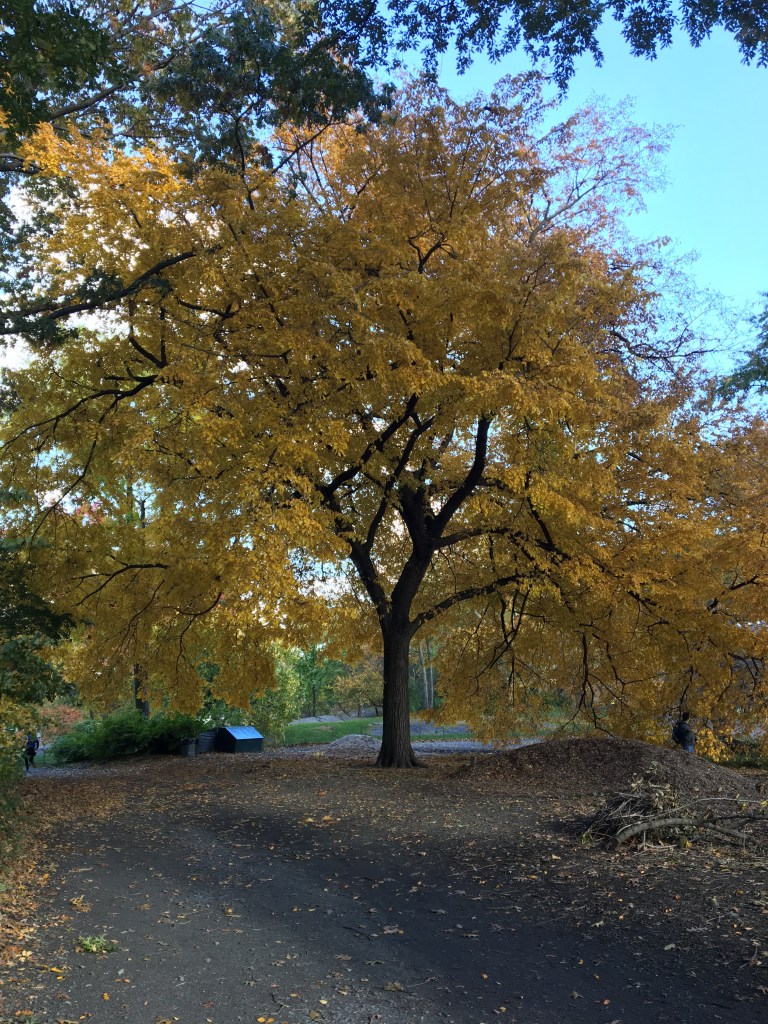
Almost every day, I walk in Central Park.  There are certain trees there I’ve come to know: the gnarled cherry trees by the reservoir, the bending willows and tall bald cypress by the pond, the sycamores that drop their bark each summer, the hawthorn not far from Central Park West.  Lately I’ve been taking photos of the trees to try to capture their essence, their posture in the world.  The trees around me feel like friends, which is what an ancient midrash (interpretation/legend) called Genesis Rabbah says about trees: that they are friends to humankind.  To me, they’ve always been a central manifestation of Mother Earth.

Currently, the national parks in the United States have no staff because of the government shutdown. Some people have taken the opportunity to cut down the rare and endangered Joshua trees in the Joshua Tree National Park—just for fun, I guess, or as a trophy of some kind.  Meanwhile, President Bolsonaro of Brazil recently has indicted that he wants to remove protection for the rainforest, in order to allow development.  It appears that my friends the trees have enemies.  Sometimes the enmity is for personal/corporate gain, and sometimes the enmity seems to have no reason at all.

Continue reading “From the Archives: Tree of Life: The Festival of the Trees in an Age of Treefall by Jill Hammer”

Legacy of Carol P. Christ: Green Solutions To The Greek Economic Crisis: We Are The 99%!

This post was originally published on May 28th, 2012

A green solution to the economic crisis insists that people and the environment can be saved together. We must dare to envision prosperity in conjunction with sustainability, social justice, nonviolence, and participatory democracy.

A rational analysis would make it clear that the Greek people did not “create” the economic crisis. Yet the poor and middle classes are being asked to “pay” for it. There is massive corruption in the public sector in Greece. But this should not blind us to the fact that the Greek people do not bear the major responsibility for creating the crisis. Those responsible include:

Legacy of Carol P. Christ: Is the Prophetic Vision of Social and Ecojustice the Fruit of the Poisonous Tree?

This post was originally published on Aug. 26th, 2011

Carol P. Christ earned her BA from Stanford University and her Ph.D. from Yale University.  She is a founding mother in the study of women and religion, feminist theology, women’s spirituality, and the Goddess movement and work has revolutionized the field of feminism and religion.  She has been active in anti-racist, anti-war, feminist, and anti-nuclear causes for many years.  Since 2001 she has been working with Friends of Green Lesbos to save the wetlands of her home island.  She drafted a massive complaint to the European Commission charging failure to protect Natura wetlands in Lesbos.  In 2010 she ran for office in Lesbos and helped to elect the first Green Party representative to the Regional Council of the North Aegean.  She helped to organize Lesbos Go Green, which is working on recycling in Lesbos.

My hope for the new blog on Feminism and Religion is that it can become a place for real discussion with mutual respect of feminist issues in religion and spirituality.

I agree with Rosemary Radford Ruether who argued in a recent blog “The Biblical Vision of Ecojustice” that the prophets viewed the covenant with Israel and Judah as inclusive of nature. Indeed in my senior thesis at Stanford University on “Nature Imagery in Hosea and Second Isaiah,” in which I worked with the Hebrew texts, I argued that too. I also agree that the dualism Rosemary has so accurately diagnosed as one of the main sources of sexism and other forms of domination comes from the Greeks not the Hebrews. I agree that Carolyn Merchant is right that nature was viewed as a living being in Christian thought up until the modern scientific revolution. I agree with Rosemary that it is a good thing for Christians to use sources within tradition to create an ecojustice ethic. I am happy that there are Christians like Rosemary who are working to transform Christianity.  Finally, I am pleased to admit that I have learned a great deal from her.

Continue reading “Legacy of Carol P. Christ: Is the Prophetic Vision of Social and Ecojustice the Fruit of the Poisonous Tree?”

Legacy of Carol P. Christ: Why Should We Care About Birds?

This was originally posted on Feb. 6, 2012 with updates added later.

I believe that we should we care about birds because it is right to do so.  If we do not, we will contribute to extinction of species, and we will leave a diminished world to those who come after us. We must not give up hope that we can save the world for birds, for other wildlife, and for our children’s children.

On February 2, 2012, the International Day for Wetlands, the Greek government signed into law a Presidental Directive mandating protection of the small wetlands of the Greek islands.  There is no assurance that this law will be enforced.  There are still no measures in effect to protect most of the larger wetlands in Greece, even though this is required by the European law Natura 2000, which requires all of the countries in the European Union to protect bird and wildlife habitats.

When I became a birdwatcher, I could not have told you what a wetland is.  Now I know that wetlands are fragile bodies of water shallow enough for wading birds from flamingoes to sandpipers to stand in “without getting their bottoms wet” while feeding on shrimp, small fish, frogs, and other watery treats.  Wetlands often take the form of pools near the sea, but they also include the deltas at river mouths and seasonally flooded fields.  In the twentieth century and today many wetlands were designated “swamps” and drained.

Continue reading “Legacy of Carol P. Christ: Why Should We Care About Birds?”

From the Archives: Earth-Spirituality in the Qur’an and Green Muslims by Elisabeth S.

This was originally posted on March 14, 2017

There is some very helpful guidance in the Qur’an for how we should and should not treat the earth. In my exploration of Qur’anic verses on the environment, I have found a great deal of Earth-love that I want to share.

The first idea is that the earth is not ours to trash and misuse recklessly or indulgently. Sura 2:284 says, “Whatever is in the heavens and in the earth belongs to God.” This sentiment is found throughout the scriptures. Individual wealth and the practice of financial profit and salary as reward has given us the illusion that, if we’ve earned the cash, we can do with it whatever we like. We can buy anything we want, show it off, hoard it, and then trash it. How often do we quell our suffering or attachments through consumerism as if there were no consequences? But we need to begin to shift to the perspective of honoring the earth as not something we are entitled to or even deserve. If we are supposed to be stewards of the earth, then fine. But it seems that selfishness and personal gain have distracted us, making us neglect our duty. The idea that the earth is a bestowed gift is embedded into the Qur’anic “golden rule”: “You who believe, give charitably from the good things you have acquired and that We have produced for you from the earth. Do not seek to give bad things that you yourself would only accept with your eyes closed” (2:267). Yes, we work the land to produce food, but not everything is within our jurisdiction.

Continue reading “From the Archives: Earth-Spirituality in the Qur’an and Green Muslims by Elisabeth S.”

Legacy of Carol P. Christ: WANGARI MUTA MAATHAI AND SACRED MOUNT KENYA

This was originally posted on September 23, 2013

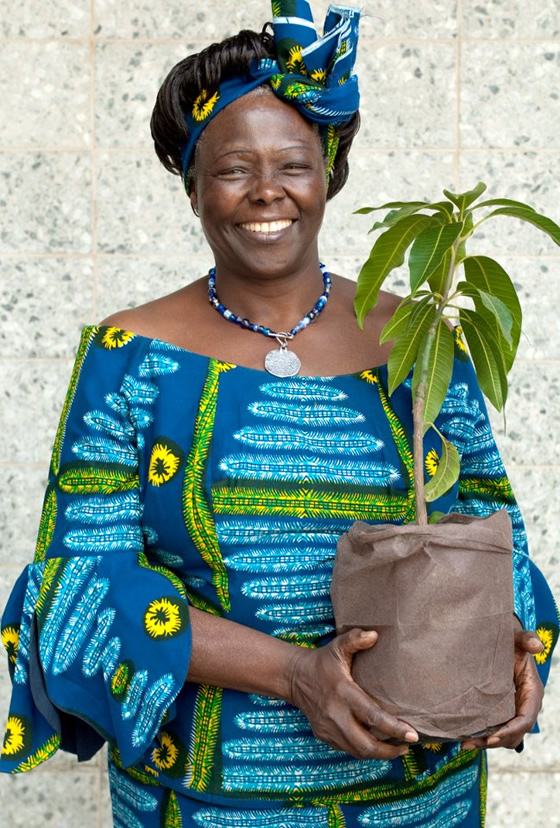
September 25, 2013 is the second anniversary of the death of environmental, peace, justice, and democracy advocate and Nobel Peace Prize recipient Wangari Muta Maathai.

Wangari Muta was born in 1940 in a round hut in rural tribal Kenya.  Wangari’s tribe considered the fig tree to be holy, and she was taught that one is never to cut a fig tree down or to use its branches for firewood.  Wangari spent many happy childhood hours in the shade of a fig tree that grew by a nearby stream.  Fig trees play an important role in the ecological system of the Rift Valley of Kenya.  Their roots penetrate the hard rock surface of the mountains to find underground water, thus opening channels where the water flows upward to fill streams and rivers.

Continue reading “Legacy of Carol P. Christ: WANGARI MUTA MAATHAI AND SACRED MOUNT KENYA”

Common Ground: Part Two:  On Enclosure, the Commons, and Awe by Beth Bartlett

Can we rise to ourselves and see what is in the nature of the soul to see – that we exist on this common ground together?” – Susan Griffin

The ideology, discussed in Part One, that land that is not being cultivated, mined, lumbered, or otherwise used to create goods and capital is ‘waste” continues its devastating effects to this day in mountaintop removal, destruction of old growth forests, fracking and drilling and mining of once pristine lands, plowing the plains into dust and spreading herbicides and pesticides over the land. Devastate – from the Latin devastare, meaning to “lay waste, ravage, make desolate.” Devastate – to de-vast – is to destroy the vastness. And so has the vastness of lands around the world been plundered, laid waste, so as not to “waste” it.

Continue reading “Common Ground: Part Two:  On Enclosure, the Commons, and Awe by Beth Bartlett”

Common Ground: Part One:  On Enclosure, the Commons, and Awe by Beth Bartlett

I spent the first half of my academic career studying and teaching the history of Western political philosophy – the works of Plato, Aristotle, Augustine, Aquinas, Hobbes, Locke, and Rousseau to name a few.  It gave me the best possible grounding in understanding the foundations of patriarchy.  In more recent years, I have used these works to explain the Western paradigm of thought to my ecofeminism students so they could better understand how women, colonized others, and the earth have been defined and dominated based on these assumptions.

Continue reading “Common Ground: Part One:  On Enclosure, the Commons, and Awe by Beth Bartlett”

From the Archives: Who Owns the Sacred? A Personal Search beyond (European) Indigenous Knowledge by Eline Kieft

This was originally posted on Jan 17, 2020

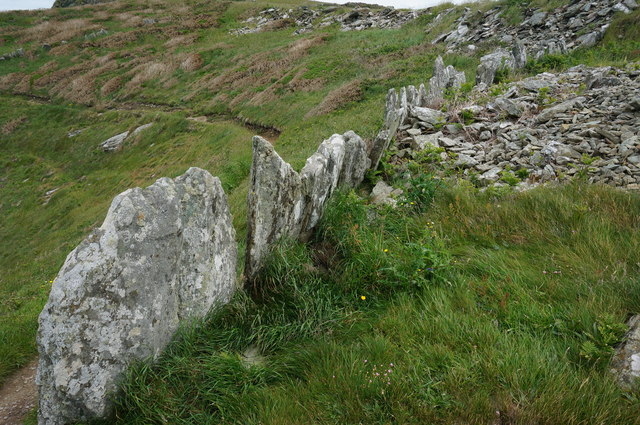
For almost 35 years nature has been my sacred place. As an 8-year old, I started to pray to Mother Earth even though the protestant tradition in which I grew up only recognised ‘God the Father’. I went outside in my inflatable rowing boat to seek solitude (as an only child in a quiet family!) on a small island in the lake of our local park. I practised rowing and walking quietly to not break the sacred silence. I collected herbs to brew infusions in my little thermos flask with boiled water brought from home. I sung to the moon, and danced my love for all creation back through my moving body. Over the last 15 or so years, I spent many days and nights at Neolithic monuments, dreaming in ancestral burial mounds, time traveling in stone circles in Cornwall, Wales, Scotland, England, Ireland and Brittany. This nature-based practice evolved naturally, and later incorporated my training with the Scandinavian Centre for Shamanic Studies and the School of Movement Medicine. Nature is where I reconnect most easily with the Sacred, and listen to the whispers on the great web of life in which all of nature is a great teacher. Nature, for me, is a strong place of prayer, solace, awe, reverence, gratitude, joy, guidance, reconnection, healing and transformation. 

Continue reading “From the Archives: Who Owns the Sacred? A Personal Search beyond (European) Indigenous Knowledge by Eline Kieft”

From the Archives: A Feminist Retelling of Noah’s Ark

This was originally posted on May 4, 2018

My daughters came to me after Sunday School one day, concerned about a story they had heard in which God drowned almost everyone on Earth. So I sat down and thought about why a community might want to tell that story, and what valuable wisdom might be lifted from it for my children. Here is what I told them:

God/ess  has  many  faces,  which  help  us  understand  different  things we  need  to  know  at different  times. Sometimes we think of God/ess as Crone, an old, old  woman  crowned with silver hair as  an  emblem of her wisdom, who helps us  learn to let go of anything that is holding back the wellness of our community and ourselves. 

Continue reading “From the Archives: A Feminist Retelling of Noah’s Ark”