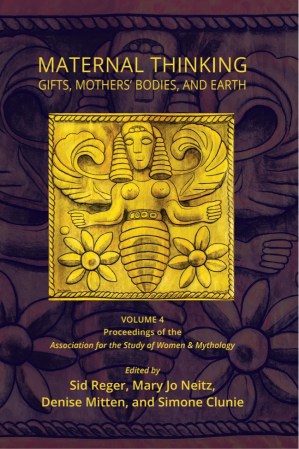
Maternal Thinking: Gifts, Mothers’ Bodies, and Earth edited by Sid Reger, Mary Jo Neitz, Denise Mitten, and Simone Clunie; book review by Carolyn Lee Boyd

Cover designed by Rebekkah Dreskin ~ http://www.blameitonrebekkah.com Front cover art “Bee Goddess of Rhodes Banner” by Lydia Ruyle. Bee goddess logo by Sid Reger

Maternal Thinking: Gifts, Mothers’ Bodies, and Earth, the fourth book of proceedings of conferences held by the Association for the Study of Women and Mythology (ASWM), is an instructional guide to saving ourselves and our planet. Many pre-historic, and even contemporary cultures, especially Indigenous communities, feature “Maternal Thinking.” Such cultures perceive that societies are successful when they center qualities associated with mothering: care, nurturance, cooperation, and meeting everyone’s basic needs while respecting the Earth and reciprocating nature’s generosity. Some 5000 years ago, Maternal Thinking was superseded in many societies by a perspective valuing instead competition, exploitation, and domination, and we and our planet are now facing the catastrophic consequences.

The fifteen contributors and four editors represent myriad disciplines and life experiences. They are academic researchers in wide-ranging fields, artists, activists, a storyteller, a therapist, scientists, educators, and more. This diversity reflects the expansiveness of the book’s vision, including many layers and facets of “mothering,” and the need for as many voices as possible to be heeded if we are to envision and birth a peaceful, just, equitable, compassionate, and environmentally balanced Earth.

Continue reading “Maternal Thinking: Gifts, Mothers’ Bodies, and Earth edited by Sid Reger, Mary Jo Neitz, Denise Mitten, and Simone Clunie; book review by Carolyn Lee Boyd”

Legacy of Carol P. Christ: The Ninth Touchstone: Repair the Web

This was originally posted on September 3, 2018

As I reflected on the Nine Touchstones again recently, I was pleased to discover that the first and the eighth touchstones are articulations of the central values of egalitarian matriarchal societies. Few of us live today in egalitarian matriarchies, and it would not be possible for all of us to return to cultivating the land. I offer the Nine Touchstones in the hope that they can help us to find a way to express and embody the values of egalitarian matriarchal cultures in the modern world. The touchstones are intended to inform all our relationships, personal, communal, social, and political.

Continue reading “Legacy of Carol P. Christ: The Ninth Touchstone: Repair the Web”

Legacy of Carol P. Christ: Maternal Gift Economy: Webinar Gifts

This was originally posted December 7, 2020

In the 1960s and 1970s, American-born Genevieve Vaughan was living in Rome with her husband, philosopher Ferruccio Rossi-Landi, and their three daughters. When Rossi-Landi, using Marxist models, began to write about language as a form of “exchange,” Vaughan was inspired to articulate her alternative theory based on the idea that language was developed and is learned through the gifts of the mother to the child. From that beginning, Vaughn developed an alternative theory of culture based on what she calls the “gift economy.”

Continue reading “Legacy of Carol P. Christ: Maternal Gift Economy: Webinar Gifts”

Legacy of Carol P. Christ: Practice Great Generosity

This was originally posted on August 20, 2018

Nurture life.

Walk in love and beauty.

Trust the knowledge that comes through the body.

Speak the truth about conflict, pain, and suffering.

Take only what you need.

Think about the consequences of your actions for seven generations.

Approach the taking of life with great restraint.

Practice great generosity.

Repair the web

In Rebirth of the Goddess, I offered Nine Touchstones of Goddess Spirituality as an alternative to the Ten Commandments. The Nine Touchstones are intended to inform all our relationships, whether personal, communal, social, or political.

The eighth touchstone asks us to practice great generosity.

Continue reading “Legacy of Carol P. Christ: Practice Great Generosity”

Transforming the Streets of Past into the Cities of the Future, Part II by Carolyn Lee Boyd

You can read yesterday’s part 1 here.

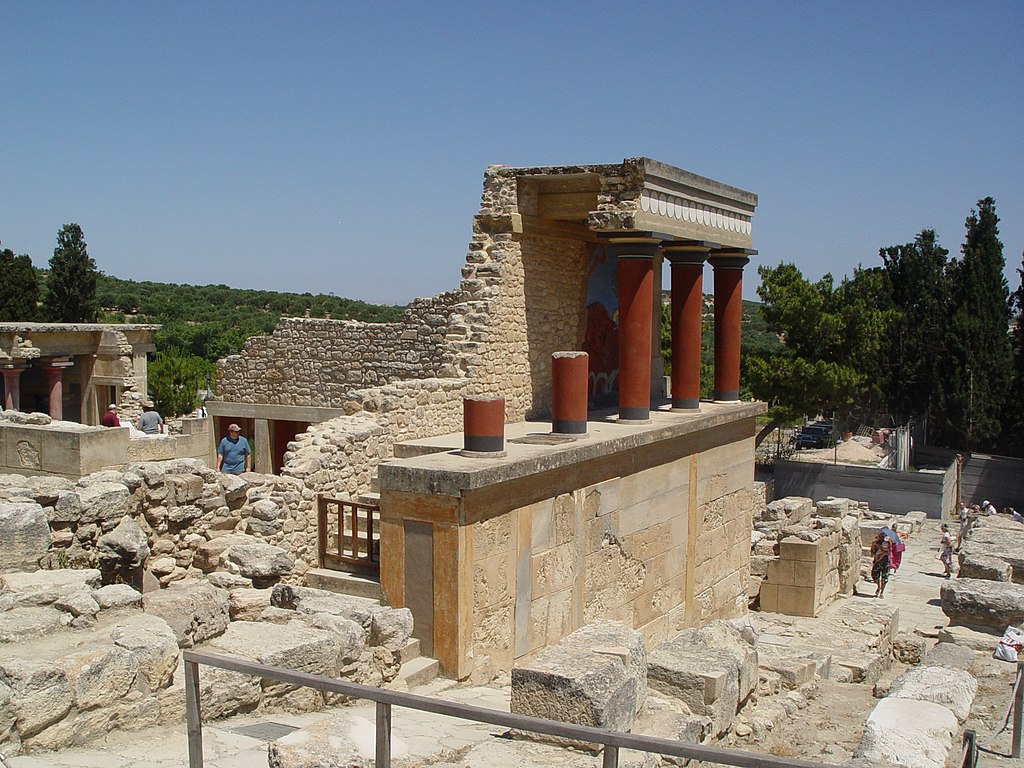
Knossos in Crete

Modern architects and urban planners have recently been designing buildings and urban spaces promoting values reminiscent of Old Europe and other societies with similar values. These societies are often referred to as “matriarchal.” However, there is ongoing discussion among scholars about what to call them. For this post, we will use Heide Goettner-Abendroth’s lovely term “societies of peace.” To read more about these societies, modern desires to live in communities similar to these societies, and modern efforts to promote social interaction and beauty, please click here to read Part 1. 

Connecting to Nature

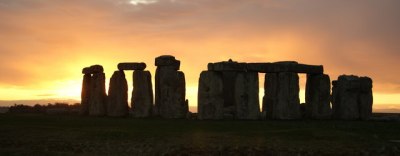
Stonehenge, Great Britain

Old Europe and other similar societies of peace frequently included well-used outdoor spaces, connecting residents to nature as they went about their daily life. Residents did weaving, baking, and other tasks in open courtyards. Public rituals were held in plazas and courtyards. Celts and those who lived in Britain before them held their religious ceremonies in groves of trees or in open spaces with standing stones or other monuments. Public art, such as frescoes in Crete, featuring plants and animals also indicates the value these societies gave to nature.

Continue reading “Transforming the Streets of Past into the Cities of the Future, Part II by Carolyn Lee Boyd”

Transforming the Streets of Past into the Cities of the Future, Part I by Carolyn Lee Boyd

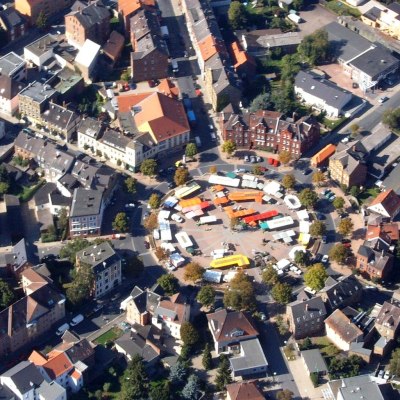
Modern Mixed Use Development with Buildings Facing Each Other in a Circle

Is a peaceful, just, creative, sustainable world a far-off, unattainable dream or might there be ways to begin to build such communities right in our own neighborhoods?

Archeologists and scholars like Marija Gimbutas, Heide Goettner-Abendroth, and Carol Christ have studied societies from Old Europe and elsewhere that share some common characteristics. (These societies are often referred to as “matriarchal.” However, there is ongoing discussion among scholars about how to name these societies. For these posts, I’ll use Heide Goettner-Abendroth’s beautiful term societies of peace). These qualities include prioritizing caring social relationships, art and beauty, ecological responsibility, equality, commitment to consensus decision-making, and more. Researchers often cite how buildings, city and town layout, and outdoor spaces of these societies of peace reflect these values by featuring similarly-sized residences, beautiful frescoes depicting women and men in peaceful pursuits, a lack of warlike structures, and plazas and courtyards for social, civic, and religious events, among other attributes.

Continue reading “Transforming the Streets of Past into the Cities of the Future, Part I by Carolyn Lee Boyd”

The Tree of Equality in the Forest of Harmony by Carolyn Lee Boyd

For millennia, people have struggled for gender and many other kinds of equality, with progress achingly slow and sometimes regressing. Egalitarian societies have existed and do exist, such as those described by Marija Gimbutas and Heide Goettner-Abendroth and others. So why does a 21st century egalitarian world seem so far away? Sometimes looking at challenges from a fresh perspective can be illuminating as well as inspiring for the long journey ahead. So, what if we envision equality as a tree, those wondrous beings that make life on earth possible and symbolize our world in so many cultures?  What are the roots, the source truths which lead to all forms of equality and, if embraced by everyone, would make equality an assumed fact of life?  What is the trunk where the roots manifest as positive supports for equality work?  What are the branches, our acts reaching up towards our greatest aspirations for a truly equal society?

Queen of the forest

Let’s start with the roots, the basic statement from which all forms of equality grow. To me it is “All participate in the essential life force of the universe and are therefore inherently, completely, and infinitely valuable.” “Essential life force of the universal” may or may not refer to a deity, depending on individual beliefs, but  it does have a spiritual element in that it relates our individual existence to that universal essence which gave us life, connects us to all other beings, and is beyond any personal characteristics. You may have a different root statement but I think that any root statement is more powerful with a spiritual element.

Continue reading “The Tree of Equality in the Forest of Harmony by Carolyn Lee Boyd”

What If We Begin from the Hypothesis that Ancient Crete Was Matriarchal, Matrifocal, and Matrilineal? by Carol P. Christ

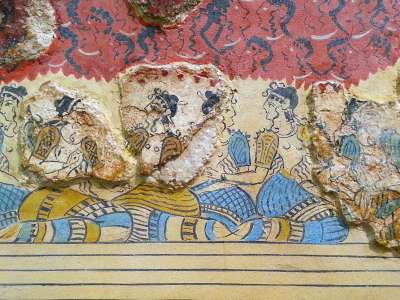
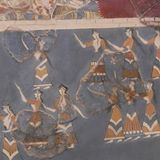
If we begin from the hypothesis ancient Crete was matriarchal, matrifocal, and matrilineal, what would we expect to be the central focus of the its religion?* Harriet Boyd Hawes and her colleague Blanche E. Williams presented an incipiently feminist, woman-centered, analysis of the religion of ancient Crete in Gournia, the book describing their excavation of a Minoan village at the beginning of the twentieth century. Boyd Hawes argued that the archaeological evidence showed not only the pre-eminence of the Goddess, a conclusion with which Williams agreed, but also the strength and independence of women in a culture she defined as matriarchal and matrilineal, centered around the Mother family. If ancient Crete was matrilineal, matrifocal, and matriarchal, we should expect to find evidence that women were not only strong and independent, but also that they had leadership roles in religion and culture. Williams noted the presence of priestesses. The miniature frescoes from Knossos show a group of older women sitting in the place of honor and a group of women performing a ritual dance. Where evidence concerning leadership roles is lacking, it should not be assumed that leadership must have been in the hands of men.
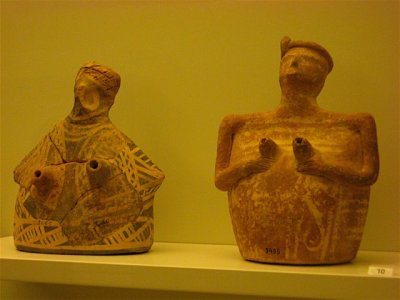
We should not be surprised to find the Goddess or mother earth to be at the center of rituals and ceremonies in ancient Crete. However, to say that the Goddess is central begs the question of what we mean when we say Goddess. In the west, deity is understood to be transcendent of the world, imaged as a dominant male other, and as the judge of the living and the dead. Citing the Oxford English Dictionary, archaeologist Colin Renfrew bases his discussion of Minoan religion on the idea of divine transcendence. But if we accept Marija Gimbutas’ insight that the Goddess represents the powers of birth, death, and regeneration in all forms of life, a different picture emerges. The Goddess is immanent in, rather than transcendent of the world. She is the enlivening force in human beings and all of nature. She is not the judge of the living and the dead, for the dead are returned to her body. Unlike later Greek deities, the Goddesses of Old Europe and ancient Crete are not generally portrayed as idealized human beings. Though they often have eyes, breasts, and sacred triangles, they also have beaks and wings, are shaped like mountains, and decorated with flowing lines symbolizing rivers or streams. These hybrid forms suggest that all of life is in the image of divinity and that humans are not higher, better, or separate from other life forms. Hybrid images celebrate the connection of all beings in the web of life and call human beings to participate in and enjoy this world, not to seek to escape or rise above it. A religion centered around gratitude for life in this world is very different from one that centers around fear and judgment and a longing for life after death. Jacquetta Hawkes’ insight that the religion of ancient Crete celebrated “the grace of life” is exactly right.
Is the Old European or Minoan Goddess one or many? Monotheists have insisted that there can be only one God, yet polytheists revere a plurality of images, while animists celebrate the spirits of (perceived) living beings such as rivers and trees, mountains and caves. The terms monotheism and polytheism are not neutral. Both were developed by monotheists: monotheism describes the correct beliefs of the self; polytheism, the false beliefs of the other. I find theologian and liturgist Marcia Falk’s distinction between exclusive and inclusive monotheism helpful in resolving the question of the one and the many. According to Falk, inclusive monotheism is an intuition of the unity of being within the diversity of the world: celebrating the unity of being, it welcomes a plurality of images to represent diversity and difference in the world. From this point of view, the boundaries between monotheism and polytheism are porous. When Gimbutas spoke of the powers of birth, death, and regeneration in all of life, she was referring to the unity of being underlying the diversity of life forms, including plants, animals, and human beings. Similarly, when indigenous peoples speak of mother earth as the giver of all and all beings as relatives, they recognize that all life is sustained by a single source. The fact that ancient Cretans imaged divinity in different ways and with different characteristics does not require the conclusion that they worshipped many discrete deities as some archaeologists argue: I suggest that they intuited a unity of being while celebrating the diversity of life. This appears to have been the conclusion of Williams who wrote of “the prominence of a goddess under various aspects.”

If matrilineal, matrifocal, and matriarchal cultures tend to view the earth as a great and giving mother, we can expect this insight to be expressed in rituals and ceremonies. Gratitude is the appropriate response to gifts freely given. I suggest that gratitude for the gift and gifts of life was not only a focus, but the central focus, of religion in ancient Crete. If this is so, we should expect to find rituals celebrating the gift of life in the birth of babies, the coming-of-age of girls, as well as in as well as in death rituals honoring the ancestors. We can also expect to find rituals honoring the mother line and expressing gratitude for the wisdom of ancestors. Many of these rituals would have taken place in the matrilineal House as archaeologist Jan Driessen suggests. Rituals for the ancestors might also have taken place in cemeteries. We should also expect to find rituals expressing gratitude for the food that sustains life, for example, in offerings of first fruits to mother earth and in the pouring of libations that are absorbed back into her body. If, women invented agriculture, and if as Gimbutas argued, Old European religion celebrated the processes of birth, death, and regeneration in all of life, we should find rituals focused on planting, harvesting, and storing seeds. Some of these rituals might have taken place in the matrilineal Houses, while others surely took place in nature and in the fields. If pottery-making and weaving were understood to be mysteries of transformation involving birth, death, and regeneration, we might find evidence of rituals associated with these activities in the Houses or in workshops. It is known that rites in ancient Crete involved trees, mountains, and caves, as well as water sources. We must ask if and how such ceremonies expressed gratitude to the mother earth, the source of life, and the cycles of birth, death, and regeneration.

*These musings are part of an early draft of the methodological prologue to an essay I have been asked to write on Religion in a Minoan Village to be published in the archaeological report on recent excavations at Gournia. In the preceding part of the prologue, I discuss the theories about matriarchal, matrifocal, and matrilineal cultures of Harriet Boyd Hawes, Blanche E. Williams, Marija Gimbutas, Heide Goettner-Abendroth, and others.

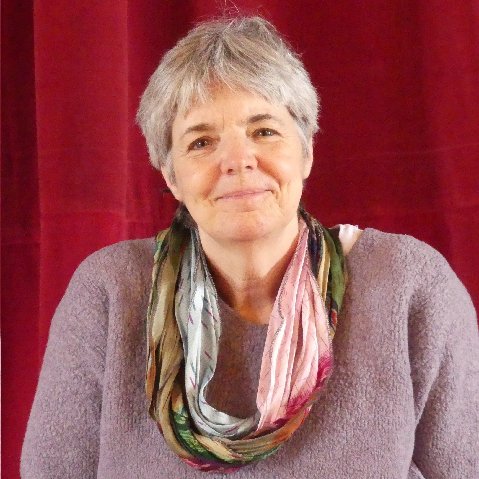
Carol P. Christ is an internationally known feminist and ecofeminist writer, activist, and educator who lives in Heraklion, Crete. Carol’s recent book is Goddess and God in the World: Conversations in Embodied Theology. Carol has been leading Goddess Pilgrimage to Crete for over twenty years: join her in Crete. Carol’s photo by Michael Honneger.

Listen to Carol’s a-mazing interview with Mary Hynes on CBC’s Tapestry recorded in conjunction with her keynote address to the Parliament of World’s Religions.

Maternal Gift Economy: Webinar Gifts by Carol P. Christ

In the 1960s and 1970s, American-born Genevieve Vaughan was living in Rome with her husband, philosopher Ferruccio Rossi-Landi, and their three daughters. When Rossi-Landi, using Marxist models, began to write about language as a form of “exchange,” Vaughan was inspired to articulate her alternative theory based on the idea that language was developed and is learned through the gifts of the mother to the child. From that beginning, Vaughn developed an alternative theory of culture based on what she calls the “gift economy.”

We are born into a Gift Economy practiced by those who mother us, enabling us to survive. The economy of exchange, quid pro quo, separates us from each other and makes us adversarial, while gift giving and receiving creates mutuality and trust.

According to Vaughan, the “exchange economy” is based in the gift economy, while at the same time it denies the gifts it has received from mothers and mothering figures and disparages mothers and their work. Mothers rear children who enter into the exchange economy, but these children would not be alive to enter the exchange economy unless they had first been nurtured by the freely given gifts of mother. Vaughan writes that prior to patriarchy, cultures and societies valued the gifts of mothers and were organized around the principle of gift-giving. Vaughan states that gift-giving economies are based in the idea of meeting the needs of others, while exchange economies are focused on the enrichment of the individual self. She believes that re-valuing and re-instating the gift economy is the only path to creating and restoring peace and justice in the world. Continue reading “Maternal Gift Economy: Webinar Gifts by Carol P. Christ”

Wisdom from our Ancient Female Lawgiver and Judge Traditions by Carolyn Lee Boyd

Carolyn Lee Boyd


As I have witnessed both the joy of so many across the world at the nomination of Kamala Harris for Vice President and the deep sorrow at the death of Ruth Bader Ginsburg, I am struck by the fact that, in 2020, supremely qualified women still need to be trailblazers to hold high office. After all, goddesses and wise women gave a number of cultures their systems of laws and governance and have been celebrated for their wisdom as judges for millennia. 

Here are a few of the goddesses and wise women lawgivers:

The Goddess Themis
  • the Italian goddess Egeria gave Rome its first laws and taught the correct rules for Earth worship; 
  • the Babylonian Kadi, was goddess of Earth and justice; 
  • Ala of the Ibo people of Nigeria is both the Earth Mother and lawgiver of society; 
  • the Greek Themis, daughter of Gaia, symbolized the social contract and cohesion of people living on Earth; 
  • the Inuit Sedna both gave humanity abundance from the ocean for life from her own body and withheld it when her laws were broken;
  • Marcia Proba, whose historical reality is unclear, is said to have created the ancient Celtic system of laws known as the Marcian Statutes that may have influenced later British law;
  • past and present Women’s Councils and Clan Mothers of the Iroquois and other Indigenous peoples as well as those of Societies of Peace have brought harmony and well being to their people for tens of thousands of years.

Continue reading “Wisdom from our Ancient Female Lawgiver and Judge Traditions by Carolyn Lee Boyd”