Seeding Up by Sara Wright

Every spring it’s the same… the hunger to begin starting seeds. As a woman and an eco -feminist I am convinced that this need to work with seeds and soil is an ancient pattern that stretches back to our egalitarian matriarchal beginnings.

Some of us like me come from a family of gardeners so there is something to say about the influence of our ancestors directing this process on a personal level. Both patterning and ancestral influences seem to work together. Another “both and”.

After I broke my foot last year I was forced to cease gardening altogether out of necessity because I could no longer use a shovel. If I am really honest I can say I was more than ready to let go. I have grown both vegetables and flowers since I was a child, then while raising a family. At mid – life when I moved to the mountains I made (what seems today) a radical decision. I decided to plant trees, plants and flowers primarily for non – humans in a small area around my house. Nature determined what grew and thrived on the rest of my land. Today people call this re-wilding but then my intention was simple. I wanted to give back to nature what S/he had given to me. I wanted nature to be the receiver.

Continue reading “Seeding Up by Sara Wright”
Seeds of Hope: Part Two by Beth Bartlett

You can read part 1 here.

The patenting of seeds[i] has made the thousands-year-old practice of seed saving illegal, as is the sharing of seeds from farmer to farmer. The most notorious case is that of Canadian farmer Percy Schmeiser, whose canola crops were contaminated with Roundup Ready canola pollen blown into his fields from neighboring corporate farms. When Monsanto trespassed onto his fields, took samples, and found Roundup Ready canola plants mixed in with Schmeiser’s own canola plants, they sued him for violation of patents. Ultimately, the Canadian Supreme Court ruled in favor of Monsanto, but also ruled that Schmeiser owed Monsanto nothing.

In my own city, seed sharing became an issue when in 2013 our local library decided to start a seed library. The project was begun with great hopes that patrons could check out seeds for their home gardens, with the understanding that they would save a portion of their seeds and return these to the library for next year’s use. [ii] Project leaders hoped this would preserve locally adapted seed varieties. Unfortunately, after the seed library came to the public’s attention, the Minnesota Department of Agriculture informed the library that they were in violation of a Minnesota statute that prohibited the exchange of non-commercial seeds. [iii] Library Manager Carla Powers commented, “ . . . the law went so far as to make it illegal for gardeners to exchange a handful of seeds with one another.”[iv] But this did not end the library’s efforts.  Several ally organizations[v] stepped up to create an amendment to the statute that exempted the exchange of non-commercial seeds from testing, labeling and licensing laws. This inspired a state-wide effort to change the law, which was successfully accomplished in that year’s legislative session.[vi]

Continue reading “Seeds of Hope: Part Two by Beth Bartlett”

Seeds of Hope: Part One by Beth Bartlett

Author’s Note: This piece was inspired by Janet Maika’i Rudolph’s wonderful FAR post of December 15th, 2022, “Ode to Seeds.”

“. . . I know, yes, there is renewal, /because this is what the seeds ask of us/ with their own songs/ when we listen to their small bundle of creation,/ of a future rising from the ground . . .” – Linda Hogan

The first seed catalogs started arriving in the mail even before the turn of the new year.  In an annual ritual of hope, in the depths of winter we turn our thoughts and dreams to growing things – seeds of heirloom tomatoes, cucumbers, squash, carrots, and beans that will feed us and grace our tables in the summer and fall, and colorful marigolds, nasturtiums, and zinnias that will delight all summer long with their beauty. Is this the invincible summer of which Camus wrote?[i] 

Continue reading “Seeds of Hope: Part One by Beth Bartlett”

Feeding the Birds….Refuge, Part 1 by Sara Wright

It’s another gray snowy day with large white flakes falling from the sky… January lasts “forever” every single year. I feed chickadees on my window ledge until the squirrels show up; then I scatter seed on the ground. Chickadees begin their day just before 7 AM when it is still dark, coming to the ledge. Today the turkeys are absent, fluffed up monks still hidden under hemlock boughs. The blood male cardinal appears with his usual message. I peer into the forest as the turkeys make their way across the brook and start up the hill while gazing at sage green shield lichens and two pure white birches that stand out like sentries, peeling white skin. Some maples and many hemlocks border the brook that is running clear of ice. A multitude of twigs and evergreen spires sway, branches twist and bend filling every inch of space, a comforting sight, even though all the deciduous trees are bare. Global warming turns snow to rain and back again in every storm creating ice bound paths, easily traversed by my little dogs. Dangerous for me. Often now I am housebound.

This gray world of mine needs animation from within…

Continue reading “Feeding the Birds….Refuge, Part 1 by Sara Wright”

Answering a Call by Sara Wright

“Shamans bridge the night flow…” the first lines from a poem I wrote long ago keep coming into my mind. Frustrated because I can no longer access the poem, I accept that the first line is what I need… ‘bridging the night flow’ of intrusive negative feelings/actions on the part of others (as well as myself) is precisely the edge I am on. Even smoke – filled rooms remind me that I need personal protection.

 An Indigenous healer and impeccable scientist and naturalist friend of mine reminds me of what I know, spiritual forces are moving. When I told him of my dream his response was to focus on protection, create the intention, and let it go… I tried to do this in my mind with limited success but apparently our discussion around this subject opened a door for me or we both did as I remembered how important it is for me to ground my intentions in something concrete. How had I forgotten?

Continue reading “Answering a Call by Sara Wright”

When Betrayal Makes Sense by Sara Wright

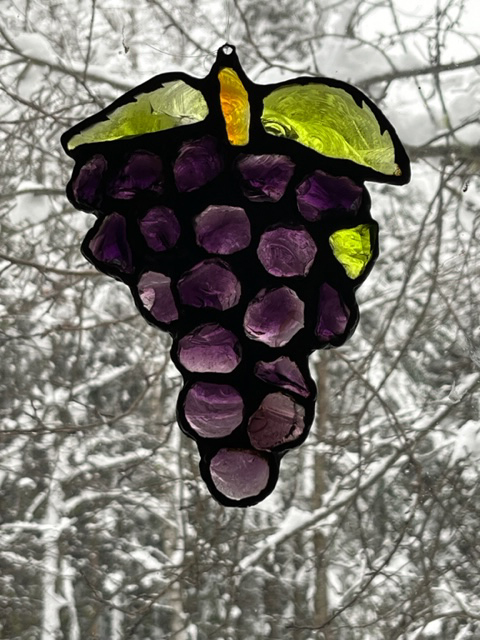
 When I was a young woman, a divorced mother of two, working as a waitress I became obsessed by a window hanging in a local store. This cluster of grapes was fashioned out of thick, uneven hunks of stained glass that the artist had retrieved from bombed cathedrals in Europe. The grapes shimmered – ecclesiastical purple with limed green leaves. Although I could hardly afford to, I paid an outrageous $50.00 for this piece and hung it above my bedroom window. I never regretted the choice. Whenever I looked at the stained glass, I had the strange sense that there was a message hidden there. I ignored it.

After my brother’s death two years later (my youngest son was two) I lost most of myself, but held on to my love for plants tending to them with deep affection and attention.

My first word was ‘fower’ for flower so my relationship with plants stretched back to babyhood. I believed the flowers plants and trees that lived around my grandmother’s house were my close friends.

Continue reading “When Betrayal Makes Sense by Sara Wright”

Saying Goodbye (Refuge), Part 2 by Sara Wright

Part 1 was posted last week. You can read it here.

When I first came to this area 40 years ago I was ‘called’ to land about 15 minutes from here. That first summer I was out in the field picking blueberries when the field rose up around me and held me like a mother. For the first time in my life I felt loved. Shortly afterwards I visited an area that had been brutally logged. I had never seen anything like this and just the scent of weeping pines sickened me. That night I had a dream: the terrifying picture of dying trees and slash and then superimposed over it the image of my beautiful land. When I awakened I thought that the dream was telling me that loving my land was somehow helping the ravaged forest I had seen the day before.

 Soon after this experience frightening tree dreams began… whole forests were being slaughtered all around me. The waters were receding in my brook and destructive uncaring neighbors moved in. Two were already living here.

Continue reading “Saying Goodbye (Refuge), Part 2 by Sara Wright”

Ode to Seeds by Janet Maika’i Rudolph

“In this is all that is.” 

Julian of Norwich (while purportedly holding a seed in her hand) – 14th century

“Even if I knew that the world would end tomorrow,

I would plant an apple tree today.”

Martin Luther

Have you ever had bedbugs or lice? If not, you’re lucky. If so, you understand just how hard they are to get rid of. Why is that? Because they are essentially seeds with legs.

Seeds need to be able to travel in order to be successful spreaders of life. For example, when an acorn falls from an oak tree, it probably can’t germinate right where it falls. The mama tree has already taken up all the earth/soil space as well as the water sources for its own roots. And the mama tree’s own leafy branches will block out access to the sun. So the innate goal of the seed is to move to find a more friendly space. Evolution has created all sorts of ways for seeds to use motion in the service of finding their own place to germinate. In the case of the acorn, there are squirrels. Because they are a food source, many of the acorns get taken to dens under the earth. Many of those are not eaten. Either they are forgotten or the squirrel in question meets another demise. An acorn that is nestled in a den under the earth, can have a potentially perfect environment to sprout far from its origins.

Continue reading “Ode to Seeds by Janet Maika’i Rudolph”

Saying Goodbye (Refuge), Part 1 by Sara Wright

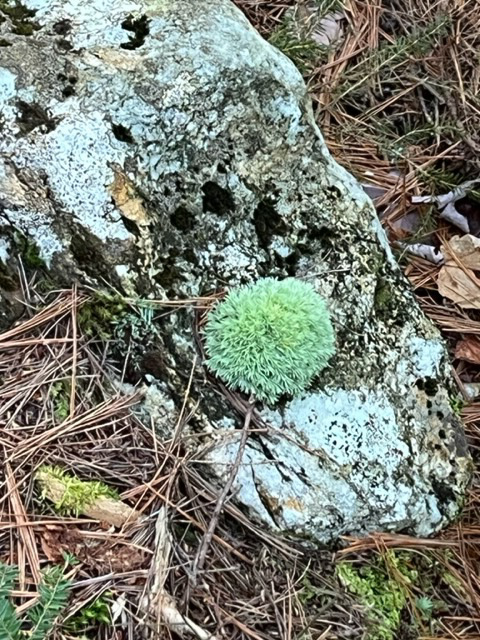
Pincushion Moss

 Leaving chores behind I bundled up and grabbed a trowel and drove between still waters to my beloved forest. The premature snow had melted, cracked ice created fantastic glittering patterns in shallow waters informing me that it was probably too late to dig plants for the frog house. Al, scientist, scholar and naturalist, Owl, my friend had just given me a terrarium, someday to become a frog house… my intention was to gather moss and jagged pieces of lichen covered bark…maybe a partridgeberry or two for both of us. Coming here to Hemlock Hollow seemed like just the right place. I also had come to say goodbye to my friends the Hemlock trees for the winter season…

At first, I scrambled around disappointed that most plants were frozen in including the sphagnum moss. Not wanting to disturb sleeping plants, I lifted pincushion and red stemmed moss that grows quickly and visited an old log ripe with rich soil and rotting sides which came away easily. This decaying wood would make walls for my frogs to cling to as vines crept up the sides. Picking up lichens on old sticks, I also uprooted two tiny hemlocks growing on a log that would thrive in a moist environment. Satisfied, that a little of this forest would spend the winter with me I returned to the car with enough bounty to satisfy both Al and me. I was going to give him and his frogs more than half of what I gathered as a surprise.

Continue reading “Saying Goodbye (Refuge), Part 1 by Sara Wright”

Aging and the Ancestral Dark? by Sara Wright

Unfortunately, an inner darkness has been with me all fall hiding in the corners of my mind and disturbing my body creating headaches and stomach troubles during the day. Although I attempt to protect myself from a culture that I cannot control by not listening to news, watching television, movies or perusing social media I am painfully aware of the fact that politicians on an international level cannot even agree to discuss what to do about climate change – this after 30 years of doing absolutely nothing – creating in me a mindless fury that leaves me in black despair. The time of acting locally and thinking globally is long past. Thinking and doing must occur on a global level. Novelist Richard Powers states the obvious: “People can better imagine the end of the end of the world before the end of Capitalism”. Then we can move to the moon.

I have also been forced to acknowledge how difficult this year has been on a personal level. Aging is affecting my energy level, increasing the severity of depressed states, my sense of inner and outer balance. I am vulnerable and know it although I do my best to begin each day with gratitude as I first peer out at my beloved trees, a little nuthatch or chickadee, gaze at a silver crescent, or celebrate a pale pink dawning.

Continue reading “Aging and the Ancestral Dark? by Sara Wright”