REMEMBERING MERLIN STONE, 1931-2011 by Carol P. Christ

“In the beginning…God was a woman.  Do you remember?”  Feminst foremother and author of these words Merlin Stone died in Feburary last year.

I can still remember reading the hardback copy of When God Was a Woman while lying on the bed in my bedroom overlooking the river in New York City early in 1977.  The fact that I remember this viscerally underscores the impact that When God Was a Woman had on my mind and my body.  Stone’s words had the quality of revelation:  “In the beginning…God was a woman. Do you remember?”  As I type this phrase more than thirty-five  years after first reading it, my body again reacts with chills of recognition of a knowledge that was stolen from me, a knowledge that I remembered in my body, a knowledge that re-membered my body.  My copy of When God was a Woman is copiously underlined in red and blue ink, testimony to many readings.

Though I could then and can now criticize details in the book, the amassing of information and the comprehensive perspective When God Was a Woman provided was news to me when I first read it.  Despite having earned a Ph.D. in Religious Studies from Yale, I did not “know” that Goddesses were worshipped at the very dawn of religion.  I had not heard of the theories of Indo-European invasions of warlike patriarchal peoples into areas already settled by peaceful matrilineal, matrifocal cultures in Europe and India.  I had written my undergraduate thesis on the prophets, studying their words in the original Hebrew, but I did not understand that their constant references to the Hebrew people “whoring” after “idols” and worshipping “on every high hill and under every green tree” referred to the fact that many of the Hebrew people were choosing to worship Goddesses in sacred places in nature.  Nor did I understand that the Genesis story which I had studied and taught took the sacred symbols of Goddess religion– the snake, the tree and the fruit of the tree, the female body—and turned them upside down.  Continue reading “REMEMBERING MERLIN STONE, 1931-2011 by Carol P. Christ”

Bareed Mista3jil: Negotiating Gender, Sexuality, and Religion in Lebanon by Amy Levin

It’s not often (enough) that I (have the time to) come across non-academic books that articulate and reflect some of the most complex intersections between religion, gender, and sexuality. Those that do are commonly produced in the Western hemisphere, often representing the voices of Euro-American cultures and religious traditions. That is why I want to give voice to Bareed Mista3jil, a book, or collection of “41 true (and personal) stories from lesbians, bisexuals, queer and questioning women, and transgender persons from all over Lebanon.” Bareed Mista3jil was published in 2009 by the organization Meem, a community of lesbian, bisexual, queer women and transgender persons (including male-to-female and female-to-male) in addition to women questioning their sexual orientation or gender identity in Lebanon. The purpose of the book is to give voice to those in Lebanon with non-conforming sexualities and identities in order to give hope to this under-represented, often silenced population. Here is a description from Meem on the origin of the book: Continue reading “Bareed Mista3jil: Negotiating Gender, Sexuality, and Religion in Lebanon by Amy Levin”

Feminism and the Emerging Church By Xochitl Alvizo

What is emerging in the emerging church will not be faithful, liberative, or just if it continues to perpetuate the erasure of women’s herstory. 

There has been on ongoing conversation among Christian identified people for about 20-30 years now. It originally started in the U.K. and Australia before making its impact in the U.S.  It has its roots in evangelical Christianity but has since extended more broadly to Christians of all stripes including Catholic ones. This conversation is often referred to as the Emerging Church, the emerging church movement, or, as preferred by many, the Emerging Conversation. Phyllis Tickle has written a book, The Great Emergence, suggesting that this movement represents a much larger historical transformation of Christianity that occurs about every 500 years prompting a kind of house cleaning and rummage sale of the church. Continue reading “Feminism and the Emerging Church By Xochitl Alvizo”

Practice What You Preach by Corinna Guerrero

The underlying principle that links a feminist critique to every other critical lens since the rise of feminist discourse is the “hermeneutic of suspicion.” Essentially,  a hermeneutic of suspicion identifies the disconnect between rhetoric and a lived reality. The lived lives of women are different than the pontifications espoused directly and indirectly by the traditionally patriarchal social, political, cultural, religious, and educational structures in which individuals participate.

I like to think that I live my life bucking these structures whenever possible because the roles a woman plays in her own life should: 1) be determined by her; and 2) if she negotiates more “traditional practices” (e.g. marriage, motherhood, etc.) then these practices do not limit her to traditionalist practices (e.g. staying at home, spousal servitude, etc.). Granted, I used the two most generic examples of traditional and traditionalist practices, but the point is still valid. When I go to holidays with my extended family there are very few questions or comments about my PhD program, but many comments about the fact that I do not make a plate of food  for my husband.   Continue reading “Practice What You Preach by Corinna Guerrero”

Feminism, Impasse, and the Redemption of Hugo Schwyzer by Cynthia Garrity-Bond

In Constance FitzGerald’s article Impasse and Dark Night,* she draws from sixteenth century Spanish mystic and reformer St. John of the Cross-and his Dark Night of the Soul.  FitzGerald moves from the individual’s experience of impasse to a larger societal impasse.  By impasse she means those experiences that bring life as you know it to a stand still, where every attempt of extracting the self from suffering is a lost cause. In what is known as the principles of  “first order change”—reason, logic, analysis, and planning, do not work to move the self forward and out of impasse. In other words, the skill set you have come to rely upon to move you out of the grip of darkness no longer works. Continue reading “Feminism, Impasse, and the Redemption of Hugo Schwyzer by Cynthia Garrity-Bond”

Feminist Theologies: Past, Present, and Future by Gina Messina-Dysert

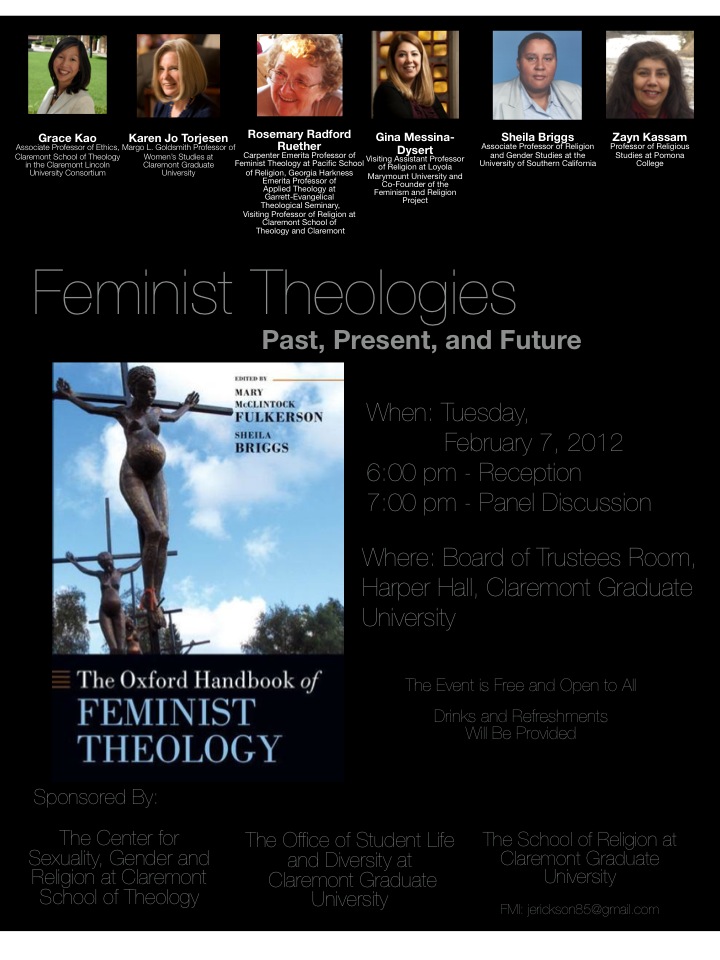
I had the great honor to be a part of the Feminist Theologies: Past, Present, and Future panel on February 7, 2012 to celebrate The Oxford Handbook of Feminist Theology.  I presented with some feminist foremothers who have had a tremendous impact on me and my feminist ideals.  To say it was a wonderful experience would be a complete understatement.

Below is the talk I shared at the conference.  It focuses on my personal experience with feminist theology, the Feminism and Religion project, and how digital print will shape the future of feminist theology.  A very special thanks to John Erickson for organizing this important event.

It is truly a pleasure to be here today to celebrate the publication of The Oxford Handbook of Feminist Theology.  Certainly a foundational text that will be instrumental in moving the field of feminist theology forward by connecting feminists from different cultural and geographical backgrounds to discuss women and religion in a globalized world. Continue reading “Feminist Theologies: Past, Present, and Future by Gina Messina-Dysert”

The Rhetoric of Freedom of Religion in the Debate about Contraception Coverage By Elise M. Edwards

Does freedom of religion include the right to impose your religious views on your employees?  Should freedom of religion exempt you from financially contributing to a medical benefit for your employees that you consider sinful?

According to an Associated Baptist Press article, Richard Land, president of the Southern Baptist Convention Ethics and Religious Liberty Commission, “called a new rule [by the Obama Administration] requiring insurance plans to cover birth control — including those paid for by religious employers that believe artificial birth control is a sin — a ‘horrible decision’ that poses a problem not just for faiths that object to birth control” in the January 28 broadcast of Richard Land Live.  Land believes that this policy infringes on religious freedom.  (Note that the health care policy  does exempt houses of worship and religious organizations that employ primarily those of the same faith, but not organizations like hospitals and colleges that employ and serve people of all faiths, or no faith. An article by Religion News Service, posted here, also on a Baptist media outlet, explains the policy in more depth.) Continue reading “The Rhetoric of Freedom of Religion in the Debate about Contraception Coverage By Elise M. Edwards”

RE-SOULING ON SHABBAT BY IVY HELMAN

I attended a service at Congregation Shalom in Chelmsford, MA two Fridays ago.  During the service, Rabbi Shoshana Perry spent a few minutes addressing the last word of a Hebrew prayer found in the Reform siddur, Mishkan T’filah.  It was translated in the siddur as “God rested” but the Hebrew word used was vayinafash, which comes from the word nefesh, or soul.  The prayer emphasizes on the seventh day that God did not rest as much as God took time out to re-soul.  Rabbi Perry believes that our Shabbat should be spent doing things that help us also re-soul.

Initially, I spent quite a long time considering why God would need to re-soul and what exactly God would do to re-soul.  When I realized the futility of trying to sort that out, I moved a little closer to home: what do I do on Shabbat to re-soul?  I was quite overwhelmed trying to answer this question as well.

Traditionally, Shabbat is about study, rest, prayer and family among other things.  In fact, many Jews avoid creative processes like writing, cooking, painting, driving and working because God rested from creative work on the seventh day.  (Incidentally, our creativity is also how we are considered to be made in the image of God).  Part of the reason this idea struck me so deeply is because I often find painting, cooking and writing rejuvenating. Continue reading “RE-SOULING ON SHABBAT BY IVY HELMAN”

Walking in the Footsteps of Mary by Najeeba Syeed Miller

As I walked into the “House of Mary”http://en.wikipedia.org/wiki/House_of_the_Virgin_Mary
in Turkey, our guide said, “As many Muslims as Christians come to visit this last home of Sayyidah Maryam (form of respectful way to refer to Mary, Mother of Jesus). The veracity of the historical claims of whether this was her home continue to be debated, but the relevance of her role in Muslim narratives continues to inform my community, and is also cherished by those of us who are mothers.

A Mother’s Heart
The verses of Surah Maryam in the Qur’an are oft recited throughout the history of Muslims and at times had great significance. Some scholars point to the bridge that these verses helped to build between the Muslims who were fleeing persecution and the Christian Abyssinian Negus (king) who gave these early Muslims asylum and safety in his Christian country.Beyond the way that the Jesus (or Prophet Esa, upon him be peace is referred to in Arabic and by Muslims) figures into Muslim religious history, so too does his mother hold a place of significance. Continue reading “Walking in the Footsteps of Mary by Najeeba Syeed Miller”

Feminism and Religion: Where Do Nontheists Fit? By Bridget Ludwa

What is a woman to do when she no longer finds any type of theism relevant to her, but as a human being still needs community, ritual and sense of the sacred that theistic religion inherently provides?  The most vocal representatives of atheists are men, such as the voices of Richard Dawkins, Sam Harris, and the late Christopher Hitchens.  I’m happy to have these voices, because they’re brilliant and well-spoken, but where are the women?  My partner shares the same belief system as I do, but he does not feel the same need for community as I do.  Is it gender?  What ratio of women to men do you observe when you look at who is spending their time and energy making sure your local Catholic Church functions?  In questioning if women are more spiritual than men, Caroline Kline observed that women outnumber men in religious observance.  For the sake of argument, let’s accept for a moment that women are more inclined than men to seek community, ritual and a sense of the sacred.  What is a nontheist woman to do?

I wanted to go through some articles posted on here before diving into this question, maybe I would find a satisfying answer and that would be the end of it.  Carol Christ consistently poses the divine gender question, and admittedly I’ve been very drawn to a feminine manifestation of the divine.  The idea of Mother resonates with me more than Father (a father whom many believe could only “save” humanity via human sacrifice).  Part of my rejection of theism does indeed stem from this issue of gender.  For many who find traditional theistic concepts unnerving, Christ’s reevaluation of the divine is gratifying and empowering.  As empowering as this reevaluation is, however, the concept of any deity, male or female, still did not settle with me.  Continue reading “Feminism and Religion: Where Do Nontheists Fit? By Bridget Ludwa”