Today I am finishing the last bit of the honey I hand-carried home from my most recent trip to Trentino. Sun yellow in color, it is made from the nectar of mountain flowers. Its label tells its origin—di montagna, of the mountains, and its type — mille fiore, often translated as “wildflowers.” Literally, however, it means “a thousand flowers.”
The valley where my maternal grandmother was born, Val di Sole, is renowned for its honey. In Croviana, one of the villages in the valley, new honey is celebrated in July with a sagra, a communal food festival. There are more than a dozen different types of honey from Trentino, including apple, chestnut, and rhododendron. These are plants of place – nature’s gifts that appear in the folk stories and are present in everyday life. Continue reading “Honey: A Thousand Flowers by Mary Beth Moser”
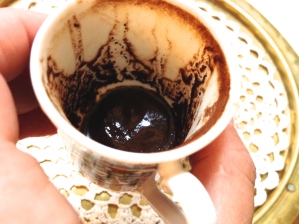
In my lifetime of researching women’s ritual dances in Greece and the Balkans, I have often come across related practices of divination or healing. One of these is the custom of coffee divination, the art of interpreting patterns in the fine grounds left in the cup after drinking Greek or Turkish coffee. The practice is found in Greece, the Balkans, Asia Minor, the Caucasus and the Middle East, and all over the world where people from these regions have emigrated. It is practiced mainly by women, particularly older women.[1]
Kafemanteía is related to much older techniques of divination and ritual, including the libations or liquid offerings which were an integral part of prayer in ancient Greece.[2] Sometimes, after the libation was poured, ‘the empty cup was examined for signs of oracle.’[3] The Old Testament mentions Joseph’s skill in divination by use of a cup,[4] while Istustaya and Papaya, the spinning and weaving pre-Hittite goddesses of destiny, divined using bowls of liquid akin to vessels used for scrying in many cultures.[5] The humble coffee cup can thus be seen as belonging to a long tradition of ceremonial vessels used in divination.[6]
Female figure in stance of invocation, with miniature votive shrines, pillars and cups or bowls for offerings. 5000 BCE, Netafim spring, Eilat, Israel.
In antiquity, Joan Breton Connelly makes clear, ‘religious office presented the one arena in which Greek women assumed roles equal and comparable to those of men,’ a fact which despite abundant evidence ‘has, until recently, been ignored by modern commentators or, worse yet, denied’.[7] In ancient Germanic, Celtic, Canaanite, Mesopotamian, and Anatolian cultures, ‘it was primarily women who were regarded as able to interpret signs and omens and to foretell the future’.[8]
Women who read cups today tend to view their ability either as a divine gift or as a talent learned or inherited from their mother, grandmother or aunt. The concept of inherited oracular or shamanic talent is an ancient one, according to Barbara Tedlock, who suggests that intuition as an ‘unconscious cognitive process’ may be ‘genetically determined in its structure and function.’[9]
In her 2005 book The Woman in the Shaman’s Body, Tedlock describes what she calls ‘the primacy of women in shamanism’, stating that ‘women’s bodies and minds are particularly suited to tap into the power of the transcendental.’[10] Her assertions have important implications for the discussion of kafemanteía as a women’s art, but also reignite feminist controversy about biological ‘essentialism’ and ways that theories about differences between the sexes have been used to justify oppression based on gender.
As an in-depth discussion of essentialism is not possible here, I highly recommend Carol P. Christ’s excellent posts on the topic for those who wish to think more deeply about these questions. As Christ shows, the assumption that ‘if there are sex differences they must inevitably determine behaviour’ is a flawed syllogism. Christ invites us to discuss these issues in a more open-minded way: ‘I think our feminist conversations would be richer if we could find ways to talk about sex differences without immediately jumping to the conclusion that it is regressive or anti-feminist to do so.’[11] In our discussion of kafemanteía, I suggest we remain open to the possibility that neurological and biological differences may have significance, though not in a deterministic way. Men can also be readers of coffee grounds and tea leaves, but the fact remains that most readers of cups are women. Why might this be?
The social component of kafemanteía is very important, offering comfort and company to both reader and querent. According to neurologist Louann Brizendine, women have both a greater need and greater capacity for the positive emotional interaction of this social relationship. Neurologically, the female brain contains more mirror neurons than the male brain, giving women an advantage in establishing emotional connection and triggering production of the anti-stress hormone oxytocin.[12] Rather than ‘fight or flight,’ female stress responses follow a behavioural pattern known as ‘tend and befriend,’ based on the maintenance of social networks that increase bonding and decrease stress.
Reading the patterns
The intuitive response when reading the patterns in a cup often comes from what we call ‘gut feelings,’ which, as neuroscientific research reveals, ‘are not just free-floating emotional states but actual physical sensations that convey meaning to certain areas in the brain.’‘ [13] As Brizendine shows, areas of the brain that track gut feelings are larger, more sensitive, and more active in women’s brains; thus ‘the relationship between a woman’s gut feelings and her intuitive hunches is grounded in biology.’ [14] A further element to consider is the fact that neurological activity in most men is left-brain dominant, while women’s brain function tends towards a more even balance between left- and right-hemisphere activity.
Finally, Barbara Tedlock presents fascinating information on protein and collagen matrices embedded in connective tissues in the human body, ‘composed of liquid crystals and biopolymers that behave as electronic conductors, storing large amounts of cognitive information.’ [15] Given that these matrices can be seen as the biological structure in which ‘somatic consciousness’ resides, I would venture to ask whether the greater proportion of fat cells in women’s bodies may enable greater cellular conductivity for storing and transmitting intuitive and cognitive information. I would love to see further research in connection with the biological tendency of women to accumulate more fat cells post-menopause, and the image of the older wise woman or crone considered in many cultures to have oracular or divinatory powers.
I have had my cup read many times on my travels, and have often been astonished by the accuracy of information offered by the reader, including precise personal details which she could not have possibly known. This remains a mystery. Although I support further study into kafemanteía, I acknowledge that in essence it appears to defy conclusive rational explanation and therefore may remain permanently impenetrable to the scholarly mind. Perhaps all we can do is to simply increase our awareness of, and respect for, this living divinatory art, and the older women who keep it alive worldwide. I would be interested to hear from others about their experiences!
This post is drawn from a much longer article I have recently written, ‘Kafemanteía: coffee divination as women’s prophetic art in ancient and modern times.’ It appears in the current issue of Walking the Worlds 3:2 (2017): 52-68, available from www.walkingtheworlds.com
Laura Shannon has been researching and teaching traditional women’s ritual dances since 1987. She is considered one of the ‘grandmothers’ of the worldwide Sacred / Circle Dance movement and gives workshops regularly in over twenty countries worldwide. Laura holds an honours degree in Intercultural Studies (1986) and a diploma in Dance Movement Therapy (1990). She has also dedicated much time to primary research in Balkan and Greek villages, learning songs, dances, rituals and textile patterns which have been passed down for many generations, and which embody an age-old worldview of sustainability, community, and reverence for the earth. Laura’s essay ‘Women’s Ritual Dances: An Ancient Source of Healing in Our Times’, was published in Dancing on the Earth. Laura lives partly in Greece and partly in the Findhorn ecological community in Scotland
References:
Barber, Elizabeth Wayland. The Dancing Goddesses. New York: Norton, 2013.
Brizendine, Louann. The Female Brain. New York: Morgan Road Books, 2006.
Christ, Carol P. ‘What If There Are Sex Differences But Biology Is Not Destiny?’ FAR February 16, 2015.
Christ, Carol P. ‘Has the Vatican Discovered that Women Should Be Running the World?’ FAR February 9, 2015.
Connelly, Joan Breton. Portrait of a Priestess. Princeton: Princeton University Press, 2007.
Green, Marian. “Wise Women Counsellors: Popular Methods of Divination.” In World Atlas of Divination, edited by John Matthews, 81-87. Boston: Little, Brown, 1992.
Karcher, Stephen. The Illustrated Encyclopedia of Divination. Shaftesbury, Dorset: Element, 1997.
Miller, Guldjin. The Secret Art of Coffee Reading. Australia: Guldjin Miller, 2015.
Seremetakis, C. Nadia. The Last Word. Chicago: The University of Chicago Press, 1991.
Shannon, L. ‘Kafemanteía: coffee divination as women’s prophetic art in ancient and modern times.’ Walking the Worlds 3:2 (2017): 52-68
Stone, Merlin. “Inner Voice: Intuition.” In Merlin Stone Remembered, edited by David B. Axelrod, Carol F. Thomas, and Lenny Schneir. Woodbury, MN: Llewellyn Books, 2014.
Tedlock, Barbara. The Woman in the Shaman’s Body. New York: Bantam Dell, 2005.
Tedlock, Barbara. “Toward a Theory of Divinatory Practice.” Anthropology of Consciousness 17:2 (2006): 62-77.
Walker, Charles. The Encyclopedia of the Occult. New York: Crescent Books, 1995.
Winkelman, Michael. Shamanism: A Neural Ecology of Consciousness and Healing. Westport, Conn.: Bergin and Garvey, 2000: 243-44. Quoted in Tedlock (2006):70.
This year the summer solstice occurs on Tuesday, June 20 in the Northern Hemisphere. (In the Southern Hemisphere, it’s the winter solstice and it occurs on June 21.) For us in the Northern Hemisphere, the summer solstice is the longest day of the year. The word “solstice” means “sun stands still.” It’s when the sun reaches its highest point in the sky and seems to stand in the same place before it begins moving toward the winter solstice. We like to think that the primary solar deity is Apollo, but there’s a whole crew of solar gods who are born near the winter solstice and live for a season in great honor, after which they’re sacrificed, spend a season underground, and are reborn.
But before there were solar gods, there were solar goddesses. Patricia Monaghan’s New Book of Goddesses and Heroines (Llewellyn, 1997) lists 58 of them, from Aclla to Xatel-Ekwa, who have been honored all around the world. Monaghan also tells us that Cinderella and Rapunzel may have been goddesses before they became heroines of what the Brothers Grimm called household tales. (Not fairy tales—no fairies in their stories.) Cinderella might have been a goddess of fire, and fire includes the sun. Rapunzel might have been “a sun maiden who would bring spring if she were not held prisoner by the witch of winter” (p. 265). Let’s reimagine Rapunzel in a solstice story… Continue reading “A New Story for the Summer Solstice by Barbara Ardinger”
Magic, divine intervention, shapeshifting – what do these things offer the modern mind, concerned with time clocks, definitive proofs and skeptical disbelief? Yet to the ancients, shapeshifting was a well known tale, found in stories and mythologies across the world.
Winter Solstice in the Northern Hemisphere is the day of the least daylight and the longest night. Long before Christmas our Northern European ancestors celebrated the Winter Solstice, the moment that heralds the return of the sun and with it the promise of new life in spring. Without the comforts offered by modern technology, this time of year must have raised fears in the hearts of our ancestors; fear that the sun would not return to its summer glory, fear that there would not be enough food for the winter, fears that surface most easily in the dark. A celebration of light would have been most welcome and needed.
Pendle Hill, seen from the back of my house, in May.
The Soul of Gaia is the numinous earth beneath my feet, her soil cradling the bones and the stories of the ancestors who have died into the land and become part of the ever-living spirit of the place.
An expat writer, my home is everywhere and nowhere. A wanderer, I have lived in many different places, from Minnesota, my birthplace, with its rustling marshes haunted by the cries of redwing blackbirds, to Bavaria with its dark forests and dazzling meadows and pure streams where otter still live. But I don’t know if any place has touched me as deeply as Lancashire, England, my home for the past fifteen years. Continue reading “Mother Demdike, Ancestor of My Heart, Part 1 by Mary Sharratt”
What is the preserving shrine? Níansa (not hard).
The preserving shrine is memory and what is preserved in it.
What is the preserving shrine? Níansa. The preserving shrine is Nature and what is preserved in it.
—Senchas Mór, Ireland
In a world in extremity, we are searching for the wellspring, the inexhaustible Source known to all our ancient kindreds. Many of us have been cut off from our deep roots, and especially from the ancient wisdom of women, and female spiritual leadership.
My long quest has been to discover the lost strands of my own roots, the old ethnic cultures of Europe, and to reweave those ripped webs. I have spent decades searching for authentic cultural testimony about women’s spiritual ways before Christianity, before the Roman empire, before men commandeered all positions of religious leadership. My book, Witches and Pagans: Women in European Folk Religion, brings together these ripped strands of the cultural web. Continue reading “In Search of Ancestral Wisdom by Max Dashu”
Hey, diddle, diddle
The cat and the fiddle.
The cow jumped over the moon.
The little dog laughed to see such sport
And the dish ran away with the spoon!
From her lips to our ears.
What is this? Maybe it’s an absurdist play. An operetta. An oracle. A carnival. Or all at once. I’m only a Seeing Woman, not a Priestess or a Thealogian, but I’ve permission to be present at great events and small. So I was there. I was watching. It was indeed a carnival, but one of our old-time carnivals where we celebrate all there is celebrate in life. Not one of those new-fangled carnivals of those new religions, where they grab everything good they can for one day before they have to give up all the pleasures in life while their god does…well, whatever he and his disciples and prophets do up there in the sky.
What on earth, I hear you asking, got into that dish? Why did she run away? Well, let me tell you. It was at one of our last carnivals. It was an enchantment. That dish was our Princess, and she was under the enchantment. Actually, the whole Royal Family was enchanted. The warriors came galloping in from the steppes beyond the river, but first they sent a Prince. He told our Queen that they were coming to “protect” us, that they were bringing new gods to us. Bringing what they called new civilization and new ways, bringing us what they called “good news.” Well, our Queen and Her Consort were rightly skeptical about all these news, and they locked the Princess up in a safe tower. Kept her there for who knows how long while that handsome but rapacious Prince came and went and the warriors surrounded our lands. Back and forth, back and forth. It was them that declared the carnival and threw that enchantment on all our important people. The Prince lured her down out of the tower—he’d stolen the magic words that unlocked the door—and then he told her he was going to eat her up. She thought it was a joke. He dressed himself up as a big spoon and persuaded her to dress herself as a dish. And then, when the invasion got serious, she ran away with him. Maybe she thought she was saving herself. Continue reading “Hey, Diddle, Diddle by Barbara Ardinger”
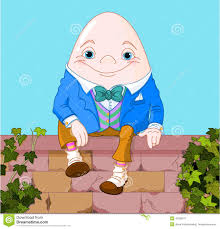
Humpty Dumpty sat on a wall, Humpty Dumpty had a great fall; All the king’s horses and all the king’s men Couldn’t put Humpty together again.
From her mouth to our ears.
You see that kid sitting over there on the wall? The one wearing the Jester’s hand-me-down suit?The Jester also gave him that funny name. That kid is looking for his father. That kid is my son.
My father the King is a tyrant, and he has more bastards than any other king in our nation’s history except for one other King, a long time ago. (Maybe these Kings try to populate the land all by themselves.) I’m one of his bastards. My mama travels with the Players, and after I was born, she traveled on and left me here. Oh, the Players come back every year, and she always tells me about her adventures, like when they went to visit that Prince up north, the one who was pretending to be crazy and got killed in a duel. My father the King lets his sons take the name Fitzroy, but us girls? What do we get? We’re lucky we get to live in the palace. That’s thanks to the Queen, who is kind and protective of all the King’s children, legitimate or not. I’m part of her court. A minuscule part, but she knows who I am and has answered my prayers several times. I’ll never rise in society. But I’m making plans for my son. Continue reading “Humpty Had A Mother by Barbara Ardinger”
Arduinna, Gaulish Goddess of Forests and Hunting is one of the many Celtic Goddesses who is associated with a particular region or body of water. She was worshipped in the heavily forested regions of the Ardennes, located in what is current day Belgium and Luxembourg with small portions found in France and Germany. She was also associated with the Forest of Arden in England. Her name has its roots in the Gaulish word “arduo” meaning “height”.


 Today I am finishing the last bit of the honey I hand-carried home from my most recent trip to Trentino. Sun yellow in color, it is made from the nectar of mountain flowers. Its label tells its origin—di montagna, of the mountains, and its type — mille fiore, often translated as “wildflowers.” Literally, however, it means “a thousand flowers.”


 This year the summer solstice occurs on Tuesday, June 20 in the Northern Hemisphere. (In the Southern Hemisphere, it’s the winter solstice and it occurs on June 21.) For us in the Northern Hemisphere, the summer solstice is the longest day of the year. The word “solstice” means “sun stands still.” It’s when the sun reaches its highest point in the sky and seems to stand in the same place before it begins moving toward the winter solstice. We like to think that the primary solar deity is Apollo, but there’s a whole crew of solar gods who are born near the winter solstice and live for a season in great honor, after which they’re sacrificed, spend a season underground, and are reborn.
 Winter Solstice in the Northern Hemisphere is the day of the least daylight and the longest night. Long before Christmas our Northern European ancestors celebrated the Winter Solstice, the moment that heralds the return of the sun and with it the promise of new life in spring. Without the comforts offered by modern technology, this time of year must have raised fears in the hearts of our ancestors; fear that the sun would not return to its summer glory, fear that there would not be enough food for the winter, fears that surface most easily in the dark. A celebration of light would have been most welcome and needed.
 The Soul of Gaia is the numinous earth beneath my feet, her soil cradling the bones and the stories of the ancestors who have died into the land and become part of the ever-living spirit of the place.
 What on earth, I hear you asking, got into that dish? Why did she run away? Well, let me tell you. It was at one of our last carnivals. It was an enchantment. That dish was our Princess, and she was under the enchantment. Actually, the whole Royal Family was enchanted. The warriors came galloping in from the steppes beyond the river, but first they sent a Prince. He told our Queen that they were coming to “protect” us, that they were bringing new gods to us. Bringing what they called new civilization and new ways, bringing us what they called “good news.” Well, our Queen and Her Consort were rightly skeptical about all these news, and they locked the Princess up in a safe tower. Kept her there for who knows how long while that handsome but rapacious Prince came and went and the warriors surrounded our lands. Back and forth, back and forth. It was them that declared the carnival and threw that enchantment on all our important people. The Prince lured her down out of the tower—he’d stolen the magic words that unlocked the door—and then he told her he was going to eat her up. She thought it was a joke. He dressed himself up as a big spoon and persuaded her to dress herself as a dish. And then, when the invasion got serious, she ran away with him. Maybe she thought she was saving herself.
  You see that kid sitting
  Arduinna, Gaulish Goddess of Forests and Hunting is one of the many Celtic Goddesses who is associated with a particular region or body of water. She was worshipped in the heavily forested regions of the Ardennes, located in what is current day Belgium and Luxembourg with small portions found in France and Germany. She was also associated with the Forest of Arden in England. Her name has its roots in the Gaulish word “arduo” meaning “height”.
 Feminism and Religion