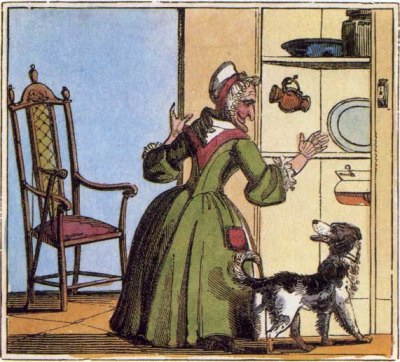
Old Mother Hubbard Went to the cupboard To get her poor dog a bone; But when she came there The cupboard was bare, And so the poor dog had none.
From her lips to our ears.
Yawanna know why my cupboard’s bare? It’s because we’re poor! Well, not all the time. Mr. Hubbard gets a good job from time to time, and then him ’n’ me an’ the kids an’ the animals have enough to eat. But those jobs never last long enough. And yawanna know why? It ain’t just the economy (which is, yeah, pretty stupid). It’s on accounta we don’t quite look like everybody else ’round here. On accountawe don’t speak the “normal” language at home. We obviously came from someplace else. An’ the folks ’round here are so worried about themselves they don’t care about us. Some of ’em don’t like us at all. (And, I ask you, where’s the folks who look like me in the schools ’n’ the gov’mintan’ on the police force?)
Now we don’t live way out in the sticks like my friend Mrs. Shoe does with all her children. We live in the outskirts of this big city, and we can grow a lot of our own food. Lotsa times, though, we march into the big city and look around for more food. There’s lotsa food that got thrown away, perfectly good food goin’ to waste every day. That’s how I get bones for the old dog an’ good stuff for the cats, too. An’, of course, for the kids an’ the hubby ’n’ me. An’for the homeless folks who show up from time to time. Share ’n’ share alike, that’s my motto. We do what we can for who we can.
And we don’t share the “normal” religion of the folks in the big city. Most of them never heard of the Mother Goddess. Or any goddess at all, for that matter. No, they’re all enthralled by that greedy Mammon or by those other old bearded guys who stand up on top o’ that metaphorical mountain and yell down at their favorite men about invadin’ some foreign land ’r other. An’ya know what? When the folks in the city are havin’ their prayers and we happen to be there, we stand quiet-like and bow our heads (politeness counts, donchaknow) and wait till they’re done before we walk away and go lookin’ for more good thrown-away food ’n’ other stuff to take home with us. But would they stand respectful-like if we started prayin’ in the city to our Mother Goddess? (That’s what they call a rhetorical question. Don’t need no answer.)
“There are years that ask questions and years that answer.” from Their Eyes Were Watching God by Zora Neale Hurston
In my previous two posts, I’ve discussed the wisdom that can be found in black women’s literature. Continuing this series, I’m sharing a statement from the most well-known novel written by Zora Neale Hurston. Hurston was an American novelist, folklorist, anthropologist, and cultural critic whose work was first published in the 1920s-1940s. Their Eyes Were Watching God was published in 1937 and has since been reissued and adapted into film.
“There are years that ask questions and years that answer.” This quote is one that has circled around my mind every New Year and every birthday for many years. These times of year are when I’m likely to reflect on the previous year and wonder what has come from it.
Perdita was in a panic. She looked this way and that, but all she saw was a towering pile of straw. She sat down to breathe deeply and think deeply. While she was breathing and thinking, the little man held is peaked green hat in his hands and marched anticlockwise around the room, whistling a jolly marching song she’d never heard before. He marched around the room three times.
Finally Perdita said to herself, Who knows what can happen in a year? That’s a long time. I can promise anything now.And then, well, I know I’ll be able to think of something to do. I’ll study all year! Aloud she said, “Kind Sir, you are miraculous, for no man can spin gold, and yet—here you are, spinning gold! You can have what you ask for.”
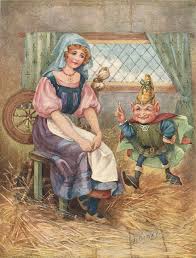
And so the little man smiled a smile that showed all his teeth and sat down at the wheel and—whirr, whirr, whirr—the whole roomful of straw was soon spun into the finest gold thread imaginable, twice as fine as the finest silk thread the merchants sold at the harvest festival.
As soon as the Queen arrived back at her palace the next day, her Nephew introduced his betrothed to her. The Queen was much older than Perdita thought she would be, and she was as wise as she was old. She took Perdita into her private chamber and asked her several questions. She learned more about Perdita than the girl realized, also about her mother and stepfather and young traveling scholars. Nevertheless, the Queen gave her royal blessing to the marriage, for she wanted her Nephew to be married to someone with a quick mind, good manners, and some ambition so the land would be well cared for after her death.
The wedding took place on the day following the summer solstice, and guests were invited from lands all around. Perdita’s mother and stepfather were invited, too, and they were both given new clothes to wear. The stepfather tried to have a private conversation with the Queen, but the major-domo led him into the map room and showed him some extremely dependable treasure maps.
After the wedding banquet of roast peacock and candied goldfish and artichoke hearts and rosewater dumplings, the Queen and Perdita’s mother walked together in the gardens and talked of many things. Pretty soon, after the stepfather had memorized several of the treasure maps and borrowed enough money to rent a ship and set off to claim his treasure, the mother was invited to move into the palace, where her healing and domestic arts would be appreciated.
A year and a day later, Perdita gave birth to a daughter who was the most beautiful baby in the whole land. The royal birth was celebrated with fireworks and parades and festivals and rituals in the temples that lasted three whole days without pause. Perdita’s mother was appointed chief nursemaid and immediately hired a wet nurse who had the creamiest milk in the whole land.
On the third night after the baby’s blessing and naming day, Perdita was alone in her chamber, brushing her long, curly hair, when she heard a noise behind her.
“Well then. I have come for the baby.”
“What?” Perdita pretended not to recognize the little man. “And just who are you? And what are you doing in my private chamber? Get out immediately or I shall call the guards.”
“You know who I am. You know why I’m here.”
“Yes, yes, I confess it. I do.” She allowed a tear to roll down her cheek. “Oh, but please don’t take my baby. I have never loved anyone before, and I love this baby more than anything I have ever possessed. Here—take my jewelry. All of it. Take my jeweled toys. Take the tapestries from the walls. Take my richly embroidered clothes. Take my royal robes. Take my golden coronet. Take these books I’ve read. Take anything you want, but please, Kind Sir, oh, please don’t take my daughter.”
“We made a bargain. I have spun the gold for you. No man can spin gold, but I can, and I spun for three nights. Because of my spinning, you are now the heiress of the throne of this land. You must keep your part of the bargain.”
“No, no!” Perdita cried, glad that the baby was in her mother’s watchful care. “I cannot give up my daughter! She is more precious to me than gold.” And Perdita began to cry, to really cry, and her crying was so heart-rending that the little man finally began to take pity on her.
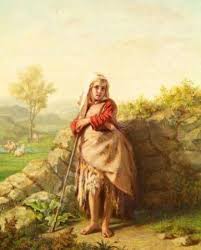
In a land not too far away there once lived a widow who was so poor and who worked so hard day and night to make a bare living that she had almost no time to teach her daughter the things a girl needs to know to be a proper wife. The girl, whose name was Perdita, had learned how to do a few useful things around the house, but when she laid the fire she always mixed green wood with the dry, when she made the soup she always forgot the salt and pepper, and when she swept she inevitably forgot to sweep under the bed. When she sewed she always pricked her fingers and left little red spots on the fabric, and when she spun she always made huge knots and horrible tangles in the new thread. Although she wasn’t very good at these important homely tasks, she had somehow learned to read and study numbers and she had even learned about Panglossian optimism. Her parents had no idea how this learning had come to her, unless it had something to do with the scholars who regularly passed through the town and with whom Perdita spent a lot of time. In her own opinion, the girl more than made up for her lack of useful skills with her brilliant mind and quick tongue…not to mention her beauty.
One day, although her mother had ordered her to finish the washing and hang the clothes in the sun to dry, Perdita left them soaking in the tub and went out and about with her mother’s second husband. On the road they happened to meet the Queen’s eldest Nephew. Now since the Queen had borne no daughters and was now too old to do so, everyone knew that one of her Nephews would inherit the throne when she died. As soon as he spotted the young man, Perdita’s stepfather saw an opportunity.
“Here’s your opportunity,” he murmured to the girl. “Do what you can to attract this fellow. If you do, things will go well for you and your mother.”
Perdita saw an opportunity, too. An opportunity to raise herself socially and find a life that was not so filled with laundry and other mind-numbing hard work. So she tossed her curls and swung her hips, she gazed up at the Royal Nephew, and soon she had his attention, for this young nobleman was interested in the things that have always interested the upper-class men. During their ensuing conversation, Perdita said coyly, “I may have a poor mother, but I’m quite clever, you know. I can read and write. I can cook and clean. I can sew and spin.”
“I’m interested in girls who can do useful things,” said the Queen’s Nephew. “Are you good at all things you do?”
“Oh, yes, I am very, very good,” the girl replied demurely. “I have a great many talents.”
“And,” said her mother’s second husband,“some of this girl’s talents no one has uncovered yet.”
“I see,” said the young man with a wink. “And may I learn what yourhidden talents are, my dear?”
“Why,” said Perdita with a pretty blush, “why I can…I can—”
“She can spin straw into gold,” said the stepfather. “Who do you know who can do that?”
“No one at all.” The Royal Nephewtook Perdita’s hand. “It’s well known that no man can spin straw into gold.”
“And she works very fast,” said the stepfather. “See how soft her hands are! Her fingers are as nimble as my own. Even though we’re not even related by blood, I have taught her all she knows!”
“Indeed,” the Royal Nephewsaid, “nimble…” And after he thought for a moment, he added, “My dear, would you like to come to my Aunt’s palace with me and show me—show us your talents?”
So with an unnecessary push from her stepfather, Perdita, who was sure she would be moving into the best of all possible worlds, went to the palace with the Queen’s Nephew. But the Queen was not there, for she was visiting one of her Sister Queens in a nearby land. When the Royal Nephew asked Perdita to show him how she spun straw into gold, she batted her eyelashes at him and, remembering what she’d seen other girls do, shrugged her linen bodice just a little bit off one shoulder. A little while later, when the Royal Nephew asked again about spinning straw into gold, she shrugged her bodice a little bit off her other shoulder. When he asked a third time about spinning straw into gold, however, she finally understood that he expected a reply.
She had to think fast. “Oh,” she said disingenuously, “oh, I only do it at night, when the moon is full, and I can never do it if anyone is watching. I can spin straw into gold only when I am left absolutely alone with my work.” She was feeling quite sure that the Royal Nephew would never leave her alone, especially with her soft linen bodice falling off both shoulders.
But Perdita hadn’t noticed that the moon was full that very night, and when the Royal Nephew offered to let her stay in the palace, she was loath to refuse the invitation. I’ll think of a way out of this predicament, she said to herself. I always do, for I’m very clever.
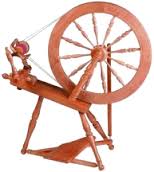
The young nobleman was keenly interested in gold, as nobles always are, and so he ordered a room at the far, far end of the farthest corridor to be filled one third full with straw. Then he got his aunt’s best spinning wheel and put that in the room, too.
“Here is a fine and private room,” he said to Perdita, “and I guarantee that no one will disturb you. Just spend the night here and show me how you can spin straw into gold, and I’ll give you a lovely reward in the morning.” And he winked at her.
What could the girl do? She watched the Royal Nephew close the door. She heard the key turn in the lock. She began to walk about the room. At last she sat down beside the wheel. But she didn’t have the least idea about how to spin straw into gold, for she couldn’t even spin flax into decent linen thread without getting huge knots and horrible tangles in it. She began to cry. “I’m lost!” she wailed. “No one is here to advise me. No scholar I’ve ever met has considered this situation. No man can spin straw into gold, but I can’t, either. Oh, woe is me.”
“Well now.”
Suddenly she heard a voice, and when she peeked between her fingers, she saw a little man wearing a peaked green hat and a long brown jacket and wide brown trousers. He had a long white beard and big strong hands.
“Good evening,” he said. “Why are you crying?”
“I’m supposed to spin straw into gold, but I don’t know how.”
We had a scrumptious dinner of fresh fish, salad, fried potatoes, local amber-colored wine, and tiny olives. Later the two waiters, Themis and Nikos, bearing another pitcher of wine, sat down at our table.
They told us they were best friends and had just gotten out of the army. When they discovered that we were writers, the two young men were intrigued. “Our village has a very interesting history and many interesting customs,” they told us. “If you would like to come back and write about it, we will introduce you to all of the old people.” This conversation was in Greek, but I translated for Naomi. “This must indeed be a very interesting village,” I said to her, “because when they learn that I am a writer, most Greek men will say ‘write about me, I have a very interesting story.’ These men, in contrast, want us to write about their village.”
When we finished our wine, the young men offered to give us a lift back to our hotel on their motorbikes, suggesting we could have a coffee at the hotel bar. When we got to the hotel, they didn’t stop. “What happened?” I asked. “The bar wasn’t open at the hotel, so we’re looking for another place.” I wondered what Naomi, perched on the back of a motorbike and unable to speak Greek, must be thinking—especially since she was afraid of the unknown. We drove through the town and turned down a dirt road, arriving at the Zaros water factory. “We wanted to show you this,” they said sheepishly. “People drink our water all over Crete.” “O.K., “Naomi said, “but then you must take us back.” There were a few workers on the night shift, and the boys told us they had worked there too, before going into the army.
Leaving the factory, we continued down the dirt road heading away from the town. “Where are we going?” I asked, wondering what we had gotten ourselves into. “Just a minute,” Themis said, as he got off the bike in front of what looked like a small house in the middle of nowhere. “We need to go back,” Naomi said definitively. “Yes, I already said that,” I answered. “Come inside,” Themis beckoned. “We want to show you how they make the raki (the colorless alcoholic drink that had been offered to us in shot glasses us after meals). This is the still,” he continued, as he showed us into a small dark room with a glowing fire. “After the wine is pressed, they put the skins and stems into barrels like those you see in the corner. The mixture takes six weeks to ferment, and then they bring it to a still, where it is heated over a fire. The steam that rises is directed through long curved pipes, and comes out as raki,” he said, pointing to various parts of the mechanism. Continue reading “Dionysian Rites by Carol P. Christ”
Once upon a time there was a woman named Carol who lived in the largest house on the Island of Crete and had the largest flower garden and the largest herd of cattle. Because of her riches, not to mention her common sense, she had been elected chief of the Council of Mothers, the government of the island. The Council had searched and searched for a proper title for their leader and finally, reluctantly, decided that Queen was as good as anything else…as long as everyone remained politically correct and understood that Queen was merely a handy title. Queen Carol had a husband named Minos who tried and tried to assume the title of King, but no one ever paid any attention to his pretensions. Because he had nothing else to do, he spent most of his time lounging in the front parlor and reading the Knossos Times-Myth-Dispatch.
“Look here,” he said one day, waving the newspaper at his wife. “The Greeks are ramping up for a war over in Troy. They’re calling for kings and armies to join them.”
Carol laid her feather duster aside for a minute. “Well, if you really want to,” she said, “you can go. It’ll be better for youthan sitting around here all the time and complaining that you’re bored. But you’d better not come back here and set yourself up as a warrior king! None of those huge statues like they’ve built in Egypt. None of those huge temples with carvings of conquering armies on them, either. We mothers won’t stand for it!”
I was trying not to fidget as I sat on the hard, unforgiving walnut pew. It was a gorgeous summer day out, and I was locked inside breathing stale air and with nothing to look at but the dreary speaker, and, behind him, a life-sized, picture of a sweet-looking man about to be hung from nails driven through his hands. I was visiting my parents, who love to take me to church, and I just wasn’t able to say no.
As I sat I daydreamed about our indigenous European ancestors. They did “church” outdoors, in fragrant, airy forests with wild bluebells, warbling birds, and gentle breezes caressing their skin, ears and eyes. Instead of doing hard time on walnut benches, they got to dance, chant, hold hands and jump through fires.
For centuries, the wolves were the lords of the forests, ruling wisely and carefully culling the herds of the dumber animals, which actually helped to preserve many species. The wolf packs, led by their alpha females, worked to maintain the balance established by Great Mother Earth. But now a new predator was coming into the forests. Men were cutting down trees and making farms and towns and cities. They were forgetting the stewardship assigned to them by Great Mother Earth, upsetting the natural balance, making enemies of the wild creatures.
Something had to be done to save the wild places and the wild creatures. The great wolf packs called a World Parliament of Lupine Peoples, which met in a secret location in Mitteleuropa. The werewolves who attended had their own breakout session later in the week, but the men who cast wolf whistles at young women were chased away, as were all wolves in sheeps’ clothing and all wolves of Wall Street. Although there was some discussion about admitting the medieval English queens called she-wolves after a queen in one of Shakespeare’s plays (if you’re curious, it’s in Henry VI, Pt. 3), they were admitted because they were intelligent, brave, and cunning women. The Princess Lupa, stepmother of Romulus and Remus, was a special guest.
Now is the time of Beltane, the great festival celebrating life and fertility.
Last week, on April 24th, in my post The Dance of Memory I wrote about the centennial of the Armenian Genocide, and invited everyone to join in this worldwide day of remembrance through prayer, meditation, music and dance. Subsequently I received testimony from students and colleagues all over the world about dance events they had organised in response to my call.
Dancing friends from Europe, North America, South America, and Australia told how moved they felt to be part of a larger whole, connected through the wordless beauty of music and dance, and by our compassion and caring for all those affected by genocide. Many, including my sister Leslie, thanked me for my ‘call to include Turkish and other dances in the Armenian commemoration activities’. She wrote from New Zealand, ‘The world needs more of this kind of inclusiveness!’
In Germany, Sybille Kolaric danced Armenian dances and a Turkish dance with her group, saying, “I really liked the idea to combine in the dance circle what is so separated in reality.”
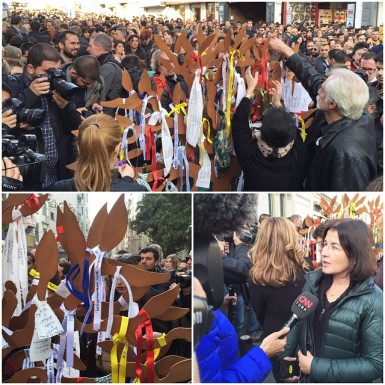
A beautiful coming together of Turks and Armenians took place in Istanbul, where my dear friend and colleague Shakeh Major Tchilingirian went with her family, along with many Armenians from all over the world, for the April 24th commemorative ceremonies. A few days before, Shakeh had been leading Armenian dances with Turkish university students there as a ritual of reconciliation (you can see the film, Circle of Life, about a similar event she led in London). Shakeh wrote that they attended a very emotional service in the Armenian Church, and then went to Taksim Square to tie cloths to the Wishing Tree.
Shakeh wrote from Istanbul, “Last night I read some of the messages on The Wishing Tree, messages remembering ALL victims of atrocities and genocide as well as the displaced. There were thousands, possibly tens of thousands, of people sitting silently in Taksim Square, many Turks and Kurds amongst us. There is a lesson to be learned here: we are all victims of the situation we find ourselves in and the longer these wounds bleed the more difficult it becomes to heal.”
The Wishing Tree in Taksim Square was created by Turkish artist Hale Tenger, specifically to mark the centennial of the Genocide. She invited participants to tie pieces of cloth to its branches in homage to the victims and survivors of the Armenian Genocide. Armenian-American Nancy Kricorian brought with her from New York a strip of fabric from one of her grandmother’s aprons, saying, “My grandmother Mariam Kodjababian Kricorian was a survivor of the 1915 Genocide, and tying this cloth to the Wishing Tree in Istanbul will be a tribute to her life.”
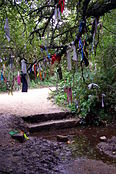
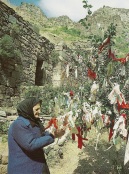
Coincidentally, my April 24 post on FAR included a photo of an Armenian grandmother tying an offering of cloth to just such a tree. The ancient folk custom of the wishing tree, where people (usually women) tie cloths with a special prayer for a loved one, can be found today in Armenia, Turkey, and Greece, in Asia and throughout Europe as far as the British Isles and in Asia as well. This ‘clootie tree’ by the ‘clootie well’ (cloth = clootie) in Madron, Cornwall, is almost identical to the Armenian one shown in my previous post.
Carol P. Christ’s comment on my last post described a similar tree on her Greek island of Lesvos which she tells me is near hot baths once sacred in antiquity. She also stated that brides in ancient Greece would leave articles of their unmarried clothing on a tree dedicated to the virgin Goddess Artemis, one of many tree-worshipping rituals which were well-known and widespread in the ancient world.
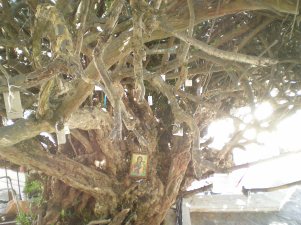
Women on Carol Christ’s Goddess Pilgrimage to Crete have all participated in such a practice, tying coloured ribbons onto the venerable myrtle tree already covered with ribbons and votive offerings called tamas, at the sacred monastery of Palianí. When I went there with Carol in 2012, my encounter with the tree led to a profound and lasting experience of healing, which Carol remembered in Giving Back to the Mother.
Sisters on Carol’s pilgrimage also get to encircle the 2,000-year-old plane tree at Krasi. Even today village festivals are held under the canopy created by the ancient tree. We know that tree worship on Crete has roots in Minoan times, as depicted in gold seal rings and other examples of Minoan art, and we know that tree worship is both ancient and widespread. My life’s work researching the Goddess in traditional Balkan dance has shown that the Tree is often associated with the Goddess, for instance in many Balkan embroideries This abstract but recognisable version comes from the curtains of the reception room in the Palianí monastery.
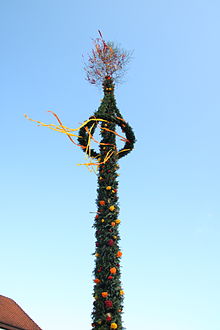
The sacred tree remains a living tradition in central, western and northern Europe in the form of the Maypole. I write this from Austria, where virtually every town and village honours May 1st (the ancient celebration of Beltane) with a May Tree, or Maibaum, a tall decorated pole with a wreath at the top. I love how this one from Germany resembles the Goddess. Can you see her too?
Once-universal practices revering trees, nature, and the Goddess may have changed, but the act of praying for others’ well-being remains common to us all. The longing to keep our loved ones safe transcends all religious, political and ethnic boundaries. Love for others is one of the strongest bridges to common ground, and here is where we find our meeting place once again.
As I read through the messages sent in response to my invitation to dance on April 24th, I feel that each dancing circle is like a votive offering hung on a sacred tree. Each one is a gift of love for humanity, unique, yet part of a shared desire to end suffering, to bring healing, and to ensure the safety and survival of every single being in creation.
Laura Shannon has been researching and teaching traditional women’s ritual dances since 1987. She is considered one of the ‘grandmothers’ of the worldwide Sacred / Circle Dance movement and gives workshops regularly in over twenty countries worldwide. Laura holds an honours degree in Intercultural Studies (1986) and a diploma in Dance Movement Therapy (1990). She has also dedicated much time to primary research in Balkan and Greek villages, learning songs, dances, rituals and textile patterns which have been passed down for many generations, and which embody an age-old worldview of sustainability, community, and reverence for the earth. Laura’s essay ‘Women’s Ritual Dances: An Ancient Source of Healing in Our Times’, was published in Dancing on the Earth. Laura lives partly in Greece and partly in the Findhorn ecological community in Scotland.
The twelve days between Christmas and the New Year are still held to be holy days in Greece, a mystical and dangerous time when mischievous spirits emerge from the underworld, seeking to wreak havoc in the human realm. On the 6th of January, Theophania or Twelfth Night, masked men in goatskins and sheepbells dance through the streets to dispel these spirits, awaken the fertility of the earth, and ensure a good year. The name Theophania, literally ‘the appearance of god’, here refers to the return of the sun after the winter solstice, and fire and light are very important to this holiday.
The rituals I describe here come from six tiny villages in the region of Drama, just south of the Rhodope Mountains, close to the border between northern Greece and Bulgaria. Similar rituals featuring masked, bell-wearing men appear all through the Balkans and Central Europe as far as the Swiss Alps. They will dance through the village streets, in the cemetery, and in front of every house, in a ritual of blessing and catharsis which has roots in age-old worship of Dionysus, god of fertility and wine.
For me, who came to Greece to study women’s traditional songs, dances and costumes, it makes a refreshing change to observe ritual customs almost exclusively performed by men. These activities take place in winter, either at Theophania or during Carnival, in contrast to spring and summer rituals which are chiefly in the hands of the women. However, as we shall see, in order for men to assume ritual abilities and responsibilities normally ascribed to women, some of the men must dress in women’s clothes.
Here I would like to mention Carol Christ’s recent analysis of essentialism in feminist theory in her excellent post of September 15. In Carol’s words, the essentialist view holds that the “‘essential qualities’ of a thing (a table, a horse, a woman, or a man) precede the ‘existence’ of any individual in the group to which it belongs; these qualities are universally—always and everywhere—expressed by members of the group.”
Carol and I both live in Greece, where, as in many other parts of the world, tradition assigns quite different tasks and attributes to men and to women. Without reawakening the essentialist discussion here, I would just like to say that modern-day feminists do not have to agree on whether women and men are essentially or inevitably different; however, in order to understand Balkan culture, we do need to realise that people here believe in these differences and have done since ancient times.
Angelos Keras, the Archigos of the Arapides in Monastiraki
Back in Drama, in the village of Monastiraki, preparations have been underway for days. The night before the big event, a designated house – half-ruined, but still with a roof intact – slowly fills with the joy of friends and acquaintances greeting one another. Red wine flows, and traditional goat soup is served free to all. A fire has been kept burning here continuously throughout the twelve nights of Christmas, producing sacred ash with healing and protective powers. Musicians play through the night, producing archaic sounds on the Macedonian bowed lyra or kemene, accompanied by large goatskin tambourines called daheres. These are the only instruments. The overall effect is all the more hypnotic as the musicians play in absolute unison; even the singing is monophonic, in a musical structure intended to emphasise old values of community and coherence.
Meanwhile, people dance the same few dances over and over. As on all ritual occasions, the repetition of familiar simple step patterns frees the dancers to focus on the inner work of igniting their own good mood and raising good energy (kefi) to bless the community.
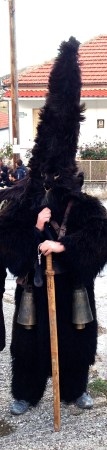
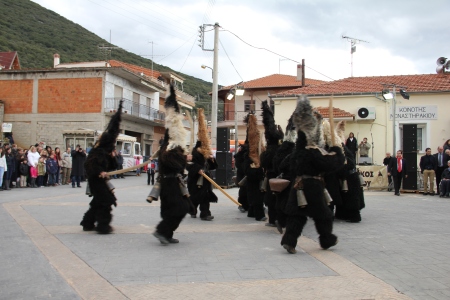
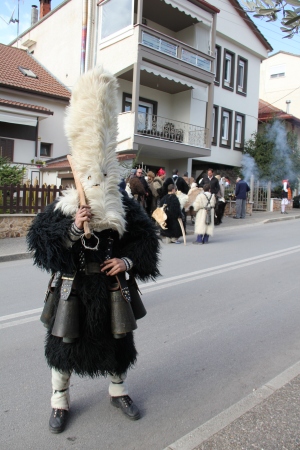
After dancing and drinking all night, the male celebrants help each other dress in the early hours of dawn. They are truly fearsome in shaggy dark skins, tall conical masks, and wide leather belts from which swing three pairs of heavy double bells. One of their names, koudonofori, means bell wearers; they are also called Arapides, the Black Ones or Moors.
Looking behind the apparent racism of the terminology, these ritual dancers blacken their skin with burnt cork both to invoke the power and protection of the sacred fire, and also in order to enter the realm of darkness. Here, the dark is seen as the repository of the earth’s fertile powers, which their bells and dances aim to awaken, as well as the realm of things ‘not seen’ , such as the spirits known as kallikantzari, which pose a threat to the new light and the new year. They themselves must go unseen, in masks and disguises, to enter this realm.
‘Arapides’, masked ritual dancers at Theophania in Monastiraki
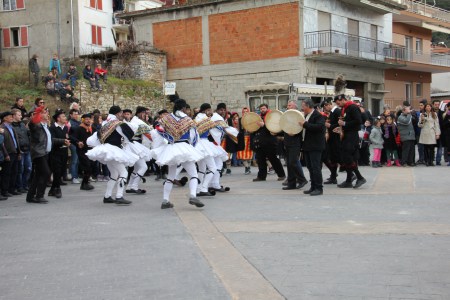
Brandishing long wooden swords, this group – known as a tseta – appears fully capable of driving out any number of kallikantzari. The phallic swords and headdresses leave one in no doubt that the Theophania rituals are men’s rituals, yet the ability to give new life, to enter the realms of the dead, and to bestow the blessing of fertility are essentially women’s powers. To claim these powers, some of the men must dress as women, as Dionysian revellers have done since ancient times. These are theGilinges, or Brides.
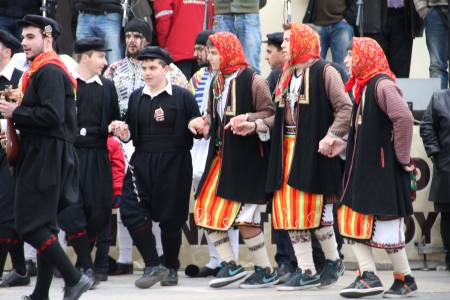
Pappoudes (‘Grandfathers’) with lozenge-shaped beaded amulets, and Gilinges (‘Brides’) in Ksiropotamos
Wearing women’s clothing may be a means for men to temporarily gain access to the realms of life and death, where normally only women may go, or to symbolically give birth to the life-affirming fertility and joy which bring renewal at this dark and hungry time of the year. (Men wearing women’s clothing for ritual purposes are depicted in archaeological finds dating back to the 5th C. BCE; I think we see it today in the ecclesiastical robes worn by Christian priests.) In an additional affirmation of what is seen as women’s power, the Brides’ costume is rich in goddess embroideries, while all the members of the party wear beaded amulets in the lozenge-shaped symbol of female fertility going back to Neolithic times. Goddess symbols are also stamped on many of the bells.
As well as the Arapides and the Brides, the tseta includes Pappoudes or Grandfathers in Thracian men’s traditional dress, and Evzones or Tsoliades wearing short white pleated foustanella kilts and thetsevres, a special garment made of twelve large white kerchiefs sewn into a triangle densely fringed with beads, sequins and coloured threads, which takes four months to prepare.
Musicians and ‘Tsoliades’ ritual dancers in Monastiraki
There is also an occasionally appearing Bear, who some say represents ancient worship of the Goddess Artemis.
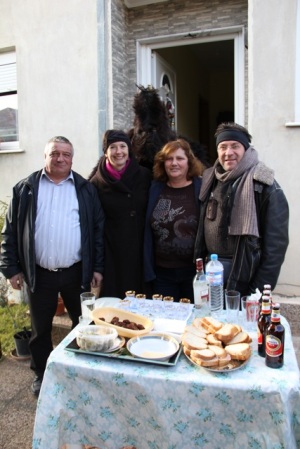
As they journey together through the village, the bell-wearers leap and stamp, swinging their bells back and forth in an apotropaic din – this will indeed awaken the earth! – almost drowning out the eerie sound of the lyras and daïres. The Evzones dance with athletic half-turns which send their short kilts sailing up to their waist, emphasising (so I am assured) the fertile power of the male generative organs, without revealing the organs themselves. At every house the entire tseta is rewarded with abundant food and drink, in the living tradition of sacred hospitality which is the most powerful blessing of all.
Hospitality to strangers in Ksiropotamos
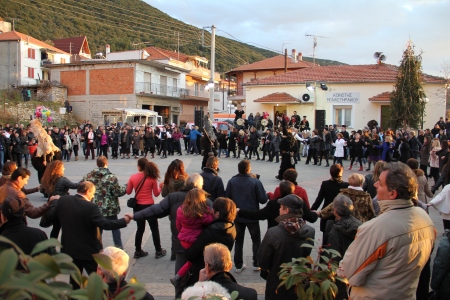
By three o’clock, the whole village gathers at the plateia to dance. Hundreds of people spiral into a single circle with one leader, keeping the large centre open as a sacred space for the tseta to enact ancient rituals of death and resurrection, plowing and planting, and the hieros gamos or sacred wedding. The dancing goes on until dusk and then continues at a taverna through a second consecutive night.
Everyone joins in the great circle dance in the plateia of Monastiraki
Each village has its own variation of the Theophania rituals. In some places, children and women also participate: in Ksiropotamos young girls dance in traditional costume, while in Petrousa, all the dahereplayers are teenage girls. Some traditionalists view this change with unease, but I must confess my pleasure at seeing thirteen young women lined up like priestesses of Cybele from the time when the drummers were women. Here too, people dance at crossroads, springs, sacred trees and finally around an enormous bonfire.
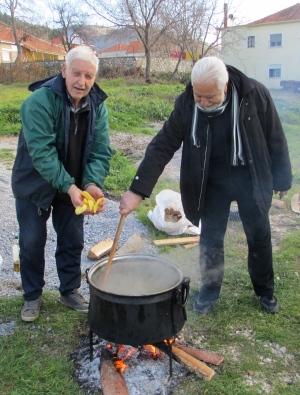
Cauldrons at the crossroads in Ksiropotamos
Fire is important in all the Theophania rituals, and cauldrons on open fires are a key part of the festivities. This is another symbol of women’s power adopted on this occasion by men – traditionally, women cooked in pots; men roasted meat over an open fire.In Petrousa, the Dance of the Cooks can still be seen. Although it is no longer danced around the cauldrons themselves, the symmetrical step pattern still focuses the energy or ‘fire’ of the dancers in a particular way.
It seems to me that these fire-focused rituals hint at the unnamed presence of the Goddess Hestia, whose domain is centred on the hearth, source of light, warmth, food and all that is beneficial to the home. The nikokira, the lady of the house, was seen since ancient times as Hestia’s priestess. Her role is to tend the sacred fire through practical and ritual work and to literally focus its brilliance (estiazo, fromHestia, means ‘to focus’) so that it may bless the household and all its inhabitants. In ritual activities such as the Theophania, through the mediation of men dressed as women, this focused fire can be brought once a year from the private space of the home – the realm of the women – into the public space of the village, the realm of the men. This union of men’s and women’s fertile powers is the hieros gamos, the holy spark of blessing which ensures health, wealth, happiness and abundance for all in the coming year.



 Perdita
 In a land not too far away there once lived a widow who was so poor and who worked so hard day and night to make a bare living that she had
  “Here is a fine and private room,” he said to

 I was trying not to fidget as I sat on the hard, unforgiving walnut pew. It was a gorgeous summer day out, and I was locked inside breathing stale air and with nothing to look at but the dreary speaker, and, behind him, a life-sized, picture of a sweet-looking man about to be hung from nails driven through his hands. I was visiting my parents, who love to take me to church, and I just wasn’t able to say no.
 Coincidentally, my April 24 post on FAR included a photo of an Armenian grandmother tying an offering of cloth to just such a tree. The ancient folk custom of the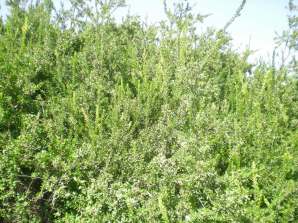

 Feminism and Religion