I remember my first feeling’s of disappointment when Simone Biles pulled out of so many events at the 2021 Olympics. But then I quickly realized that here I was falling for the patriarchal lines that are so much a part of our reality that they become unconscious. Simone Biles taught me. Winning isn’t about slaying your foes (although someone who watches politics here in the US would think so). When Biles withdrew, there were many angry tweets and letters that she wasn’t living up to her promises. Let’s review that. She has been called the GOAT (Greatest Of All Time) of her sport. She is the most decorated gymnast in history. She is only 24. What promise has she broken? To whom? And who are we (meaning the public) to even determine what her promise is?
Moderator’s note: This marvelous FAR site has been running for 10 years and has had more than 3,600 posts in that time. There are so many treasures that have been posted in this decade. They tend to get lost in the archives. We are beginning this column so that we can all revisit some of these gems. Today’s blogpost was originally posted October 1, 2017. You can visit it here to see the original comments.This post is the 3rd and final of a series which has been posted for the past 2 days. They were curated by Barbara Ardinger to stand together for their relevancy, now, 5 years later.
Members of this community (and others) have been feeling that the world is out of balance since the 2016 election. There’s a feeling that people are becoming less kind and that some men (following the model that lives and tweets in the White House when he’s not at one of his golf resorts) are more misogynistic. I’ve heard that Orwell’s novel Nineteen Eight-Four is more popular than ever before. We seem to be living in a new dystopia. It’s very sad and very scary.
I’ve recently reread three novels written by women that I think may be both prophetic and inspiring. I’m hoping that if you read them, too, you’ll inspired by their brave heras to keep on resisting. The novels are Gibbon’s Decline and Fall (1996) by Sheri S. Tepper, Woman on the Edge of Time (1976) by Marge Piercy, and The Fifth Sacred Thing (1993) by Starhawk.
Starhawk (Miriam Simos) was probably the most famous “out” witch in the last quarter of the 20th century. Her book The Spiral Dance (1979) introduced uncountable numbers of people to the Goddess, Paganism, and Witchcraft. Nowadays, she’s teaching “Regenerative Culture, Earth-based spirituality, and Permaculture.” She is no doubt working up to the Uprising described in The Fifth Sacred Thing that separated northern and southern California—a generally bucolic San Francisco filled with Pagans and an eclectic mix of every other religion with free healthcare for all and a City of Angels (Los Angeles) filled with Stewards, ruins, and sex slaves.
The Fifth Sacred Thing opens in 2048 with Maya, a 98-year-old Orthodox (sic.!) Pagan climbing a mountain. At the Lammas (August 1) ritual, she tells how the Uprising began. Global warming has happened, and during the drought of 2028, four old women (remember Tepper’s bag ladies?) went with pickaxes to a major thoroughfare in San Francisco, dug up the pavement, and planted seeds in the earth. The Uprising was led by people who had participated in the Summer of Love (1967) and demonstrated against the Vietnam War.
In the next chapter we begin to meet the Stewards, who in 2028 canceled the elections and took control. Now “the Corporation,” which banished women from every profession but the oldest one, owns the Southlands and apparently most of the U.S. Although Starhawk wrote this novel in 1993, the Stewards look like Trump’s cabinet and true believers exponentially multiplied. The Steward are allied with the Millennialists, who have suppressed every religion but their own and whose Creed reads in part, “…we abhor the earth, the Devil’s playground, and the flesh, Satan’s instrument. We abhor the false…gods…who tempt us to wallow in the worship of demons, whether they be called Goddesses, Saints, Lucifer, or the so-called Virgin Mary. For we know that Our Lord never lowered Himself to take on loathly flesh….” Maya’s grandson, Bird, has been their prisoner for ten years. He’s been drugged (like Connie), but now he’s beginning to feel his magical powers returning.
Another protagonist is Madrone, a healer and midwife. As we read through a long Council meeting (they’ve got Councils for everything), we see the similarities between San Francisco is 2048 and Piercy’s free future of 2137. The values are much the same, although Starhawk’s future is determinedly Pagan and Witchy (and very PC). Madrone has lost a patient to a mysterious fever that morning. In the council meeting, one character says they’re still living in the “toxic stew” of pollution in the Bay. Is this fever becoming an epidemic? Is it biological warfare?
Bird summons the best magic he can and escapes with two other prisoners. As he travels up the California coast, sometimes along what was once the Pacific Coast Highway, sometimes along what was Interstate 5, he learns what happened to him ten years ago. When he and some other Witches destroyed an atomic reactor (probably in Santa Barbara County), his friends were killed by the Stewards and he was captured. Now he’s regaining his memory and his powers as he’s meeting other outlaws.
When Bird arrives in San Francisco, not much has changed: there’s still a lot of free love and arguing and they all still work collectively. Madrone recently went into “the ch’i worlds” to search for the virus, caught it, and almost died, but now she’s mostly recovered. They hold a meeting in which they discuss nonviolent resistance. After much argument about how best to resist, Madrone finally decides to travel south to find out if the Stewards are really planning an invasion. As she retraces Bird’s trail and meets the people who helped him, she gives them free healings and teaches them Witchy powers. The book thus turns into what is essentially a handbook of resistance and Witchy powers. When Madrone goes to Hollywood to take part in raid on a drug warehouse, we learn that in the Southlands only the rich have water, medicine, fresh vegetables, cars, access to education, healthcare, and any kind of technology (which is mostly built by prisoners).
Yes, there is a war in this novel. Just think of any superhero-action-adventure movie and add Nazis, and you’re seeing it. The Stewards’ army invades San Francisco, and nonviolent resistance seems to wither under bullets. Although she finds pockets of rebellion and resistance, Madrone nearly dies in Los Angeles. She finally gets home and learns that Bird has been captured again. But the Witches are also learning how to get soldiers to desert.
The novel has a sort of happy ending. Is it prophetic? I hope not! I live in the Southlands. But anyone who is paying attention to the daily news sees that we’re already on the path to a world run by the Stewards and the Millennialists. Starhawk has written a sequel, City of Refuge (2015), around the three major characters to tell what happens next in the North and the Southlands. I have not read the new novel.
But I know that Witches can prophesy. And so can writers, and so we have in these three novels four protagonists—Carolyn Crespin, Consuelo Ramos, and Maya and Madrona—who can teach us a great deal about resistance. The four sacred things are earth, air, fire, and water. The fifth is spirit. Blessed be.
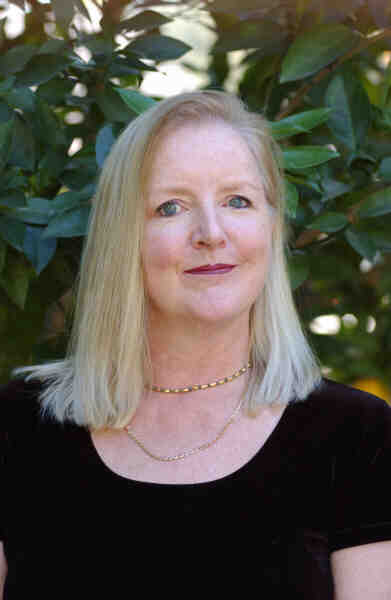
BIO:Barbara Ardinger, Ph.D. (barbaraardinger.com), is the author of Secret Lives, a novel about crones and other magical folks, Pagan Every Day, a unique daybook of daily meditations, and other books. She really enjoys writing her monthly blogs for FAR. Her work has also been published in devotionals to Isis, Athena, and Brigid. Barbara’s day job is freelance editing for people who have good ideas but don’t want to embarrass themselves in print. To date, she has edited more than 400 books, both fiction and nonfiction, on a wide range of topics. She lives in Long Beach, California, with her rescued calico cat, Schroedinger.
Moderator’s note: This marvelous FAR site has been running for 10 years and has had more than 3,600 posts in that time. There are so many treasures that have been posted in this decade. They tend to get lost in the archives. We are beginning this column so that we can all revisit some of these gems. Today’s blogpost was originally posted September 3, 2017. You can visit it here to see the original comments.This post along with the one posted yesterday and the one which will be posted tomorrow were curated by Barbara Ardinger to stand together for their relevancy, now, 5 years later.
Members of this community (and others) have been feeling that the world is out of balance since the 2016 election. There’s a feeling that people are becoming less kind and that some men (following the model that lives and tweets in the White House when he’s not at one of his golf resorts) are more misogynistic. I’ve heard that Orwell’s novel Nineteen Eight-Four is more popular than ever before. We seem to be living in a new dystopia. It’s very sad and very scary.
I’ve recently reread three novels that I think may be both prophetic and inspiring. I’m hoping that if you read them, too, you’ll inspired by their brave heras to keep on resisting. The novels are Gibbon’s Decline and Fall (1996) by Sheri S. Tepper, Woman on the Edge of Time (1976) by Marge Piercy, and The Fifth Sacred Thing (1993) by Starhawk.
The woman who is on the edge of time is Consuelo (Connie) Ramos, a Mexican-American who lives in a New York barrio and has a life so dreadful that even as Piercy describes the poverty and the abuse in exquisite detail, I can’t really see it…though I bet any homeless person who lives on or under a freeway overpass could add more horrific details. Connie’s father beat her, two of her three husbands beat her, her daughter’s pimp beats her. Her brother has anglicized himself by changing his name from Luis to Lewis. Her third husband was a blind black musician named Claud; it was while she was deep in mourning (and withdrawal) that she struck out at her daughter and injured her, which led to her first imprisonment (Lewis signed the committal forms) in an insane asylum that is immeasurably worse than, say, Dotheboys Hall in Oliver Twist. The bureaucrats who run the asylums have zero interest in their patients. If a patient complains of a burnt back (the pimp knocked Connie into a hot stove) or a headache, that patient is accused of making a “medical diagnosis.” The favored treatment? Huge doses of Thorazine, which has terrible side-effects. Connie finds herself “stymied, trapped, and drugged with Thorazine that sapped her will and dulled her brain and drained her body of energy.”
It is while she is in the asylum that Connie begins to feel a presence of some sort. This turns out to be psychic “calling” from Luciente, an androgynous woman who lives in Mattapoisett, Massachusetts, in 2137. Luciente, who is somehow physically present when she visits Connie, persuades her to let the contact go forward. When Connie visits Mattapoisett in an ambiguous state that is both psychic and physical, she enters a hippie paradise (remember, this novel was written in 1976) filled with free people who garden, compost, ride bicycles, eat healthy (mostly vegetarian) food, have manufacturing and technology (including solar power and computers), raise their children communally, and speak a politically correct language in which the pronouns “he” and “she” are replaced by the gender-neutral word “per.” It isn’t a true utopia, of course—there are echoes of Brave New World and they have government by consensus—but Connie visits many times and eventually learns about individual rights. She also learns that they have an enemy that arose from “corporations and the Pentagon” and which occupies Antarctica, space platforms, and some large cities; all the free people have to do six months of “defense.”
Looking at Mattapoisett through our 2017 eyes, we realize that many of our modern cities are trying to incorporate those Mattapoisett values. We’re aiming at racial and cultural diversity. We have bike lanes in city streets. Green spaces and community gardens. Recycling programs, solar and wind power, cleaner water. The High Line Park in New York City.
So now Connie has a sort of escape from the asylum. In a visit about halfway through the book, she enters a meeting in which Luciente and the others are discussing people like her. They’re nearly all “crazy” people. “At certain cruxes of history,” a character says, “forces are in conflict. Technology is imbalanced. Too few have too much power.” A bit later, Connie learns that there was a thirty-years’ war fought by ordinary people that led to a revolution that led to Mattapoisett. But, says Luciente, “we’re struggling to exist.” It’s people like Connie—“crazy” people who sound saner than the attendants in the asylums—that are on the edge of time and can perhaps turn society toward Mattapoisett values.
And then Dr. Redding arrives with experimental equipment that will change “crazy” people’s brain function to “normal.” He and his team are clichéd control-freak physician-scientist-businessmen—think Nurse Ratched+Gordon Gekko on steroids—with no emotional affect except some semi-concealed fear of the crazy patients into whose heads they insert electrodes and tiny radios. Connie is interviewed and selected to be a “participant.” She can’t allow this to happen to her! But the selected patients are moved to a New York hospital, where their heads are shaved and tiny “machines” are inserted into their brains. Now the doctors can control their mood with a push of a button.
During this time, Connie cannot connect with Luciente, however much she tries. Instead, she arrives one night in a different future: the windowless room of a woman named Gildina, who has been surgically engineered to be a sex toy (huge breasts, tiny feet, minuscule intellect) and who eats packets of food made from coal, algae, wood by-products, and artificial flavors. When Connie asks Gildina if she ever goes outside, say, for a walk, Gildina replies that the outside is full of air and “you can’t see through air.” Connie is nearly captured when a huge eunuch bursts into Gildina’s room.
Spoiler alert: When Connie gets back to the hospital, she can still think for herself. She sees that she is now “enlisted in Luciente’s army” and makes a huge sacrifice to help the good future hopefully arrive and survive.
BIO:Barbara Ardinger, Ph.D. (barbaraardinger.com), is the author of Secret Lives, a novel about crones and other magical folks, Pagan Every Day, a unique daybook of daily meditations, and other books. She really enjoys writing her monthly blogs for FAR. Her work has also been published in devotionals to Isis, Athena, and Brigid. Barbara’s day job is freelance editing for people who have good ideas but don’t want to embarrass themselves in print. To date, she has edited more than 400 books, both fiction and nonfiction, on a wide range of topics. She lives in Long Beach, California, with her rescued calico cat, Schroedinger.
Moderator’s note: This marvelous FAR site has been running for 10 years and has had more than 3,600 posts in that time. There are so many treasures that have been posted in this decade. They tend to get lost in the archives. We are beginning this column so that we can all revisit some of these gems. Today’s blogpost was originally posted August 6, 2017. You can visit it here to see the original comments.This post along with those which will be posted in next two days were curated by Barbara Ardinger to stand together for their relevancy now, 5 years later.
Members of this community (and others) have been feeling that the world is out of balance since the 2016 election. There’s a feeling that people are becoming less kind and that some men (following the model that lives and tweets in the White House when he’s not at one of his golf resorts) are more misogynistic. I’ve heard that Orwell’s novel Nineteen Eight-Four is more popular than ever before. We seem to be living in a new, dystopic society. It’s very sad and very scary.
I’ve recently reread three novels written by women that I think may be both prophetic and inspiring. I’m hoping that if you read them, too, you’ll inspired by their brave heras to keep on resisting. The novels are Gibbon’s Decline and Fall (1996) by Sheri S. Tepper, Woman on the Edge of Time (1976) by Marge Piercy, and The Fifth Sacred Thing (1993) by Starhawk.
Moderator’s Note: We here at FAR have been so fortunate to work along side Carol Christ for many years. She died from cancer in July, 2021. Her work continues through her non-profit foundation, the Ariadne Institute for the Study of Myth and Ritual and the Goddess Pilgrimage to Crete. To honor her legacy, as well as allow as many people as possible to read her thought-provoking and important blogs, we are pleased to offer this new column to highlight her work. We will be picking out special blogs for reposting.This blog was originally posted February 18, 2013. You can read it long with its original commentshere. It was the first in an important 3 part series. We will be posting the next 2 parts in subsequent weeks (or you can read it earlier by going to the original post).
Recently feminist scholar Vicki Noble commented that this is the best definition of patriarchy she has read–but she hadn’t read it earlier. I am reposting it now in the hopes that all of you will share it with your social media so that it will be more widely known.
Patriarchy is often defined as a system of male dominance. This definition does not illuminate, but rather obscures, the complex set of factors that function together in the patriarchal system. We need more complex definition if we are to understand and challenge the the patriarchal system in all of its aspects.
Patriarchy is a system of male dominance, rooted in the ethos of war which legitimates violence, sanctified by religious symbols, in which men dominate women through the control of female sexuality, with the intent of passing property to male heirs, and in which men who are heroes of war are told to kill men, and are permitted to rape women, to seize land and treasures, to exploit resources, and to own or otherwise dominate conquered people.*
Moderator’s note: This marvelous FAR site has been running for 10 years and has had more than 3,600 posts in that time. There are so many treasures that have been posted in this decade that they tend to get lost in the archives. We are beginning this column so that we can all revisit some of these gems. Today’s blogpost was originally posted August 11, 2015. You can visit it here to see the original comments.
I recently came back from a weeklong camping retreat for Christian faculty and their families in beautiful Catalina (an island an hour’s boat ride away from the Southern Californian mainland). This year’s conference theme was “Power Revealed: Gifts, Dangers, and Possibilities.” Not surprisingly, the topics of race, race relations, and institutional racism came-up repeatedly in sessions and informal conversations.
In a world where the words of black women writers, even our very names are often soon forgotten, it is essential and necessary that we live through writing and teaching the words of our great and good writers, whose voices must no longer be silenced, even by death.[i]
– bell hooks
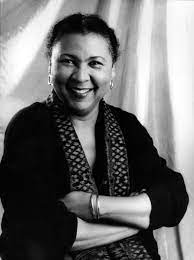
On December 15, 2021, the world lost the great feminist theorist, teacher, activist, and writer bell hooks. As a white feminist theorist, I valued immensely the ways her work widened my partial perspective, challenged my blind sports, and gave me important viewpoints on everything from sexism, racism, classism, pedagogy, militarism, work, and parenting. Her piece on feminist solidarity is the best I know — examining not just the ways we are divided by classism and racism, but also by sexism, addressing the very real and destructive ways that women undermine, abuse, and disregard each other, and how important it is to unlearn this with each other. She used the term “feminist movement,” rather than the feminist movement, knowing it not to be one thing, but rather a verb, a process of moving, changing, and transforming. Championing the power of coming to voice, she spoke truth to power, engaging in honest exploration of often difficult and divisive topics. It was this honest, liberatory voice that spoke throughout her work and made her voice so compelling, and so valuable.
Moderator’s note: Today’s post has been paired deliberately with yesterday’s archivalpost by Mary Sharratt. Both pay homage to Margaret Fell in very different yet complementary ways.
In the conservative evangelical church world—a world I was deeply invested in for most of my twenties—people often spoke of Christian feminism as if it appeared for the first time in our generation, or maybe one generation prior. I’m not totally sure why I accepted this as true—but I did, for a long time. It wasn’t until seminary that I learned otherwise.
It turns out that the dream of full, real, felt equality for women within Christianity is a very, very old dream. The history of women in church is a great deal more complex than I had assumed, or been led to believe. Over the course of two thousand years of Christian history, women have fought for, and sometimes experienced, freedom to lead and minister and be fully human.
Moderator’s note: This marvelous FAR site has been running for 10 years and has had more than 3,600 posts in that time. There are so many treasures that have been posted in this decade that they tend to get lost in the archives. We have created this column so that we can all revisit some of these gems. Today’s blogpost was originally posted March 6, 2019. It is paired with a new guest post abut Margaret Fell which will be posted tomorrow. You can visit the original post here to see the comments.
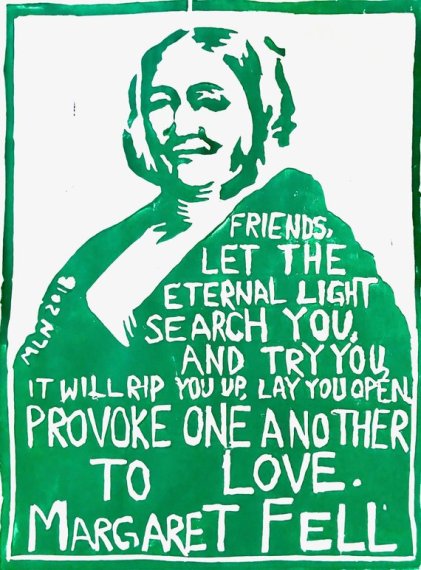
This linoprint of Margaret Fell can be orderedhere.
Pendle Hill will forever be associated to the Pendle Witches of 1612 who live on in the undying soul of the landscape and its folklore and who inspired my 2010 novel, Daughters of the Witching Hill. Pendle Hill also gave birth to the Quaker movement.
In 1652, George Fox, a simple weaver’s son and cobbler’s apprentice turned dissenting preacher, wandered across England on a spiritual quest. When he climbed Pendle Hill, his revelation came to him—an event that would change both Fox and the world forever. He envisioned a “great multitude waiting to be gathered.”






 Feminism and Religion