The Flesh Made Word: Colm Toibin’s “The Testament of Mary” on stage and in print By Joyce Zonana

Colm Toibin Fiona Shaw Testament of Mary Ephesus Artemis House of the VirginBefore the play begins, the audience is invited on stage; we walk around, not quite knowing what to do, gazing at the props, uncertain.  A few chairs, scattered jars of honey, jugs of water beside a free-standing waist-high faucet, a tall ladder, a long table, a stripped tree trunk with a wooden wheel at the top suspended from the rafters, a menacing roll of barbed wire, and a live turkey vulture occasionally spreading wide its iridescent blue-black wings: such is the set for Deborah Warner’s searing production of Colm Toibin’s The Testament of Mary, a one-woman show currently in previews at the Walter Kerr Theater in New York.  In a large open-sided box, stage left, the actress Fiona Shaw, draped in blue from head to toe, arranges herself, then sits perfectly still, holding a lily and an apple.  We know this woman.  The Virgin Mary.  The Icon.  Incarnate.

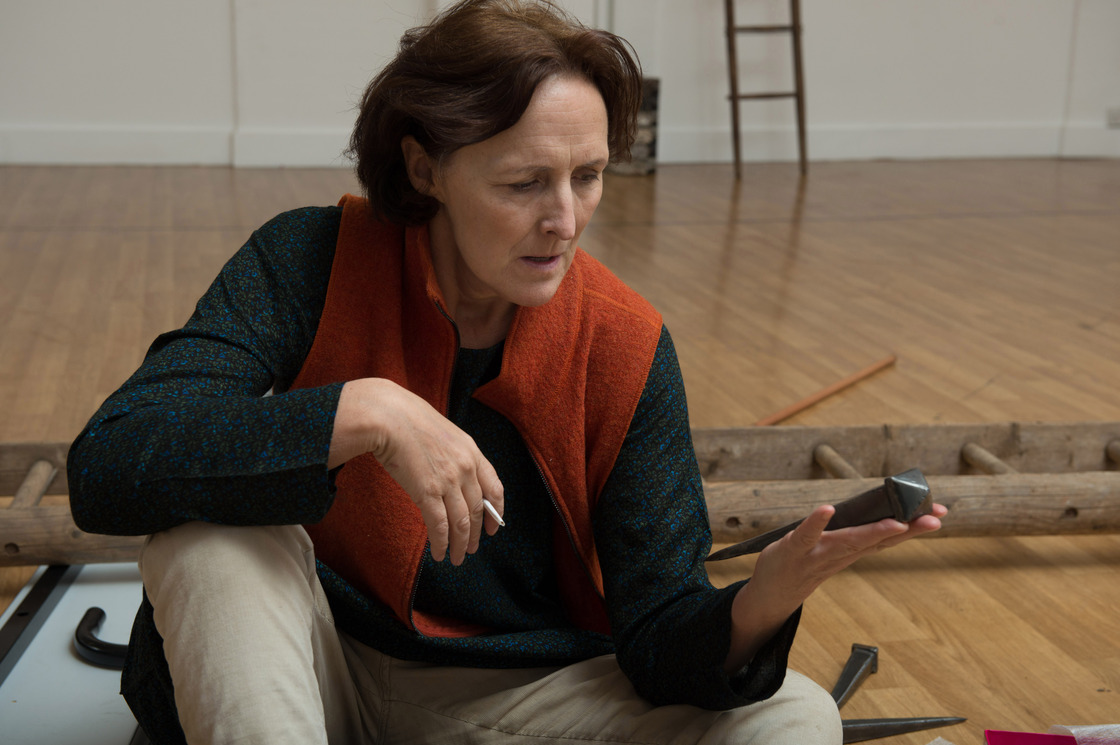
Fiona Shaw rehearses for her role as the Virgin Mary in The Testament of Mary. Irish novelist Colm Toibin's one-woman play opens April 22 at Broadway's Walter Kerr Theater.
Shaw in rehearsal. Photo by Hugo Glendinning

But when we are all back in our seats, Mary casts off her robe to stand before us in a simple black shift, flowing easily over narrow brown pants. Her hair is cropped, her face haunted; wearing short leather boots, she fumbles as she searches for a hand-rolled cigarette to steady herself.   “I remember everything.  Memory fills my body as much as blood and bones.”  No longer an icon, hardly a virgin, this Mary addresses us with the piercing directness of the passion she has suffered: to have seen her only son crucified despite her efforts to save him. Now, interrogated by two unnamed apostles (John and Luke?) who want to fix the story of her son’s life and death and resurrection, Mary insists on reporting only what she knows:  “I was there.  I fled before it was over but if you want witnesses then I am one and I can tell you now, when you say that he redeemed the world, I will say that it was not worth it.  It was not worth it.”

Continue reading “The Flesh Made Word: Colm Toibin’s “The Testament of Mary” on stage and in print By Joyce Zonana”

“Am I Crazy?” Loving Laura Dern by Carol P. Christ

carol p. christ 2002 color“Am I crazy?”

“No, just full of hope. You got more hope than most people do. It’s a beautiful thing to have a little hope for the world, you know.”

This question was posed by Amy Jellicoe, played by Laura Dern, at the end of the HBO television series Enlightened.  Unemployed, single, and in debt after she was fired for “whistle-blowing” on the corrupt activities of the corporation where she worked, Amy wondered if she had done the right thing.  The answer of her ex-husband Levi  brought tears to my eyes.

In many ways, I am Amy.

Let’s begin with the obvious.  When I was young, I was slender and pretty and exceedingly tall, with long blonde hair—I imagine I looked like Amy.  I couldn’t take my eyes off Laura Dern. There just aren’t many women in the world as tall as I am. Because of that I don’t know what I look like to others.  In the series, Laura Dern is taller than just about everyone else, including the men, and she seems not to care, because she often wears high heels.  Continue reading ““Am I Crazy?” Loving Laura Dern by Carol P. Christ”

What Does Exclusivism Feel Like? Part II by Janice Poss

This is part two of a post started yesterday. At the end of it I asked why a woman cannot be a follower of St. Ignatius and a Jesuit.

The days of separating religious communities because rape is a possibility should be behind us–as we all know separating the sexes does not prevent rape anyway.  Let’s get real, if I can understand the Ignatian exercises, use them in discernment, prayer, and reflection, understand the concepts and gain the graces, through doing them in a similar fashion as male Jesuits, what’s the big mystery, what’s keeping me out of the Jesuits–except that that it is a male club that is exclusive.  Exclusion of any kind is oppressive, whether it is for racist, sexist, or other reasons.

Communities based on separation and exclusion because of sexual temptation ignore the simple fact that all people need to be responsible for their own actions.  Male religious in exclusivist communities are like the Iowa  dentist who fired his assistant because she was “too” good looking.  He said could not control his own urges, his own temptations.  An all-male court was unanimous in upholding his right to fire his assistant of more than 10 years. Is not an all male court a biased court? The woman in question certainly did not get a decision rendered by her peers!

That such a trial could even take place is an aberration of colossal proportions and reeks of the male, misogynist, supremacist backlash that is going in society right now in America and everywhere.  Continue reading “What Does Exclusivism Feel Like? Part II by Janice Poss”

What Does Exclusivism Feel Like? Part I by Janice Poss

In the last few weeks of 2012, a sister parishioner recommended I read Transforming Knowledge by Elizabeth Kamarck Minnich.  Many in academia perhaps have already read this book, but I am just getting to know the world of scholars and have found this book refreshing.  It puts its finger on the messy entangled core issues that we grapple with on this blog site.

Minnich enumerates errors prevalent the way we think, suggesting that we need to restructure knowledge traditions that privilege the few and create “higher/lower” thinking, categorical “kind” thinking, and hermeneutical circles of presuppositions that only get reinforced time and again.  Such circles are never broken into by any other thoughts or ideas because they are believed to be epistemologically and ontologically normative.

Imbalances that start in academic disciplines and then trickle down to and through society at large in all areas, not just religion, must be brought into consciousness so they can be corrected with new thinking that no longer oppresses those outside these circles, but brings them into the dialogue so that new more creative thinking happens.  The point is to level the playing field, but not to relativize knowledge.  The goal is create a new way of thinking that is a diverse and pluralistic.

Much that currently passes for reasoning is based on four errors in thinking that Minnich identifies as:

  • faulty generalizations – thinking that uses the few to create maxims about the many;
  • circular reasoning – thinking that reinforces its major premise over and over again without evolving even in the view of new information that might refute the original thesis;
  • mystified concepts – thinking evolving out of circular reasoning by surrounding the idea in a mythical membrane of illogically, believed legends that endure;
  • partial knowledge – one-sided thinking that refutes impartiality never considering the whole picture. Continue reading “What Does Exclusivism Feel Like? Part I by Janice Poss”

What Is Love? by Jassy Watson

Jassy_Agora1-150x150I asked this question at the family dinner table, on facebook, and by e-mail.  Many heartfelt responses were offered, all insightful. Some spoke of romantic love, sexual love (eros), self-love, spiritual love, the love a parent has for a child, unconditional love (agape), primal love, authentic love, universal love, divine love, the source of love, friendship (philia), love of nature, and love of a pet, while others considered the destructive nature of love. What was demonstrated by these conversations was that not only are the possibilities of love’s expressions endless, but there can ultimately be no right or wrong answer when it comes to the meaning of love. Our cultural, familial, religious and spiritual backgrounds all play a part in the way we think and feel about love.

I was raised in a secular, middle-class, two parent, two children, cat, and sometimes a dog kind of family. Despite the usual ups and downs, our family life was full of love. I remember having feelings of love as a child that were so incredibly overwhelming I would be brought to tears. I loved everything and everybody. Mum still reminds me that if I could have, I would have brought every elderly person along with every stray animal home to look after. After reading about the process view in Carol Christ’s book She Who Changes: Re-Imagining the Divine in the World, I see now that this love I felt was born out of feelings of deep sympathy.

Because we did not have a religious or spiritual background, I had no idea what divine love meant. My idea of the divine was the male, Christian, biblical God that our family rejected. It is said that Christian love is selfless and is best seen in actions such as compassion and kindness. This may be so. But selflessness, compassion and kindness are not limited to Christian values. They are human values. In his book The Art of Happiness, the Dalai Lama says that “love and compassion are necessities, not luxuries. Without them humanity cannot survive”. All religious, spiritual and philosophical traditions speak of the values of love. They say that love encompass compassion, kindness, selflessness, acceptance, gratitude, sympathy, sharing, grace, justice, charity, and liberation. They also speak of tension, wrath, discomfort, unkindness, loss, and judgement. For me, love is all these things and more.

Ancient myths address these values of love through tales of passion and devotion. Diane Wolkstein celebrates some of these myths in her book The First Love Stories. Each story expresses a distinct aspect of love. For instance: the tale of Isis and Osiris represents love that is stronger than the forces of nature, Innana and Dumuzi expresses the cyclical quality of love; Shiva and Sati reveals the eruption of passion and the taming of the mind; the Song of Songs celebrates love’s yearning; the story of Psyche and Eros portrays the forging of the self. All of these stories emphasize the sacred nature of love.

For me, having children awakened a love so very deep within. When I gazed into the eyes of my first born son at the tender age of 18, I was so overwhelmed by love I thought my heart would burst. I now have four children a husband and a loving extended family and friends who all teach me much about the true nature of love. They teach me above all else that love is patient, non-judgmental, and unconditional. It is through the growing awareness of my spiritual being and my journey with the Goddess that love has become something deeper than I ever thought possible. Love, for me has become a union with something higher than my individual self. My love extends beyond the family to include every living being on this planet and beyond. It is not just all about giving and receiving, but rather it is a state of being. It is personal yet universal and comes from deep within my sub-conscious. Love for me, not unlike the tales woven in ancient myth, is profoundly sacred.

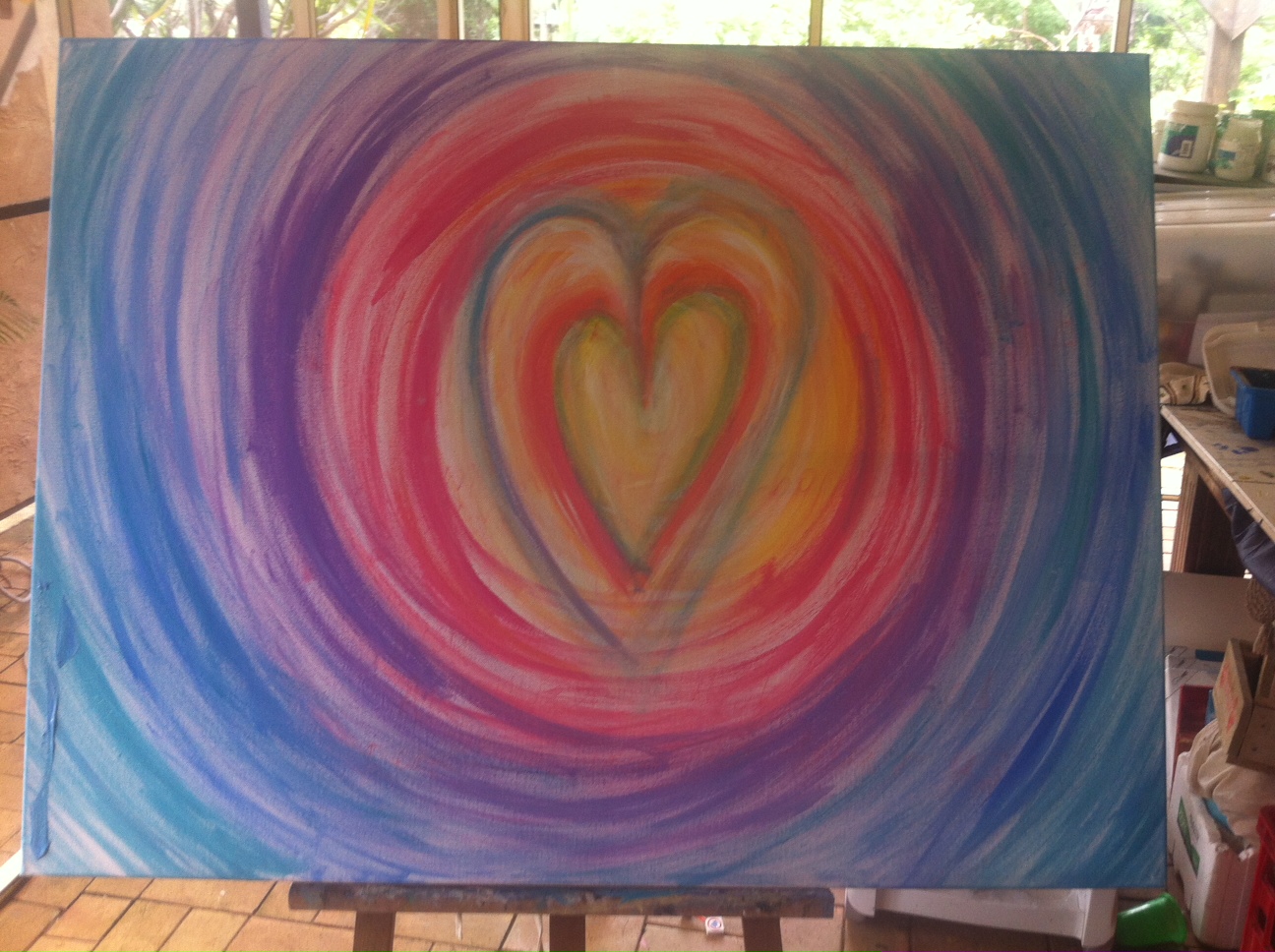
Embodied with love I set out to create my next painting. Out of this portal of love:


Portal of love, WHAT IS LOVE?  by Jassy Watson

Aphrodite, Goddess of love, pleasure and relationships, in all her glory was born. Continue reading “What Is Love? by Jassy Watson”

Where Were the Women? by Kat Robb

Kat Robb, BunniHoTep, goddess

Where were the women? I grew up in the Presbyterian Church, and it wasn’t until I was in my late teens that I ever saw a woman offer a prayer in church. That was when they hired a woman with a Masters of Divinity to be an Associate Pastor in charge of Christian Education, meaning they had hired another woman to be in charge of Sunday School and this one had a higher degree. I, very early on in my Sunday School career used to ask, why can’t women pray in front of the church? Why can’t women give the sermon? Why is the only place girls are allowed to be in the front of the church, the choir loft? Why do we only mention Mary at Christmas? Why was Eve bad and not Adam? Why is it all right for Mary to be an unwed mother but not me? My Sunday School teachers loved me.

The answer for prayer was that you can pray anywhere you are because it’s your conversation with God–but I would ask if that is true, then why aren’t  we allowed up front? No one ever had a good answer  for that.  Continue reading “Where Were the Women? by Kat Robb”

Mormons Who Advocate Women’s Ordination by Caroline Kline

Kline, CarolineA couple of months ago, I came across the “Ordain a Lady” video by the Catholic Women’s Ordination Conference. Even though it was lighthearted, clever, and fun, it made me cry. Why? Because as a Mormon feminist, I had never seen such confident assertions on video for the need for women’s ordination:

“Woman priest is my call
Women preaching for all
Don’t listen to St. Paul
‘Cuz I can lead the way”

I felt chills run up my spine as I watched these women asserting their strength, their vision, and their truth. Amen, I said to myself. Indeed, “Justice doesn’t look like only male priests.” As this video circulated among various Mormon feminist email lists, several other women mentioned that this video brought them to tears too. Continue reading “Mormons Who Advocate Women’s Ordination by Caroline Kline”

What Might It Be Like To Live In A Matriarchal Society Of Peace? Can You Imagine? by Carol P. Christ

carol p. christ 2002 colorThere are many reasons for women, slaves, and the poor to rebel against domination and unjust authorities in patriarchal societies. But we should not assume that there are any reasons to rebel against domination where no domination exists or to rebel against unjust authority in societies where there are no unjust authorities.

In response to my recent series of blogs on patriarchy as a system of male dominance created at the intersection of the control of female sexuality, private property, and war (Part 1, Part 2, Part 3), I was asked if there is an injustice inherent in matriarchal societies that caused men to rebel and create patriarchy.

The assumption behind this question is that if women are dominated by men in patriarchal societies, then men must have been dominated by women pre-patriarchal societies. Lurking behind the question is the further assumption that there must have been “a good reason” for the development of patriarchy. The idea that there is “no good reason” for patriarchy to exist–if “good” means fair and just–is just too painful for many of us to want to consider it.

The missing link is our inability to imagine societies without domination.

According to Heidi Goettner-Abendroth “matriarchal societies” are “societies of peace” in which neither sex dominates the other.

Continue reading “What Might It Be Like To Live In A Matriarchal Society Of Peace? Can You Imagine? by Carol P. Christ”

The Body of Goddess by Deanne Quarrie


In the earliest of times, I believe, humans did not see themselves as separate from all that was around them.  All of life was known as interdependent.  This is how I see it today.  When we are born, we are born to a mother.  Our lives are solely dependent on her for survival.  We are birthed by her, nourished by her, protected by her, and sometimes forced out to experience on our own, by her.  She is at first, our own Original Uncultured Mother.  Once we move from her shelter, we begin to experience our world in the same way, looking not only for what nourishes, what protects and what shelters, but also for what we need to be mindful of for our own safety, those forces far out of our control.  Those forces, which were uncontrollable, the ancients held in high esteem, and honored with reverence.    Continue reading “The Body of Goddess by Deanne Quarrie”

Your Body is the Body of the Goddess by Marie Cartier

My body is the body of the goddess—witches and shamans and other magical beings (including humans) chant this in spring ritual …and other times of the year as well.

But as we prepare for spring equinox, I thought I would use my blog this March to give the Feminism and Religion community a chakra mediation for spring ritual and renewal. Spring is here. Your body is the body of the goddess. If desired, please say the following aloud or silently, participate in the suggested breathing exercise and allow yourself to sink deeply into the body that is yours and is part of the season– the awakening of spring.

Breathe deeply: in and out; in and out; and in and out. Continue reading “Your Body is the Body of the Goddess by Marie Cartier”