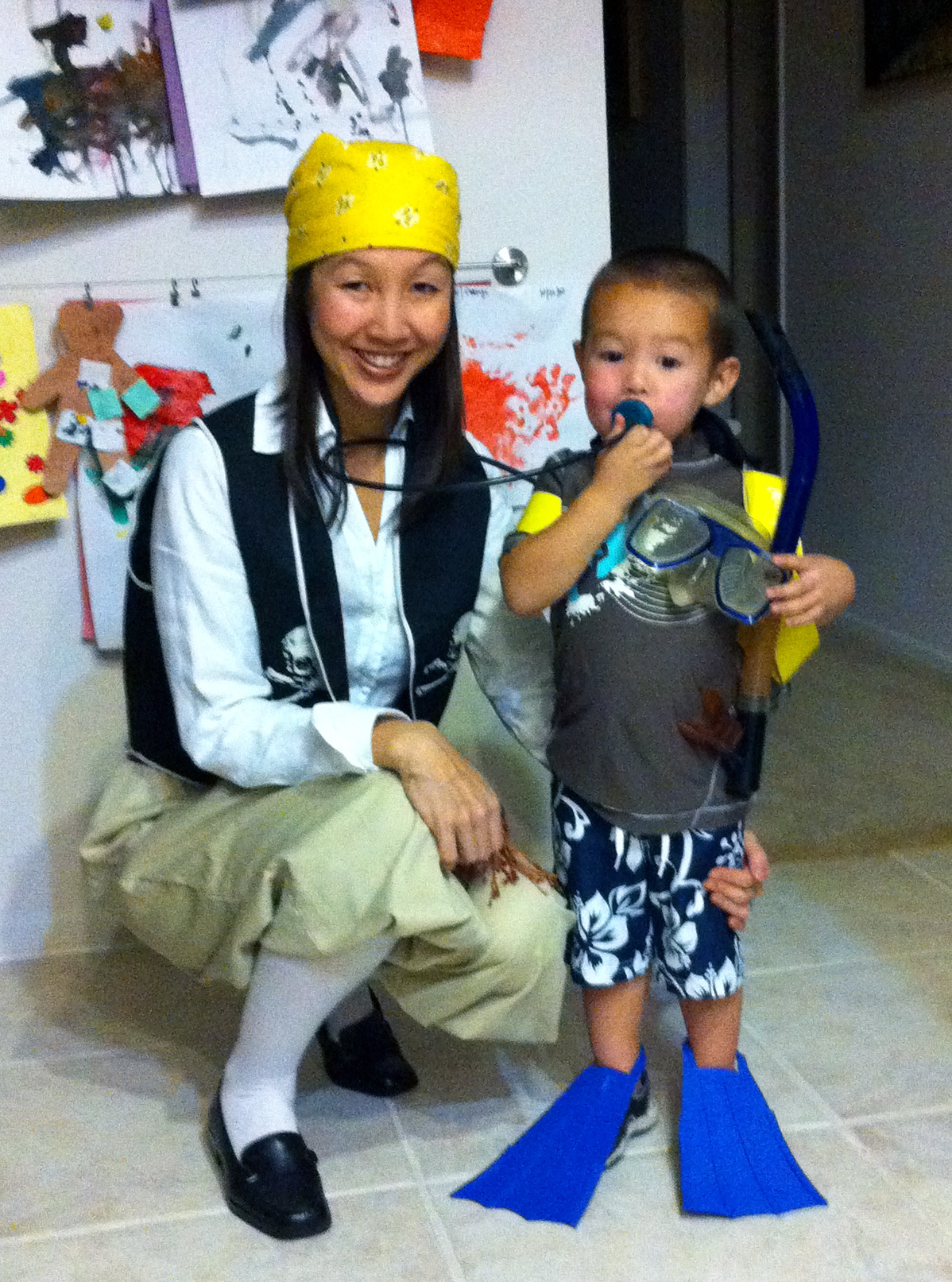
“I had realized that my parents legitimately had more important things to do than to carve pumpkins or buy costumes. But as a young child, I equated participating in the cultural phenomenon that is Halloween with being an American. I, as a daughter of immigrants, just wanted to fit in and join the fun.”
Category: General
Seeds of Hierarchy By Xochitl Alvizo
Last month I was at an event that I helped organize. Inevitably I was here and there and everywhere: greeting people, making sure things were in place, answering questions, and taking pictures (I’ve been the official ‘unofficial’ photographer at this event for 4 years now). But, the one thing that will stick in my memory was the reminder that the little things count: “What we are doing in the present is creating the future, is the future.”[1]
You see, while I was taking pictures of people at one of the tables I ended up in front of someone I had not yet met, so I introduced myself and asked him his name. After he told me his name, Joe – a first year masters student, immediately proceeded to tell me how intimidated he was by me. He told me that I was famous and that he got so nervous each time I came around that he tried not to look at me because he wouldn’t know what to say. (Obviously he couldn’t have been truly intimidated since he was able to tell me all this – but the lightning speed in which he talked and his obvious nervousness made me realize there was some truth to what he was expressing). Continue reading “Seeds of Hierarchy By Xochitl Alvizo”
Outsider Looking In: A “Tradition” of a Different Name By John Erickson
The following is a guest post by John Erickson, doctoral student in Women’s Studies in Religion at Claremont Graduate University. His research interests involve an interdisciplinary approach and are influenced by his time as the director of a women’s center and active member in the GLBTQ and women’s rights movements. His work is inspired by the intersectionality of the feminism, queer identity, and religious political and cultural rhetoric. He is the author of the blog, From Wisconsin, with Love and can be followed on Twitter at@jerickson85.
I often read on this blog about the effects various religious traditions have on people’s personal and professional psyches. As I sit in class, I listen to people tell their harrowing stories of how they “escaped” restrictive religious practices or were able to “work within” their religious community to attempt to or even in some cases create the change they wanted to see.
Although I enjoy listening to my peers talk about the issues that have followed them along throughout their life, I find myself struggling to personally validate these experiences in relation to my non-religious background. More specifically, I want to associate with your feelings but I just cannot seem to relate in any way no matter how hard I try. Continue reading “Outsider Looking In: A “Tradition” of a Different Name By John Erickson”
Anita Caspery, IHM: Prophetic Icon of Renewal By Cynthia Garrity-Bond
this we were, this is how we tried to love,
and these are the forces they had ranged against us,
and these are the forces we had ranged within us,
within us and against us, against us and within us.
Adrienne Rich
Last week a colleague of mine forwarded the sad news that Anita Caspary, IHM, had died at the rich age of 95. This was the same day (October 5) that Steve Jobs passed away from his battle with pancreatic cancer. The tension between the two figures was not lost on me. The death of Jobs, an icon of ingenuity and leadership, wonderful husband and father, is mourned throughout the world. The life and legacy of Anita Caspary will be remembered and mourned as well, but by comparison, on a much smaller scale. That’s unfortunate, because the life and legacy of Caspary as an instrument for change in the lives of Catholic women in general, and Women Religious in particular is what legends are made of.
As an IHM sister, Caspary was teacher, poet, author, and president of Immaculate Heart College (1958-1963), but is best known in her role as Mother General Sister Humiliata (1963-1973) of the IHM’s. In Witness to Integrity, Caspary dramatically chronicles the painful struggles and controversies between the IHM sisters and Cardinal Archbishop of Los Angeles, James Francis McIntyre, in which 600 IHM Los Angeles nuns were released from their canonical vows in 1970. Released because of their self-determination in remaining at the center of their religious fidelity and thought by putting into practice The Second Vatican Council’s Decree on Up-to-Date Renewal of Religious life, or Perfectae Caritatis. Addressed to priest and religious, this decree sanctioned the exodus from the middle ages for the sisters by insisting they join the modern world in both dress and discernment of vocation that best utilized each sister’s talents. In an exert put forth from the 1967 Decrees of the Ninth Chapter, the IHM community clarify their position for renewal: Continue reading “Anita Caspery, IHM: Prophetic Icon of Renewal By Cynthia Garrity-Bond”

The Misbegotten Male: Male Sex-Selection & Female Abortion By Cynthia Garrity Bond
Mary Daly: My Springboard Into Critical Feminist Thought By Katie Driscoll
This post is written in conjunction with the Feminist Ethics Course Dialogue project sponsored by Claremont School of Theology in the Claremont Lincoln University Consortium, Claremont Graduate University, and directed by Grace Yia-Hei Kao.
Katie Driscoll is pursuing an MA in the Applied Women’s Studies Program at Claremont Graduate University and is participating in the Feminist Ethics Course Dialogue project.
Mary Daly, a professor of theology at Boston College, is known as a radical feminist, one who is widely understood to have epitomized the stereotypical “man-hating femi-nazi.” Daly earned the latter title as the result of a dispute with Boston College concerning her supposed refusal to grant male students admittance into her classes. This dispute ultimately resulted in Daly’s retirement from Boston College in 1999. Somehow, Daly remained a presence on campus, attending panels and other events for years to follow. I had the privilege of meeting her twice while attending BC between 2002 and 2006. I cannot claim that she was particularly warm or personable. She was actually quite cold and demanding. While I was never close to Mary Daly, I feel that I owe her my deepest gratitude for her role in my Self-discovery. I would like to take this opportunity to reflect upon her influence in my life and, utilizing the insights of some of Daly’s former colleagues and students, to set the record straight regarding her alleged refusal to allow men into her classes. Continue reading “Mary Daly: My Springboard Into Critical Feminist Thought By Katie Driscoll”
Infantilizing Women, Sexualizing Girls By Grace Yia-Hei Kao
The Real “Affirmative Action”: Musings on Race, Class, and Gender in the Religious Academy By Egon Cohen
Egon Cohen is completing a Master of Theological Studies at Brite Divinity School in Fort Worth, Texas. His research focuses on gender, sexuality, ethics, hermeneutics, and the intersection of liturgical praxis, politics, and BDSM. Egon likes riding motorcycles and eating Haribo gummibears. He is secretly still 10.
According to the Association of Theological Schools, about 1,100 students enroll in Ph.D. programs at divinity schools and seminaries in theU.S.each year. And hundreds more enroll in graduate religion departments at public and secular universities. However, job postings on theAmericanAcademyof Religion, Society of Biblical Literature, and Chronicle of Higher Education websites suggest that in any given year there are only around 200 tenure track openings in the field. Needless to say, those of us who are pursuing academic careers in religious studies/theology are a bit nervous (and if we aren’t nervous, we should be).
So, when we’re not discussing all the fun God stuff, grad students in theology often spend our time talking about our (lack of) job prospects. And there’s a common refrain that almost invariably surfaces. My friend, Mr. X, put it rather eloquently the other day: “My dad told me that I need to work extra hard—after all, I’m a white male trying to get a job in theology.” Continue reading “The Real “Affirmative Action”: Musings on Race, Class, and Gender in the Religious Academy By Egon Cohen”
Religious Mestizaje by Xochitl Alvizo
Some have said that all theology is autobiographical. Whether this is always the case or not, in my case, it is absolutely true. I came to the topic of religious mestizaje because of my own need to make sense of the fact that I fully identify as a Goddess loving person as well as a Christian-identified one. I have made reference to this before on this blog; I have admitted that even after my feminist awakening, even after coming to love and practice Goddess spirituality, even after reading all of Mary Daly’s books (some of them more than once), I have chosen to affiliate with Christianity all while also maintaining my Goddess devotion nonetheless. Therefore, Gloria Anzaldua’s understanding of mestijaze, and religious mestizaje in particular, has contributed to the ongoing revision of my religious identity.
The word mestiza or mestizo is born of the incarnation of hybridity and diversity.[1] Historically mestizaje is the new hybrid race, a reference to Mexicans who are the mixed people born of Indian and Spanish blood in the 16th century.[2] The Spanish invaded the land now called Mexico, and in partnership with rival tribes, conquered the Aztec people. Oscar Garcia-Johnson, in his book A Mestiza Community of the Spirit, states that mestizaje “represents a hub of dehumanizing stories and self-empowering templates.”[3] Thus, there is an inherent violence implied in mestizaje as the word originated, and this violence is also implied in my Goddess Loving Christian mestizaje. Christianity has been the cause of much harm and dehumanizing violence, especially in its relationship to women, and really is in need of transformation and self-empowering templates. The origin of mestizaje implies the violence of one tradition or people dominating and suppressing another and the reality that new life, a new people and tradition, find a way nonetheless; I think this is part of what leads to my religious mestizaje. The new ‘way’ that I have found has taken form in a Goddess Loving Christian religious practice that reflects the concrete embodied reality of my experience – a religious practice that is always negotiated with a community of people. .
Reflecting on the Construction of Race as our National Identity Shifts By Helene Slessarev-Jamir
The following is a guest post written by Helen Slessarev-Jamir, Ph.D., Mildred M. Hutchinson Professor of Urban Studies at Claremont School of Theology. Her research focuses on the character of religiously inspired justice work in response to globalization and American empire. Helene is a member of the Board of Directors and writes for Sojourners; she has authored multiple articles and books including most recently published Prophetic Activism: Progressive Religious Justice Movements in Contemporary America.
Today my son Stephan celebrates his 31st birthday. In the year Stephan was born he was one of very few bi-racial children in the U.S. I personally knew of no one else who had a bi-racial child. His father and I agreed that given the racial realities of the U.S. in 1980, he needed to be raised as an African-American because that was how he would be perceived. We consciously constructed Stephan’s identity as black.
We lived on the Southside of Chicago in an all-black neighborhood. Yet, when he was ready to enter elementary school, I was advised to register him as “white” so that he would have a better chance of being admitted into the local public magnet school. Having resisted any significant plans to desegregate its public schools, the Chicago Board of Education used racial diversity as one of the main criteria for admission into their magnet schools. As a result, Stephan became one of the “white” children in his 1st grade classroom even though all the faces in his school photo were varying shades of brown. Continue reading “Reflecting on the Construction of Race as our National Identity Shifts By Helene Slessarev-Jamir”