I learned, recently, that this is a common phrase among my family members – “an hour of life, is life.” I remember the first time I heard my mom use the phrase, not more than a few years ago, I latched onto it immediately. Since then, I have realize that many of my relatives use the phrase – it’s kind of a family mantra, which makes sense, then, that when I heard it, it reverberated within me—“Yes! An hour of life is life.”
To me it was a clarion call to not waste a single hour – to never think, “Oh, but I only have an hour…” and instead embrace the hour for all its potentiality—I have an hour, what will I do with it?
Leaving chores behind I bundled up and grabbed a trowel and drove between still waters to my beloved forest. The premature snow had melted, cracked ice created fantastic glittering patterns in shallow waters informing me that it was probably too late to dig plants for the frog house. Al, scientist, scholar and naturalist, Owl, my friend had just given me a terrarium, someday to become a frog house… my intention was to gather moss and jagged pieces of lichen covered bark…maybe a partridgeberry or two for both of us. Coming here to Hemlock Hollow seemed like just the right place. I also had come to say goodbye to my friends the Hemlock trees for the winter season…
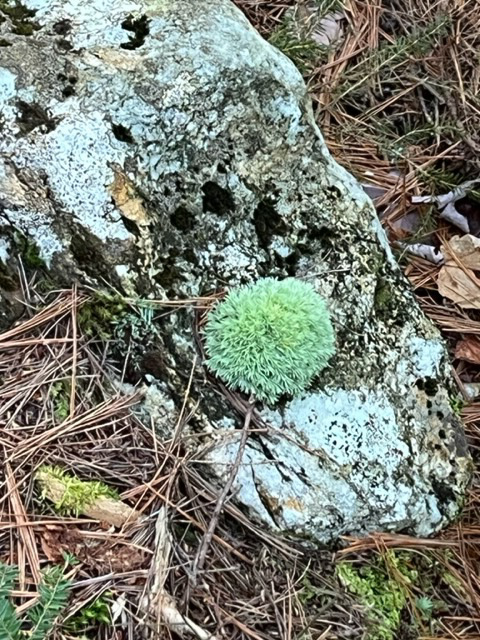
At first, I scrambled around disappointed that most plants were frozen in including the sphagnum moss. Not wanting to disturb sleeping plants, I lifted pincushion and red stemmed moss that grows quickly and visited an old log ripe with rich soil and rotting sides which came away easily. This decaying wood would make walls for my frogs to cling to as vines crept up the sides. Picking up lichens on old sticks, I also uprooted two tiny hemlocks growing on a log that would thrive in a moist environment. Satisfied, that a little of this forest would spend the winter with me I returned to the car with enough bounty to satisfy both Al and me. I was going to give him and his frogs more than half of what I gathered as a surprise.
Towards the end of Braiding Sweetgrass, mother, biologist, and member of the Citizen Potawami Nation Robin Wall Kimmerer sets out at the end of winter to visit a forest area near her home that she considers hers not in name but in virtue of her love and care for it. On arriving, she discovers that the forest is no more, having been clear-cut by the owner. The wildflowers and the plants she has harvested over the years have sprouted up, but Kimmerer knows that without the forest cover they will be burned by the sun and their places taken by brambles.
Kimmerer is overcome by anger and despair, her feelings for the land she loves merging with her knowledge that not only her forest, but the earth itself is being treated as nothing more than a product by so many—without second thought for all that is lost.
This week’s Torah portion is Vayeishev, Genesis 37:1-40:23. The portion covers too much information to address it adequately in one post. Therefore, in this post, I will examine, from a feminist perspective, Joseph, the women in his life, and dreams. While the women in Vayeishev leave much to be desired, its dreams point to an important connection between humanity, divinity, and nature.
Vayeishev starts with the raw jealousy that some of Jacob’s sons have for Joseph. This jealousy is so great that it sends Joseph all the way to Egypt. As a feminist, I have always found it both comforting and completely realistic the way the Torah delves into emotion. Since even the lofty patriarchs are jealous, no superhuman behavior is expected of us. Despite this comfort, I am not happy that it is once again men and boys who take centerstage. We know that these men and boys also had women and girls in their lives.
I have long struggled with winter. I grew in Minnesota where winters were long and brutally cold. I remember hauling myself through hip-deep snowdrifts on my walk to elementary school and that was in the suburbs! The North of England, where I lived for nearly twenty years, has a much milder climate. But being so far north, I was plunged into infernal darkness from Halloween to Candlemas. It started getting dark at 3:30 in the afternoon and by 4:00 it was pitch dark. Remember those horror movies where it’s dark ALL THE TIME?? That’s Lancashire in midwinter. I felt I was trapped inside some brooding gothic novel.
Now that I’ve moved to the Silver Coast of Portugal, I get a lot more daylight in winter, but also storm winds and torrential rain. My Welsh pony is not impressed!
Author’s Note: Today’s post is the 4000th FAR blog post! I first became aware of the Feminism and Religion blog when participating in a symposium honoring the life and work of Carol P. Christ in October 2021. I was inspired to write a piece on Christ’s contribution to ecofeminism, that was posted in the FAR blog a year ago today. I wanted to post another piece on Christ on the anniversary of that first post. I’m delighted that it is the 4000th, and so fitting that it is written in honor of Carol Christ, who was such an important part of the FAR blog.
A while ago, a friend asked me what spiritual reading I’d been doing lately. I told him that I’d been revisiting classics from the past. When he asked me who specifically, the first name I mentioned was Carol Christ. Even though he was a minister, he had never heard of her. Sadly, I suspect the same would be true for the vast majority of ministers, priests, rabbis, theologians, and other religious leaders. Yet, I can think of no one who has had a greater influence on my religious and spiritual thought and beliefs.
Thirty years ago, Carol P. Christ founded her Goddess Pilgrimage to Crete, which she wrote about in her book A Serpentine Path: Mysteries of the Goddess (original 1995 title Odyssey with the Goddess) and in numerous posts on this site over the years. She led over 40 groups of women Pilgrims to encounter the history and sacred sites of the peaceful, egalitarian civilisation of Bronze Age Crete.
Here, the Goddess-honouring culture of Old Europe survived the longest, when patriarchal Indo-Europeans were taking over in the ‘Kurgan waves’ Marija Gimbutas has described. The sophisticated artworks of ‘Minoan’ Crete show women in positions of honour and authority, and do not depict violence, slavery, or war. People celebrated at ceremonial centres, made offerings at cave and mountain shrines, and worshipped the Goddess in sacred trees and stones.
As many readers know, before Carol passed away, she asked me to take on the leadership of her Goddess Pilgrimage, and to serve as her literary executor and the director of her Ariadne Institute for the Study of Myth and Ritual. Deeply moved by her trust in me, and guided by very clear dreams I received around the time of her death, I accepted Carol’s request. In October 2022, after a three-year delay due to the pandemic, the Goddess Pilgrimage to Crete was reborn.
Scrooge … became as good a friend, as good a master, and as good a man, as the good old city knew…. Some people laughed to see the alteration in him, but he let them laugh, and little heeded them; for he was wise enough to know that nothing ever happened on this globe, for good, at which some people did not have their fill of laughter….. His own heart laughed: and that was quite enough for him. … It was always said of him, that he knew how to keep Christmas well, if any man alive possessed the knowledge.
You no doubt recognize this as the conclusion of A Christmas Carol by Charles Dickens, who wrote the book in six weeks in 1843 because the holidays were coming and he was nearly broke. He had to earn some money. The book was so immediately successful that it went into a second printing right before Christmas and has been in print ever since. There’s a memorable movie called The Man Who Invented Christmas (2017), starring Dan Stevens as an unstable Dickens. As the movie tells the story, most of the characters in the novel turn up in Dickens’ “real life” and either inspire or force him to write the book. Scrooge (Christopher Plummer) follows him all over London and forces him to confront his childhood. The climax is both dramatic and satisfying.
During the last few years I have spent hours listening to the haunting cries of Sandhill cranes, awaiting them at the river, stunned each time as I glimpsed a flock float to the ground, great gray wings extended to break their fall as talons touched earth, attended to enthusiastic family greetings and muted conversations, felt a sense of devastating loss when these birds circled overhead to say goodbye each year before heading north to breed (while I lived in New Mexico), and then discovering to my joy that they live and breed here in Maine. I still experience the same hunger to glimpse families in Fryeburg each October and lose time watching their loving family dynamics. I continue to feel intense grief and loss at crane leave-taking remaining baffled by the intensity of my own responses. In the last week I think I have finally uncovered the roots of the story behind the cranes and me…
These birds are prehistoric in origin and have the strongest family ties. The families never break up and when separated greet each other joyously even after a few hours as small groups fly to different feeding areas. Incredibly poignant. There is always one that stands watch at night, a protector, so the others can sleep in peace, one leg extended, usually in water. I am in love with these birds but until a few days ago did not understand the powerful pull their presence exerts over me.
This was originally posted on August 26, 2019. It fits in with our new project of Unsung Heroines.
A few days ago while watching the movie The Wife, I kept hearing the words “Ursula Niebuhr, Ursula Niebuhr,” in my mind. I knew the reason was Ursula’s unacknowledged collaboration on the work of Reinhold Niebuhr, which I discovered while writing an earlier blog on uncredited co-authors.
I had not been particularly interested in seeing The Wife because I assumed it was the familiar story of the woman who gives up her career interests when she marries. Want to become a rabbi? Marry one. Want to become an artist? Live with him and become his muse. This is a very old story, and for me, not a very interesting one.






 Feminism and Religion