What Is Love? by Jassy Watson

Jassy_Agora1-150x150I asked this question at the family dinner table, on facebook, and by e-mail.  Many heartfelt responses were offered, all insightful. Some spoke of romantic love, sexual love (eros), self-love, spiritual love, the love a parent has for a child, unconditional love (agape), primal love, authentic love, universal love, divine love, the source of love, friendship (philia), love of nature, and love of a pet, while others considered the destructive nature of love. What was demonstrated by these conversations was that not only are the possibilities of love’s expressions endless, but there can ultimately be no right or wrong answer when it comes to the meaning of love. Our cultural, familial, religious and spiritual backgrounds all play a part in the way we think and feel about love.

I was raised in a secular, middle-class, two parent, two children, cat, and sometimes a dog kind of family. Despite the usual ups and downs, our family life was full of love. I remember having feelings of love as a child that were so incredibly overwhelming I would be brought to tears. I loved everything and everybody. Mum still reminds me that if I could have, I would have brought every elderly person along with every stray animal home to look after. After reading about the process view in Carol Christ’s book She Who Changes: Re-Imagining the Divine in the World, I see now that this love I felt was born out of feelings of deep sympathy.

Because we did not have a religious or spiritual background, I had no idea what divine love meant. My idea of the divine was the male, Christian, biblical God that our family rejected. It is said that Christian love is selfless and is best seen in actions such as compassion and kindness. This may be so. But selflessness, compassion and kindness are not limited to Christian values. They are human values. In his book The Art of Happiness, the Dalai Lama says that “love and compassion are necessities, not luxuries. Without them humanity cannot survive”. All religious, spiritual and philosophical traditions speak of the values of love. They say that love encompass compassion, kindness, selflessness, acceptance, gratitude, sympathy, sharing, grace, justice, charity, and liberation. They also speak of tension, wrath, discomfort, unkindness, loss, and judgement. For me, love is all these things and more.

Ancient myths address these values of love through tales of passion and devotion. Diane Wolkstein celebrates some of these myths in her book The First Love Stories. Each story expresses a distinct aspect of love. For instance: the tale of Isis and Osiris represents love that is stronger than the forces of nature, Innana and Dumuzi expresses the cyclical quality of love; Shiva and Sati reveals the eruption of passion and the taming of the mind; the Song of Songs celebrates love’s yearning; the story of Psyche and Eros portrays the forging of the self. All of these stories emphasize the sacred nature of love.

For me, having children awakened a love so very deep within. When I gazed into the eyes of my first born son at the tender age of 18, I was so overwhelmed by love I thought my heart would burst. I now have four children a husband and a loving extended family and friends who all teach me much about the true nature of love. They teach me above all else that love is patient, non-judgmental, and unconditional. It is through the growing awareness of my spiritual being and my journey with the Goddess that love has become something deeper than I ever thought possible. Love, for me has become a union with something higher than my individual self. My love extends beyond the family to include every living being on this planet and beyond. It is not just all about giving and receiving, but rather it is a state of being. It is personal yet universal and comes from deep within my sub-conscious. Love for me, not unlike the tales woven in ancient myth, is profoundly sacred.

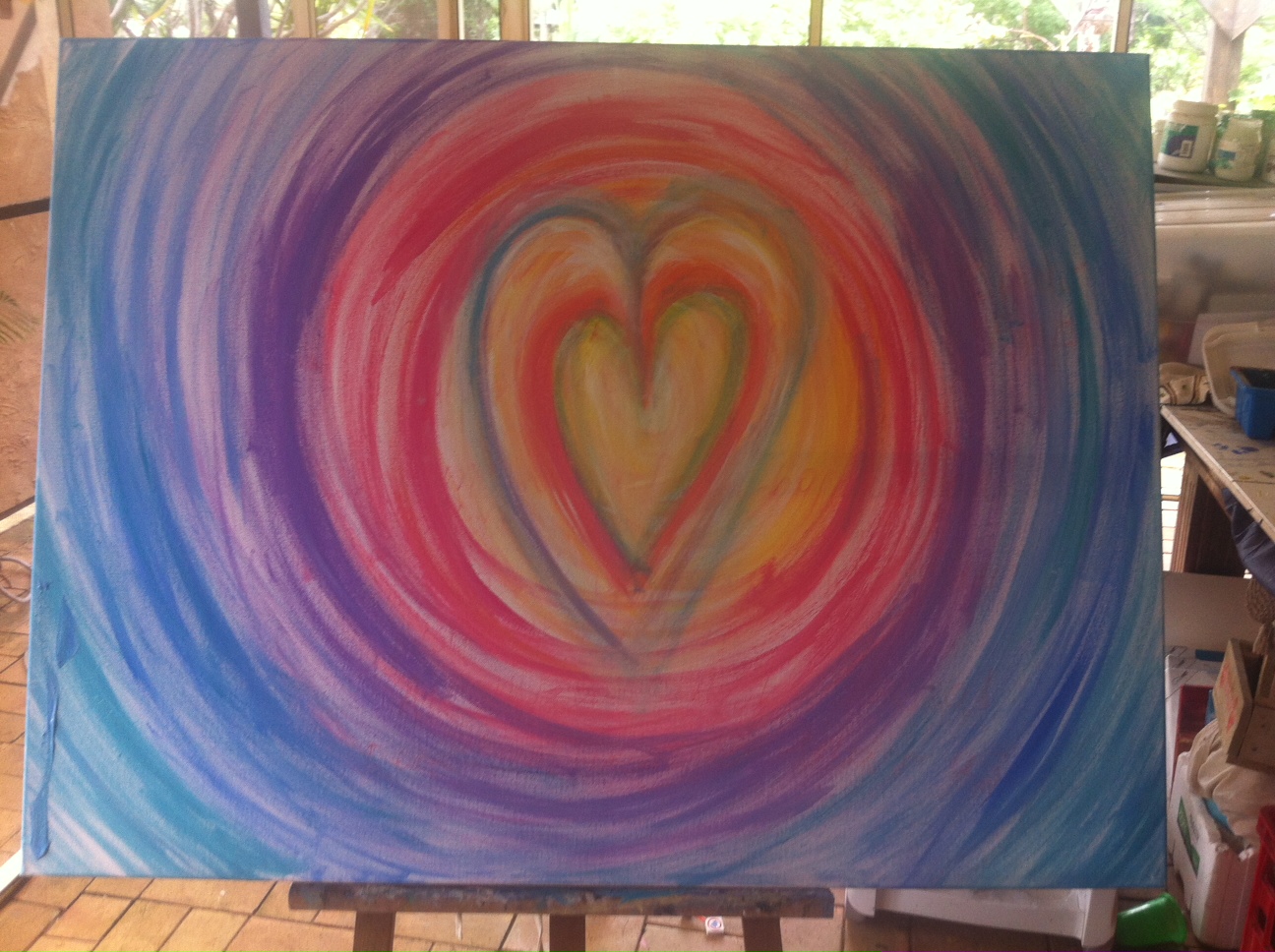
Embodied with love I set out to create my next painting. Out of this portal of love:
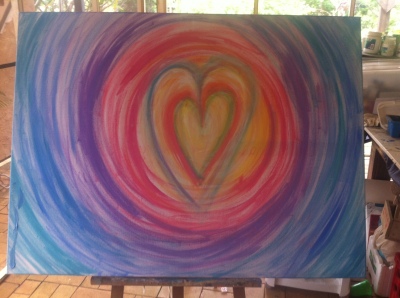

Portal of love, WHAT IS LOVE?  by Jassy Watson

Aphrodite, Goddess of love, pleasure and relationships, in all her glory was born. Continue reading “What Is Love? by Jassy Watson”

Where Were the Women? by Kat Robb

Kat Robb, BunniHoTep, goddess

Where were the women? I grew up in the Presbyterian Church, and it wasn’t until I was in my late teens that I ever saw a woman offer a prayer in church. That was when they hired a woman with a Masters of Divinity to be an Associate Pastor in charge of Christian Education, meaning they had hired another woman to be in charge of Sunday School and this one had a higher degree. I, very early on in my Sunday School career used to ask, why can’t women pray in front of the church? Why can’t women give the sermon? Why is the only place girls are allowed to be in the front of the church, the choir loft? Why do we only mention Mary at Christmas? Why was Eve bad and not Adam? Why is it all right for Mary to be an unwed mother but not me? My Sunday School teachers loved me.

The answer for prayer was that you can pray anywhere you are because it’s your conversation with God–but I would ask if that is true, then why aren’t  we allowed up front? No one ever had a good answer  for that.  Continue reading “Where Were the Women? by Kat Robb”

The Body of Goddess by Deanne Quarrie


In the earliest of times, I believe, humans did not see themselves as separate from all that was around them.  All of life was known as interdependent.  This is how I see it today.  When we are born, we are born to a mother.  Our lives are solely dependent on her for survival.  We are birthed by her, nourished by her, protected by her, and sometimes forced out to experience on our own, by her.  She is at first, our own Original Uncultured Mother.  Once we move from her shelter, we begin to experience our world in the same way, looking not only for what nourishes, what protects and what shelters, but also for what we need to be mindful of for our own safety, those forces far out of our control.  Those forces, which were uncontrollable, the ancients held in high esteem, and honored with reverence.    Continue reading “The Body of Goddess by Deanne Quarrie”

The Child of the Bog (continued) By Barbara Ardinger

The story so far. In the ancient land beside the river, the God-King lies in what appears to be death. No one can awaken him. In the house of a court Magician, the peasant girl Ubastet is dusting and conversing with a magical stork when two minor miracles occur. The Magician consults the Hierophant, but they cannot explain the miracles. Now the Queen has come into the room. She is determined to figure out what’s going on. (Where do they fly to? Romania, another land of great enchantment.)

Before the sun set that day, the Queen of the golden land called a convention of priests and wizards and magicians and astrologers and seers and prophets and physicians. When they had all assembled in the throne room, she set the matter before them. Day after day, the learned ones debated, night after night, they performed their high magics and gorgeous rituals. In their secret places, the animals gathered together as well and performed their own rituals. But the mirror, whose thousand pieces had been gathered up and cleansed and set back into the frame in a sublime mosaic, the mirror refused to speak again. The golden beetle remained cold and silent.

child of the bog, barbara ardinger
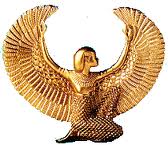
Isis

Continue reading “The Child of the Bog (continued) By Barbara Ardinger”

The Child of the Bog By Barbara Ardinger

Isis, She of Ten Thousand Names, was worshipped in ancient days for longer than any other deity. What is sometimes called her cult (remember, if it’s ours it’s a true religion; if it’s theirs, it’s only a cult) can be traced back six thousand years. Her worship spread throughout the lands around the Mediterranean and the Roman Empire, going as far north as London. The last temple of Isis was razed by fanatical Christians in the 6th century. But Isis did not die! As we can see in any representation of the Madonna and Child, the iconography of Isis—a mother nursing her son—was adopted by the early Christian church. Worship of Isis was reborn in the 20th century with the establishment in 1976 of the Fellowship of Isis to renew worship of the Great Goddess in modern times. Another temple of Isis, established in 1996, is located at the Isis Oasis in Geyserville, California. It is a legally recognized religion in California.

The name Isis is the Hellenized version of her Egyptian name, approximately Auset. If you want to know more, read The Golden Ass by the Roman author Apuleius (translated by Robert Graves) and Plutarch’s Of Isis and Osiris.

The story below is partly based on the myths of Isis and Osiris and partly on European fairy tales (which almost never have fairies in them) and comes from my imagination, although the motifs are, of course, common ones. Talking animals and miraculous births are common in fairy tales, and the animal gods of Egypt are well known, and storks and other birds are held to be sacred by many cultures. 

Continue reading “The Child of the Bog By Barbara Ardinger”

Do Women’s Circles Actually Matter? By Molly

“We need rituals of memory…because a political movement, the public policy and tactics of our movement, does not come from our ideas, but from the bloody and joyful substance of our lives. We need to be conscious about what our lives have been, to grieve and to honor our strength, in order to break out of the past into the future.” –Minnie Bruce Pratt

I’ve been feeling depressed and discouraged lately after reading some really horrifying articles about incredible, unimaginable violence and brutality against women in Papua New Guinea who are accused of being witches as well as a book about human trafficking around the world (I wrote about this book in a recent post for Pagan Families). Then, I finished listening to David Hillman on Voices of the Sacred Feminine, in which he issued a strong call to action to the pagan community and to “witches” in the U.S. to do something about this violence, essentially stating that it is “your fault” and that rather than spending energy on having rituals to improve one’s love life (for example), modern witches should be taking to the streets and bringing abusers to justice. And, he asserts, the fact that they don’t, shows that they don’t really “believe”—believe in their own powers or in their own Goddess(es). Continue reading “Do Women’s Circles Actually Matter? By Molly”

Water, Spiritual Source By Deanne Quarrie


We are creatures of water.  Water is our original source as well as what makes up at least 70% of our bodies. It is part of every cell and fiber in us and is our essence.  What if water were the common denominator weaving all of life (earth, animal, human, and plant) together? Is it what connects us all?   It is pretty incredible when you realize that the water we have here on Earth right now is the same water that has always been here.   Do you suppose there are messages contained within water?  Do you think it is possible for our ancestors to speak to us through water?

When I think about water I am immediately taken down memory lane to the various “waters” I lived near or visited.  As a child I spend several summers on Hermosa Beach in Southern California where the intertidal zone reaches far out, gently sloping to deeper waters.  There is an abundant kelp forest off the shore there in the warmer Southern California waters.  For a child, kelp was the food for imagination, as we dressed ourselves in it, becoming sea monsters chasing each other about! In addition, I found pleasure in popping the pods, which sprayed seawater upon bursting. Continue reading “Water, Spiritual Source By Deanne Quarrie”

Rhiannon, Goddess of Birds and Horses by Judith Shaw

judith shaw photoRhiannon, Goddess of Birds and Horses, is also know as the Queen of  Fairies.  She is a Sovereignty Goddess who the king must wed to legitimate his rule.  A Goddess of Transformation, she uses her powers for love of others or self.  She shines in our hearts as an example of true love and beauty. She appears in both the first and third branches of the Medieval Welsh stories, The Mabinogion, a narrative which grew out of the ancient myths of the Celtic Gods and Goddesses.

Rhiannon is associated with Epona, the Gaulish Horse Goddess.  They are probably both derived from the ancient Celtic Goddess, Rigatona, whose name means “Great Queen”.  Unfortunately, Rigatona’s stories  and meaning are lost to us today.

Things sacred to Rhiannon are the moon, horses, horseshoes, songbirds, gates, the wind, and the number 7.

In the Mabinogion Rhiannon first appears to Pwyll, King of the new tribes of Dyved, as a beautiful  dream vision, riding a glowing white horse. Her hair shining in the sun, her birds twittering in circles around her head, She seems to be clothed by golden light.   Thus begins her journey to attain the man of her desires.  She possesses deep magic and can manifest her dreams and desires both for herself and for the good of all.

Rhiannon painting by Judith Shaw

Continue reading “Rhiannon, Goddess of Birds and Horses by Judith Shaw”

A Pro-Science, Skeptical Woman Speaks by Kile Jones

Kile Jones, atheistIn my last post, “Feminism and Religion: Where Do I stand?” I talked about how I support an atheistic, secular, and liberal feminism that criticizes organized religion and certain religious beliefs.  After reading the comments and responding to them, I figured that having a brief interview with a woman who holds these sorts of views would be a good way to introduce them to this blog.  I met Anondah Saide at a course at Claremont Graduate University titled, “Evolution, Economics, and the Brain,” taught by the Executive Director of the Skeptics Society and Founding Publisher of Skeptic Magazine, Dr. Michael Shermer.  Anondah was the TA for the course, and I found her comments in class to promote science, reason, and skepticism towards religious and spiritual claims of all kinds.  So without further ado, here is the interview: Continue reading “A Pro-Science, Skeptical Woman Speaks by Kile Jones”

Inanna’s Return and Bread and Waters of Life By Deanne Quarrie

Most of us know the story of Inanna’s descent into the Underworld to visit with her sister Erishkigal. The reason for her visit is that Erishkigal’s husband has died.  Inanna was a childhood friend of his, and she will visit to pay her respects.  As she travels to meet her sister, Inanna must pass through seven gates where she is asked to to remove and part with aspects of herself before she approaches Ereshkigal.

Upon Inann’s arrival, her sister, who is angry because she believes that her husband loved Inanna, hangs Inanna from a meat hook to die.

While Inanna was in the Underworld, Ninshubur waited three days for Her to return, and when she did not she thought all was lost and began to mourn for her. Continue reading “Inanna’s Return and Bread and Waters of Life By Deanne Quarrie”