Iron Mothers: Iron as Embodiment of the Biblical Matriarchs in Jewish Folklore by Jill Hammer

Jewish amuletic objects come in many forms: salt, the hamsa or hand, the bowl, the scroll with verses, even sword-shaped amulets. These items are meant to provide spiritual protection from malevolent forces such as demons and the evil eye and vary across different times and places.  One protective item from Jewish folklore is iron. In medieval Germany, for example, pregnant Jewish women carried an iron object to repel malevolent forces.  This was part of a wider cultural norm: across Western Europe, iron was understood to repel fairies and spirits of all kinds, and was sewed into babies’ clothing, hung above cradles and doorways, etc.  According to one Jewish legend, when the waters of Egypt turned to blood during the first plague, water in metal vessels was 34245 the only water to remain unchanged. Pieces of iron were placed on all vessels containing water during the solstices and equinoxes—considered to be a time when spirits were roving the world—to protect them from contamination.

Continue reading “Iron Mothers: Iron as Embodiment of the Biblical Matriarchs in Jewish Folklore by Jill Hammer”

From the Archives: “Home: A New Pesach Reflection” by Ivy Helman

Author’s note: This post originally published on this website on March 11, 2018. How prescient it is. I live in Prague, about an 8 hour car-ride to the Ukrainian border. Over 300,000 Ukrainian refugees have arrived here, with more arriving daily. They need homes, and this need is overwhelming our small country. Yet, we are doing all we can each and everyday to help those fleeing the war. Yet, this housing is not home, not when war still rages and when families are still separated. We need peace. Everyone deserves a home.

In ancient times, Pesach was one of three pilgrimage holidays, the others being Sukkot and Shavuot.  According to the the Torah, Israelite men were required to travel to Jerusalem to bring offerings to the temple. Supposedly, this reconnected these Israelites to their religion, to each other and to the deity.  Participating in these pilgrimages brought about a deeper sense of community. In short, three times a year, Jerusalem became a home away from home.

Continue reading “From the Archives: “Home: A New Pesach Reflection” by Ivy Helman”

Tzav: Holiness, the Situation in Ukraine, and Eating Animals by Ivy Helman

The parshah for this upcoming Shabbat is Tzav (Leviticus 6:1-8:36).  It details the investiture of Aaron and his sons into the priesthood and lays out the basics of various offerings (mostly, although not exclusively, animal sacrifices) and the rules regarding the eating of them.  As I’ve mentioned before on this site, I would like to complete at least one commentary on each parshah of the Torah.  Yet, there are only so many times that one can question the establishment of the temple, condemn animal sacrifice, and denounce the absence of women.  Yet, as we approach another Torah portion this week, Tzav , this is more or less what we have.  So, what do we do?

Tzav starts, as parshot from the book of Leviticus often do, with descriptions of various laws.  Here, the laws focus on various offerings including the grain, sin, peace, thanksgiving, and burnt.  Only the male members of Aaron’s family can eat the offerings.  Consumption of the offering increases the holiness of the consumer as long as the eating of the animals falls into the guidelines outlined within the text.  

The parshah ends with an explanation of how to consecrate Aaron and his sons.  The process lasts a total of seven days.  It includes residing at the entrance to the tent for the duration, offering various animals as sacrifices, eating copious amounts of said animals, the donning of specific ritual clothing, and multiple anointings of the men and the altar (often with blood).   

Continue reading “Tzav: Holiness, the Situation in Ukraine, and Eating Animals by Ivy Helman”

Calling All Biblical Wise Women by Rabbi Jill Hammer, PhD

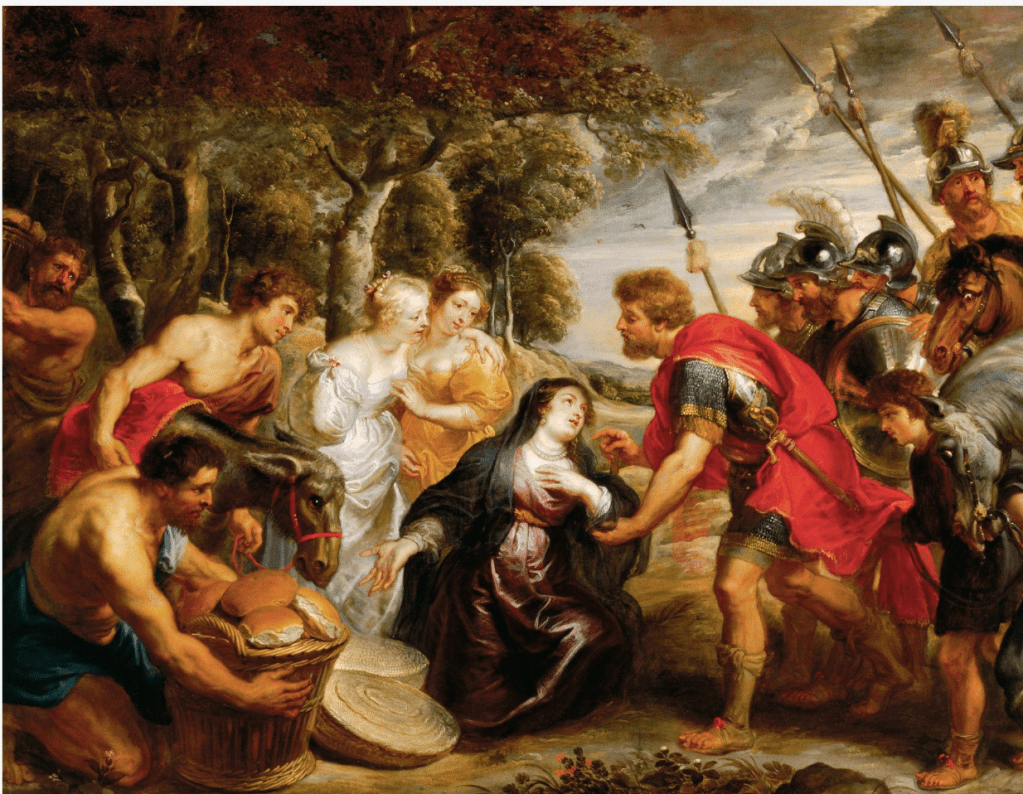
The meeting of David and Abigail by Peter Paul Rubens circa 1630

In these days when so many are afraid and aching for the people of Ukraine, and concerned about the lasting impacts of this war around the world, I cannot help thinking of the wise women of ancient Israel. These wise women, unafraid of confronting dangerous men, used their intelligence and storytelling skill to defuse violent situations between powerful adversaries and restore peace. May their wisdom be felt in the world now. 

The institution of “wise woman” appears several times in the Bible. In the Book of Samuel, a wise woman (chachamah in Hebrew, from chochmah, wisdom) steps in when there is a war, or political conflict, to promote peace. In II Samuel 14, after King David’s son Amnon rapes David’s daughter, Tamar, the king does nothing. Tamar’s full brother Absalom takes matters into his own hands and kills Amnon, then flees to another country.  David grieves for Absalom but won’t send for him. The wise woman of Tekoa appears before King David, pretending to be a woman whose sons fought, and one killed the other. The story she tells helps to reconcile King David with his son Absalom, at least temporarily.  

Continue reading “Calling All Biblical Wise Women by Rabbi Jill Hammer, PhD”

The Patriarchy of Ki Tisa and a Call to Reimagine Divinity by Ivy Helman.

This week’s Torah portion is Ki Tisa, Exodus 30:11-34:35.  Its events revolve around the theme of creation, destruction, and recreation.  From a feminist perspective, it is quite clear that this cyclical process is a result of a patriarchal understanding of the divine as jealous, distant, and rage-filled.  

Ki Tisa begins soon after the Israelites have been delivered from Egyptain slavery.  This delivery creates a new people devoted to this divine liberator.  Yet, Ki Tisa starts with both that deity and their leader, Moses, nowhere to be found. So, what do the Israelites do being in such a vulnerable spot?  They create a golden calf in order to have a spiritual connection to something.  

Continue reading “The Patriarchy of Ki Tisa and a Call to Reimagine Divinity by Ivy Helman.”

Vayechi’s Take on Fertility, Women and Theodicy by Ivy Helman.

This week’s Torah portion is Vayechi, or Genesis 47:28-50:26.  It is the last part of the Joseph saga (For my thoughts on two other parshot relating to Joseph, see Mikeitz and Vayigash).  While there is much that could be said, there are three aspects of the parshah which I would like to concentrate on for this post: blessings being associated with fertility; verses 50:19-20’s troubling theodicy; and its women.

Let us begin with the last topic: women.  Women are mentioned four times in Vayechi.  Jacob recalls the burial of Rachel in verse 48:7.  Joseph’s beauty is such that women often look at him (49:22). The blessing that Jacob gives to Joseph includes the blessings of both mother and father (49:25-26).  At present, I will focus my commentary on Jacob’s request for burial, the fourth mention of women in this parshah.

Continue reading “Vayechi’s Take on Fertility, Women and Theodicy by Ivy Helman.”

The Treasures of Vayishlach by Ivy Helman

The Torah portion to be read this Shabbat is Vayishlach (Genesis 32:4-36:43).  It contains the reunion between Jacob and Esau, the twice-renaming of Jacob to Israel, events relating to Dinah, the mass murder of all of the male inhabitants of Shechem, the birth of Benjamin, the death of Rachel in childbirth, the death from old-age of Isaac, and a long list of the descendants of Esau.  Like every blog, there is too much material on which to comment.  Therefore, I will focus on three examples.  Each of these examples in their own way turns expectations or aspects of the Torah on their heads.   

First, we have the way in which Jacob wholeheartedly avoids war.  This is despite the fact that, in the Torah, war is demanded, normalized, or doled out as a form of punishment.  Rarely does fear factored into the Torah’s discussions of war, yet this parshah starts with Jacob’s fears about war: his brother Esau is going to start a war with him.  To avert this war, Jacob sends, in advance of their meeting, large quantities of gifts, mainly in the form of animals.  In addition, as he approaches his brother, he prostrates himself on the ground seven times.  

Continue reading “The Treasures of Vayishlach by Ivy Helman”

Facing the Angel:  Samson’s Mother as a Model for Feminist Spiritual Practice by Jill Hammer

Dedicated to Kohenet Andrea Jacobson of blessed memory, a deep practitioner of priestess presence

I have always loved obscure biblical women.  My wife, who was educated in a yeshiva, marvels at the names and tales I mention to her; she’s never heard of them.  Telling their stories, for me, is a form of resistance.  They may be minor to the text, but to me they are main characters.  As a feminist midrashist, I love digging into a text to find out more, to discover a radical take, to imagine a first-person perspective.  As a contemporary spiritual teacher on the trail of the ancient priestesses, I find priestess role models in these hints of story.  As the Jewish holiday season ends and we return to finding the sacred in the mundane, I want to share about a character I love, who doesn’t even have a name, but who, to me, teaches about being present, and meeting the mystery wherever we go. 

“Manoah’s Sacrifice” by Rembrandt Harmensz. van Rijn 1641.( Source: Wikimedia Commons, public domain, PD-1923)

Judges 13 begins with a traditional biblical scene of annunciation.  The wife of Manoah does not have a child.  An angel appears to her to say that she will bear a son.  He must be a nazir or nazirite and will be a hero, delivering his people from their enemies. A nazir is a kind of self-appointed priest, who has taken a vow not to drink wine or cut one’s hair, and who, like the high priest of the Temple, is forbidden to be near dead human bodies.  Such a person’s hair is holy and, at the end of the nazirite service, will be offered on an altar.  Both men and women could be nazirites; indeed, the nazirite vow seems to be an avenue where women can become holy.  We can see there is patriarchal anxiety about this avenue to priestesshood; Numbers 30 is full of laws about how fathers and husbands can annul the vows of daughters and wives, which likely is partly concerned about women becoming nezirot (sing. nezirah) of their own volition.

Continue reading “Facing the Angel:  Samson’s Mother as a Model for Feminist Spiritual Practice by Jill Hammer”

Ha’azinu and Models of the Divine by Ivy Helman.

This week’s Torah parshah, as you can tell from the title, is Ha’azinu, or Deuteronomy 32:1-52.  This is Moses’ final speech to the Israelites before he ascends Mount Nebo to die.  It is traditionally associated with Yom Kippur and read somewhere very close to it (when exactly depends on the year).  The reasons for this association should become obvious as we continue.  

In the parshah, Moses describes how, even in the Promised Land, the Israelites will continue to be idolatrous, thus disobeying their deity and bringing divine wrath upon themselves.  From what I have already discussed in past blogs about the history of the Torah’s composition, clearly the exiled Israelites in Babylonian sought reasons for that exile; in traditional Isrealite fashion, they made sense of their current circumstances by reasoning whose disobedience was to blame.   

Continue reading “Ha’azinu and Models of the Divine by Ivy Helman.”

Shofetim: The Divine Feminine, Magic, and the Role of Gender by Ivy Helman.

This post is dedicated to Carol P. Christ. I knew her first as my professor and then my friend for over 15 years. May her memory be a blessing.

This week’s Torah portion is Shofetim (also spelled Shoftim), or Deutoronomy 16:18-21:9.  I have written about this parshah before.   In that post from August of 2018, I reflect on how the patriarchal elements of the portion should not detract from its larger concern for justice, compassion, and peace. Yet, there is more to the parshah.  In fact, I have recently begun exploring Judaism’s connection to all things magical, and interestingly enough, this parshah fits right into my recent inquiries.   Let me share with you some of what I have learned as it relates to this parshah.  

Where Shofetim and magic meet is idolatry.  There are three instances in Shofetim where idolatry is condemned, punished by stoning to death.  All three of these prohibitions involve polytheism, either directly worshiping other deities or participating in practices associated with the worship of those deities.  What are they?

Continue reading “Shofetim: The Divine Feminine, Magic, and the Role of Gender by Ivy Helman.”