Part 1, yesterday traced how the eight-festival Wheel of the Year was assembled in the middle of the twentieth century from older ingredients, some surviving only in a line or two of medieval writing. It began with a blessing. Writing for this site in July 2017, Carol P. Christ closed a post with words that name no gender at all: “As we bless the Source of Life, so we are blessed.” We return to it at the end.”
The divine couple, and who was told no
The gendering was there from the beginning. Hutton describes Gardner’s earliest seasonal rites as pairing a god and a goddess, “a divine couple who were intrinsically linked to the annual cycle of winter and summer”, the god predominating in the cold-season festivals and the goddess in the warm-season pair.
The seasonal love story that many readers first meet as something ancient is a modern liturgical pattern, not a preserved pre-Christian myth. That does not make it less meaningful to those who keep it; it makes it datable.
The pattern also carried an exclusion. The World Religions and Spirituality Project, in its profile of the Minoan Brotherhood, describes Gardner’s Wicca as a “fertility religion” organized around male-female polarity, God and Goddess, high priest and high priestess, and records that “Gardner was homophobic and refused initiation to anyone whom he thought was homosexual”, noting that Alex Sanders and Doreen Valiente rejected that exclusion. A framework built on a heterosexual pair puts pressure on those it does not fit, and some people built elsewhere.
Pick up almost any introduction to the modern Pagan festival year and you will meet a couple: a goddess of the growing season and a god born, crowned and cut down at harvest. Writing for this site in July 2017, Carol P. Christ described Lammas as the point at which “the young male God identified with the harvest … is sacrificed.” She closed the same post with a blessing that names no gender at all: “As we bless the Source of Life, so we are blessed.”
The eight-festival Wheel of the Year and its divine-couple story were assembled in the middle of the twentieth century by people whose names, meetings and dates are known. That recency is exactly why the wording has been open to revision, and revised it has been, in public and on the record. What follows traces that rewriting rather than judging it.
How the eight festivals came together
In a 2008 study in Folklore, the historian Ronald Hutton traces the eight festivals to two separate modern sources. The solstice and equinox feasts descend from Edward Williams, better known as Iolo Morganwg, who invented four Druidic solar festivals between 1792 and 1826. The quarter days come from Margaret Murray’s now rejected account of witch festivals.
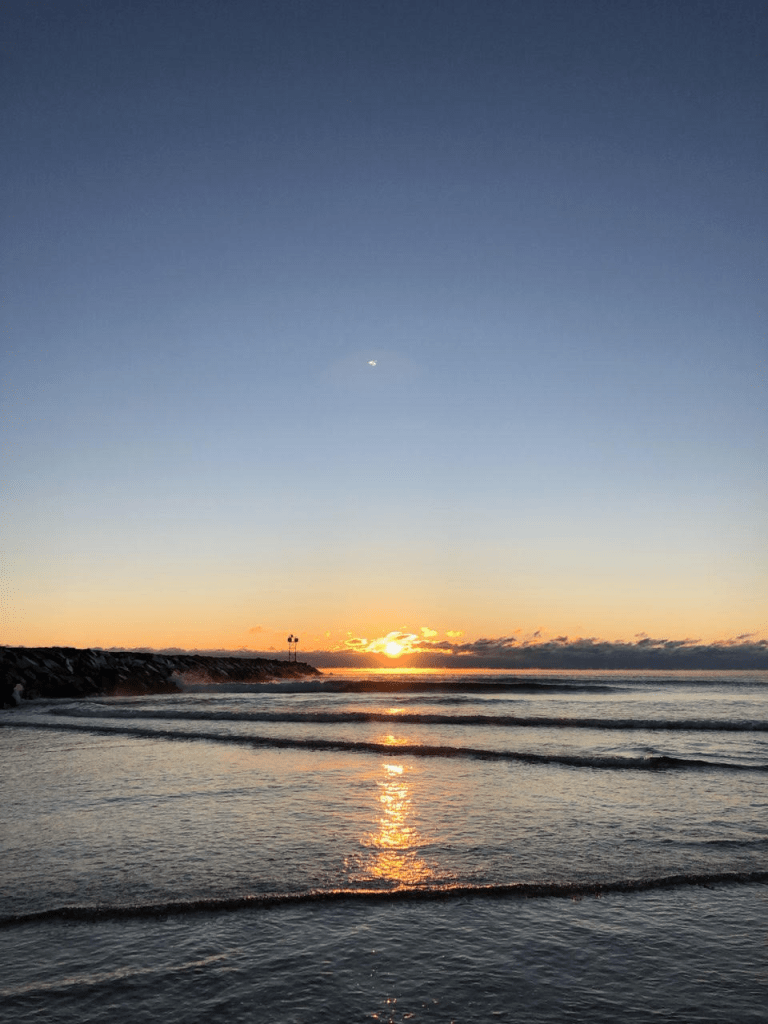
Solstice Sunrise by Joie Granbois, used with permission
In the northern hemisphere, we recently celebrated Winter Solstice – the time of year when the days begin to grow longer and the nights shorter as the Earth begins another orbit of the Sun. In some cultures, the beginning of a new year is determined by the Earth’s orbit around the Sun. Other cultures, such as Hebrew or Chinese, track the beginning of a new year through the lunar cycles. In most of Western culture, the day we name as the beginning of a new year is not determined by the cycles of Sun or the Moon but instead by a seemingly arbitrary calendar devised by a Roman emperor and modified by a Renaissance pope. Go figure.
Nonetheless, the turning of the New Year is a powerful time. It is a good time to slow down, listen to our hearts, be in community, pray and create intentions for the coming seasons of our lives. What do we need to forgive? For what are we grateful? What do we desire to bless for the coming year?
Last year we created a New Year’s worship service for our Unitarian Universalist church here in New England. This simple service and ritual invites participants to spend a little time spiritually preparing for the coming new year. If you wish to engage with this simple ritual from home you will need a small totem to interact with. This could be a stone or a shell—a feather or a tree branch—a flower or a piece of jewelry. You might also wish to light a candle. Take a deep breath as we begin with Forgiveness.
This week’s Torah portion is Vayechi, or Genesis 47:28-50:26. It is the last part of the Joseph saga (For my thoughts on two other parshot relating to Joseph, see Mikeitz and Vayigash). While there is much that could be said, there are three aspects of the parshah which I would like to concentrate on for this post: blessings being associated with fertility; verses 50:19-20’s troubling theodicy; and its women.
Let us begin with the last topic: women. Women are mentioned four times in Vayechi. Jacob recalls the burial of Rachel in verse 48:7. Joseph’s beauty is such that women often look at him (49:22). The blessing that Jacob gives to Joseph includes the blessings of both mother and father (49:25-26). At present, I will focus my commentary on Jacob’s request for burial, the fourth mention of women in this parshah.
For the last year I have had the honor of serving as Chair of the Board of Directors for the Religious Coalition for Reproductive Choice (RCRC). This leadership role often requires great personal and professional sacrifices and yet blesses me tenfold in return. At this moment in history I can think of no more important organization to offer my time and gifts than on behalf of RCRC.
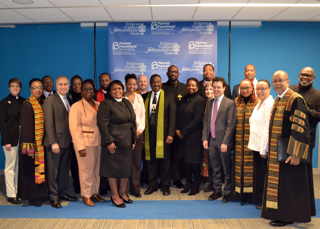
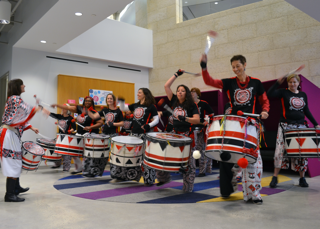
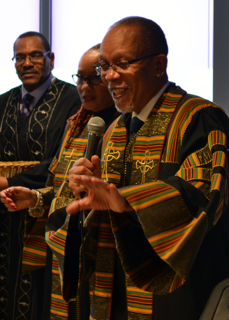
Last week RCRC partnered with Planned Parenthood of Metropolitan Washington (PPMW) to hold an Interfaith Unity Ceremony to honor their brand new health center in southeast D.C. I had the privilege of joining more than sixty clergy, justice leaders, and clinic staff as were led by the Reverend Doctors Dennis and Christine Wiley, co-pastors of the Covenant Baptist United Church of Christ, through an interfaith service of blessing. There was drumming from the all female percussion band Balatá, testimonies from providers and patients, poetry, liturgical dance, a Hindu chant, and a ritual of healing from the shame and stigma surrounding abortion.
Photo Credit: Helen Parshall
At one point during the service a colleague of mine turned to me and whispered, “I’ve got goose bumps. Something is happening here, isn’t it?” I said, “Yes, Spirit is here.”
Many might find an encounter with the sacred at a Planned Parenthood surprising to say the least. It might have been for me had I not experienced something quite similar ten years ago. At the time I was a seminary student at Yale, and I had recently participated in RCRC’s pastoral care training on how to walk alongside women making decisions about their unplanned pregnancies. Before I offered any kind of counseling I wanted to see for myself what went on in abortion clinic. After taking a tour of the local Planned Parenthood health center I was so moved by the love and kindness of the doctors and support staff that I decided to volunteer on days when abortions were provided. Through that experience I felt the holy nudge to dedicate my ministry to supporting the work of abortion providers like Planned Parenthood and standing up for the rights and dignity of those who need access to safe, legal abortion care.
Now, almost a decade later, I found myself back in a health center. That time of being amongst my people, surrounded by words and sounds of truth affirming the sacred decisions of women about their bodies and lives, felt like I had tasted my first bite of food after a long, difficult fast. I didn’t realize how much over these last few months I had been starving for hope, love, and life-giving energy until that ritual of blessing held within the walls of the Planned Parenthood health center.
Photo Credit: Helen Parshall
Later that night on my drive back to the airport I found myself repeating the same simple prayer, “Thank you, thank you, thank you.” I felt an overwhelming sense of gratitude for the way that ritual had restored my spirit and affirmed my call to ministry. For the first time I felt prepared to take on the heavy burden of the next four years. I am ready. Are you?
Katey Zeh, M.Div is a thought leader, strategist, and connector who inspires intentional communities to create a more just, compassionate world through building connection, sacred truth telling, and striving for the common good. She has written for outlets including Huffington Post, Sojourners, Religion Dispatches, Response magazine, the Good Mother Project, the Journal for Feminist Studies in Religion, and the United Methodist News Service. Her book Women Rising will be published by the FAR Press in 2017. Find her on Twitter at @kateyzeh or on her website kateyzeh.com.


 communities to create a more just, compassionate world through building connection, sacred truth telling, and striving for the common good. She has written for outlets including Huffington Post, Sojourners, Religion Dispatches, Response magazine, the Good Mother Project, the Journal for Feminist Studies in Religion, and the United Methodist News Service. Her book Women Rising will be published by the FAR Press in 2017. Find her on Twitter at @kateyzeh or on her website

