Bridging Beyond Binaries: Painting Gloria Anzaldúa by Angela Yarber

One of the great joys of being an artist and writer is working on commissions, enlivening in paint, canvas, and word the stories of revolutionary holy women who have emboldened and inspired the one commissioning the Holy Woman Icon. Gloria Anzaldúa was on my list of holy women for a while when Dr. Robyn Henderson-Espinoza finally gave me the nudge to paint her by commissioning an icon. Anzaldúa gave Robyn—and so many others—the framework, the bridgework, for dismantling the binaries of difference, for finding the beauty that resides at the borderlands of race, gender, and sexuality. As a scholar-activist, Robyn speaks of Anzaldúa as a patron saint, saying:

“Anzaldúa has always been for me the bridge between theory and action, and her work, both in writing and teaching, compels me to live into my vocation as a public theologian, which at root is bridging across lines of radical difference. Without Anzaldúa and without her bridging frame, I am unable to do the work that I now do. This icon offers me a visual reminder of the ways in which I’m called to be a bridge in curating communities of radical difference.”

Queer borderlands. Chicana borderlands. Feminist borderlands. Gloria Anzaldúa (September 26, 1942 – May 15, 2004) was an American scholar who focused on the intersections among queer theory, feminist theory, and Chicana cultural theory. Born in the Rio Grande Valley of south Texas, Anzaldúa also bridged the borders of personal and academic writing, weaving together theory with lived experience, English with Spanish, and inviting readers into a new world—Mundo Zurdo—that transcended these seeming binaries. Continue reading “Bridging Beyond Binaries: Painting Gloria Anzaldúa by Angela Yarber”

Pride by John Erickson

When we come together, we are the Divine.  I didn’t think I could experience that twice in one year; clearly, I was wrong. 

If you’re anything like me you not only hate opening up your Twitter feed each morning but also feel compelled to in order to make sure you didn’t miss whatever new atrocity to come out of 1600 Pennsylvania Ave. After the Women’s March, I felt charged. I felt that whatever this administration threw at the proverbial “us,” I knew we could and would overcome it. Although that charge kept me going for a few months, there came a time where I just couldn’t go on anymore and that I was completely drained; then walked in a man named Brian Pendleton.

After the Women’s March on January 21, I didn’t know what to expect. The event was truly so successful that many of the organizers and coordinators were on an activist high as a result of what was a truly magical and divine moment. A few months came and went and the 45th President of the United States continued (much to our surprise) to be as awful as we all knew and expected. However, while I am able to exist in a world, no matter how oppressive, as a cisgendered white male and the full on privilege and power that comes along with that territory, many of the individuals and communities being attacked did not have those same freedoms; and like with the Women’s March and how that all took shape, in walked Brian Pendleton to my life to talk to me about the #ResistMarch.
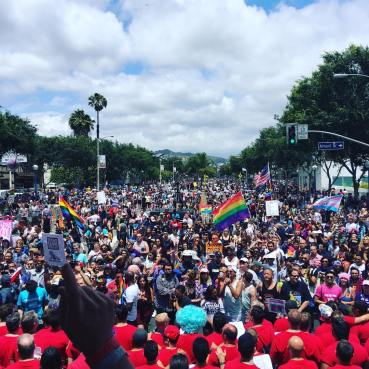
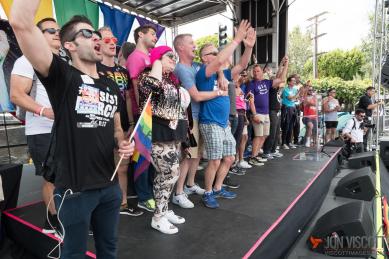
Cover PhotoAlthough my involvement during the 120 days or more that led up to the #ResistMarch happened in a flash, one thing is for certain: miracles exist not because of divine intervention but because G-d places people on this Earth to make positive impacts. The beauty of the #ResistMarch was not just the passion of the organizers but the beauty of the rainbow that came out in full force on June 11

The strength shown by our community was one that, for all intensive purposes, proves that love does conquer all. RuPaul couldn’t have expressed the common and conquering theme better than when he said: “It’s all about love; giving love and being able to receive love. That’s our secret weapon; that’s the one thing they don’t have: our love and our music. That is our activism. That is what we use and what we always use to fight the ugliness.”

That is the one experience that I took most out of the #ResistMarch: the power of love and friendship; the beauty in the unexpected conversation that leads to changing the world, again.  Thank you, Brian. Thank you, for bringing us all together to resist, recharge, and love.
19055531_10158898620590385_6920780108892374453_o

When we come together, we are the Divine.  I didn’t think I could experience that twice in one year; clearly, I was wrong.

John Erickson is the President of the Hollywood Chapter of the National Organization for Women. John is a Ph.D. Candidate in American Religious History at Claremont Graduate University where he is finishing up his dissertation tentatively titled “Step Sons and Step Daughter”: Chosen Communities, Religion, and LGBT Liberation.” John holds a MA in Women’s Studies in Religion; an MA in Applied Women’s Studies; and a BA in English and Women’s Studies. He is the Founding and Past President of the University of Wisconsin Oshkosh’s LGBTQA+ Alumni Association and currently serves as the Chair of the Legislative Committee for the Stonewall Democratic Club, a Diversity and Inclusion Fellow at Claremont Graduate University. He is a permanent contributor to the blog Feminism and Religion, a Co-Founder of the blog The Engaged Gaze, and the Co-Chair of the Queer Studies in Religion Section of the American Academy of Religion’s Western Region, the only regional section of the American Academy of Religion that is dedicated to the exploration of queer studies in religion and other relevant fields in the nation. In April 2017, he was the first openly gay athlete to be inducted into the Wisconsin Volleyball Conference Hall of Fame. Most recently, John was one of the coordinators of the Women’s March Los Angeles, which brought together 750,000 people in downtown Los Angeles on January 21, 2017, and a Committee Member for the #ResistMarch, which brought together 100,000 people from Hollywood to West Hollywood in honor of LA Pride on June 11, 2017.



Holy Women Icons Contemplative Coloring Book by Angela Yarber

angelaAround the time Microaggressions in Ministry: Confronting the Violence of Everyday Church was published, I was under contract and furiously trying to finish yet another book project, a coloring book of all things. On the heels of such imperative justice work as microaggressions, why on earth was creating a coloring book on my radar? Feminist academic-activists don’t dabble in such seemingly insignificant projects as coloring books, do they? As I wrote about my potential coloring book for the first time with FAR, I realized the time is ripe for such work—a coloring book that fuses feminism, arts, and spirituality—so I graciously took the feedback offered here and shared them with my publisher.

Coloring is a fast growing trend among over-stressed adults. “Soothing coloring pages” is a top Google search item. Amazon.com lists over 3,000 adult coloring books, some even featured on their bestsellers list.

Articles—popular and academic—whose authors range from psychologist to spiritual director purport the power of coloring to calm anxiety, relieve stress, and provide a creative and spiritual outlet. Is this a feminist issue? I’d say so. In fact, part of the problem of microaggressions is the difficulty in coping with the stress, depression, and anxiety caused by them. Hear me clearly, I’m not saying that coloring in my coloring book will rid the world of microaggressions and usher in a utopian paradise where every person is treated equally and justly. What I am saying is that, since studies have proven that coloring is a valid mode of relieving stress and anxiety and microaggressions create stress and anxiety, coloring pages filled with bold, revolutionary women, many of whom are women of color and/or queer, can provide a balm, a method of empowerment, a window into what that utopian world could be. Continue reading “Holy Women Icons Contemplative Coloring Book by Angela Yarber”

The Denied Trans-Childhood of Medusczka by Vanessa Rivera de la Fuente

13162008_266379727041652_171093612_n

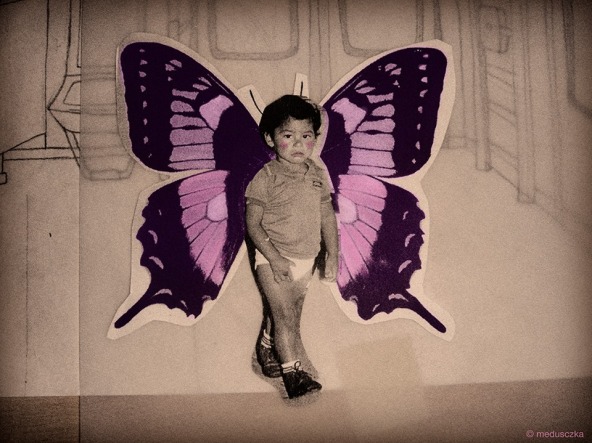
One of my articles in April featured one of the “Niñas Santas Trans”(1). I have been asked often where I came across her and if there are more liken her. Well, she is part of a colorful and provocative project of mexican trans-feminist artivist and illustrator Medusczka Gorgona, who developed a series of images that mix religion Mexican popular culture and trans identities to make visible the non-conforming childhood subjugated by heterosexual discipline.

I have known Meduscka for a while. I am personally fascinated with each one of those beautiful and cheeky “Niñas Santas Trans.” Now is your chance to meet her and her “Niñitas”(2), through this short interview she agreed to have for this site. Continue reading “The Denied Trans-Childhood of Medusczka by Vanessa Rivera de la Fuente”

Queering Kenosis: A Review of “God and Difference” by Caryn D. Riswold

caryn2I still think that Valerie Saving was right.

It’s been 56 years since she published her article on “The Human Situation” in The Journal of Religion, and her most basic groundbreaking insight holds true: Under patriarchy, the fundamental sin and danger for women is not too great a sense of self, too much pride as Reinhold Niebuhr would argue; rather, the problem is too small and diffuse a sense of self. Prioritizing others ahead of herself, the woman under patriarchy accepts second-class citizenship and submission to male headship as her rightful place.

Wrong.

Yet, in recent years, when reminding colleagues of this fundamental feminist insight from the second wave, I have received replies that begin “But Sarah Coakley says ….” What they lift up is Coakley’s supposed reclamation of kenosis as feminist, of self-emptying as a revolutionary Christian act in relationship to God. To them, this corrects Valerie Saiving. I have heard variations on this defense from senior male scholars who believe themselves to be quite advanced in their thinking, as well as from female scholars who believe this is the kind of feminist theology they want.

Wrong. Continue reading “Queering Kenosis: A Review of “God and Difference” by Caryn D. Riswold”