Long Live Queer Nightlife! by Amin Ghaziani – Book Review by Marie Cartier

I was invited to be on a panel for the Pacific Sociological Association (PSA) in San Francisco this past March for a new book by Amin Ghaziani, Long Live Queer Night life (Princeton University Press, 2024).

Since I wrote Baby, You Are My Religion – Women, Gay Bars, and Theology Before Stonewall and have discussed aspects of this work here I thought the FAR family would also enjoy this conversation on where queer nightlife is now.

The book is interspersed with visits to club nights, something Ghaziani says helps widen the possibilities for communities—different communities can have their own nights and these chapters where he visits these various hot spots are exciting and first person.

Continue reading “Long Live Queer Nightlife! by Amin Ghaziani – Book Review by Marie Cartier”

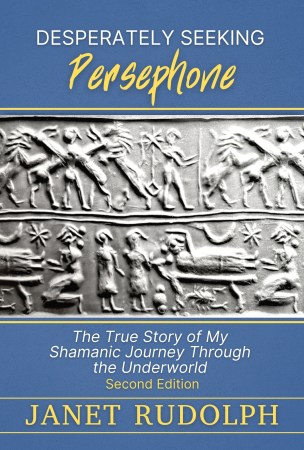
Desperately Seeking Persephone by Janet Rudolph, Book Review by Carolyn Lee Boyd, Part One

The myths of the descents of the Sumerian Inanna and the Greek Persephone to the underworld have fascinated and inspired women for millennia with their violence and betrayal, leaving behind all you love and that hold you up, and facing your deepest fears, even death. We recognize our own traumas in their struggles and seek guidance as to how to navigate our ascents back to wholeness and well being in their stories.

After her own experience of childhood abuse and stranger rape as a young woman, Janet Rudolph, one of FAR’s co-weavers, also pored over the myths in hopes of finding a helpful account of their journey home. “Once I had tumbled metaphorically, literally and mythically into the thorny quagmire of the underworld, it was devilishly hard to escape. I felt lost. I needed a guide, a role model to find my path outward”(xii). The problem is, Janet says, “The stories of their return are glossed over. There is no detailed story called From the Great Below Back to the Great Above” (15). Until now in Janet’s recently re-published book, Desperately Seeking Persephone.

Continue reading “Desperately Seeking Persephone by Janet Rudolph, Book Review by Carolyn Lee Boyd, Part One”

From the Archives: Book review: Merlin Stone Remembered: Her Life and Works by Barbara Ardinger

This was originally posted on June 7, 2015

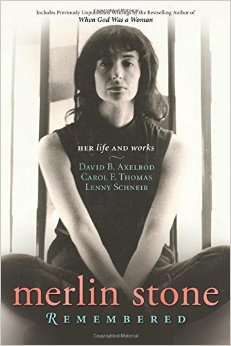
When Merlin Stone’s book, When God Was a Woman, was published in 1976, it was a lightning bolt of feminist scholarship that told the world that before there was a Judeo-Christian god there were goddesses, and before there were goddesses, there was the Goddess. If you’re reading this review and you have not read When God Was a Woman, buy the book. Right now. As you sink into Stone’s book, try to imagine what it was like before we knew about Isis or Inanna or Astarte, before we knew that the tree in the Garden of Eden was probably a sacred fig and that the serpent was a symbol or aspect of the Goddess and that people (mostly women) who ate figs or worked with serpents were honored priestesses and prophets. Just imagine! The work of the second wave feminists added to the work of scholars like Merlin Stone and Marija Gimbutas, but it didn’t begin until the second half of the 20th century. Before that? All there was, was God the Father, maker of heaven and earth. Yes, Merlin Stone hurled lightning bolts into our hearts and minds and bookshelves.
Continue reading “From the Archives: Book review: Merlin Stone Remembered: Her Life and Works by Barbara Ardinger”

Archives from FAR Founders: Rosemary Radford Ruether’s Quests for Hope and Meaning by Gina Messina-Dysert

This was originally posted on December 18, 2013. This is part of a project to highlight the work of the four women who founded FAR: Xochitl Alivizo, Caroline Kline, Gina Messina, and Cynthia Garrity-Bond

Rosemary Radford Ruether is one of the most brilliant theologians of our time and her newly released autobiography, My Quest for Hope and Meaning, is a gift to those of us who have been so touched by her work.  In this intimate and beautiful piece, Ruether shares her personal journey in feminist scholarship and activism.  The autobiography opens with a profound forward by Renny Golden (that is also shared here on Feminism and Religion) and continues with an introduction and six chapters where Ruether guides us through an exploration of the influence of the matriarchs in her life, her interactions with Catholicism, her continued exploration of interfaith relations, her family’s struggle with mental illness, and her commitment to ecofeminist responses to the ecological crisis.

Ruether states that “Humans are hope and meaning creators” (xii), and her autobiography details her own quests for hope and meaning.  She reflects on the incredible impact made by the female-centered patterns in family and community in her life.  According to Ruether, these “matricentric enclaves” grounded and shaped her interest in feminist theory and women’s history.  She also describes the spiritually and intellectually serious Catholicism that she received from her mother and articulates her continued frustration with Vatican leadership that has undermined the efforts of Vatican II.  For Ruether, her ongoing affiliation with feminist theological circles is crucial as she continues to work toward shaping an ecumenical and interfaith Catholicism.

Continue reading “Archives from FAR Founders: Rosemary Radford Ruether’s Quests for Hope and Meaning by Gina Messina-Dysert”

The Witch Trials of J.K. Rowling by Mary Sharratt

The new podcast series The Witch Trials of J.K. Rowling is a deep dive into some of the most contentious ideological conflicts of our age through the experience of the world’s most successful author, a woman who has been vilified and physically threatened and whose books have been burned by both right-wing Christians and, more recently, by her detractors on the liberal and progressive left.

Continue reading “The Witch Trials of J.K. Rowling by Mary Sharratt”

White Monkey Chronicles: Myth-busting in Eden BOOK REVIEW by BJ Austin

I binge-read White Monkey Chronicles The Complete Trilogy. The first time. It’s like Douglas Adams, Kurt Vonnegut, J.K. Rowling and Gloria Steinem got drunk one night and decided to write a book.  A second, slower read was even sweeter.

The first paragraph of the Prologue tipped me headfirst and wide-eyed into this mind-bending, myth-busting, topsy-turvy tale. Its innocuous, traditional “Once Upon” opening was immediately blown up by the explosive words “infant deity abandoned,”, “famous bachelor Jew,”, and “A-list Hindu”.  Wait. Whaaat? The stage was set for a rebellious, revolutionary saga destined to be voted “Most Popular” at a fundamentalist book burning!

A white monkey (part-time Plush toy, full-time guardian of an off-the-record baby boy deity) sets the book’s roller coaster ride in motion on a snowy night in Humbolt County, USA. There, at the withered and weathered Sisters of Immaculate Conceptions convent, we meet the three remaining Sister-resisters of The Great Church’s preening patriarchy. (Lets just say the clergy is strictly for the birds — in dress and demeanor.) Getting a whiff of the unauthorized deity’s arrival, a conclave of Cardinals swoop in to confirm (and possibly kidnap) the threatening newborn from the kind, caring, and radical hands of the rogue nuns. Not so fast. Continue reading “White Monkey Chronicles: Myth-busting in Eden BOOK REVIEW by BJ Austin”

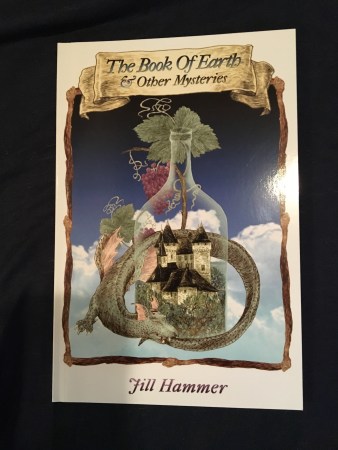
The Book of Earth & Other Mysteries: a book review by Elizabeth Cunningham

book-of-earth-photojpgWhen a poem shows me something in a strange and wonderful light and at the same time awakens some bone-deep knowing of my own, I feel more alive, I feel less alone. My soul is stirred and satisfied. The Book of Earth & Other Mysteries by Rabbi Jill Hammer, author, teacher, midrashist, mystic, poet, essayist, and priestess, is a whole collection of such poems.
Collection is not a vivid enough word. The structure of this book is more like a fairy palace, a sandcastle blazoned with shells, a dragon’s lair, a bold work of art in itself.  The book begins with a five part prose piece called “Intentions,” the first four invoking an element and the last one holding open the door for us to enter the world of the poems.  Here are a couple of sentences excerpted from each. Continue reading “The Book of Earth & Other Mysteries: a book review by Elizabeth Cunningham”

The Heart of the Labyrinth: BOOK REVIEW by Mary Petiet

the-heart-of-the-labyrinth_cover_front_72What if it really is as simple as changing our minds?

This is the central question of Nicole Schwab’s book, The Heart of the Labyrinth (Womancraft Publishing, 2014). This question paves the way for her eco-feminist approach to balancing the self and the environment. Schwab’s book is a parable as multilayered and complex as human nature, and it moves through the ages to probe the pure core of the self and the sustaining energy that connects all. Continue reading “The Heart of the Labyrinth: BOOK REVIEW by Mary Petiet”

“We Knocked” :: A Review of Mormon Feminism by Caryn D. Riswold

caryn2Mormon feminists experience what most feminists of faith have heard at some point. Utter dismissal of the possibility of their existence.

We know several variations:

You can’t be Christian and feminist.

There’s no such thing as a Catholic feminist.

You can’t seriously be Jewish and feminist.

You can’t possibly be Muslim and feminist.

To be Mormon and feminist? Preposterous.

In response, scholars, activists, and writers within each tradition have had to document their history, make their theological case, and engage their scriptures as robustly as any conservative traditionalist would. In order to achieve meaningful institutional change, unimpeachable work and confident testimony is required. Continue reading ““We Knocked” :: A Review of Mormon Feminism by Caryn D. Riswold”

Book review: Merlin Stone Remembered: Her Life and Works by Barbara Ardinger

Barbara ArdingerWhen Merlin Stone’s book, When God Was a Woman, was published in 1976, it was a lightning bolt of feminist scholarship that told the world that before there was a Judeo-Christian god there were goddesses, and before there were goddesses, there was the Goddess. If you’re reading this review and you have not read When God Was a Woman, buy the book. Right now. As you sink into Stone’s book, try to imagine what it was like before we knew about Isis or Inanna or Astarte, before we knew that the tree in the Garden of Eden was probably a sacred fig and that the serpent was a symbol or aspect of the Goddess and that people (mostly women) who ate figs or worked with serpents were honored priestesses and prophets. Just imagine! The work of the second wave feminists added to the work of scholars like Merlin Stone and Marija Gimbutas, but it didn’t begin until the second half of the 20th century. Before that? All there was, was God the Father, maker of heaven and earth. Yes, Merlin Stone hurled lightning bolts into our hearts and minds and bookshelves.

Merline StoneMerlin Stone Remembered is a new book edited by Dr. Carol F. Thomas, Dr. David B. Axelrod, and Stone’s life partner Leonard Schneir, with an introduction by Gloria Orenstein, professor emerita, USC. Orenstein opens the book by putting Stone’s work in context. Before the 60s and 70s, she writes, no one was ever taught anything about the matristic cultures. Yes, a few books had been written. She cites G. Rachel Levy’s The Gate of Horn (published in England in 1948, republished in the U.S. in 1963), Helen Diner’s Mothers and Amazons (1973), and Elizabeth Gould Davis’ The First Sex (1971). These books gave us some of our foundational myths, but, Orenstein writes, “we can see that although there was some writing that had already attempted to reconstruct a history of women …, much more expertise and authority were needed” (p. 8). “Once Merlin Stone provided us with her careful scholarship and a truly feminist (not biased, patriarchal) accounting of ancient Goddess cultures, I and all who found Merlin’s work were finally able to understand our herstory…” (p. 9).

Continue reading “Book review: Merlin Stone Remembered: Her Life and Works by Barbara Ardinger”