A Cross-Cultural Feminist Alchemy: Studying Mago, Pan-East Asian Great Goddess, Using Mary Daly’s Radical Feminism as Springboard by Helen Hye-Sook Hwang

Feminist theology was self-transcending to me. I was unafraid of going beyond the boundary of Christianity and its God. 

Mago is the Great Goddess of East Asia and in particular Korea. Reconstructing Magoism, the cultural and historical context of East Asia that venerated Mago as the supreme divine, is both the means and the end. Magoism demonstrates the derivative nature of East Asian religions such as Daoism, Buddhism, and Confucianism while redefining East Asian Shamanism to be the religious expression of Magoism.

I encountered the topic of Mago during my doctoral studies. The topic of Mago fell out of nowhere at the time I was preparing for qualifying examinations. I had never heard the name, Mago. Only when I was able to collect a large amount of primary sources from Korea, China, and Japan, was I awakened to the cultural memory of Mago. I grew up craving the stories of Halmi (Grandmother/Great Mother), a common referral to Mago among Koreans. I had a childhood experience of being in the fairy land unfolded by my grandmother’s old stories. While “Mago” was unfamiliar to most Koreans, she was taken for granted in her many other names such as Samsin (the Triad Deity) and Nogo (Old Goddess) and place-names such as Nogo-san (Old Goddess Mountain) and Nogo-dang (Old Goddess Shrine). Continue reading “A Cross-Cultural Feminist Alchemy: Studying Mago, Pan-East Asian Great Goddess, Using Mary Daly’s Radical Feminism as Springboard by Helen Hye-Sook Hwang”

Where Did the Gods Come From? by Barbara Ardinger

A man in the group leaned forward and asked, “But how did the Goddess get overcome?” So I told him. Young “warrior heroes” came galloping out of the Russian steppes and the Caucasus Mountains, including Afghanistan, which no one (not even Alexander the so-called Great) has ever conquered. The boys were carrying their thunder-solar-sky gods with them.

I attended a book club at a beautiful metaphysical bookstore a few weeks ago where we discussed the conquest of matrilineal civilizations by the patriarchy. A man in the group leaned forward and asked, “But how did the Goddess get overcome?” So I told him. As my friend Miriam Robbins Dexter writes in her essay in The Rule of Mars, young “warrior heroes” came galloping out of the Russian steppes and the Caucasus Mountains, including Afghanistan, which no one (not even Alexander the so-called Great) has ever conquered. The boys were carrying their thunder-solar-sky gods with them. Those gods included Jehovah, Zeus, Jupiter, and Ares. (Allah arrived later.) Some of these young “heroes” were outlaws “who live[d] at the edge of society and are connected in legend and myth to wolves, dogs, or other animals.”[1] Dexter does not use the term “biker gangs,” but that’s what they were. Testosterone-crazed invaders out to have a good time. They ran over every goddess and temple in their path, and to make themselves seem more legitimate, they “married” former Great Goddesses (like Hera) to their thunder gods (Zeus). Their gods are famous for hurling lightning bolts, enticing their generals to invade peaceful, Goddess-worshipping lands (like Canaan), and populating their new turf via rape, which is how the innumerable sons of Zeus were conceived. More recently, during the last two or three millennia, one of those gods has inspired his prophets and preachers to roar about sin and hell and idol-worship and punishment. The new gods and their carriers thus planted the seeds of warfare in society and its literature. I describe one such invasion in the prologue of Secret Lives, where after a horrific vision that causes her the blind herself, the shaman sends her people out into the world to escape the coming hooligans on their horses and become the secretive, dark “little people” of Europe. Continue reading “Where Did the Gods Come From? by Barbara Ardinger”

Still Practicing Her Presence By Barbara Ardinger

In my blog of May 11 about practicing the presence of the Goddess, I explained how Brother Lawrence of the Resurrection inspired me. Many thanks to everyone who read that blog and commented on it. One comment came via email from a friend, who said, “I kept thinking as I read about that expression ‘walking one’s talk.’” But of course. It would be lovely if anyone outside a nunnery or monastery could be as filled with their god or goddess as Brother Lawrence was. Though we try to be as mindful as we can, we obviously don’t always succeed as well as we’d like. But surely it’s better to have a positive intention than a negative one.

So let’s get practical. Instead of filling our heads with what’s been called monkey-chatter, let’s fill ourselves with the Goddess so that our thoughts of Her can go on autopilot. Instead of obsessing over, say, if the Lakers, Packers, or Cardinals are going to win their next whatever-they-play or who’s gonna win this week on Dancing With the Stars, let’s set our minds on the Goddess so our thoughts go to Her when we don’t have to concentrate on some specific, important task at hand.

Stop reading now. Listen to the Goddess Chant. Turn on your sound and click here:

  Continue reading “Still Practicing Her Presence By Barbara Ardinger”

SHE WHO CHANGES* by Carol P. Christ

She changes everything She touches and everything She touches changes. The world is Her body. The world is in Her and She is in the world. She surrounds us like the air we breathe. She is as close to us as our own breath. She is energy, movement, life, and change. She is the ground of freedom, creativity, sympathy, understanding, and love. In Her we live, and move, and co-create our being. She is always there for each and every one of us, particles of atoms, cells, animals, and human animals. We are precious in Her sight. She understands and remembers us with unending sympathy. She inspires us to live creatively, joyfully, and in harmony with others in the web of life. Yet choice is ours. The world that is Her body is co-created. The choices of every individual particle of an atom, every individual cell, every individual animal, every individual human animal play a part. The adventure of life on planet earth and in the universe as a whole will be enhanced or diminished by the choices we make. She hears the cries of the world, sharing our sorrows with infinite compassion. In a still, small voice, She whispers the desire of Her heart: Life is meant to be enjoyed. She sets before us life and death. We can choose life. Change is. Touch is. Everything we touch can change. Continue reading “SHE WHO CHANGES* by Carol P. Christ”

Art – A Bridge Between the Physical and Spiritual Worlds by Judith Shaw

judith shaw photoBrushing yellow gold on top of deep crimson, I sense the paints coming alive, even as I feel myself moving outside of ego, outside of time, and inside to my deepest source.

At least forty thousand years ago the human family began to make art; drawing, painting, sculpting and playing music. For much of human history, art has served a dual purpose. Some art has been purely decorative, while much art has expressed a spiritual understanding of our physical existence.

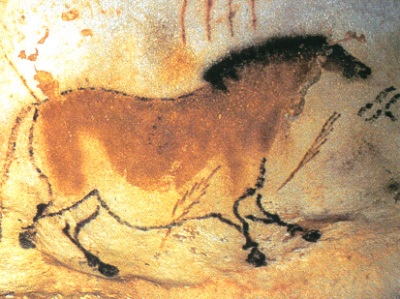
During the Paleolithic period, c.15–18,000 B.C. on the walls of a sacred cave, Lascaux, in southern France, our ancestors created beautiful paintings, often interpreted as a ritual that invoked sympathetic hunting magic. They are a reminder of the bond between the spirit world and the human world. This was a magical time in which humans lived immersed in the connection between the physical and spiritual worlds. Art was a means to both express and facilitate that connection.

Neolithic Goddess Figure

The seasons turned and the art and mythical imagery of the Paleolithic era was transmitted to the Neolithic era in Old Europe. Worship of the Goddess, as giver of all life, continued as did the art which honored Her and our connection to Her. The artists from these ancient days expressed their communal worship through the creation of cult idols and objects, shrines, painted pottery, and religious ceremonialism. The artists, though anonymous, were the hands and eyes of the creator, deepening and transforming the consciousness of their community.

As the human community in the western world developed and grew, art remained firmly grounded in the spiritual. From the megalithic stones of the Celtic era, to the illuminated manuscripts, mosaics and fresco paintings in the churches of the Middle Ages, right up to the work of painters like Van Gogh, Kandinsky, Malevich and Mondrian in the more modern era of late 19th and early 20th century – art expressed our human connection to the divine.

Continue reading “Art – A Bridge Between the Physical and Spiritual Worlds by Judith Shaw”

Songs We Sing By Barbara Ardinger

Even though I’m a spiritual feminist—and a pretty cranky one—I like the old familiar Christmas carols. I’m listening to a CD of Christmas songs in my car. One of the songs on the CD has the line, “God is watching us from a distance.”

There’s a reason Plato banned music from the Republic. Music gets into our heads and it stays there. Not only the tune and the rhythm, but the lyrics, too. So what idea does this song plant in our heads? God is out there. Watching us like we’re being baby-sat From a distance. So if we should happen to fall down, maybe he’s only watching and he doesn’t have long-enough arms to reach down and pick us up.

Passive watching is a key difference, of course, between the standard-brand religions (also called the religions of the book) and the Goddess religion. They’ve got a transcendent god somewhere up in heaven, up in outer space, up on the mountain, sitting up in the judge’s throne. Keeping an eye on us so if we misbehave, he can slam some thunderbolts down at us. Continue reading “Songs We Sing By Barbara Ardinger”

The Dark Half: Reflections on the Winter Solstice By Xochitl Alvizo

Photo by Chris Pinkham

I’m a Capricorn. People seem not to be surprised when they find out. I’m also the oldest of three siblings and a keeper of people’s secrets. Stories and secrets – my family’s included – I hear them all, take them all in. Sometimes someone will share something with me that involves another and afterward say, Now, don’t you go telling so and so that I said this. And of course I always reply, I don’t tell no one nothin’. And it’s true, I don’t tell – I simply take it in. I listen and I take it all in. The stories shared, stories of joy and of love, excitement and disappointment, of hurt feelings and misunderstandings, all of them inform me. They all cause me to reflect and consider the fragility of us all, the precariousness of life. We affect each other so much, from the smallest moment to the largest system, all of it makes such a difference to us.

Tonight we celebrate the Winter Solstice – it marks the boundary of darkness and light – it is the shortest day and longest night of the year.  Continue reading “The Dark Half: Reflections on the Winter Solstice By Xochitl Alvizo”