During the last week of September I had the opportunity to spend a few days in solitude in a place that is my soul’s home. I spent part of my time reflecting on questions posed by ecotheologian Mary DeJong to mark the autumnal equinox. The first question was “What is a desire you carry into the autumn season? What are you seeking?” After much contemplation, the words that came were, “I wish for a change in government – to be rid of Trump and company – for freedom, equality, respect, for the dignity of all, for an end to the suffering in Gaza and the reign of terror of ICE in this country – the horrors of those being abducted and imprisoned – for an end to cruelty. Yes, for an end to cruelty everywhere. Why is this country so cruel? I do not understand cruelty. Where does it come from? Why would anyone want to be cruel? How could anyone even stomach the suffering of another? How does that happen? Yes, I desire an end to cruelty.”
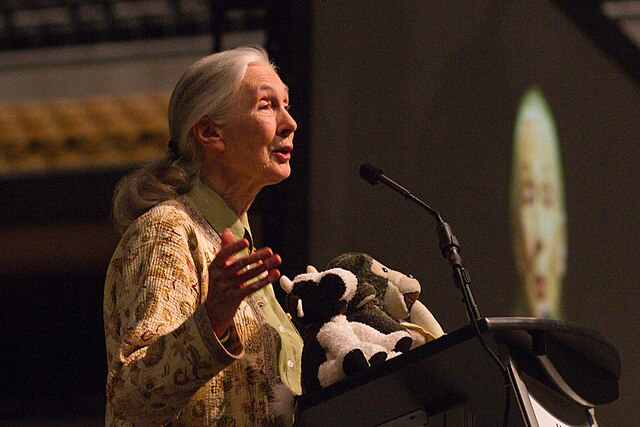
A few days after writing those words, on October 1st, scientist, environmentalist, and humanitarian Jane Goodall passed away in her sleep, prompting me to re-read her book, Reason for Hope. There I found her words echoing my own, “To me, cruelty is the worst of human sins. . . “[i] And while she had not set out to study human cruelty, how we become cruel and how we might move beyond our worst impulses, her work with chimpanzees eventually would lead her to this.
May we be resilient in the face of conflict and change. May we lean in, reach out, root down, and deepen into the practices that nurture us and sustain us. May we cultivate wise discernment. May we persist in reclaiming our power and our attention. May we embody our prayers. May we dance bravely on the bones of the coercive systems that try to drag us down. May we lift our heads to meet the eyes of life. May we persist in seeing, in being, in lifting our resilient and stubborn joys up to soar.
I know we are weary, overwhelmed by how much damage can be done by sweeps of pen and distant deciding, callous disregard seeming to seep into all the edges and change how the world feels to live in. We may feel frozen with indecision, unsure of what to do or how to help or what to say. So much asks for our attention and our time, asks us to look and to not turn away. We wonder what there is to celebrate in the face of so much anger and so much need. It is hard to feel so small and human, hard to keep hoping, to trust in our own inherent magic and that goodness and beauty are still at work amid the pain.
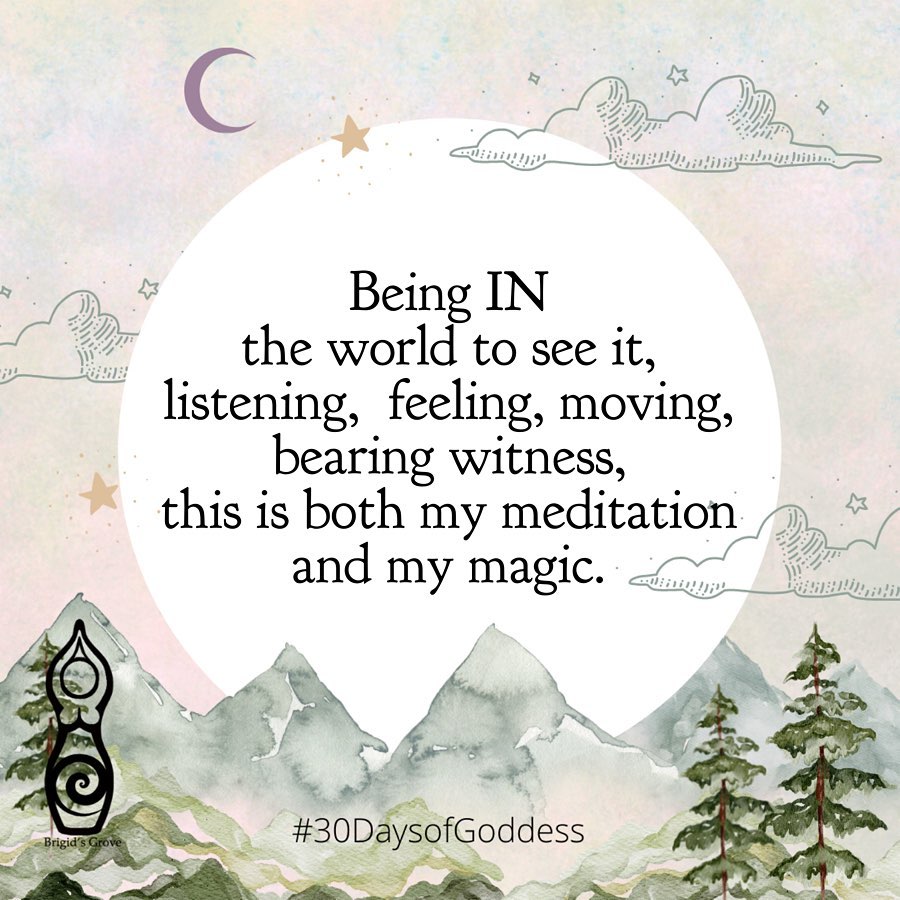
Sometimes I wonder what I do in a year. Then I remember that I watch nighthawks migrate and coneflowers go to seed. I find Monarch caterpillars small and brave on persistent milkweed. I travel over miles of stone and moss, sometimes on my knees, seeking mushrooms and cackling with glee. I kneel in the violets, purple and white and yellow, and inhale great breaths of wild plum. I keep dates with as many sunsets as I can. I walk and walk and walk, carry leaves of mullein, crow feathers, bits of chicory, coreopsis, evening primrose, and wild rose home to press into the pages of my prayers. I pick blackberries with the bees and feel butterfly tongues on the skin of my wrist. I reach for wild raspberries under both thunder and sun. I slide down hillsides with muddy feet and antlers in my hands. I make eye contact with hummingbirds and turtles and deer and raccoons. I watch both fawns and nestlings grow. I learn how woodpeckers talk to their babies and the purring sound crows make at the compost pile when they think they’re unobserved. I lose and recollect myself more times than I can count, hold myself steady and let myself dissolve. I create new things with a wild veracity of devotion that sometimes threatens to consume me. And, I learn over and over again every day, how much it matters to bear witness, to what means to sit with myself in the temple of the ordinary each day, calling my attention back, recommitting to being here for it all, settling back into center again and again, rebuilding and renewing, witnessing and weaving, losing and finding, laughing and crying, refusing to surrender my joy and trusting that somehow it matters to be here, to see everything I can.
During late summer a few years ago I had a vision. I know it was summer because it was hurricane season and there were several active storms in the Atlantic & Caribbean. Since I grew up in Florida and lived in New Orleans for many years, I have a lot of experience with hurricanes.
In this vision, I found myself seated at the side of the Great Mother Goddess looking down thru a portal at planet Earth. The Goddess looked at me and then turned back to the portal. She put a finger out and touched a place on the planet with a spark of light. Then She turned to me and said, “The energy must be discharged!” She repeated this multiple times and ultimately put her finger on planet Earth five times, each time touching a spot where a hurricane was active.
I often speak of being in the temple of the ordinary, of seeing the enchantment in the ordinary. In the book The Spirituality of Imperfection, the authors write that “beyond the ordinary, beyond material beyond possession, beyond the confines of the self, spirituality transcends the ordinary, and yet, paradoxically, it can be found only in the ordinary. Spirituality is beyond us, and yet it is in everything we do. It is extraordinary. And yet, it is extraordinarily simple.”
This spring, I presented at an event and the concept of “being versus doing” arose. I reminded participants that “being” is not a competitive sport. We cannot not be, we are being all the time. I think sometimes the pressure we put on ourselves to be better, to “do” being better, can be really hobbling. Likewise, the sensation that spirituality is somewhere “out there” or that it has to be bigger than or better than or transcendent instead of present in the ordinary. On a goddess based path, with a feminist orientation, I find that the Goddess herself pervades all of existence, pervades your whole entire life, even the rough and weary places, even the ragged and strange places. Returning to Kurtz and Ketcham, they write: “Now…beyond the ordinary is not meant to suggest something complicated, different, different or self-consciously special. Nothing is so simple, or so out of the ordinary for most of us, then attending to the present. The focus on this day, suggested by all spiritual approaches, attending to the present, to the sacredness present in the ordinary, if we can get beyond the ordinary is, of course, a theme that pervades Eastern expressions of spirituality and other expressions too.”
I know that I often find myself seeking or longing for the special moments, the magic, the flashes of transcendence, and sometimes this can cause me to miss the ordinary, to miss the present, to miss where I am because I’m longing for something else. Adages to the effect of “do what you are doing” and “be where you are” may begin to sound cliché almost and the reason they do is because it’s so simple and so out of the ordinary to simply come back to attending to the present. The present moment is, in my eyes, truly where we find the goddess, in the pulse of presence in the every day. In the book She of the Sea, author Lucy Pearce addresses the question of the transcendent ordinary as well: “I want to write of the oceanic mystery, the soul of goddess magic, the sacred that which lies beyond words, because the repeated deliberate seeking of connection to this is at the heart of what I do and who I am. It is my creative and spiritual practice. I want to speak of this so that you can close your eyes turn inwards and smile knowing, just knowing until our conversation can continue without words…I want to share what I have known and for not to sound strange, yet strangeness is its nature. The soul is not of this world. It’s not rational, the sacred is not logical, but nor is this chaotic, magnificent, contradictory, and complex world of ours. And yet, we insist on pretending that it is and being disappointed, afraid, or bemused when it shows us its reality, again and again.”
The sacred is not logical, and neither is the world itself, but we pretend that it is, and then we get disappointed when we see reality. I originally learned the phrase “don’t argue with reality” from self-help author Wayne Dyer. There can be a whole range of potential experiences that are beyond objective reality or the reality that people sometimes insist is all there is. Jeanette Winterson, in her book Lighthousekeeping writes: “I do not accept that life has an ordinary shape, or that there is anything ordinary about life at all. We make it ordinary, but it is not.”
Maybe we are trying to make things ordinary that are not. My kids are growing up and getting ready to graduate from high school. One of my sons is very into science and loves biology and genetics and he is fond of boiling things down to an “everybody’s just a mass of cells having a collective hallucination” type of rhetoric that leaves little room for the esoteric and little room for inherent meaning. However, for me, I come back to the reality of being human as its own kind of miracle, its own profound magic. The reality of having this body with all these cells, which are doing all these things day in and day out that I don’t consciously know how to do, and yet my body does them every single day. That’s magic, even if we can explain the objective “why” of it. I don’t consciously know how to beat my own heart, but wait a second, yes, I do, because here it is beating every day from birth till death. Some people may be quite attached to maintaining the assertion that life is random and pointless, but this is not the story I see. I see wonder. I see magic. I see a miracle in motion. I am awestruck at the impossible reality of being a bundle of cells typing this essay right now. Yes, I am “only” a bundle of cells and that is absolutely pure magic to me. In fact, your very presence right here, right now is proof of the sacred on this earth in my eyes. May we all love the ordinary and let it whisper of the magic right beneath the skin.
Breathe deep and allow your gaze to settle on something you love. Draw up strength from the earth. Draw down light from the sky. Allow yourself to be refilled and restored. There is good to be done on this day. Let your own two hands against your heart be the reminder you need that the pulse of the sacred still beats and the chord of the holy yet chimes.
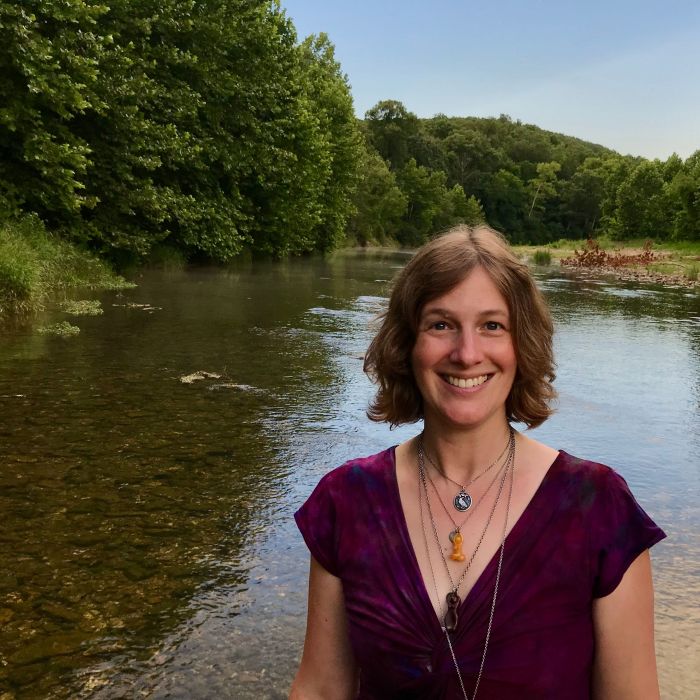
Molly Remer, MSW, D.Min, is a priestess facilitating women’s circles,seasonal rituals, and family ceremonies in central Missouri. Molly and her husband Mark co-create Story Goddesses at Brigid’s Grove. Molly is the author of nine books, including Walking with Persephone, Whole and Holy, Womanrunes, and the Goddess Devotional. She is the creator of the devotional experience #30DaysofGoddess and she loves savoring small magic and everyday enchantment.
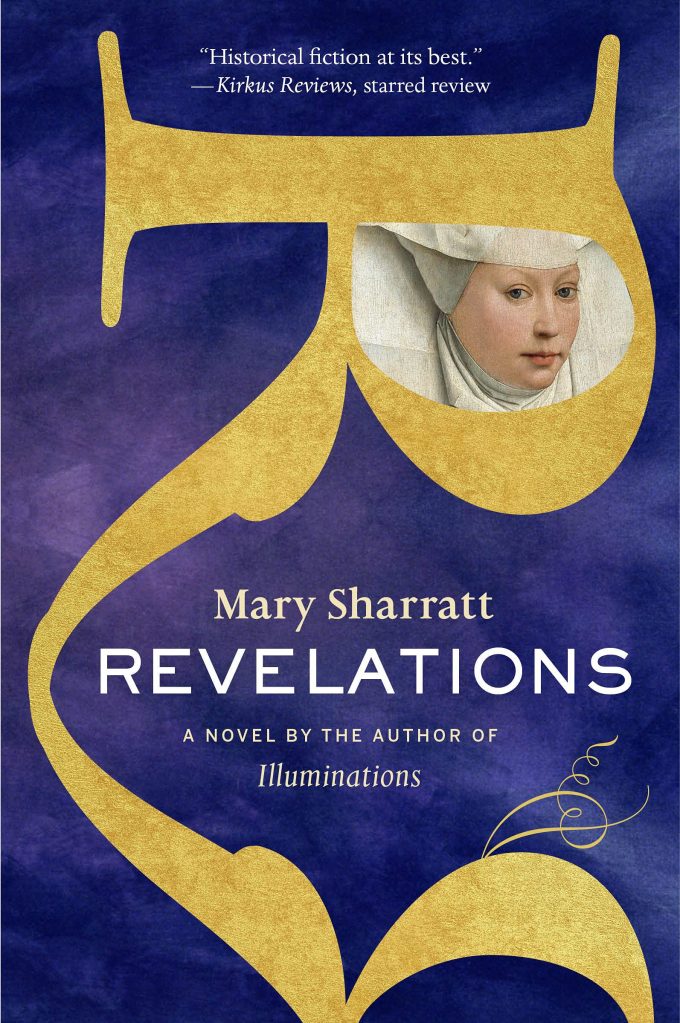
My novel Revelations, based on the intertwined lives of female mystics Margery Kempe and Julian of Norwich, will be released in paperback on April 19. You can order HERE.
“All shall be well, and all shall be well, and all manner of things shall be well.”
These words of Julian of Norwich, taken from her masterpiece of visionary theology, Revelations of Divine Love, seem almost tone deaf against our current backdrop of war and the ongoing pandemic. In a world like ours, with war criminals like Putin calling the shots, it’s so tempting to fall into either hardened cynicism or hopeless despair.
But Julian of Norwich was no naïve simpleton. Although an anchoress who had taken vows as a fully cognizant adult to wall herself into a cell built on to the back of Saint Julian’s Church in Norwich, England, she wasn’t living in some airy-fairy cloistered bubble. Her own age was riven by plague, war, and religious intolerance, which saw the burning of many perceived witches and heretics. Saint Julian’s Church (she took the name of the church, not the other way around) was located in a rough part of town near the river and the stinking tannery district where prostituted women and girls plied their trade.
Far from walling herself off from the world’s woes, Dame Julian had a window in her anchorage wall facing out into the street. Anyone might seek her counsel. She was famous throughout Britain for her sage advice. One of the many who poured her soul out to Julian was a desperate housewife and mother of fourteen children, who had finally plucked up the courage to walk away from an abusive marriage. This woman was none other than Margery Kempe, the heroine of my novel.
Margery had been experiencing sensual, visceral images of the divine for over twenty years. Now she had reached a crossroads in her life. She wanted to walk the mystic’s path and travel as a pilgrim to Jerusalem and Rome. But her choice to leave her family and travel the world as a solo woman was even more controversial and downright dangerous in her age than in ours.
It would have been so easy for a spiritual counselor to parrot the voice of conventional wisdom and tell Margery that her dream of pilgrimage was a self-indulgent folly and that her true calling was to serve her children as a conventional wife and mother.
Instead, Julian did something unheard of. She empowered Margery to trust herself, to trust the voice of spiritual wisdom within her own heart. She told Margery to set all her trust in the divine and not to worry too much what the world thought of her choice–if some people disliked Margery, perhaps that meant Margery was doing something right.
Julian didn’t promise Margery–or us, the readers of Revelations of Divine Love–an easy ride. In one of her searing visions, Julian received the message, “You shall not be overcome.” She wrote in her book, “Our Lord did not say, ‘You shall not be tormented, or troubled, or grieved’ but ‘You shall not be overcome.'”
Julian received her divine revelations around the age of thirty when she was deathly ill and thought she was going to die. Instead, she survived and dedicated the rest of her life to being a living witness to the exquisite divine love she had experienced.
We don’t have to be anchoresses or travel to Jerusalem to experience this deep love and wisdom. The deepest pilgrimage of all is the journey into the depths of our own hearts where divine love dwells eternally, in each one of us, regardless of our faith or spirituality. The sacred inside us can never taken from us.
The heart will always be there for us and it is only from the heart that we can bring peace and justice to our fractured world. By bringing our information-overloaded brains inline with the deep wisdom of the heart. By bringing our speech inline with the heart. By bringing all our deeds inline with the heart.
May we all be witnesses to the Divine Love within us.
“All shall be well and all shall be well, and all manner of things shall be well.”
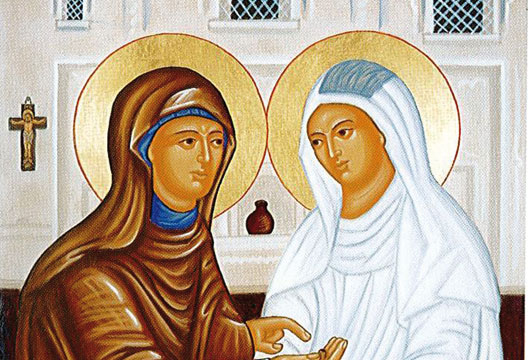
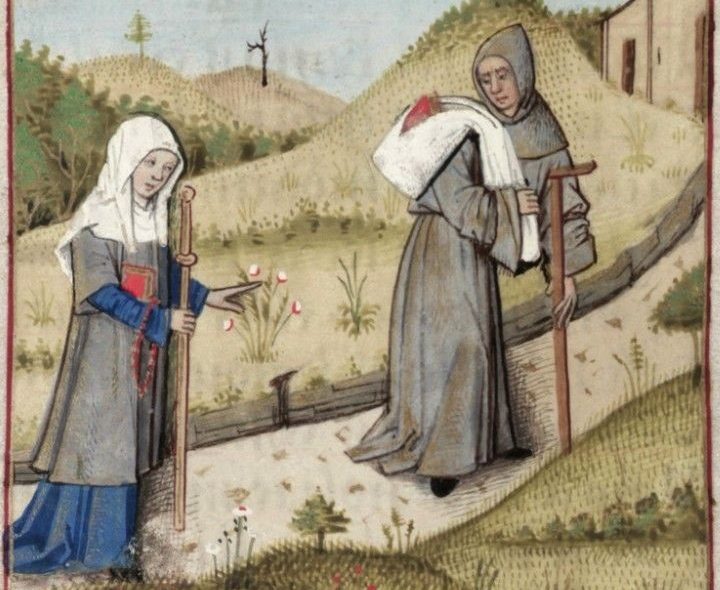
Julian of Norwich (left in her Benedictine habit) counsels Margery Kempe, who dressed all in white to mark her vocation as a mystic and pilgrim.
Mary Sharratt is committed to telling women’s stories. Please check out her acclaimed novel Illuminations, drawn from the dramatic life of Hildegard von Bingen, and her new novelRevelations, about the mystical pilgrim Margery Kempe and her friendship with Julian of Norwich. Visit her website.
We are hard-wired to frame our experience in stories. Almost anything we endure, no matter how painful, can take on a deeper meaning if we see it as one chapter in an overarching narrative. Stories give coherence and meaning to our often fragmented and chaotic lives.
Georgia O’Keeffe lived way beyond Act One!
We live in a youth-obsessed culture. The cosmetic industry pushes wrinkle creams and hair dye on us while celebrities resort to fillers and surgery to preserve an illusion of eternal girlhood. Advancing age, once a mark of honour, has become a source of shame. Popular fiction, literary classics, television, and movies celebrate young heroines, from Elizabeth Bennett to Katniss Everdeen. But where are the stories about older women and why do we all need to hear them?
We live longer than ever before. Women’s lives don’t play out in one act, even though our culture programs us to think that way. It almost seems a travesty to imagine an older Elizabeth Bennett grown bored of Darcy and yearning to reinvent herself and embrace some new adventure.
Old-school male authors were really big on killing off their young heroines so they couldn’t even dream about maturing into women with agency. Shakespeare merrily committed femicide on Juliet, Ophelia, and Desdemona, to name just a few of his hapless heroines.
Ophelia drowning. Don’t try this at home.
Why have so many authors, past and present, refused to let their heroines age? Why this reluctance to write about seasoned female protagonists who have been around the block more than once? Perhaps because too many people, even today, consider experienced women threatening. Since the time of witch burnings and scold’s bridles, male-dominated culture has been petrified of older woman who seize their power. That’s why stories about young women with a certain cut-off date are much cosier and less threatening.
But coming-of-age stories can only take us so far. We need to imagine lives beyond Act One, beyond a vague glimmering on the horizon. We need signposts to help us navigate our long and unavoidably complicated modern lives. We live in an age of divorce, blended families, and many of us pursue several careers and many paths of discovery over the course of a single lifetime. Contrary to cultural expectations, women do have exciting, juicy lives after forty and beyond. Contemporary fiction should explore and celebrate this.
Yes, there have been break-out books about older women—Elizabeth Strout’s Olive Kitteridge, and even literary classics, such as Virginia Woolf’s Mrs. Dalloway—but these are the exceptions that prove the rule. In the publishing marketplace, stories about older women remain a hard sell. Which is bitterly ironic, considering that most fiction is purchased by women over the age of forty.
Yet it’s not just an older audience that needs to read about older heroines. I would argue that girls and young women are in even greater need of literary role models to guide them way beyond a self-limiting Act One.
As a teenager, I was hungry for such stories. Some proof that I had something to look forward to beyond the awfulness of high school (not the best years of my life). Like Holden Caulfield, I was caught in a web of angsty adolescent nihilism which cast everyone from the cheerleaders to the teachers as a chorus of fakes and phonies. I needed a gutsy female role model to pull me out of this miasma.
Eventually I found my heroine, not in the pages of a novel, but in Blackberry Winter, Margaret Mead’s memoir. I was electrified by this strong woman who didn’t give a fuck about preening for the male gaze and yet still had an amazing love life. Born in 1901, in an era when women were programmed for domesticity, she became a pioneering anthropologist and feminist icon. Her memoir, subtitled “My Earlier Years,” is not cut off at Act One, but only ends when she becomes a grandmother. Well into old age, Mead remained a mesmerizing and magnetic presence for being authentically herself.
Mead’s memoir is a rare jewel of female self-confidence in an ocean of women’s self-censorship and self-effacement. In Writing a Woman’s Life, Carolyn G. Heilbrun observes how both biographers and autobiographers have suppressed the truth about lived female experience to force it to conform to society’s script of how a woman’s life should be.
Heilbrun then discusses the Mother of All Female Memoirs, the first to appear in the English language. The Book of Margery Kempe (c. 1436–38) reveals the escapades of a woman mystic who wasn’t enclosed in a cell, but was literally all over the map. Kempe’s call to adventure unfolded amid the bitter disillusionment of midlife. She was forty, a desperate housewife, a failed business woman, a mother of fourteen children, and trapped in an abusive marriage. Marital rape was her lived reality—a fifteenth child might have killed her.
Her story completely exploded my every stereotype of medieval womanhood. Her life choices seem absolutely radical by the standards of our time as well as hers.
Since divorce was not an option, she seized back control by setting off on the perilous pilgrim’s path to Rome, Jerusalem, and Santiago de Compostela. She literally walked away from her unhappy marriage and blazed her trail across Europe and the Near East in an age when very few women traveled, even in the company of their husbands.
Alas, Kempe’s independence and eccentricities drew suspicion. When she returned to England, she found herself on trial for heresy. A guilty verdict would have seen her burned at the stake, yet she kept her spirits high by regaling the Archbishop of York with a parable of a defecating bear and a priest.
Most significantly, the spiritual mentor who stood by Kempe as she made her unorthodox choices was a woman in her seventies, the anchoress Julian of Norwich. Before leaving on her monumental pilgrimage, Kempe sought Julian’s counsel. This was an exceedingly vulnerable time in Kempe’s life. In leaving her husband and children, she had broken all the rules and was filled with self-doubt and uncertainty. Julian’s advice to trust her inner calling and not worry too much about what other people thought seemed to have a profoundly empowering impact on her. While Julian had chosen to wall herself into a cell and live as a religious recluse, she gave Kempe her blessing to wander the wide world.
Kempe’s story would have been lost to history if she hadn’t recorded it in her autobiography, a tremendous act of foresight and courage that made her a literary pioneer. She dictated her story to a priest, who copied it down for her and whose ecclesiastical authority gave gravitas to her narrative.
We are hard-wired to frame our experience in stories. Almost anything we endure, no matter how painful, can take on a deeper meaning if we see it as one chapter in an overarching narrative. Stories give coherence and meaning to our often fragmented and chaotic lives.
Margery Kempe’s story proves that even in the Middle Ages, women had the power to re-invent themselves in midlife and beyond. If Act One disappoints, time to dive feet first into Act Two. We can continually re-vision our own narrative.
Our culture likes to pit women against each other. Divide and conquer. Popular tropes cast young women and older women as rivals or even enemies. In fairy tales a young maiden’s coming of age involves going out into the wild forest to encounter the scary old witch who acts as a foil to the maiden’s youth and innocence.
But if we look past the patriarchal smokescreen, we see that youth and aging are mirrors reflecting one another. The maiden and the witch are not enemies. The true coming of age unfolds when the maiden seeks out the witch who ultimately empowers her. Who teaches her to be fierce and not suffer fools.
As we mature, we are gifted with the superpower of seeing through the false scripts that consumer society hands us. We can see just how absurd it is to kill ourselves to emulate airbrushed fashion models. We understand that the greatest lover in the world can’t fulfill us until we are at peace with ourselves. And so we can let ourselves go, whatever our age. Paint the pictures we’ve always longed to paint. Learn French and travel the world. Dance under the stars and see visions. Offer our own song to the vast symphony of life.
We need stories that honor the entire sweep of womanhood, not just Act One. What would our literary canon and popular culture look like if it truly reflected the depths and breadth of our authentic, lived experience as women and girls today?
This essay was originally published in Literary Hub.
Mary Sharratt is on a mission to write women back into history. Her acclaimed novel Illuminations, drawn from the dramatic life of Hildegard von Bingen, is published by Mariner.Her new novelRevelations, about the mystical pilgrim Margery Kempe and her friendship with Julian of Norwich, is now available and will be released in paperback in April. Visit her website.
, elders are people who have illuminated my path, inspired me to see my own potential. To open my eyes, all my senses, even those I did not know I had. Elders show bravery and model for us how to be strong.
What is an Elder?
The word elder comes from an Old English word which also meant ancestor or chief. A lot can change in a thousand years and many of us no longer honor older people or seek out them out for advice.
In my experience, elders are people who have illuminated my path, inspired me to see my own potential. To open my eyes, all my senses, even those I did not know I had. Elders show bravery and model for us how to be strong.
My first wise woman teachings came from my family. My mother, and her mother, taught me to be myself, to love being outdoors and the importance of having a garden. Feeling the joy of flowers, cooking with fresh herbs, planting a tree to honor the dead. These are a few ancient traditions of my ancestors that have survived even in a modernized and urban setting.
As I rediscover my connection with the earth, my eco-consciousness inspires me to transform. As I go back to nature, I re-awaken my ancient cellular memories of living in harmony with the earth. I feel called to dance barefoot, play drums, make offerings, bathe in moonlight, harvest with my own hands. As I move forward on a path which is both new and old, it is my beloved elders who have shown me how to find my way.
What is an Elder?
The word elder comes from an Old English word which also meant ancestor or chief. A lot can change in a thousand years and many of us no longer honor older people or seek out them out for advice.
In my experience, elders are people who have illuminated my path, inspired me to see my own potential. To open my eyes, all my senses, even those I did not know I had. Elders show bravery and model for us how to be strong.
My first wise woman teachings came from my family. My mother, and her mother, taught me to be myself, to love being outdoors and the importance of having a garden. Feeling the joy of flowers, cooking with fresh herbs, planting a tree to honor the dead. These are a few ancient traditions of my ancestors that have survived even in a modernized and urban setting.
In the 15th century, as now, independent female travelers faced harassment and suspicion.
I’ve always been fascinated with the women mystics, such as 12th century powerfrau and visionary Hildegard von Bingen, the heroine of my 2012 novel, ILLUMINATIONS. Likewise my new novel, REVELATIONS, which will be published in April 2021, is centered on two 15th century English mystics, Margery Kempe and Julian of Norwich. Like Hildegard, they were women of faith facing the roadblock of institutional, male-dominated religion that sidelined them. But instead of letting this beat them down, they found within their own hearts a vision of the divine that mirrored their female experience. I believe it’s no mere coincidence that both Hildegard and Julian dared to create a theology of the Feminine Divine, of God the Mother. All three women seized their power and their voice to write about their encounters with the sacred, preserving their revelations to inspire us today.
While Hildegard and Julian are iconic, Margery Kempe is a more marginal figure–well-known among medievalists but much less known to a general audience. I first encountered Margery in a post-grad course entitled Late Medieval Belief and Superstition. I was blown away by the story of this enterprising woman who survived postnatal depression and a soul-destroying marriage to become an intrepid world traveler and literary pioneer. The Book of Margery Kempe (c. 1436–38) is the first autobiography in the English language.
Margery’s story explodes our every stereotype about medieval women.
She was not just a desperate housewife and mother of fourteen. She rebelled against the straightjacket of an abusive marriage by becoming an entrepreneurial businesswoman. First she ran a brewery, then a grain mill. When both businesses failed and she’d had enough, she left her husband behind and took to the road as a pilgrim, traveling to Jerusalem, Rome, and Santiago de Compostela. This in an age when very few women traveled even in the company of their husbands, Margery blazed her own trail across Europe and the Near East.
Alas, like strong women throughout history, her independence and eccentricities drew suspicion. Before long she found herself on trial for heresy. A guilty verdict would have seen her burned at the stake, yet she kept her spirits high by regaling the Archbishop of York with a parable of a defecating bear and a priest.
Before leaving on her monumental pilgrimage, Margery sought the counsel of her sister mystic, Julian of Norwich. This was an exceedingly vulnerable time in Margery’s life. In leaving her husband and children behind, she had broken all the rules, and she was filled with self-doubt and uncertainty. Julian’s advice to trust her inner calling and not worry too much about what other people thought seemed to have a profound and empowering impact on Margery. While Julian had chosen to wall herself into a cell and live as an anchoress, she gave Margery her blessing to wander the wide world.
Sadly, some historians and theologians try to pit Julian and Margery against each other. Julian is held up as the real saint, the real deal, while Margery is dismissed as a hysterical wanna-be. Because she had the habit of copious weeping when in the throes of mystical experience, many people, both in her time and ours, have refused to take her seriously.
Yet a number of fascinating synchronicities connect Margery and Julian. In so many ways, their stories intertwine and complement each other.
Margery was born in 1373, the same year that thirty-year-old Julian received her “showings”—the divine visions that would inspire her landmark book Revelations of Divine Love, the first book written in English by a woman. Both women lived in Norfolk, in cities less than 45 miles away from each other. Both women were literary pioneers whose lifework was lost to obscurity, only to resurface in the twentieth century.
Immersing myself in Julian’s radical theology of the primacy of divine love was a profound experience. Like Margery, I often found myself moved to tears by the beauty of Julian’s visions, by her absolute assurance that no matter how dire things may seem, all will be well.
But what took me by surprise was how revelatory Margery’s dance with self-doubt was for me. In writing this book and delving into medieval mystical texts, I discovered that our doubts, as painful and wrenching as they are, aren’t a flaw or hindrance. In fact, they lead us deeper into the divine mystery, the vast “Cloud of Unknowing” where God dwells. Only when we set aside our preconceived notions of what we think we believe the divine to be, can we enter this numinous place.
As a mystic, Margery’s especially fascinating to me, because she found her spiritual bliss not in the cloister, but as a laywoman, in the full stream of worldly life with all its wonders and perils. May we all have the power to reinvent ourselves as courageously as Margery did.
Mary Sharratt is on a mission to write women back into history. Her acclaimed novel Illuminations, drawn from the dramatic life of Hildegard von Bingen, is published by Mariner.Her new novelRevelations, about the globe-trotting mystic and rabble-rouser, Margery Kempe, will be published in April 2021. Visit her website.
When I wrote Murder at the Rummage Sale, my agent warned: “You have to have a sequel in mind!” I was supposed to write a second domestic cozy, same setting, same characters, different victim. But what came to mind was a memory. When I was a troubled teen visiting England, my uncle gave me a map and let me go sightseeing in London on my own. It was early winter 1968, the war in Vietnam was raging. I did not want to be an American; so I faked an accent, wore an eccentric hat, and called myself Eliza Doolittle. When a man picked me up, I did not know how to break out of character. I ended up drunk in his flat. I just managed to fight off rape. The man must have figured out that I didn’t add up and could land him in trouble. He took me back to my uncle’s office. The kernel for All the Perils of this Night is: what if he hadn’t? What if, like so many others, I had been trafficked? I couldn’t shake that “what if.” So I wrote the standalone sequel, no domestic cozy but what I would call a numinous thriller.
In July, in honor of Mary Magdalen’s feast day, I usually post about Maeve, my Celtic Mary Magdalen. This year Maeve urged me to select an excerpt from the new novel. In the scene below Anne, teenaged Katherine’s mother, is searching for her vanished daughter in London’s red light district. A prostitute agrees to speak with her if Anne will pay for her time.Continue reading “All the Perils of this Night: a preview by Elizabeth Cunningham”





 Mary Sharratt is on a mission to write women back into history. Her acclaimed novel
  When I wrote Murder at the Rummage Sale, my agent warned: “You have to have a sequel in mind!” I was supposed to write a second domestic cozy, same setting, same characters, different victim. But what came to mind was a memory. When I was a troubled teen visiting England, my uncle gave me a map and let me go sightseeing in London on my own. It was early winter 1968, the war in Vietnam was raging. I did not want to be an American; so I faked an accent, wore an eccentric hat, and called myself Eliza Doolittle. When a man picked me up, I did not know how to break out of character. I ended up drunk in his flat. I just managed to fight off rape. The man must have figured out that I didn’t add up and could land him in trouble. He took me back to my uncle’s office. The kernel for All the Perils of this Night is: what if he hadn’t? What if, like so many others, I had been trafficked? I couldn’t shake that “what if.” So I wrote the standalone sequel, no domestic cozy but what I would call a numinous thriller.
  Feminism and Religion