From the Archives: Resistance and the Religious Left by Gina Messina

This was originally posted on June 21, 2017, you can read the original comments here.

For the last forty years, the Christian Right has influenced the conversation in American politics. Where is the Religious Left and how are they impacting our nation’s moral agenda? It is an important question, and now, more than ever, we need a progressive religious viewpoint in the conversation.

We are living in an era where the morality of our society is at stake and the soul of our nation is being bought by billionaires who have an insatiable appetite for money, power, and control. With an alt-right movement growing and nationalism becoming the Trump Administration theme, we are in danger of losing our humanity.

It is time for a serious response to the Christian Right. Why must we associate Christianity with bigoted policies? This ongoing movement has dominated our nation’s political agenda and led to the idea that you are either religious and conservative or liberal and atheist. Don’t get me wrong, every person’s belief system is their own and should not be judged.  However, studies well demonstrate that many Americans are walking away from religion all together because of the Christian Right’s political influence. It is time that Christianity be recognized as more than a conservative movement seeking to highjack policies and victimize the disenfranchised.

The true message of Jesus is founded on love, inclusion, liberation, and social justice. No Christian Right position resembles this. In fact, they are in direct conflict. Rather than focusing on condemning those who are deemed “the other,” why not focus on caring for the poor, welcoming the stranger, and healing the sick?

Likewise, conservative Christian stances have been historically anti-feminist and anti-woman. Those clinging to such beliefs would rather elect a president that has openly discussed grabbing women by the “pussy” than risk giving up privilege.

As the Women’s March has challenged Trump and his policies on gender, an anti-feminist backlash has strengthened with Evangelical women arguing that feminists have created their own oppression by whining rather than taking responsibilities for themselves.

The Christian Right would be surprised to find out that Jesus’ politics and teachings mirror the values of feminism – calling for an end to all oppression and creating a society that is just and fair for every person regardless of gender, race, ethnicity, age, religion, etc. Jesus welcomed women to his community and women played a critical role in his ministry.  Jesus not only had women disciplines; but also selected women as prominent recipients of his revelation. Most notably, Jesus chose women as the first witnesses of his resurrection. And while the apostles did not believe Mary Magdalene’s testimony, nevertheless, she persisted.

It is time not only for a resistance but a religious resistance where those who try to abide by the message of Jesus stand up to the Christian Right.  I acknowledge that no one is a perfect Christian; we all fail. But what is important is that we recognize the message of the Gospels and keep trying. Thus, we must reject the oppressive regime of the Trump Administration and the bigoted claims of the Christian Right. We must reclaim the Christian faith in its true form and live out its message the way it was intended.

We are living in a difficult time, but let us claim this moment to energize and unify the Religious Left. In the name of the Lord, let us challenge those who manipulate the Christian message as means to claim power and privilege while oppressing everyone else. It is time to make humanity great again.

From the Archives: The Quality of Mercy by Barbara Ardinger

This was originally posts on October 4, 2020. You can see the original comments here.

The quality of mercy is not strained;
It droppeth as the gentle rain from heaven
Upon the place beneath. It is twice blest;
It blesseth him that gives and him that takes…

This speech (Act IV, scene 1) from The Merchant of Venice, given by Portia in disguise as a boy lawyer (and Bassanio doesn’t even recognize her!), may be one of Shakespeare’s most famous. In the play, as we know, Shylock, a Jewish moneylender, and Antonio, a merchant waiting for his ships to come in, make a bargain, one part of which is that if Antonio doesn’t pay on time, Shylock gets to collect one pound of his flesh. Antonio’s ships don’t come in, the case is taken before the Duke of Venice, and Portia appears in disguise to solve the legal issues. She goes immediately to Shylock and speaks this speech to him.

Continue reading “From the Archives: The Quality of Mercy by Barbara Ardinger”

GOD IS A BLACK WOMAN by Christena Cleveland, PhD – Book Review by Carolyn Lee Boyd

God Is a Black Woman by Christena Cleveland PhD

FAR recently published an excerpt and lively discussion of Christena Cleveland, PhD’s new book God Is a Black Woman. We thought the FAR community might enjoy learning more about this memoir of her moving journey from the terror and control of “whitemalegod” to the unconditional love and healing of the Sacred Black Feminine. Her recounting of her 400-mile walking pilgrimage to see eighteen French Black Madonnas is especially fascinating and poignant.

Christena is a social psychologist, former professor at Duke University’s Divinity School, public theologian, researcher, author, and speaker. She is “the founder and director of the Center for Justice + Renewal as well as its sister organization, Sacred Folk, which creates resources to stimulate people’s spiritual imaginations and support their journeys toward liberation.” She blends all these areas of expertise to offer theological, sociological, psychological, and historical insights into her stories of her spiritual quest. The book offered me many “aha!” moments about my own beliefs and assumptions regarding spirituality, feminism, and the ubiquitous effects of racism.

Continue reading “GOD IS A BLACK WOMAN by Christena Cleveland, PhD – Book Review by Carolyn Lee Boyd”

The Magic of the Ordinary, by Molly Remer

“Nothing is so simple, or so out of the ordinary for most of us, then attending to the present.”

— Ernest Kurtz & Katherine Ketcham, The Spirituality of Imperfection

I often speak of being in the temple of the ordinary, of seeing the enchantment in the ordinary. In the book The Spirituality of Imperfection, the authors write that “beyond the ordinary, beyond material beyond possession, beyond the confines of the self, spirituality transcends the ordinary, and yet, paradoxically, it can be found only in the ordinary. Spirituality is beyond us, and yet it is in everything we do. It is extraordinary. And yet, it is extraordinarily simple.”

This spring, I presented at an event and the concept of “being versus doing” arose. I reminded participants that “being” is not a competitive sport. We cannot not be, we are being all the time. I think sometimes the pressure we put on ourselves to be better, to “do” being better, can be really hobbling. Likewise, the sensation that spirituality is somewhere “out there” or that it has to be bigger than or better than or transcendent instead of present in the ordinary. On a goddess based path, with a feminist orientation, I find that the Goddess herself pervades all of existence, pervades your whole entire life, even the rough and weary places, even the ragged and strange places. Returning to Kurtz and Ketcham, they write: “Now…beyond the ordinary is not meant to suggest something complicated, different, different or self-consciously special. Nothing is so simple, or so out of the ordinary for most of us, then attending to the present. The focus on this day, suggested by all spiritual approaches, attending to the present, to the sacredness present in the ordinary, if we can get beyond the ordinary is, of course, a theme that pervades Eastern expressions of spirituality and other expressions too.”

I know that I often find myself seeking or longing for the special moments, the magic, the flashes of transcendence, and sometimes this can cause me to miss the ordinary, to miss the present, to miss where I am because I’m longing for something else. Adages to the effect of “do what you are doing” and “be where you are” may begin to sound cliché almost and the reason they do is because it’s so simple and so out of the ordinary to simply come back to attending to the present. The present moment is, in my eyes, truly where we find the goddess, in the pulse of presence in the every day. In the book She of the Sea, author Lucy Pearce addresses the question of the transcendent ordinary as well: “I want to write of the oceanic mystery, the soul of goddess magic, the sacred that which lies beyond words, because the repeated deliberate seeking of connection to this is at the heart of what I do and who I am. It is my creative and spiritual practice. I want to speak of this so that you can close your eyes turn inwards and smile knowing, just knowing until our conversation can continue without words…I want to share what I have known and for not to sound strange, yet strangeness is its nature. The soul is not of this world. It’s not rational, the sacred is not logical, but nor is this chaotic, magnificent, contradictory, and complex world of ours. And yet, we insist on pretending that it is and being disappointed, afraid, or bemused when it shows us its reality, again and again.”

The sacred is not logical, and neither is the world itself, but we pretend that it is, and then we get disappointed when we see reality. I originally learned the phrase “don’t argue with reality” from self-help author Wayne Dyer. There can be a whole range of potential experiences that are beyond objective reality or the reality that people sometimes insist is all there is. Jeanette Winterson, in her book Lighthousekeeping writes: “I do not accept that life has an ordinary shape, or that there is anything ordinary about life at all. We make it ordinary, but it is not.”

Maybe we are trying to make things ordinary that are not. My kids are growing up and getting ready to graduate from high school. One of my sons is very into science and loves biology and genetics and he is fond of boiling things down to an “everybody’s just a mass of cells having a collective hallucination” type of rhetoric that leaves little room for the esoteric and little room for inherent meaning. However, for me, I come back to the reality of being human as its own kind of miracle, its own profound magic. The reality of having this body with all these cells, which are doing all these things day in and day out that I don’t consciously know how to do, and yet my body does them every single day. That’s magic, even if we can explain the objective “why” of it. I don’t consciously know how to beat my own heart, but wait a second, yes, I do, because here it is beating every day from birth till death. Some people may be quite attached to maintaining the assertion that life is random and pointless, but this is not the story I see. I see wonder. I see magic. I see a miracle in motion. I am awestruck at the impossible reality of being a bundle of cells typing this essay right now. Yes, I am “only” a bundle of cells and that is absolutely pure magic to me. In fact, your very presence right here, right now is proof of the sacred on this earth in my eyes. May we all love the ordinary and let it whisper of the magic right beneath the skin.

Breathe deep
and allow your gaze
to settle on something you love.
Draw up strength from the earth.
Draw down light from the sky.
Allow yourself to be refilled and restored.
There is good to be done on this day.
Let your own two hands
against your heart be the reminder
you need
that the pulse of the sacred
still beats
and the chord of the holy yet chimes.

Molly Remer, MSW, D.Min, is a priestess facilitating women’s circles, seasonal rituals, and family ceremonies in central Missouri. Molly and her husband Mark co-create Story Goddesses at Brigid’s Grove. Molly is the author of nine books, including Walking with Persephone, Whole and HolyWomanrunes, and the Goddess Devotional. She is the creator of the devotional experience #30DaysofGoddess and she loves savoring small magic and everyday enchantment.

Birch in Spring  2022 by Sara Wright

Black eyes

 smooth white

   supple body,

budded branches

torching

 cobalt sky

in pink;

hidden roots

    are fed by

March waters.

Continue reading “Birch in Spring  2022 by Sara Wright”

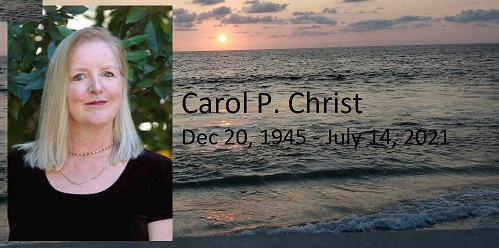
Carol P. Christ’s Legacy: Please Keep It in Your Pants by Carol P. Christ

This blog was originally posted on November 6. 2017. You can read the original comments here.

Trigger warning: this post describes sexual abuse

Last week while responding to a comment on my blog, I suddenly remembered a series of incidents in which men I did not know exposed themselves to me in public places. The first time occurred at a park around dusk during an outing with a group of girls. I was about 11, I may have wandered away from the group, or I may have been with others. What I remember is seeing a man with his pants down sitting on a park bench, possibly the first time I ever saw an adult man’s penis. I told or we told, but the man was not reported by the adults. Fast forward to the beautiful gardens of the Palace Schoenbrunn in Vienna where I was confronted by a penis while lost in thought when I was 19. I ran, but said nothing. In my 20s at the early showing of movies in New York City men would sit next to me and jerk off into paper bags. I learned to move whenever a man was near me in the theater, but I never told the ticket seller. A few years later, I crossed paths with a man who had his penis out on my favorite walk in the hills of Alum Rock Park in San Jose. I never walked carefree in that park again. When I was looking for the cave of the Furies on the Acropolis Hill in Athens, a man followed me waving his penis. I told the guard, but when the police came, he was gone. I arrived home in distress. My boyfriend said I was over-reacting. I learned to stay clear of men in cars on the streets of Athens at night after seeing things I did not want to see more than once in their hands. I coded this behavior as part of the background of my life. There was a man who from the basement apartment a few doors up from the Cycladic Museum pressed his erect penis against the window. I told the guard at the museum who said, “We have called the police more than once, but he always cries, and they let him go.” On a trail I had walked many times with my dogs near Lafionas in Lesbos, coming around a bend, I encountered a young farmer, who as soon as he saw me, pulled out his penis and urinated against a fence. That was the last time I walked the trail. We are supposed to learn to consider this behavior as well, if not normal, anyway, not such a big deal. After all, I wasn’t hurt, or was I?

Continue reading “Carol P. Christ’s Legacy: Please Keep It in Your Pants by Carol P. Christ”

From the Archives: “Home: A New Pesach Reflection” by Ivy Helman

Author’s note: This post originally published on this website on March 11, 2018. How prescient it is. I live in Prague, about an 8 hour car-ride to the Ukrainian border. Over 300,000 Ukrainian refugees have arrived here, with more arriving daily. They need homes, and this need is overwhelming our small country. Yet, we are doing all we can each and everyday to help those fleeing the war. Yet, this housing is not home, not when war still rages and when families are still separated. We need peace. Everyone deserves a home.

In ancient times, Pesach was one of three pilgrimage holidays, the others being Sukkot and Shavuot.  According to the the Torah, Israelite men were required to travel to Jerusalem to bring offerings to the temple. Supposedly, this reconnected these Israelites to their religion, to each other and to the deity.  Participating in these pilgrimages brought about a deeper sense of community. In short, three times a year, Jerusalem became a home away from home.

Continue reading “From the Archives: “Home: A New Pesach Reflection” by Ivy Helman”

All Shall Be Well: Hope in Hopeless Times

My novel Revelations, based on the intertwined lives of female mystics Margery Kempe and Julian of Norwich, will be released in paperback on April 19. You can order HERE.

“All shall be well, and all shall be well, and all manner of things shall be well.”

These words of Julian of Norwich, taken from her masterpiece of visionary theology, Revelations of Divine Love, seem almost tone deaf against our current backdrop of war and the ongoing pandemic. In a world like ours, with war criminals like Putin calling the shots, it’s so tempting to fall into either hardened cynicism or hopeless despair.

But Julian of Norwich was no naïve simpleton. Although an anchoress who had taken vows as a fully cognizant adult to wall herself into a cell built on to the back of Saint Julian’s Church in Norwich, England, she wasn’t living in some airy-fairy cloistered bubble. Her own age was riven by plague, war, and religious intolerance, which saw the burning of many perceived witches and heretics. Saint Julian’s Church (she took the name of the church, not the other way around) was located in a rough part of town near the river and the stinking tannery district where prostituted women and girls plied their trade.

Far from walling herself off from the world’s woes, Dame Julian had a window in her anchorage wall facing out into the street. Anyone might seek her counsel. She was famous throughout Britain for her sage advice. One of the many who poured her soul out to Julian was a desperate housewife and mother of fourteen children, who had finally plucked up the courage to walk away from an abusive marriage. This woman was none other than Margery Kempe, the heroine of my novel.

Margery had been experiencing sensual, visceral images of the divine for over twenty years. Now she had reached a crossroads in her life. She wanted to walk the mystic’s path and travel as a pilgrim to Jerusalem and Rome. But her choice to leave her family and travel the world as a solo woman was even more controversial and downright dangerous in her age than in ours.

It would have been so easy for a spiritual counselor to parrot the voice of conventional wisdom and tell Margery that her dream of pilgrimage was a self-indulgent folly and that her true calling was to serve her children as a conventional wife and mother.

Instead, Julian did something unheard of. She empowered Margery to trust herself, to trust the voice of spiritual wisdom within her own heart. She told Margery to set all her trust in the divine and not to worry too much what the world thought of her choice–if some people disliked Margery, perhaps that meant Margery was doing something right.

Julian didn’t promise Margery–or us, the readers of Revelations of Divine Love–an easy ride. In one of her searing visions, Julian received the message, “You shall not be overcome.” She wrote in her book, “Our Lord did not say, ‘You shall not be tormented, or troubled, or grieved’ but ‘You shall not be overcome.'”

Julian received her divine revelations around the age of thirty when she was deathly ill and thought she was going to die. Instead, she survived and dedicated the rest of her life to being a living witness to the exquisite divine love she had experienced.

We don’t have to be anchoresses or travel to Jerusalem to experience this deep love and wisdom. The deepest pilgrimage of all is the journey into the depths of our own hearts where divine love dwells eternally, in each one of us, regardless of our faith or spirituality. The sacred inside us can never taken from us.

The heart will always be there for us and it is only from the heart that we can bring peace and justice to our fractured world. By bringing our information-overloaded brains inline with the deep wisdom of the heart. By bringing our speech inline with the heart. By bringing all our deeds inline with the heart.

May we all be witnesses to the Divine Love within us.

“All shall be well and all shall be well, and all manner of things shall be well.”

Julian of Norwich (left in her Benedictine habit) counsels Margery Kempe, who dressed all in white to mark her vocation as a mystic and pilgrim.

Mary Sharratt is committed to telling women’s stories. Please check out her acclaimed novel Illuminations, drawn from the dramatic life of Hildegard von Bingen, and her new novel Revelationsabout the mystical pilgrim Margery Kempe and her friendship with Julian of Norwich. Visit her website.

Walking With Aletheia by Jean Hargadon Wehner – Book Review by Janet Maika’i Rudolph

Trigger Alert: There is discussion of sexual violence.

“I transformed from terrified victim to a courageous survivor . . .Different than an ‘out of body’ experience, this felt more like an ‘in-body’ experience. I stood my ground and did what I had to do to get the hell out of there.” Jean Hargadon Wehner (pg 89).

In 2017, a Netflix documentary came out called The Keepers. It is the story of abuse and torture that was not only allowed but protected by the Catholic Church. Jean was featured in the series as the linchpin who helped to uncover and bring to light the atrocities. Our own Carol Christ watched the seven-episode series when it came out and wrote a blogpost about it. FAR reposted that blog at the end of February to honor Jean who has now written her own book, Walking with Aletheia. In it she describes her own healing journey or as she calls it her “health walk” out of the wreckage of that horror. For more on The Keepers, you can read Carol’s post here (which also includes Jean answering some questions about her story). This book is Jean’s story which, while intricately intertwined with the Church, is ultimately about her own pathway to spirituality and healing.

It’s hard to imagine the emotional weight of the authority figures that bore down on Jean when she was a student at Baltimore’s Archbishop Keough High School in the late 1960s. Not only did two priests torture and abuse her but they drew in other Church officiants as well as the police. The legal system actively turned its collective back to her. It is a great gift that she has survived and a testament to her strength, inner creativity, and the love in her heart that she was able to navigate such an apocalyptic terrain. The instruments of the torture were horrendous including rape, sex trafficking, drugs, and mind control techniques.

Continue reading “Walking With Aletheia by Jean Hargadon Wehner – Book Review by Janet Maika’i Rudolph”

Finding Andraste in the Norfolk Landscape by Claire Bullion

Goddess Andraste is the embodied spirit of all of nature in Norfolk, England. We know She must have been a Goddess of Sovereignty to the Iceni tribe because Queen Boudica called on her to protect the people and their lands when they were invaded and brutalised by the Romans in 60AD.

Boudica may have been a Priestess of Andraste, possibly as Queen she was an earthly embodiment of the Goddess, or at least chosen as leader by Andraste. Able to perform ritual, she was probably trained as a Druid.

Continue reading “Finding Andraste in the Norfolk Landscape by Claire Bullion”