The more I practice the spirituality of the Goddess, the more I understand that earth-based spiritualities are rooted in two fundamental principles: gratitude and sharing. We give thanks to the earth for the gift of life. As we recognize our interdependence and interconnection in the web of life, we are moved to share what has been given to us with others. *
When I first began to lead Goddess Pilgrimages in Crete, I was inspired by a line in Homer to begin a pilgrimage tradition of pouring libations of milk, honey, water, and wine on ancient stones. At first I knew the form, but not its deeper meaning. It gradually dawned on me as I thought about the large number of pouring vessels in the museums, the altar stones, and the Procession Fresco from Knossos, that an important part of Minoan rituals involved processions in which people offered first fruits back to the Mother whose body had produced them, and poured libations on altars.
Yet another of my great spiritual teachers has died. Buddhist monk, peace activist, author, and teacher Thich Nhat Hanh died on January 22nd at Tu Hieu Temple in Hue, Vietnam. I have found wisdom in so many of his books, but it is his The Miracle of Mindfulness that has become almost a daily guide. I discovered it sometime in my four-year wait for a new heart after being put on the transplant list following my second cardiac arrest in my 30s. In that time of living with the ever-present fear of sudden cardiac death, it probably saved my life, and certainly my sanity and spiritual well-being.
This blog was originally posted on April 4, 2012. There were a significant number of comments which you can read here.
Photo of Marie Cartier by Lenn Keller
This spring I am teaching “Feminist Ethics” at California State University Northridge. For the students’ midterm and final we are doing an innovative project that we want to share with the “Feminism and Religion” blogging community. My students have been asked to find a problem in the public world, or their private world, that they wish to interact with and provide a solution for. The solution can solve the problem or a piece of the problem. They must deconstruct the problem and then construct the solution for the midterm. For their final they actually must *do* the solution.
In creating their solution, they must address and use the tools in what I call “the Feminist Ethical Toolbox.” These tools are ones we have been extracting from the class readings (so far we have read the anthologies Feminist Theological Ethics, and Feminist Ethics and Social Policy, and Carol Gilligan’s philosophical treatise on the patriarchy, In The Deepening Darkness, and the students have been using the toolbox and its accumulated (and accumulating) tools throughout the class, in their own lives, and interacting with the toolbox in the reading response journals in terms of looking at wider world issues.
Despite the distances involved, throughout my adulthood, I regularly visited my parents. As their home was small, I often found myself seated at the kitchen table with my mother while my father watched TV in the adjacent living room. During those visits, it was not unusual for my mother to come and stand behind me and begin working her fingers into my thick dark hair.
I knew why she did this—she was looking for my scars, hidden under the abundance of my hair but still visible to those with patience. Two scars are hidden by my hair. When I was three, I received a glancing blow from a horse’s hoof which cut my scalp causing it to bleed profusely. When I was six, I fell out of a tree in our back yard and cut my scalp again. Maternal fingers remembered where those scars should be, and Mom would weave her fingers through my hair until she found each scar. Then she would lovingly stroke each spot several times and return to her seat. Even at the time it seemed like she was offering a blessings to my wounds.
Last month I wrote about the Garden of Eden. You can read it here:
In that post, I described how Eden is essentially a garden of treasures. What are those treasures? I believe that they are seeds, the most prolific and creative element for spreading life here on Earth. Below is my own fantastical story about the Garden and how the seeds came to reside there.
Sinuous and serpentine, Hawwah, Hayyat, Eve emerged from Apsû, carrying within her seeds, fertilized eggs, and all the fruitfulness and abundance therein.
The story of Sedna is yet another rendition of the Handmaid’s Tale. This one comes from the Arctic and the Inuit people. During this time when it seems as if patriarchy has a stranglehold on so many of us, I offer this Indigenous version of the story to remind feminists that tapping into mythical patterns strengthens us in ways that are impossible to articulate beyond stating that we can access that power when we align ourselves with it. As in all oral traditions there are many versions of the story but the roots of the myth are the same.
In one version of the story a young man comes to sleep with an entire family during a blizzard. By morning he is gone without having revealed his identity, but the father discovers large dog tracks in the snow and realizes his family has been deceived. The young man who slept with the family was a wild dog.
Moderator’s note: Today’s blogpost was originally posted March 24, 2015. You can visit the original post here to see the comments.
This post is a response to a recent blog entry titled “Who is Gender Queer?” on this site from Carol Christ. It was posted yesterday. I want to thank my friend, advocate, and upcoming scholar Martha Ovadia for reasons only she knows! Stay brave, speak up, be heard!
Moderator’s Note: Carol Christ died from cancer in July, 2021. Her work continues through her non-profit foundation, the Ariadne Institute for the Study of Myth and Ritual and the Goddess Pilgrimage to Crete. This blog was originally posted March 2, 2015. You can read its original comments here. It is being paired with an archive post tomorrow from Dr. John Erickson who responded to Carol with his own blogpost.
“It seems to me that calling oneself queer can be a way of affirming the parts (or all) of oneself that do not fit into the heteronormative paradigm. In my case, though I am white and straight, I am too tall, too smart, too assertive, too strong, too bold, too flashy, too unwilling to be controlled by men to fit the heteronormative paradigm of woman as in every way a little less than man–not as tall, not as smart, not disagreeing too much, not putting herself forward too much, not taking too many risks, not standing out in a crowd, and at least letting men think they are in charge. From this perspective, a whole lot of women are queer.”*
The parshah for this upcoming Shabbat is Tzav (Leviticus 6:1-8:36). It details the investiture of Aaron and his sons into the priesthood and lays out the basics of various offerings (mostly, although not exclusively, animal sacrifices) and the rules regarding the eating of them. As I’ve mentioned before on this site, I would like to complete at least one commentary on each parshah of the Torah. Yet, there are only so many times that one can question the establishment of the temple, condemn animal sacrifice, and denounce the absence of women. Yet, as we approach another Torah portion this week, Tzav , this is more or less what we have. So, what do we do?
Tzav starts, as parshot from the book of Leviticus often do, with descriptions of various laws. Here, the laws focus on various offerings including the grain, sin, peace, thanksgiving, and burnt. Only the male members of Aaron’s family can eat the offerings. Consumption of the offering increases the holiness of the consumer as long as the eating of the animals falls into the guidelines outlined within the text.
The parshah ends with an explanation of how to consecrate Aaron and his sons. The process lasts a total of seven days. It includes residing at the entrance to the tent for the duration, offering various animals as sacrifices, eating copious amounts of said animals, the donning of specific ritual clothing, and multiple anointings of the men and the altar (often with blood).
In the past months, Luiza has been generous enough to introduce me to some local folk festivals that celebrate key moments in the wheel of the solar and agricultural year. With their deep Earth-based roots, these festivals have endured under an overlay of Catholic observance and are integrated into the calendar of saints’ feast days in the liturgical year. Underlying established religious observance, there is an unbroken stream of syncretized folk religion and folk practices that connect the people to the heartbeat of the numinous Earth on which they live.
Unfortunately, since I moved to the Oeste region of Portugal in July 2020, the Covid pandemic has seen many of the local festas temporarily canceled, but as 98% of the local population is now triple-vaccinated, we’re seeing a slow resurgence of these gatherings.
Usseira, the farming and fruit-growing village where I live, has an annual festival of Santa Luzia, held between December 7 to 13 in most normal years. During the height of Covid, the festivities were canceled, but in December 2021 the festa was celebrated, although it was a much smaller, more low-key affair than before the pandemic.
Celebrating Santa Luzia in 2019, before the pandemic.
We gathered at night in front of our small chapel dedicated to Santa Luzia, our village’s patron saint. An enormous bonfire was lit and people gathered around to share grilled meat and sardines, prepared on site. Much local wine was passed around. Nobody officially charged money for anything. You just donated what seemed fair.
Gathering in the light and warmth of the enormous bonfire with my Portuguese neighbors and trying my best to communicate with my limited Portuguese was a challenge, but the universal language we all spoke was happiness and goodwill. The bonfire blazing on the dark winter night seemed symbolic of a sense of community life returning after the constrictions of lockdown and social isolation.
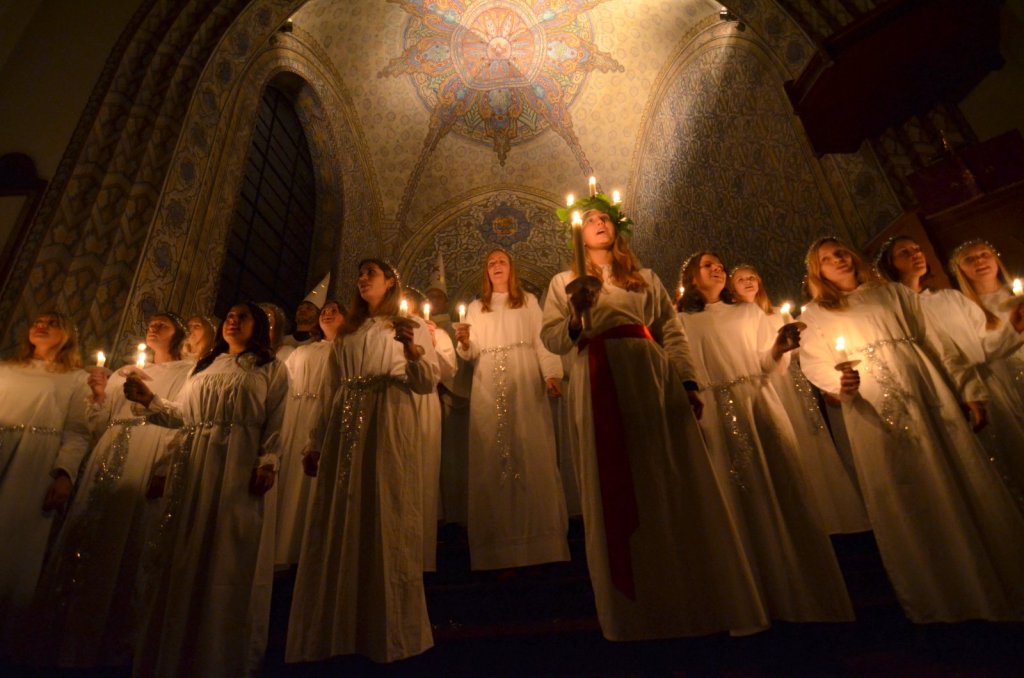
The root of Luzia’s name is luz, which means light. Across Europe, from Scandinavia to Sicily, Saint Lucia is honored as a bringer of light to the midwinter darkness. Luiza Frazão explained that before the Gregorian calendar reform altered the old Julian calendar, Luzia’s feast fell directly upon the Winter Solstice. John Donne’s 1627 poem “A Nocturnal upon St. Lucia’s Day, being the shortest day” bears witness to this fact—the Gregorian calendar wasn’t adopted in Britain until the 18th century!
Celebrating Santa Lucia in Sweden
Meanwhile, back in Portugal, Luiza and I met again around one month later, on January 17 for the Festa of Santo Antão, traditionally celebrated in an old hermit’s chapel on a hill outside the medieval town of Óbidos. This festa is traditionally a very large gathering, attracting thousands of people from far and wide in what the newspaper Caldas Gazeta describes as a pilgrimage for Christians and Pagans.
The Festa of Santo Antão in January 2020, before lockdown and all the rest
This festa, which is celebrated in the daylight, comes around the time of Imbolc in the old Julian calendar, Luiza explained. It celebrates the steadily increasing daylight and the promise of spring and new growth. It is also a feast focused on healing and blessing the animals that are so important in rural communities.
Santo Antão was a hermit who lived in the Egyptian desert. He is the patron saint and protector of animals. In the old days, farmers would bring their livestock to be blessed at this festa. But nowadays people are offered special blessed ribbons to take home to their animals. Traditionally a Mass is held in the chapel and there’s a market on the hilltop. However, in January 2022, the festa was officially canceled due to a spike in Covid infections. But that didn’t stop people hiking up the hill in small groups.
Our small group shared a picnic of the traditional grilled sausage along with halloumi, since I’m vegetarian. We lit candles outside the locked chapel and then raced down to Óbidos to get our blessed ribbons from the Church of Saint Peter before they closed at 5pm. As we left the hilltop, other people were hiking up with their picnic baskets and wine bottles. In previous years, the celebrations continued until early the following morning.
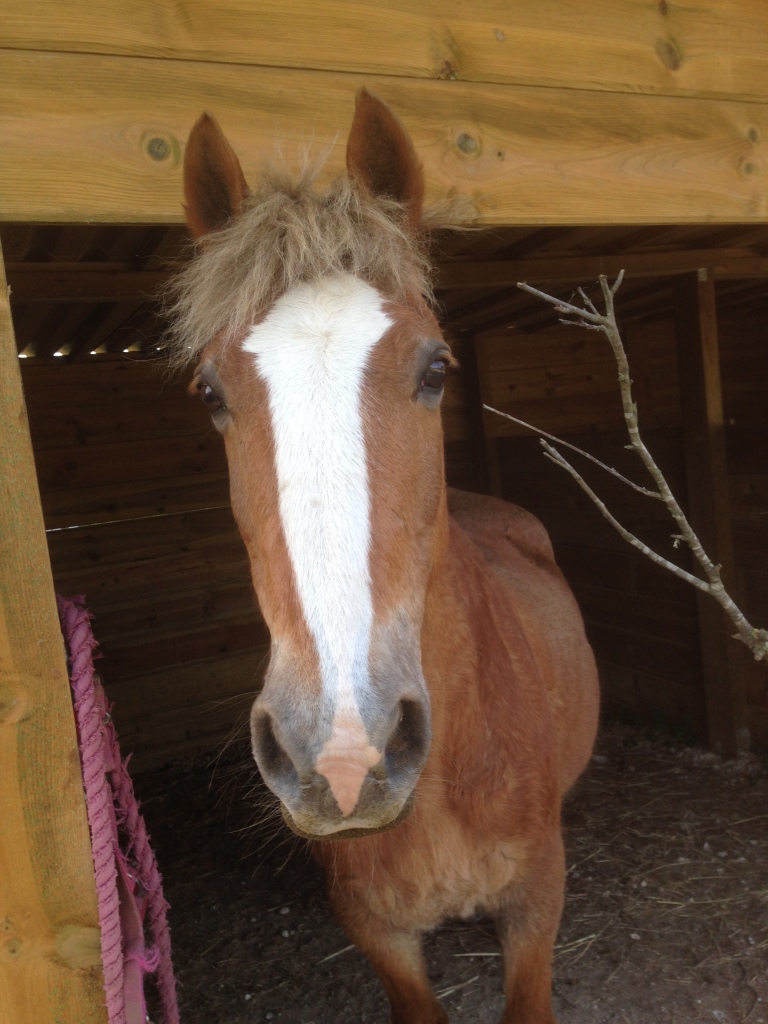
When we reached the church in Óbidos, five minutes before closing, I took two ribbons for my horses in exchange for a small donation. Back at home, I tied the pink ribbons in the horses’ manes, but the beasts had other ideas and rolled in the mud. So I rescued the ribbons and tied them to the field shelter instead.
Protected!!!
As the Spring Equinox approaches, I look forward to discovering more local festas.
Mary Sharratt is committed to telling women’s stories. Please check out her acclaimed novel Illuminations, drawn from the dramatic life of Hildegard von Bingen, and her new novelRevelations, about the mystical pilgrim Margery Kempe and her friendship with Julian of Norwich. Visit her website.