Women’s Ordination and the Mormon Church by Margaret Toscano

Me April 2011 3Caroline Kline’s March 26 post, “Mormons Who Advocate Women’s Ordination,” marks a new direction in the Mormon feminist movement. As she describes, the website Ordain Women was launched on March 17 by a few dozen Mormon women and men who state: “As a group we intend to put ourselves in the public eye and call attention to the need for the ordination of Mormon women to the priesthood.” By the end of March, 44 people (37 women and 7 men, including a Mormon bishop) have posted profiles with photos where they describe their relationship to Mormonism and why they think women should be ordained. I understand from the organizers of this site that a number of others have submitted profiles for posting and that the site has had close to 100,000 hits. On the corresponding Facebook page, however, only 363 people have given Ordain Women a “Like” sign.

While supporters may appear to be a small group in comparison to the 14 million Mormon (aka LDS) church members worldwide, it is a significant number for a grassroots movement like this. As a Mormon feminist who has publicly advocated for the ordination of women since 1984, this is the first time I have seen more than a handful of people willing to state publicly their belief that women should be ordained. In the past, women’s ordination has always been the dividing issue among Mormon feminists. All Mormon feminists want women to have more voice in the Church, more decision-making power, more visible authority and equality. Very few have wanted to be ordained into the male-priesthood structure of the Church, though more have claimed a private, spiritual priesthood.

And yet, as I have always argued, there is no way that Mormon women can be equal to Mormon men as long as they are denied access to priesthood ordination and offices because the priesthood structure controls all resources, discourses, and practices. In some ways this issue is even more crucial in the LDS Church than in other religious traditions because the Mormon organization is based on a lay priesthood where all active boys and men have priesthood. What this means is that grown women have less practical and religious authority than their 12-year old sons. Continue reading “Women’s Ordination and the Mormon Church by Margaret Toscano”

Pope Francis: A Fisherman for Our Times? by Dawn Morais Webster

Dawn Morais Webster, the Pope off to his summer palace, Castel Gandolfo. He tells the world he will now become just a “humble pilgrim.”

 A thoughtful non-Catholic friend, Mei Li, in largely Muslim Malaysia, wondered aloud in a Facebook chat after the election of Pope Francis: “How many people get to start anew like this?   A new name, a new life, a new kingdom here on earth. He could be what keeps thousands, maybe millions of people from getting AIDS. Even if my vote does not count, so to speak, I have to care what he teaches.”

Yes, believers or not, we all have to care.  The skeptics were right.  Picking a Pope from the ranks of the nuns was expecting the current crop of cardinals to cast their net further than they could. But Pope Francis may yet prove to be a fisherman who casts a different kind of net.

Countries of the South, where Catholics still fill the churches, rejoice at the selection of a Pope with whom they might claim a closer kinship. It is unclear whether he can ensure the success of a soccer team, or even whether his election proves that God is an Argentine.  But the fact that even the weary are tuning in is a good sign. Continue reading “Pope Francis: A Fisherman for Our Times? by Dawn Morais Webster”

Gender in Kabbalah by Judith Laura

Judith LauraI first started delving into both Jewish Kabbalah and Hermetic Qabalah in the 1990s, after friends told me these forms of mysticism included both female and male representations of divinity and therefore were gender equitable. They were right about the first part: Kabbalah/Qabalah contain both divine masculine and feminine imaging and male and female images.  But as far as gender equity goes, to use today’s slang, not so much!

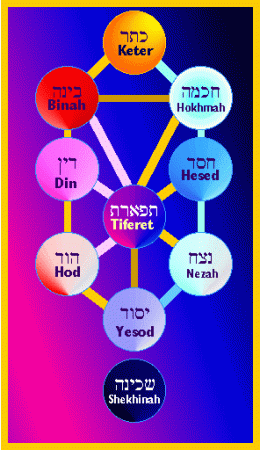
tree of life kabbalah

Though they are both transliterations of the same Hebrew word, as is common I use “Kabbalah” for the Jewish versions, and “Qabalah” for the Hermetic version, best known through its association with the British Hermetic Order of the Golden Dawn, which began in the 19th Century. The word means “that which is received,” with the understanding that it was “received” from ancient times. Though there is one tradition that says Adam was given Kabbalah in the Garden of Eden, the first written material for Kabbalah, Sefir Yetsirah (Book of Creation), is dated to between 200 and 500 C.E. Kabbalistic concepts changed over the centuries, with writings becoming more significant in the 13th century and even more popular in the 16th and 17th centuries.

Beginning with the Sefir Bahir (Bright Book) in late 12th century France, Kabbalah is represented by the Tree of Life, which has round areas transliterated sefirot (Heb. pl.; sing. sefirah) that I think of as fruit and others call “spheres,” but which in the Bahir, are more accurately translated “sapphires.”*  These “divine emanations,” as they are often called in English, are gendered. How equal is the gender representation? Continue reading “Gender in Kabbalah by Judith Laura”

Cosplay and Choice by Sara Frykenberg

Sara FrykenbergCosplay is often a deliberate, interpretive and self-chosen performance of gender and power.  Like drag performers, cosplayers put on a show of the characters they represent; and in my experience, they often do so within diverse, supportive and principally, inclusive communities. 

This week my husband sent me a great blog post he found about cosplay and one woman’s determination that she would no longer tolerate being demeaned, objectified or trivialized because of what she chooses to wear.  Blogger Megan Marie’s post, entitled “What would you do if you weren’t afraid,” inspires me.  She points out and refuses the trappings of rape culture: victim blaming, assumed male control over female sexuality and shame; and claims her right to be who she is.  I, as fellow (what is the female equivalent for fellow???) cosplayer, was also moved by her defense of this creative art.  I have been cosplaying a long time, but I have been too afraid to speak much about this or to directly protest the rejection of these fantasy images within some feminist communities.  So to answer Megan Marie’s question* in her own words, “What would you do if you weren’t afraid? My answer.  I’d write this blog.”

Coplay = costume + play!  It is the recreation of popular characters from video games, comic books, anime, scifi series, fantasy literature or the like.  Cosplayers do this for the fun of it, the craft involved, to express one’s fandom and sometimes, professionally, usually within an arena where fans can enjoy one another’s recreations.  The attempt to embody these characters involves a great deal of work and artistic expression.  Many conventions, like Fanime Con in San Jose, CA, host panels in which fans can learn cosplay skills, such as armor construction, wig making and costume design.  I have cosplayed the following characters: Sailor Star Healer, Eudial and Sailor Iron Mouse from the anime Sailor Moon, Misa

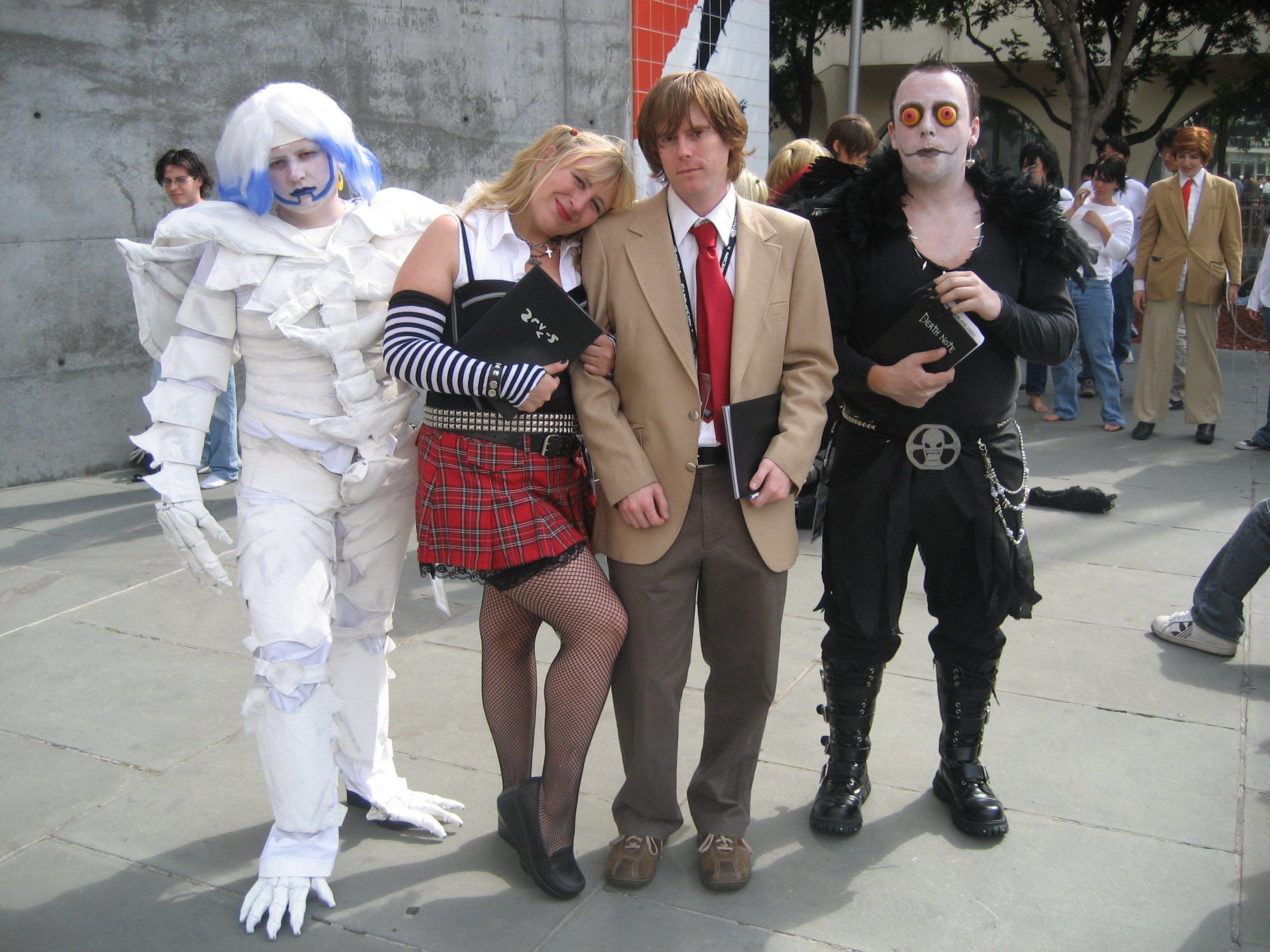
Death Note Cosplay: Misa and Light are in the center, flanked by their respective "Shinigami," or the death gods they are working with
Death Note Cosplay: Misa and Light are in the center, flanked by their respective “Shinigami,” or the death gods they are working with

from the manga Death Note, the Sorceress from He-man, a Star Fleet officer from Star Trek: The Original Series, and most recently, a giant “Angel,” Sachiel from Neon Genesis Evangelion.

Sachiel from Neon Genesis Evangelion: I am trying on my almost finished costume here!

I am currently planning a to make a Metroid out of an umbrella and to cosplay Nyan-kitty at the May conference that my husband (who will be playing Tac-nyan), my sister and many of my friends attend.

So, why the feminist-anxiety?  Continue reading “Cosplay and Choice by Sara Frykenberg”

“Am I Crazy?” Loving Laura Dern by Carol P. Christ

carol p. christ 2002 color“Am I crazy?”

“No, just full of hope. You got more hope than most people do. It’s a beautiful thing to have a little hope for the world, you know.”

This question was posed by Amy Jellicoe, played by Laura Dern, at the end of the HBO television series Enlightened.  Unemployed, single, and in debt after she was fired for “whistle-blowing” on the corrupt activities of the corporation where she worked, Amy wondered if she had done the right thing.  The answer of her ex-husband Levi  brought tears to my eyes.

In many ways, I am Amy.

Let’s begin with the obvious.  When I was young, I was slender and pretty and exceedingly tall, with long blonde hair—I imagine I looked like Amy.  I couldn’t take my eyes off Laura Dern. There just aren’t many women in the world as tall as I am. Because of that I don’t know what I look like to others.  In the series, Laura Dern is taller than just about everyone else, including the men, and she seems not to care, because she often wears high heels.  Continue reading ““Am I Crazy?” Loving Laura Dern by Carol P. Christ”

What Does Exclusivism Feel Like? Part II by Janice Poss

This is part two of a post started yesterday. At the end of it I asked why a woman cannot be a follower of St. Ignatius and a Jesuit.

The days of separating religious communities because rape is a possibility should be behind us–as we all know separating the sexes does not prevent rape anyway.  Let’s get real, if I can understand the Ignatian exercises, use them in discernment, prayer, and reflection, understand the concepts and gain the graces, through doing them in a similar fashion as male Jesuits, what’s the big mystery, what’s keeping me out of the Jesuits–except that that it is a male club that is exclusive.  Exclusion of any kind is oppressive, whether it is for racist, sexist, or other reasons.

Communities based on separation and exclusion because of sexual temptation ignore the simple fact that all people need to be responsible for their own actions.  Male religious in exclusivist communities are like the Iowa  dentist who fired his assistant because she was “too” good looking.  He said could not control his own urges, his own temptations.  An all-male court was unanimous in upholding his right to fire his assistant of more than 10 years. Is not an all male court a biased court? The woman in question certainly did not get a decision rendered by her peers!

That such a trial could even take place is an aberration of colossal proportions and reeks of the male, misogynist, supremacist backlash that is going in society right now in America and everywhere.  Continue reading “What Does Exclusivism Feel Like? Part II by Janice Poss”

What Does Exclusivism Feel Like? Part I by Janice Poss

In the last few weeks of 2012, a sister parishioner recommended I read Transforming Knowledge by Elizabeth Kamarck Minnich.  Many in academia perhaps have already read this book, but I am just getting to know the world of scholars and have found this book refreshing.  It puts its finger on the messy entangled core issues that we grapple with on this blog site.

Minnich enumerates errors prevalent the way we think, suggesting that we need to restructure knowledge traditions that privilege the few and create “higher/lower” thinking, categorical “kind” thinking, and hermeneutical circles of presuppositions that only get reinforced time and again.  Such circles are never broken into by any other thoughts or ideas because they are believed to be epistemologically and ontologically normative.

Imbalances that start in academic disciplines and then trickle down to and through society at large in all areas, not just religion, must be brought into consciousness so they can be corrected with new thinking that no longer oppresses those outside these circles, but brings them into the dialogue so that new more creative thinking happens.  The point is to level the playing field, but not to relativize knowledge.  The goal is create a new way of thinking that is a diverse and pluralistic.

Much that currently passes for reasoning is based on four errors in thinking that Minnich identifies as:

  • faulty generalizations – thinking that uses the few to create maxims about the many;
  • circular reasoning – thinking that reinforces its major premise over and over again without evolving even in the view of new information that might refute the original thesis;
  • mystified concepts – thinking evolving out of circular reasoning by surrounding the idea in a mythical membrane of illogically, believed legends that endure;
  • partial knowledge – one-sided thinking that refutes impartiality never considering the whole picture. Continue reading “What Does Exclusivism Feel Like? Part I by Janice Poss”

What Is Love? by Jassy Watson

Jassy_Agora1-150x150I asked this question at the family dinner table, on facebook, and by e-mail.  Many heartfelt responses were offered, all insightful. Some spoke of romantic love, sexual love (eros), self-love, spiritual love, the love a parent has for a child, unconditional love (agape), primal love, authentic love, universal love, divine love, the source of love, friendship (philia), love of nature, and love of a pet, while others considered the destructive nature of love. What was demonstrated by these conversations was that not only are the possibilities of love’s expressions endless, but there can ultimately be no right or wrong answer when it comes to the meaning of love. Our cultural, familial, religious and spiritual backgrounds all play a part in the way we think and feel about love.

I was raised in a secular, middle-class, two parent, two children, cat, and sometimes a dog kind of family. Despite the usual ups and downs, our family life was full of love. I remember having feelings of love as a child that were so incredibly overwhelming I would be brought to tears. I loved everything and everybody. Mum still reminds me that if I could have, I would have brought every elderly person along with every stray animal home to look after. After reading about the process view in Carol Christ’s book She Who Changes: Re-Imagining the Divine in the World, I see now that this love I felt was born out of feelings of deep sympathy.

Because we did not have a religious or spiritual background, I had no idea what divine love meant. My idea of the divine was the male, Christian, biblical God that our family rejected. It is said that Christian love is selfless and is best seen in actions such as compassion and kindness. This may be so. But selflessness, compassion and kindness are not limited to Christian values. They are human values. In his book The Art of Happiness, the Dalai Lama says that “love and compassion are necessities, not luxuries. Without them humanity cannot survive”. All religious, spiritual and philosophical traditions speak of the values of love. They say that love encompass compassion, kindness, selflessness, acceptance, gratitude, sympathy, sharing, grace, justice, charity, and liberation. They also speak of tension, wrath, discomfort, unkindness, loss, and judgement. For me, love is all these things and more.

Ancient myths address these values of love through tales of passion and devotion. Diane Wolkstein celebrates some of these myths in her book The First Love Stories. Each story expresses a distinct aspect of love. For instance: the tale of Isis and Osiris represents love that is stronger than the forces of nature, Innana and Dumuzi expresses the cyclical quality of love; Shiva and Sati reveals the eruption of passion and the taming of the mind; the Song of Songs celebrates love’s yearning; the story of Psyche and Eros portrays the forging of the self. All of these stories emphasize the sacred nature of love.

For me, having children awakened a love so very deep within. When I gazed into the eyes of my first born son at the tender age of 18, I was so overwhelmed by love I thought my heart would burst. I now have four children a husband and a loving extended family and friends who all teach me much about the true nature of love. They teach me above all else that love is patient, non-judgmental, and unconditional. It is through the growing awareness of my spiritual being and my journey with the Goddess that love has become something deeper than I ever thought possible. Love, for me has become a union with something higher than my individual self. My love extends beyond the family to include every living being on this planet and beyond. It is not just all about giving and receiving, but rather it is a state of being. It is personal yet universal and comes from deep within my sub-conscious. Love for me, not unlike the tales woven in ancient myth, is profoundly sacred.

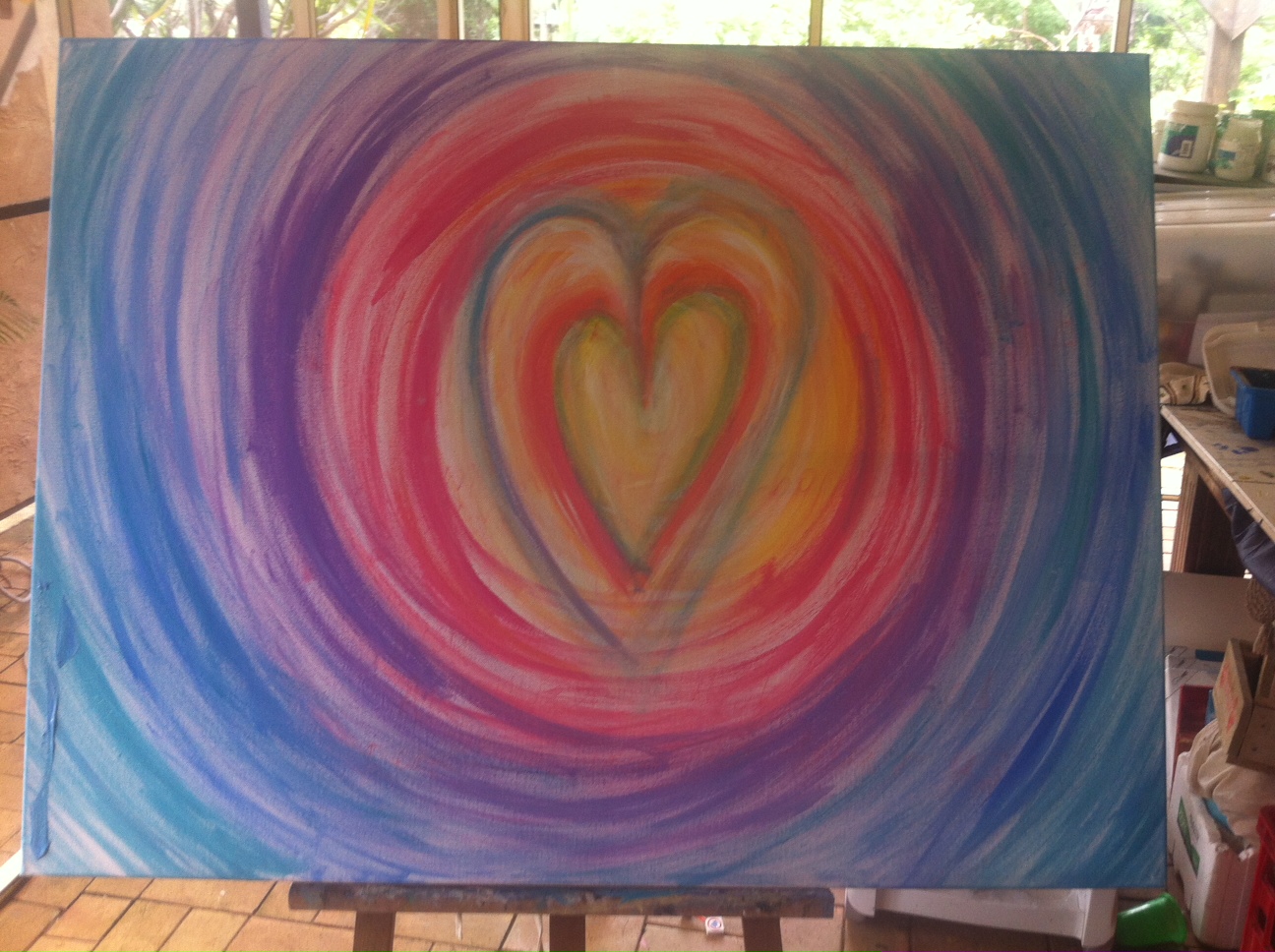
Embodied with love I set out to create my next painting. Out of this portal of love:


Portal of love, WHAT IS LOVE?  by Jassy Watson

Aphrodite, Goddess of love, pleasure and relationships, in all her glory was born. Continue reading “What Is Love? by Jassy Watson”

Reflections on Good Friday by Kathryn House

Tomorrow is Good Friday on the western Christian calendar, the day when western Christians remember Jesus’ death on the cross. The day is often memorialized in ways that recall Jesus’ last moments, from his final steps to his final words, with great specificity. For as many traditions to observe the day, there are theologies to interpret just what, if anything, the cross “means.” In the past few years, I have found myself moving further and further away from identifying this day as one that saves. If I am honest, it has been, and continues to be, an exercise and practice in theological freedom. For me it started with the moment in my first year of theology class when my professor spoke about Anselm and Abelard, of transactions, of debt satisfaction. Something about seeing this formula within its feudal context – of seeing it for the first time as a deeply contextual rather than eternal or primordial or absolute theology – struck a chord and disrupted some sediments I considered unshakeable.

This fissure and subsequent reimagining has continued as over the years I’ve engaged the work of womanist and feminist theologians. There was sister FAR contributor Xochitl Alvizo’s post last year disrupting the spectacle of Good Friday, of re-imaging new rituals that do not dwell on death. There is the work of JoAnne Terrell, the books Proverbs of Ashes and Saving Paradise by feminists Rebecca Parker and Rita Nakashima Brock, and my professor Shelly Rambo’s work on spirit and trauma. I suppose if I am anywhere on the topic, I am just no longer sure that Jesus paid a debt he did not owe because I owe a debt I cannot pay. I am unconvinced that suffering redeems, that blood atones, that the death of a son – of anyone’s daughter or son – brings satisfaction. Certainly feminists and womanists hold diverse beliefs, but here is where I can stand, for now.

Continue reading “Reflections on Good Friday by Kathryn House”

Where Were the Women? by Kat Robb

Kat Robb, BunniHoTep, goddess

Where were the women? I grew up in the Presbyterian Church, and it wasn’t until I was in my late teens that I ever saw a woman offer a prayer in church. That was when they hired a woman with a Masters of Divinity to be an Associate Pastor in charge of Christian Education, meaning they had hired another woman to be in charge of Sunday School and this one had a higher degree. I, very early on in my Sunday School career used to ask, why can’t women pray in front of the church? Why can’t women give the sermon? Why is the only place girls are allowed to be in the front of the church, the choir loft? Why do we only mention Mary at Christmas? Why was Eve bad and not Adam? Why is it all right for Mary to be an unwed mother but not me? My Sunday School teachers loved me.

The answer for prayer was that you can pray anywhere you are because it’s your conversation with God–but I would ask if that is true, then why aren’t  we allowed up front? No one ever had a good answer  for that.  Continue reading “Where Were the Women? by Kat Robb”