Storytelling to Restore the Sacred in Our Lives by Najeeba Syeed Miller

I was recently offering a workshop to a group of Muslim educators from all types of ethnic, racial and community backgrounds. One of my points in the training on conflict resolution was the importance of story telling,the many ways that stories are formed, told and uttered in different cultural contexts. Sometimes, the content of the story is less important that the WAY we tell the story. We talked about how to listen to the form of the story being told, its inherent design logic, and what we learn about a person and her community from the way she chooses to tell her story especially in times of conflict. For it is in conflict times that we resort to what is most familiar and sacred to us all.

For years, I have had the honor of being a peacemaker, a mediator who listens to people’s stories. I jokingly told a colleague that I could tell what they were thinking even as they were telling their story just by the way they sat, how their hands moved, whether they looked away at certain points or by what they also did not say. It is important to hear a story being told as a fully embodied experience. The words, the way they are arranged, the flow of the narrative, its resonance with body language give you a more complete vision and experience of the story and insights into the storyteller. Continue reading “Storytelling to Restore the Sacred in Our Lives by Najeeba Syeed Miller”

Remembering My Grandmother: Not as a Suffering Servant but as a Devoted and Loving Mother By Michele Stopera Freyhauf

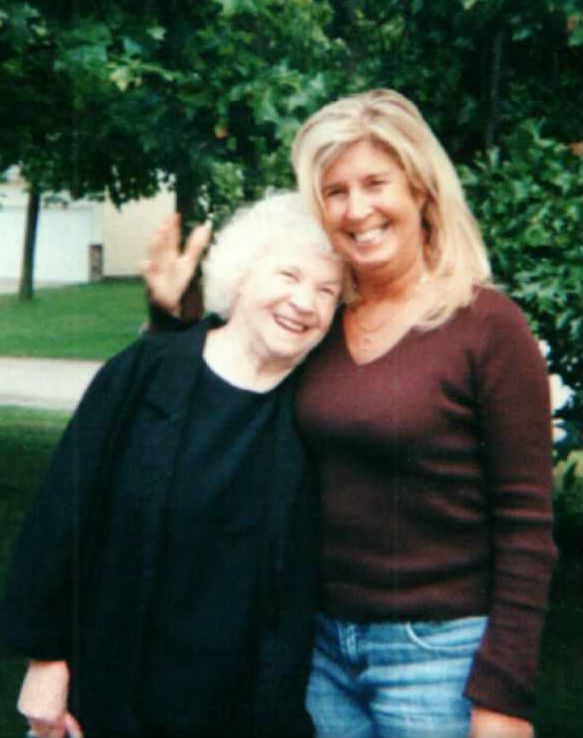
The last week-and-a-half has been probably the most heart wrenching time I remember having in my life.  You see, my grandmother passed from this life June 19th and the void in my heart is huge.  I have to admit that I am lucky that my grandmother was a huge part of my life and the last family funeral I attended was in 1983.  Certainly one expects grandparents to pass away, even when they live a healthy long life.  Nothing prepares you for the time that you must say good-bye.  You yearn for one more conversation, one more hug, one more kiss – the thoughts churn and churn robbing you of sleep or peace.  At some point, a level of acceptance or at least the ability to cope will occur – when is a mystery, but for now I just try to be strong – for my mom, my sister, and my children.

Driving home from vacation, I received the news from my sister, Lisa:

Lisa:    Nanny has lymphoma, which they found in her stomach and invaded her spine, paralyzing her from the hips down.  It is fast moving.

Me:     How long?

Lisa:    2-4 weeks. Hospice was called and is making her comfortable.

The news was jolting, but I did not realize that the initial expectation 3 days earlier was 6-8 weeks.  She had tests for a bleeding ulcer, so this diagnosis was jolting.  Over the last year, we dealt with dementia and health issues.  These either were false alarms or cured thanks to the love of her family, care from the people at the nursing home, and her nurse practitioner and physician.  I wished that this was also a false alarm – but it was not, this time it was real and the end was eminent.
Seeing my mother at Father’s Day celebration, the news was even more grim – Nanny is no longer alert, can no longer open her eyes – they are making her comfortable.  The last time her eyes opened was after her priest gave her last rites.  He turned to leave, she opened her eyes, said “Hi Father,” and went back to sleep.  This was the last time her eyes would open.  My mother tells me that she is not expected to live through the week.

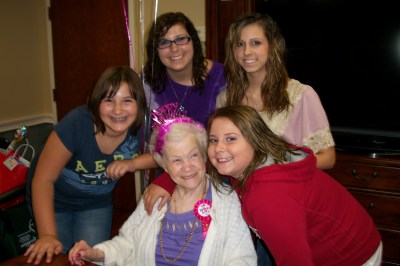
I took my children over to say good-bye.  I know I should be grateful that my girls have a close relationship with their great-grandmother, one that spanned 19 years.  I know I should be grateful that I had her in every facet of my life.  It is no secret that family was important to my grandmother, and she adored all of her children, grandchildren, and great-grandchildren.  This is a trait handed to my mother, my sister, and me.  Something I strive to instill in my children.

The good-byes were difficult as she was essentially unconscious and her breathing was noisy.

My sister called, how is she?

Me:     Breathing is labored and gaps between breaths are getting longer.

Lisa:    Will she be o.k. tomorrow?

Me:     I have no idea.  You may want to visit tonight just in case.

My sister and her husband appeared about 10 minutes later.  Wanting to give her time, I left with my family.  Going home was hard.  I was afraid she may not make it through the night.  I hoped with all my heart that this was not the end.

The next morning I returned to work.  She made it through the night.  I was in my office for a few hours before when I received a call from my dad.

Dad:    I am just calling to tell you Nanny is declining pretty fast.  They are saying minutes to hours – we are all here.  No need for you to come, I just wanted to let you know.
Me:     I am on my way.

Depending on traffic, I had a 40 – 60 minute drive.  I had to be with the woman that helped care for me and loved me.  The person that I took trips with, would talk hours on the phone with, cook with.  My grandmother was at every event, every family function, every holiday, and every birthday.  She was a huge part of my life and very important to me.  I needed to get there before she took her last breath – thankfully, I did.

The goodbyes continued.  Staff and residents alike came down to say goodbye. She was loved my so many.  Tears flowed for this petite woman with beautiful blue eyes, a contagious smile, and a heart of gold.  Her three children, my father, my sister, a few friends, and I kept vigil by her bedside.  I held her hand, sponged her neck and forehead to help with the fever, and kissed her forehead.  This went on all day and all night.

It was now midnight.  Everyone left the room to have a snack.  It was a long day and we forgot to eat dinner.  The staff was nice enough to provide us with muffins, water, pop, and coffee but this was no longer enough.  Every time someone would leave to use the restroom, you did not know if she would still be there when you came back.  Even running to a fast-food restaurant to grab a few sandwiches was done with angst and concern. Continue reading “Remembering My Grandmother: Not as a Suffering Servant but as a Devoted and Loving Mother By Michele Stopera Freyhauf”

Why Feminists Should See Snow White and the Huntsman by Erin Lane

When all the taco meat was refrigerated, the grease-stained plates loaded into the dishwasher, and the church volunteers departed, my husband peeked into our bedroom where I had been hiding out (er, I mean reading my Bible) for the duration of his adviser meeting. “Put some pants on, Erin. We’re going to the movies.
 
It was a magic Monday night at the theater seeing Snow White and the Huntsman, a sort-of Braveheart-like retelling of the Brothers Grimm fable.  I was hesitant to go, afraid it would be too dark. The Walt Disney version, after all, had me running off to a child psychologist who assured me the wicked queen wasn’t all that bad. I spent more than a few nights sleeping in the bathtub with my Micky Mouse comforter, safe from her clutches. Continue reading “Why Feminists Should See Snow White and the Huntsman by Erin Lane”

A Cross-Cultural Feminist Alchemy: Studying Mago, Pan-East Asian Great Goddess, Using Mary Daly’s Radical Feminism as Springboard by Helen Hye-Sook Hwang

Feminist theology was self-transcending to me. I was unafraid of going beyond the boundary of Christianity and its God. 

Mago is the Great Goddess of East Asia and in particular Korea. Reconstructing Magoism, the cultural and historical context of East Asia that venerated Mago as the supreme divine, is both the means and the end. Magoism demonstrates the derivative nature of East Asian religions such as Daoism, Buddhism, and Confucianism while redefining East Asian Shamanism to be the religious expression of Magoism.

I encountered the topic of Mago during my doctoral studies. The topic of Mago fell out of nowhere at the time I was preparing for qualifying examinations. I had never heard the name, Mago. Only when I was able to collect a large amount of primary sources from Korea, China, and Japan, was I awakened to the cultural memory of Mago. I grew up craving the stories of Halmi (Grandmother/Great Mother), a common referral to Mago among Koreans. I had a childhood experience of being in the fairy land unfolded by my grandmother’s old stories. While “Mago” was unfamiliar to most Koreans, she was taken for granted in her many other names such as Samsin (the Triad Deity) and Nogo (Old Goddess) and place-names such as Nogo-san (Old Goddess Mountain) and Nogo-dang (Old Goddess Shrine). Continue reading “A Cross-Cultural Feminist Alchemy: Studying Mago, Pan-East Asian Great Goddess, Using Mary Daly’s Radical Feminism as Springboard by Helen Hye-Sook Hwang”

GOD AND WOMAN AT YALE* by Carol P. Christ

As a graduate student, I was told in every way possible that I could not be a woman and a theologian.

When I was studying for my Ph.D. at Yale in theology in the late 1960s and early 1970s, my skirts were short as was the fashion of the day.  The male faculty and students and their wives dressed in ways that would not call attention to themselves or their sexuality.  I was also over 6’ tall.  When I walked into a room, I was consciously and unconsciously perceived as a threat to a world which these men had simply assumed was “theirs.”  Their response was to categorize me as a sexual being (I was once introduced as “our department bunny”) and to erase my mind.  I was to discover that the male graduate students were making bets in the dining hall about “where she will sit today.”  One of my friends frequently fell down and feigned to “worship” me when I passed him in the hallways.  I had never received so much attention from men before and it was flattering.

At the same time, I was being told by these men that of course “no one expected me to finish my degree because I would marry and have children” and that “all of the jobs should go to men who have families to support.”  The “generic male,” as in “when a man finishes his PhD,” was the common language of both faculty and students.  If I protested, I was reminded that I probably would not finish my degree anyway.  I dated two of the other students in my first year, fell in love with one of them and lost my virginity to the other.  They both dumped me.  I was being told in every way possible that I could not be a woman and a theologian.  There was such a disconnect between the way I was perceived and the way I perceived myself that I came close to suffering a mental breakdown. Continue reading “GOD AND WOMAN AT YALE* by Carol P. Christ”

“Eating Our Words” Decoupling Women’s Eating Habits from the Language of Sin: Part 2 by Stefanie Goyette

This post is the second part of a two-part series. Read Part I here.

In my previous discussion of the language associated with women’s eating habits, I mostly left aside the problem of weight. Weight, and certainly obesity, was hardly a concern in the Middle Ages, whereas I do not think that it would be controversial to suggest that fatness in the modern era is viewed as nothing less than a moral weakness, a failure of self-control. This viewpoint that is emphasized by weight-loss programs on television, in magazines, etc. But this is another matter that deserves a full discussion, which I cannot offer today. Rather, I would like to suggest that gluttony as a moral concern has shifted in meaning between the Middle Ages and the modern era, building on the fact that in medieval Europe, gluttony was an explicitly religious problem, a cardinal sin, even when separated from the related issues of libido and lust.

Despite the intense moralization of alimentary behavior in the Middle Ages, medieval writers often refused constrictive, moralized models of food and eating. Hildegard of Bingen, in her manual of natural medicine, the Physica (twelfth century), recommends different foods that help feed and diminish sexual desire, in order to balance the body rather than to suppress its needs. Continue reading ““Eating Our Words” Decoupling Women’s Eating Habits from the Language of Sin: Part 2 by Stefanie Goyette”

Grasping for Truth, Arriving at Wisdom by Leanne Dedrick

“Quite apart from explicit religious belief, every time that a human being succeeds in making an effort of attention with the sole idea of increasing [her] grasp of truth, [she] acquires a greater aptitude for grasping it, even if [her] efforts produce no visible fruit.”  Simone Weil, Waiting For God

I think and write a lot about ‘truth.’ I love truth and I hate truth. I love truth for its security, for its comfort, for its ease at organizing thoughts and feelings and, of course, for its honesty. Relationships are never simple however, and I find that all the reasons I love truth are also the reasons I hate truth. This dichotomy speaks also to the relationship I have with myself; one woman in two worlds, or in other words, an ordinary woman and a philosopher of religion.

Truth is fundamentally tricky in its deceptive simplicity. There are three basic ways the dictionary describes the word truth. The first has to do with a quality – the quality or state of being true. The second references fact – that which is in line with reality. The third becomes more problematic; it includes the language of belief – a fact or belief accepted as true. Continue reading “Grasping for Truth, Arriving at Wisdom by Leanne Dedrick”

Government “Apologies” for Historical Injustices: Why They Matter

“I rejoice in this most recent admission of institutional racism. I am not naïve enough to believe that this public acknowledgment, like previous ones to other racial-ethnic groups, was untainted by political calculations. But I am also not Kantian (so I reject the view that anything done out of mixed motives accordingly lacks moral merit).”

Continue reading “Government “Apologies” for Historical Injustices: Why They Matter”

Back to Beginnings by Elise M. Edwards

I wasn’t reading it to find out about the origins of the earth in the way the big bang theory explains it.  I was reading it to find out what an ancient people thought about the connection between God, the heavens and the earth, and all the creatures and creations in between.

For years, I’ve been fascinated by creation myths.  Yet as a feminist, I was taught to be suspicious of the biblical creation myths in Genesis.  The creation of man from dust and the subsequent creation of woman from his rib have often been interpreted to support claims about women’s inferiority to men.  And obviously, the accounts of Eve and the serpent and her role in “tempting” Adam have been used to justify claims of women’s susceptibility to evil and their wanton natures which lead men astray.

So it was a bit of relief when in my first weeks of study in seminary, my Hebrew Bible professor pointed out that there are two creation myths in the opening chapters of Genesis.   I was relieved because Chapter 1 and the first few verses of chapter 2 told a creation story I enjoyed reading.  Continue reading “Back to Beginnings by Elise M. Edwards”

A Tale of Power and Beauty, Part I: The Queen by Amanda Kieffer

A closer look at Snow White and the queen reveals that these women have a common enemy that neither is either willing or able to perceive—the patriarchal lie that a woman’s power is synonymous with youth and beauty. 

A couple of weeks ago, to bide some time, I went to see Snow White and the Huntsman, the latest expression of the classic Grimm Brothers tale, “Little Snow White.” Expecting a mediocre experience, I was unprepared for the complex emotions that followed me out of the theater. Don’t misunderstand me: the film was mediocre.  But it also provided some poignant opportunities for me to reflect on my own feminist journey and to ponder some essential feminist themes.  While, Snow White and the Huntsman does offer some acute depictions of the reality of women’s lives, the film as a whole misunderstands these interpersonal dynamics, fails to acknowledge the true source of oppression and, in the end, offers up two lead female characters neither of which is liberating.  One is real but vanquished, the other unreal but victorious.

There are a number of elements in this film, which, in the barest terms, might hint at a genuinely appealing picture of female empowerment.  There is a powerful queen, who even above the male characters is the most complex and sympathetic.  She enjoys vast amounts of power and independence.  In this film we also encounter a Snow White who traipses around in pants and a torn up dress, which is delightfully ambiguous.  Continue reading “A Tale of Power and Beauty, Part I: The Queen by Amanda Kieffer”