My mother and I have always been very interested in our personal connection to the spirit realm. This connection, for us, is an important one. We pay attention to the signs and messages that remind us of our continued connection to those we love who no longer occupy our own physical time and space. Each cardinal, butterfly, and ceaselessly repetitive number (310 in our case) promises the continuation of relationship with the ones we miss so dearly.
A few years ago my mother and I were able to see a live show at the Chicago Theater featuring Long Island Medium Teresa Caputo. Even with hundreds of people in the audience, specific moments of Caputo’s readings spoke to images and memories that resonated and connected to our experiences. The show allowed us to once again be reminded of the continued connection between us and those special ones who we love and miss. Continue reading “Remembering My Saints by Katie M. Deaver”
In the past week I visited Cherry Ridge, Honesdale, Wayne, Pennsylvania in the Pokonos, where I was welcomed by my third cousin Marcia Perry Gager whose family never left the place where our ancestors settled. Marcia and I have been corresponding about our family’s history since Ancesty.com connected us about three years ago. During that time, together with another cousin, Debra Ball, we have managed to decipher the complicated history of Henry Iloff, his two wives, and their eighteen children.
My visit to Honesdale began at John’s Evangelical (formerly German) Lutheran Church. Following a last-minute discovery that the baptism, marriage, and funeral records of the church were not in the Wayne County Historical Musem archives as I had been led to believe, I made a call to the “emergency number” of Pastor Richard Mowery the day before our scheduled visit, not knowing how he would respond to this “not-really-emergency” invasion of his personal space. Continue reading “Down on the Farm by Carol P. Christ”
Outside my childhood home grows a yellow rose bush descended from one planted by my great-grandmother, Jennie, a century ago. That bush has given her descendants many gifts of spirit over the years— her love of beauty despite a life of tragedy and constant toil, her deep connection to nature persisting through four generations, her hope for the future inherent in planting anything that will take years to fully develop. When I contemplate my own fall garden and its plants sowing seeds for next year, I ponder the special responsibility we, as spiritual feminists, have for leaving to those who will come after us a legacy of inner resources that they will need to meet the challenges of the planet they will inherit and hopefully make into their own sustainable world of equality, peace and happiness.
In my mind I sit with a circle of spiritual feminists of the future. Around me might be a hairdresser or a President, a doctor, barista, poet, scientist, salesclerk, priestess, or elder. They could be old or young or in-between, from anywhere on Earth, of any spiritual tradition or practice. For one moment of time, I can speak directly to them of what I have distilled from my life that I would like them to know. I say to them: Continue reading “Planting Roses for Our Daughters: Creating a Community in Time by Carolyn Lee Boyd”
This continues the story I began last week. Catherina is my 2x great-grandmother; Agnes is my 2x great-aunt; Johanetta is my first cousin, 3x removed, and my step-2x great-grandmother; Henry is my 2x great-grandfather. It is true that Henry had eighteen children with two wives. It is also true that Henry and Johanetta married and had a child soon after Catherina’s death. Some of the other details came in waking trance as I allowed the ancestors to tell their stories through me.
Agnes Lattauer Sweitzer: I thought the day Catherina left for America would be the worst day of my life. I did not know I would see Catherina again. I did not know I would outlive my two little sisters and both of my brothers. I did not know what my daughter would do. I read Catherina’s letters from America through my tears. How I wanted to be with her on her wedding day. How I wished she had been with us when we buried our sister Johanetta. My heart nearly burst when Catherina wrote that she longed to take my hand when she gave birth to her first child. My mind contorted itself trying to envision her living in a big city, in a big building, climbing up and down stairs, her feet never touching the earth, her hands never working the soil. What kind of life was that?
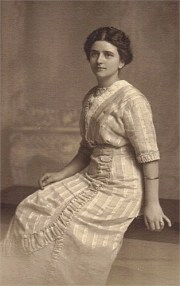
Catherina Lattauer Iloff
Catherina Lattauer Iloff: I left home a girl. Because I was not yet engaged, Mother and Agnes never told me about married life. What to expect. What to do. I loved Heinrich, or Henry, as he wanted to be called after he became a citizen of the United States. I was not prepared. Henry was so insistent. I was soon pregnant. First Henry, named for Henry’s father Heinrich, then Elisabeth, named for Mother. I had to care for them on my own. Henry was busy with his work during the days. In the evenings he went to the German beer garden to meet his friends. Growing up with my mother and sisters, I had never been alone. There were other women around, but they were busy with their own lives. Some of them were kind, some of them were not, but nobody cared about me the way Mother and Agnes did. One night Henry came home and told me he had been talking with his friends. There was land available in a place called Cherry Ridge, Pennsylvania, a day’s journey from New York City. He said it was his dream come true. We would build our own house. There was plenty of land to farm—not like back home where there were never enough fields to go around. I held my tongue. I did not tell him that I suspected I was pregnant again.
The Iloff farm house
Agnes Lattauer Sweitzer: Catherina and Henry have been to Cherry Ridge. Catherina says there is land for us there too. I don’t know what my Heinrich will say. Life is difficult for us here, but we have two young daughters, Elisabeth and Johanetta, and the baby, Peter. There is Mother to consider. Well, you could have blown me over with a feather. Heinrich said we should grab the opportunity before it is too late. Mother said she would come with us, because she wants to see Catherina and Rudolph again before she dies. She is an old lady. I wonder how she will manage the journey. But I couldn’t say no. The two of us cannot contain our joy. We will see our beloved Catherina again.
Catherina Lattauer Iloff: My life is complete. Mother and Agnes and the dear little children arrived. Mother immediately took Henry and Elisabeth in her arms. Agnes comforted me about the loss of Baby John. I could finally allow myself to cry, knowing that Mother and Agnes would be there to wipe away my tears.
Agnes Lattauer Sweitzer: Our first years in Cherry Ridge were difficult. There were houses to be built, fields to be plowed, cows to be bought and milked. I had two more children, Henry, who died as a boy, and John. My little sister outdid me. She had nine children in all: Henry, Elisabeth, John who died, John who lived, George, Catherine, Mary, Frank, and Barbara. Giving birth to so many children took its toll on her. After the last one, she was never well. I think she may have been pregnant again several times, but she never spoke about it, not even to me. Finally, she took to her bed.
Catherina Lattauer Iloff: I had nine children. I never told anyone about the babies I lost before I began to show. Mother and Agnes worried that I was having too many children. But what could I do? I loved Henry, and I loved every one of my children. Mother died a few years after she came to Cherry Ridge. She always said she was so happy she had undertaken such a great adventure. She was pleased to know that Agnes and I were settled and happy. I miss her every day. Agnes is always by my side. I was forty-two when Barbara, my last baby was born. I bled a lot. After that, I never carried another child to term. I was never myself again. Agnes is my rock. Johanetta helps with the little ones. Henry is still strong as an ox, busy in the fields or with the cattle. I see that Johanetta hangs on his every word. I dismiss such thoughts from my mind. I do not know how much longer I have.
Agnes Lattauer Sweitzer: Catherina died yesterday. She was only forty-six (I am now fifty-six), and she had not been well for several years. I told her to stay away from Henry, but she was powerless to do so. Sometimes I blame him for her death. I worry about Johanetta now. Wild horses will not keep her away from Henry. I see the way she looks at him, and I see the old goat looking right back at her. She is twenty-six, a full grown woman.
Johanetta displaying her engagement ring
Johanetta Sweitzer: I can’t believe it! Henry asked me to marry him. Mother is furious. Father says he should have whipped me a long time ago. But they can’t say no. I told them I am pregnant with Henry’s child. The older children are shocked that their cousin is marrying their father. The younger ones are thrilled. They have always viewed me as a second mother as well as an aunt. I have been looking after all of them these last years what with Aunt Catherina being so ill. I love those children.
Agnes Lattauer Sweitzer: I had to forgive Johanetta, but I will never forgive Henry. I smile when I see him to keep the peace, but my heart is cold. Peter was her first-born. After that she had Agnes and Emma, who died of some of those diseases children get. I could not help wondering if that was God’s punishment.
Johanetta Sweitzer Iloff: Henry and I were married for twenty years. Except for losing Agnes and Emma, those were the happiest years of my life. In all, we had nine children: first Peter, Agnes, and Emma, and then, Anna, Lawrence, Charles, Robert, Otto, and Phillip. Henry was a good man. He worked hard all of his life to support his family. We lost the second John a few years ago, but there were fourteen living children to mourn Henry’s death. The little ones are still with me, some of the others are scattered to the winds, and quite a few are settled around here, raising families of their own. While he was still strong and able, Henry was elected Commissioner of Wayne County. He served his fellow countrymen proudly for years. I wish Mother had been alive to see that. Maybe then she would have understood what a wonderful man he was.
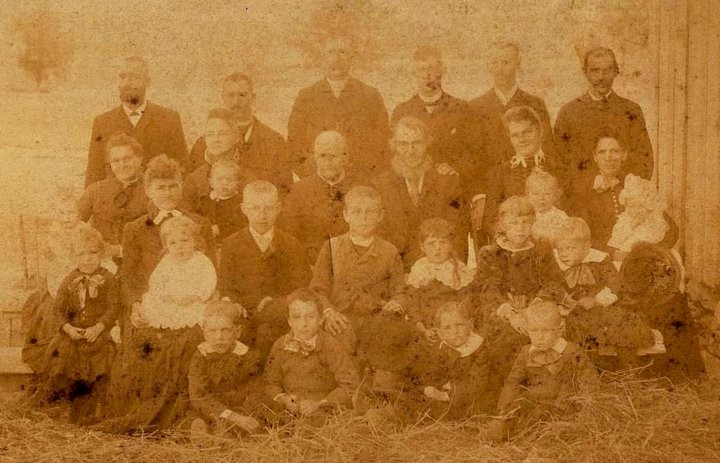
Henry and Johanetta, second row, center right with some of Henry’s children and grandchildren
When we decided to buy some land on which to build our home, one of the deciding factors was the wonderful big rocks on the hillside behind where we imagined building our house. Over the years, we would go out and walk through the woods and stand on the rocks, and I often said that I wanted to create a sacred space down there to visit regularly. As I realized later, there was no need to “create” the sacred space, it was already there.
Following two miscarriages, I would often go to the woods to sit on a chair-shaped rock and connect with nature and my body. During my subsequent pregnancy with my daughter, I would return to this place to sit and connect with my baby and prepare for her birth. After she was born, I brought her to these rocks and these woods to “introduce” her to the planet. At some point at the end of 2010, I suddenly “heard” the words priestess rocks when I was standing out on these large flat stones that look out over the horizon. It felt like their name, I suddenly knew it. So, in July of 2012 when I became ordained as a priestess, the priestess rocks felt like the absolutely perfect place to bear witness to my ceremony of ordination. They called me. They named me priestess first. Continue reading “Forest Heritage by Molly”
We were playing six-degrees of separation, I think. I don’t know if there are rules to follow. It was after dinner, and we were talking about people we had encountered and their linkages to others. Surprisingly quickly, we found ourselves connected to Dwight D. Eisenhower, Elvis, Winston Churchill, and the Queen of England, herself. My mom had autographs from Jerry Lee Lewis, Duke Ellington, the Globe Trotters, and a gaggle of NFL players and professional golfers. She once chatted up Tori Spelling in a bathroom in Canton, Ohio at a Football Hall of Fame Induction ceremony. My husband worked in film in Los Angeles and Cleveland, meeting a crowd of stars and politicians over the years. One time he had a chance, face-to-face encounter with Prince (the artist himself!) as one rode up and the other rode down an escalator at a Borders in Chicago. As the distance between them closed, my husband quietly acknowledged him, saying, “Bravo!” Prince, whose head was angled away so as to avoid having to say anything, apparently, after a moment of consideration, looked back over his shoulder as they passed and silently mouthed, “Thank you.” I still give my husband kudos here… I mean, what else do you say to Prince? This connection, moreover, gave us our links to Morris Day, Jerome, Apollonia, and Shelia E., so we were all excited at his impressive list. I had a far less remarkable cast of characters to contribute, but I could offer a Vatican insider acquaintance, providing thereby a papal connection, which gave us our links to several world leaders. I felt I had contributed my part, even without autographs and celebrities.
With the exception of a Robert Redford encounter while volunteering on a political campaign, the couple that was with us had fewer serendipitous meetings to report. But, we did learn that there was a grandfather in their mix who had served as a royal cook in Hungary. The game now shifted to linkages in history. Who were our notable ancestors? Who were our ancestors, period? Continue reading “Six Degrees of Separation, Hungarian Royalty Chefs, & A Trip to Lens Crafters by Natalie Weaver”
When I decided to become a career woman, I thought I had no role models in my family. My parents (who sometimes considered me the black sheep) would have agreed. Imagine my surprise to find a matriarchal family and three generations of businesswomen women among my Swedish family in Kansas City!
My great-aunt Edith who was a stenographer, secretary, and notary public was a fixture at family gatherings. When I knew her, she was living in California with her two brothers who also were not married. Until their father died, they had lived their whole lives in the family home in Kansas City. I sensed that though my family respected my uncles, they felt sorry for Aunt Edith. It certainly was never suggested to me that instead of getting married and being supported by a husband, I could become a self-supporting working woman like my aunt. Continue reading “Strong Female Role Models among Swedish Immigrant Ancestors in Kansas City by Carol P. Christ”
In the summer of 1960 when I was 14 years old my much loved grandmother Mae Inglis Christ died of a cancer that affected her brain. The last time I saw my Nannie was shortly after her diagnosis in the early spring. While we were visiting, the cancer affected her back, and she took to her bed. In those days children were not allowed in hospitals. I never saw my grandmother alive again, but my mother told us that our grandmother was hooked up to tubes much longer than she should have been. Mother vowed, “This will never happen to me.” I was driven to the funeral in a limousine with my grandmother’s girlfriends. They spoke about my grandmother’s last days, describing how (because her mind was affected by cancer) my little grandmother had screamed and screamed at them for not visiting–even though they were with her every day. They found my grandmother’s outbursts so traumatic that they said they were relieved to see her looking so peaceful in her coffin.Continue reading “Death with Dignity by Carol P. Christ”
On the recent Goddess Pilgrimage to Crete women had the option of riding up a winding road on a mountainside in the back of a farm truck singing “She’ll Be Comin’ ‘Round the Mountain” or could choose to go with the guard in his closed automobile.
That evening one of the older women who had chosen to ride in the car said, “I saw how much fun you were all having, but I have done that before. This time I was happy to let the rest of you do it.”
“That’s exactly how I feel about death,” I responded. “Some people want to live on after death, but I don’t. I am happy to let others do it. The only thing that would upset me would be if life did not go on after me.” Continue reading “The Ancestors Live in Us by Carol P. Christ”
These days I can’t get my 2x great-grandmother Anna Maria Christ off my mind. She may be the independent female ancestor I have been looking for all these years.
My father’s father was transferred from New York to San Francisco during the depression. When I moved to New York City, I felt powerfully connected to its diverse immigrant culture, but I never thought of trying to figure out where and when my ancestors lived there.
Recently I found my Scottish and Irish 2x great-grandparents, James Inglis, the seaman, and Annie Corliss, mother of 9, living in the tenements on Cherry Street near the port of New York. These were my father’s ancestors on his mother’s side. I felt inspired by a photograph of Annie to take her Irish spirit of triumph over adversity into my soul.
Because it has become fashionable to be interested in things Irish, I began my ancestor research there. In fact, I am more German (3/8) than I am Irish (3/16). As I have delved into my German ancestry, I realized that being German became a cause for shame in both the First and Second World Wars. German language newspapers were banned, Germans were interned, people hated Germans, and many Germans changed their names.



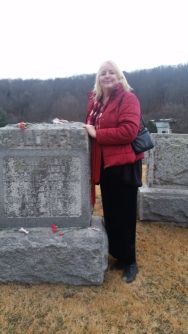 In the past week I visited Cherry Ridge, Honesdale, Wayne, Pennsylvania in the Pokonos, where I was welcomed by my third cousin Marcia Perry Gager whose family never left the place where our ancestors settled. Marcia and I have been corresponding about our family’s history since Ancesty.com connected us about three years ago. During that time, together with another cousin, Debra Ball, we have managed to decipher the complicated history of
  Outside my childhood home grows a yellow rose bush descended from one planted by my great-grandmother, Jennie, a century ago. That bush has given her descendants many gifts of spirit over the years— her love of beauty despite a life of tragedy and constant toil, her deep connection to nature persisting through four generations, her hope for the future inherent in planting anything that will take years to fully develop. When I contemplate my own fall garden and its plants sowing seeds for next year, I ponder the special responsibility we, as spiritual feminists, have for leaving to those who will come after us a legacy of inner resources that they will need to meet the challenges of the planet they will inherit and hopefully make into their own sustainable world of equality, peace and happiness.

 Carol P. Christ is author or editor of
 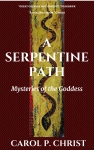 A Serpentine Path: Mysteries of the Goddess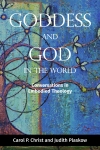
 We were playing six-degrees of separation, I think. I don’t know if there are rules to follow. It was after dinner, and we were talking about people we had encountered and their linkages to others. Surprisingly quickly, we found ourselves connected to Dwight D. Eisenhower, Elvis, Winston Churchill, and the Queen of England, herself. My mom had autographs from Jerry Lee Lewis, Duke Ellington, the Globe Trotters, and a gaggle of NFL players and professional golfers. She once chatted up Tori Spelling in a bathroom in Canton, Ohio at a Football Hall of Fame Induction ceremony. My husband worked in film in Los Angeles and Cleveland, meeting a crowd of stars and politicians over the years. One time he had a chance, face-to-face encounter with Prince (the artist himself!) as one rode up and the other rode down an escalator at a Borders in Chicago. As the distance between them closed, my husband quietly acknowledged him, saying, “Bravo!” Prince, whose head was angled away so as to avoid having to say anything, apparently, after a moment of consideration, looked back over his shoulder as they passed and silently mouthed, “Thank you.” I still give my husband kudos here… I mean, what else do you say to Prince? This connection, moreover, gave us our links to Morris Day, Jerome, Apollonia, and Shelia E., so we were all excited at his impressive list. I had a far less remarkable cast of characters to contribute, but I could offer a Vatican insider acquaintance, providing thereby a papal connection, which gave us our links to several world leaders. I felt I had contributed my part, even without autographs and celebrities.


 Feminism and Religion