What Would Durga Do? by Barbara Ardinger

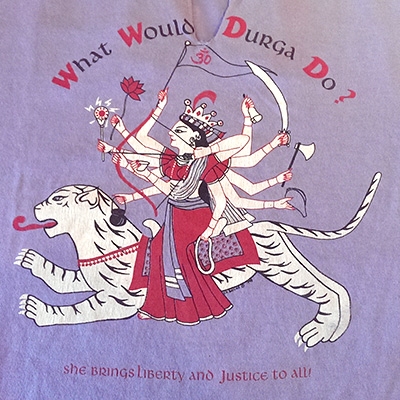
durga1_4inIt’s one of my favorite T-shirts. Every time I wear it, people who know who Durga is comment. So do some people who don’t know who the Hindu goddess is.


“What would Durga do?” is of course an echo of the question What would Jesus Do?

I’ve just done a bit of research and learned that this phrase may come from the Middle Ages, that it was famously used in a sermon in about 1891, and that it became very popular among evangelical Christians during the 1990s. What would Jesus do? I think he’d remind us to pay closer attention to the Sermon on the Mount (Matthew 5, 6, 7), especially the Beatitudes and the Golden Rule: “So whatever you wish that others would do to you, do also to them” (Matt.: 7:12). The Golden Rule is of course given in the other major religions, too. WWJD has also been turned into WWBD—“What would Buddha do?” I think the Buddha would tell us to live more mindfully.

But who, you may be asking, is Durga? Why does she have all those arms? Why is she carrying all those weapons? Why is she riding on a tiger? I’ll answer with reference to Patricia Monaghan’s New Book of Goddesses and Heroines (Llewellyn, 1997). While all the Hindu goddesses are ultimately one goddess with the collective name Devi (“goddess”), Monaghan writes, the goddess appears in different forms. “One of the fiercest of Devi’s forms is Durga … [who is] also the eldest.” She appeared during the “primordial war between gods and antigods” and is the “first manifestation of goddess energy” (p. 106). Continue reading “What Would Durga Do? by Barbara Ardinger”

A Fairy Tale Starring Real Fairies (with apologies to W.S. Gilbert) by Barbara Ardinger

IolantheOnce upon a time very close to right now and in a realm way too much like our world there lived the Sisterhood of Faeries. We remember their names. There’s the Faerie Queen, Belphoebe, who spent much of her time composing epic poetry, which her sister Gloriana wrote down for her. Other fairies were Titania (who ran the orphan asylum for abandoned children), Carabosse (whose job it was occasionally to Speak Firmly to children, both fey and human, who were behaving badly), Fata (an astrologist), Morgan le Fay (no one was ever quite sure what she did), and Tinkerbell (who especially loved to play with well-behaved children). Most of the fairies worked as fairy goodmothers and guided their special human charges through their complicated human lives. A few of the younger fairies collected teeth. It was a rule in the Realm of Faerie that fairies were forbidden to marry human men, though they could (and did) of course flirt and dally with them.

One of Belphoebe’s favorite daughters was the adventurous Iolanthe, who traveled much in the consensual reality where the humans lived. Iolanthe had, in fact, gone among men so often that she had married the Chief Justice of the human realm. For her crime passionel, she was banished from the Faerieland. She took up residence in a stream, where she cast dreams and the occasional nightmare upon the Chief Justice, who had no idea where she’d gone. She also took up good works. Among other things, she pushed drowning children out of the water (though she occasionally arrived too late, as we know from young Ophelia’s sad demise). She spent most of her time reading great books, especially history and law. What no one had known when Iolanthe was banished was that she was pregnant. Her son, Strephon, was born and raised in an underwater castle. Because his mother was so busy with her books and works, the lad was nursed by a kindly female wolf and educated by scholars and sorcerers, and he finally found minimum-wage work as a shepherd. But the lad had ambitions! He abandoned his flock, found suitable clothing, and managed to enroll himself in a large university, where, inspired by his mother, he studied political science, law, history, music, and literature. When he confessed all this to his mother, she immediately blessed him and gave him more great books to study. Continue reading “A Fairy Tale Starring Real Fairies (with apologies to W.S. Gilbert) by Barbara Ardinger”

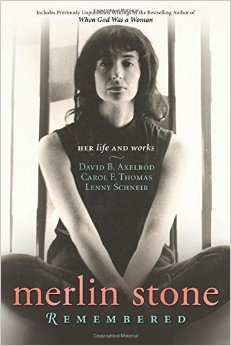
Book review: Merlin Stone Remembered: Her Life and Works by Barbara Ardinger

Barbara ArdingerWhen Merlin Stone’s book, When God Was a Woman, was published in 1976, it was a lightning bolt of feminist scholarship that told the world that before there was a Judeo-Christian god there were goddesses, and before there were goddesses, there was the Goddess. If you’re reading this review and you have not read When God Was a Woman, buy the book. Right now. As you sink into Stone’s book, try to imagine what it was like before we knew about Isis or Inanna or Astarte, before we knew that the tree in the Garden of Eden was probably a sacred fig and that the serpent was a symbol or aspect of the Goddess and that people (mostly women) who ate figs or worked with serpents were honored priestesses and prophets. Just imagine! The work of the second wave feminists added to the work of scholars like Merlin Stone and Marija Gimbutas, but it didn’t begin until the second half of the 20th century. Before that? All there was, was God the Father, maker of heaven and earth. Yes, Merlin Stone hurled lightning bolts into our hearts and minds and bookshelves.

Merline StoneMerlin Stone Remembered is a new book edited by Dr. Carol F. Thomas, Dr. David B. Axelrod, and Stone’s life partner Leonard Schneir, with an introduction by Gloria Orenstein, professor emerita, USC. Orenstein opens the book by putting Stone’s work in context. Before the 60s and 70s, she writes, no one was ever taught anything about the matristic cultures. Yes, a few books had been written. She cites G. Rachel Levy’s The Gate of Horn (published in England in 1948, republished in the U.S. in 1963), Helen Diner’s Mothers and Amazons (1973), and Elizabeth Gould Davis’ The First Sex (1971). These books gave us some of our foundational myths, but, Orenstein writes, “we can see that although there was some writing that had already attempted to reconstruct a history of women …, much more expertise and authority were needed” (p. 8). “Once Merlin Stone provided us with her careful scholarship and a truly feminist (not biased, patriarchal) accounting of ancient Goddess cultures, I and all who found Merlin’s work were finally able to understand our herstory…” (p. 9).

Continue reading “Book review: Merlin Stone Remembered: Her Life and Works by Barbara Ardinger”

Howl: A Mashup Story by Barbara Ardinger

Barbara ArdingerHowl!

For centuries, the wolves were the lords of the forests, ruling wisely and carefully culling the herds of the dumber animals, which actually helped to preserve many species. The wolf packs, led by their alpha females, worked to maintain the balance established by Great Mother Earth. But now a new predator was coming into the forests. Men were cutting down trees and making farms and towns and cities. They were forgetting the stewardship assigned to them by Great Mother Earth, upsetting the natural balance, making enemies of the wild creatures.

wolf

Something had to be done to save the wild places and the wild creatures. The great wolf packs called a World Parliament of Lupine Peoples, which met in a secret location in Mitteleuropa. The werewolves who attended had their own breakout session later in the week, but the men who cast wolf whistles at young women were chased away, as were all wolves in sheeps’ clothing and all wolves of Wall Street. Although there was some discussion about admitting the medieval English queens called she-wolves after a queen in one of Shakespeare’s plays (if you’re curious, it’s in Henry VI, Pt. 3), they were admitted because they were intelligent, brave, and cunning women. The Princess Lupa, stepmother of Romulus and Remus, was a special guest.

Continue reading “Howl: A Mashup Story by Barbara Ardinger”

Popeye as Deity by Barbara Ardinger

Barbara Ardinger

If you’ve read any of my posts here (or my books), you know that I’m not a friend of the fellow I call the standard-brand god. This is the “man upstairs” who goes by such names (in alphabetical order) as Allah, El Shaddai, Jehovah, and Yahweh. He’s the guy who’s snoopier than Santa Claus—he knows when we’re sleeping, when we’re awake, when we’ve been bad or good, and what we’re doing in any state of consciousness. At least that’s what his priests and preachers tell us. His holy books were written by men and his stories are told from the male point of view. (But how did Ruth and Esther get in the canon?) He has priests, but no priestesses that I know of, and even the named angels are male. I mean no disrespect to people who honor this god, but he’s just not my kind of deity.

But hark! There is a charming fellow. We all know him. Continue reading “Popeye as Deity by Barbara Ardinger”

Today is International Women’s Day—Let’s celebrate! by Barbara Ardinger

Barbara ArdingerAccording to their website, International Women’s Day (March 8)  is a “global day celebrating the economic, political and social achievements of women past, present and future. In some places like China, Russia, Vietnam and Bulgaria, International Women’s Day is a national holiday.” The day was established to honor the work of the suffragettes who campaigned for women’s right to vote. (Note that the word “suffragette” is derived from “suffrage,” the right to vote. Today some women prefer to lose the “-ette” syllable, which diminishes any word it’s added to, and say “suffragist.”) “Great unrest and critical debate,” the website continues, “was occurring amongst women [at the beginning of the 20th century]. Women’s oppression and inequality was [sic.] spurring women to become more vocal and active in campaigning for change. Then in 1908, 15,000 women marched through New York City demanding shorter hours, better pay and voting rights.”

On March 19, 1911, the site continues, “more than one million women and men attended IWD rallies campaigning for women’s rights to work, vote, be trained, to hold public office and end discrimination. However less than a week later on 25 March, the tragic Triangle Fire in New York City took the lives of more than 140 working women, most of them Italian and Jewish immigrants. This disastrous event drew significant attention to working conditions and labour legislation in the United States that became a focus of subsequent International Women’s Day events.”

Two thousand years earlier in Rome, the month of March began with the Matronalia, or Festival of Women, when the Vestal Virgins entered a sacred grove and hung offerings of their hair on the oldest tree. Some historians say that Roman matrons served their female slaves at this feast. For every baby born in Rome, a coin was deposited in the temple of Juno Lucina, “Light,” to give thanks to the goddess for a safe birth. Continue reading “Today is International Women’s Day—Let’s celebrate! by Barbara Ardinger”

Fragment. From Delphi. Part Two by Barbara Ardinger

Barbara ArdingerRead Part One of this story here

The two men nodded in mutual respect, and the priest pointed at the old woman, who was now sitting on a three-legged stool. “Your Grace, the Pythoness herself is in attendance today. The Eldest One. Because of your … ah … great generosity to the holy precinct of the College of Lord God Apollo, we—I, myself, I went down … down in the darkness … went down to fetch her. Under the command of the Lord God Himself. All has been explained to you?” As the general nodded, the priest hurried on. “You understand, then, that Lord God Apollo has received your inquiry? The Pythoness will reply. That is, she will convey the Lord God’s words, which I myself will translate. You understand that old women often speak gibberish that common men—that … ah … august personages such as yourself—do not … er … comprehend.” The general frowned. “It’s part of the mystery! It is as Lord God Apollo permits.” The general nodded again. “If Your Grace will kindly excuse me, I must prepare myself. Ordinarily, the younger priests carry out these duties … for the questions of common men … that is to say—”

“Get on with it, man. I’m waiting. My army is waiting. The enemy is waiting.”

The high priest bowed. “Yes. Of course. Waiting.” He bowed again, backed away, and walked with fussy dignity to his station, a pavilion just outside the shed where the veiled woman sat waiting. The pavilion had been especially constructed for this occasion. Gold and white cloths were draped across ebony poles to shade a wide ivory chair for the head priest and a low table for the stenographer, a skinny brown man who emerged from one of the marble outbuildings and stumbled down the slope.

Continue reading “Fragment. From Delphi. Part Two by Barbara Ardinger”

Fragment. From Delphi. Part One by Barbara Ardinger

Barbara Ardinger

The United States has not won a war by the surrender of its enemies since 1945, yet we keep going to war. Young men are committing acts of war to terrorize us at home. Our civilian police forces are becoming increasingly militarized. Who can remember what it was like when the warrior-priests of the mouse-god, Apollo Smintheus, took over Gaia’s ancient shrine?

Long before they came down, she could see the three men in their imitation women’s robes. Because she had no place to hide, she continued to sit calmly on her little stool. She stroked the serpent, which tended to become excitable when the priests were present. It coiled more snugly around her shoulders.

The oldest of the three men, the one right behind the warrior with the torch and the sword, was wheezing heavily as he explained the situation to the boy, whose first trip into the darkness this was. “She’s always back there,” he said, mopping his forehead. “Like a damn snake in a hole.” He paused to catch his breath, and the other two paused with him. “So we always have to run her to ground, so to speak.” He laughed. “Sometimes we have to bind her to bring her out. She’s old. Used to be quite dangerous—” Continue reading “Fragment. From Delphi. Part One by Barbara Ardinger”

A New Yarn for a New Year by Barbara Ardinger

Barbara Ardinger
Once upon a time there lived a smart but lonely woman named Wrenhilde who had had five husbands (but only one of them was her own) and was a single mother. Because she was seldom unwilling to speak her mind in public, she was either unliked or envied by the respectable women of the town, who were ordered by her husbands to avoid her company. So Wrenhilde did what she could to earn a pittance to pay the rent. She also grew as much of her food as she could. As she worked (or didn’t work), she sang to herself:

Bitter is my cup,
My life’s not worth a shtup,
I believe I need a new world—
I’ll have to make one up.

Well, with that kind of song and the attitude it betrayed, no one was surprised that her son Jack was a dropout by the time he was fifteen. Jack lazed around, acted stupid, stood up to the rich boys who tried to bully him, and secretly wished he had a pet for company. One of his chores at home was to milk the cow. This was the only thing he never neglected because the cow was big and white and warm and affectionate. She practically purred while she was being milked! Continue reading “A New Yarn for a New Year by Barbara Ardinger”

An Archaic Trinity of Goddesses? Not Necessarily. by Barbara Ardinger

Barbara ArdingerIn her comment following my last post which was about mythology, my friend, Carol Christ, expands on my paragraph about how the so-called “ancient triple goddess” was really invented in 1948 by Robert Graves in his book, The White Goddess. (Thanks, Carol.)

Back in the 1970s and 1980s, when the Goddess movement was just getting up on its feet and our ovular books were being published, the idea arose that if “they” have a holy trinity, “we” have one, too. And ours is older and holier. We see it in the three phases of the moon, new (Virgin), full (Mother), and dark (Crone). Here’s a tiny sample of these books that changed the lives of so many women and men:

  • Woman’s Mysteries Ancient and Modern by M. Esther Harding (1971, but first published in 1933)
  • The Goddesses and Gods of Old Europe (1974) by Marija Gimbutas
  • When God Was a Woman (1976) by Merlin Stone
  • Lost Goddesses of Early Greece: A Collection of Pre-Hellenic Myths (1978) by Charlene Spretnak
  • The first edition of The Spiral Dance (1979) by Starhawk
  • The Chalice and the Blade (1987) by Riane Eisler
  • Laughter of Aphrodite (1987) by Carol P. Christ
  • The Holy Book of Women’s Mysteries (1989) by Z. Budapest
  • The Reflowering of the Goddess (1990) by Gloria Feman Orenstein
  • Whence the Goddesses: A Source Book (1990) by Miriam Robbins Dexter

Triple goddess? ’Tain’t so. Our beloved triple goddess is one of our foundational myths. It’s nice and it’s perhaps inspiring, but it’s only a myth. Anyone who looks at a calendar or almanac—or up into the sky every night for a month—can easily see that the moon doesn’t have three phases. It has four: waxing, full, waning, and dark. And since the late 20th century, women have lived long enough to go through more than three stages of life. Continue reading “An Archaic Trinity of Goddesses? Not Necessarily. by Barbara Ardinger”