The Quality of Mercy by Barbara Ardinger


The quality of mercy is not strained;
It droppeth as the gentle rain from heaven
Upon the place beneath. It is twice blest;
It blesseth him that gives and him that takes…

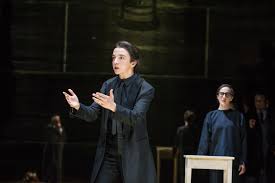
This speech (Act IV, scene 1) from The Merchant of Venice, given by Portia in disguise as a boy lawyer (and Bassanio doesn’t even recognize her!), may be one of Shakespeare’s most famous. In the play, as we know, Shylock, a Jewish moneylender, and Antonio, a merchant waiting for his ships to come in, make a bargain, one part of which is that if Antonio doesn’t pay on time, Shylock gets to collect one pound of his flesh. Antonio’s ships don’t come in, the case is taken before the Duke of Venice, and Portia appears in disguise to solve the legal issues. She goes immediately to Shylock and speaks this speech to him.

Portia, The Merchant of Venice Act IV, sc. 1, Royal Shakespeare Company production

Continue reading “The Quality of Mercy by Barbara Ardinger”

“We Must Have Music” by Barbara Ardinger

In 1936, Sir Noël Coward (1899-1973), one of England’s greatest and most prolific songwriters and playwrights, wrote a song for a play called Shadow Play, which is part of a series of ten short plays gathered under the title Tonight at 8:30. At one point, Simon steps down to the footlights and sings this song:

Play, orchestra, play
Play something light and sweet and gay
For we must have music
We must have music
To drive our fears away.

You can listen to Coward and Gertrude Lawrence (one of his best friends) singing the song here.

Shadow Play can probably best described as surrealistic: the major characters travel through dreams and flashbacks and flash-forwards as they try to figure out what on earth they’re doing. What do they fear? Probably what they’re doing to themselves with their illusions and delusions. But let’s take the song out of its dramatic context. What did people have to fear in 1936? Franco in Spain. Mussolini in Italy. Hitler in Germany.

From the 1920s to the 1950s, Coward wrote dozens of plays, many of them comedies, and acted in them, too. He also wrote more songs than I can count, most of them witty (“Sail Away”), many ironic (“Mad Dogs and Englishmen”), some romantic (“I’ll See You Again”), that not only advance the plots of the plays but also possibly distract listeners from whatever misery is happening in “real life.” As Amanda says in Private Lives, “[It’s] strange how potent cheap music is.” (Irony: she’s talking about “Someday I’ll Find You,” https://www.youtube.com/watch?v=_i3DDHL_dnw a romantic song Coward wrote that is playing offstage.) During the war, Coward also wrote and acted in popular movies to cheer his audiences.

Now let’s move into 2020. What do we have to fear? Here’s my current short list.

  1. That the coronavirus will get stronger and hungrier and Station Eleven (which I reviewed in April) https://feminismandreligion.com/2020/04/05/not-if-but-when-by-barbara-ardinger/ will turn from a spellbinding novel into nonfiction.
  2. That Trump will refuse to leave the White House in January and Washington will turn into a literal war zone.
  3. That patriarchy, misogynism, nationalism, white supremacy, and the gun lobby will get stronger and noisier.
  4. That our school-age children will never go back to school as we know school and grow up to be illiterate and innumerate.
  5. That climate change will destroy our blessed Mother Earth and all our kin, both animal and vegetable.

What can you add to my list? What do you fear today?

We all know, of course, that music by itself will not solve any of these problems or literally drive our fears away. But music is powerful. As William Congreve (an early 18th-century playwright) wrote, “Musik has charms to soothe a savage breast.” (No, that line isn’t from Shakespeare and, no, it’s not “savage beast.”) Music can help feel less savage…but well, yes, it can also sway us to be more savage (ask the Nazis about that). During this pandemic, perhaps music can heal us emotionally, perhaps help us deal with staying at home and meeting our friends only via Zoom. Music can both stimulate and soothe our poor, worn-out minds. Music can lift us out of depression and help us forget to worry for a while. Listening to and participating in music (maybe virtual bands and orchestras or choruses) will surely help us survive individually, maybe collectively.

Shakespeare often tells us how good music is for us. Two brief examples:

Music oft hath such a charm
To make bad good….
(Measure for Measure, 4.1)

Let there be no noise made, my gentle friends;
Unless some dull and favourable hand
Will whisper music to my weary spirit.
(2 Henry IV, 4.5)

I quit watching the Sunday TV talk shows several months ago, and now I don’t watch more news than I must to more or less keep up with what’s going on. I fill my evenings with music. What I’m totally insane about is musical theater. My all-time favorite shows are 42nd Street (Arlen and Dubin—all that tapdancing!), Ragtime (Flaherty and Ahrens), The Fantasticks (Jones and Schmitt—“Try to Remember”), Bright Star (Martin and Brickell), the balletic American in Paris (the Gershwins—“inspired by” and better than the movie), and Rent (Larson—“Seasons of Love”). How many of these shows do you know? Back when we could still go to the theater and see live actors, I saw all of these shows; now I have them on DVD, along with a gazillion others. I also like folk music (especially Pete Seeger and Arlo Guthrie…can you hum “Alice’s Restaurant”?) and classical music (especially Mozart’s Magic Flute because Papageno is so earthy and pagan). Oh, gee, another fear—what if theaters and real symphony orchestras are gone forever?

Now it’s your turn to consider the benefits of music in your life. What music do you listen to? When do you listen? Does this music help drive your fears away? Make yourself some new playlists and schedule more music into your days and nights. And remember—“we must have music.”


Barbara Ardinger, Ph.D. (www.barbaraardinger.com), is a published author and freelance editor. Her newest book is Secret Lives, a novel about grandmothers who do magic.  Her earlier nonfiction books include the daybook Pagan Every DayFinding New Goddesses (a pun-filled parody of goddess encyclopedias), and Goddess Meditations.  When she can get away from the computer, she goes to the theater as often as possible—she loves musical theater and movies in which people sing and dance. She is also an active CERT (Community Emergency Rescue Team) volunteer and a member (and occasional secretary pro-tem) of a neighborhood organization that focuses on code enforcement and safety for citizens. She has been an AIDS emotional support volunteer and a literacy volunteer. She is an active member of the Neopagan community and is well known for the rituals she creates and leads.

Dr. Signature’s Whoopee Pack by Barbara Ardinger

As I write this in late June, the news is still pretty depressing. Pandemic. Politics. Corruption. No no no. I can’t write anything current and cheery, so here’s another bit of distracting nonsense from my so-called archive.

Back in the 80s, I had a consulting position (sic.) with a multi-level marketing company. How many of us remember MLM? How many of us even remember the 80s? MLM was really big in the last quarter of the last century. Everybody thought it was a really good idea to enroll all their friends in “marketing” assorted products. (Well, I once sold a candy bar via MLM, but I never got around to recruiting my friends.) In 1984, I had a job with an MLM company writing product descriptions and announcements. One of their products was called Dr’s Signature Vita-Pack. It contained lots and lots of multi-vitamins and other supplements. Continue reading “Dr. Signature’s Whoopee Pack by Barbara Ardinger”

Practical Lessons in Kindness from the Grasshopper and the Ant by Barbara Ardinger

(With apologies to Jean de La Fontaine for significant changes to his fable)

Note: I first posted this story in 2016 and posted it again in 2019. As the pandemic drags on and the huge orange Tyrannosaurus Rex in the White House has not only endangered the lives of everyone in the land but also models and encourages all the awful “isms” that we need more than ever to leave behind, I’ve decided this story might make someone’s day a bit cheerier. Yes, we need lessons in kindness more than ever before. I bet you agree with me!

“Curses on that grasshopper!” exclaimed the ever-busy Madame Fourmi. “All he ever does is play. He’ll be sorry when winter comes.”

And so it went. Every day, Mme. Fourmi spent the morning scrubbing her front steps. And Monsieur Cigale?

“Partaaaaayyyyy!” Every day, he sped by on his skateboard. “Hey, Auntie Ant, stop cleaning the concrete and come and play with us. We’re gonna start a band!” Continue reading “Practical Lessons in Kindness from the Grasshopper and the Ant by Barbara Ardinger”

The Eldest, Truest Olympians by Barbara Ardinger

Scene: A comfy lecture hall in the temple on the summit of Mount Olympus. The feminist historians have taken their seats. The eldest Olympians rise to speak. Let us attend to their words.

I am Hera, Queen of All, Daughter of Gaia, Daughter of the Great Mother, whose body is our holy earth, whose bodily fluids are our springs and oceans, whose mind is our precious air and holy fire. I am Mother of the Fates, Sister of Hestia, protector of homes, and sister of Memory, whose daughters are the Muses, sponsors of our culture. I live in contentment with my wife, Zeusina.
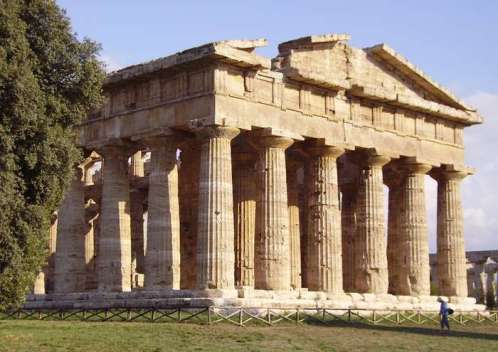
I am Zeusina, Co-Queen of All, Wife of Hera, Co-Mother and Sacred Guardian of all lands. You’ve heard the stories of that rapacious lecher who usurped my place? Don’t believe them! That dirty dog stole my throne, my wife, and even my name. Now one of my constant duties is to battle against the armies that are invading our peaceful lands and bringing their thunder-gods to cast us down and stand in dominion over us. The generals of those armies are bringing ruin and desolation to our lands and cities. Another of my tasks is to correct the stories the speakers for the thunder-gods tell. I rescue young women like Leda and Danae and Europa from their greedy fathers, who would sell them to the highest bidders. So many young women have I had to rescue!

I am Poseidis, Queen of Waters. When I was young, I swam and played with mermaids and seals and dolphins and whales. Now I find I must protect them from the ravages of royal navies and ruthless fishermen. I spend my days and nights working to clean up after the careless men who discard their trash in my waters. I yearn to swim and play again. Can you help me clean our waters?

I am Demeter, Queen of Crops and Farmlands. You perhaps know the story of my daughter Persephone. Men have told how she was kidnapped by my little brother, Hades. Don’t believe it! She went to visit the lands beneath the earth because she could hear the crying of souls caught in boredom in the Elysian Fields. She visited them to sing to them and to teach them to protect and fertilize the roots of plants that grow on the surface of the earth. Friends, let us work to save our lands from harm. And let us always celebrate Our Holy Mysteries.

I am Athena, Queen of Holy Wisdom. From my birth among the Amazons of Libya and my childhood among the Amazons who live near the Black Sea, I have sought learning and inspired humans to think and write. You have no doubt heard of my so-called friendship with Odysseus, that hubristic king of such a tiny island. Don’t believe what you’ve read about him! My perpetual chore is to cleanse him of that sneaky cunning and to teach him to be friendlier to the people he meets in his travels. Actually, he needs to stay home with his family.

I am Apolla, Queen of Music and Sunlight. When your day is bright and the sun is shining down upon you, think of me. When you hear a lyre or a lute or a guitar, think of me. I invented all musical instruments, and my greatest joy is the symphony orchestra. Perhaps you’ve heard the tale about how I “conquered” Delphi and took over the oracle? Don’t believe it. Like her sister sibyls, the oracle was growing elderly. I went to help her interpret some obscure riddle and liked that vale so much I bought a timeshare and now spend much of my time there. The oracles and I are aging gracefully together.

I am Ares-ma, Queen of Armies. I am so angry! Warriors should not be mercenaries working for greedy kings. They should be honorable explorers. I am so angry that kings prefer to abandon justice and their goddess-given healing touch and sit on higher and mightier thrones. I am so angry at the armies and their thunder-gods that all I want to do is fight against them and defend our ancient mothers against their burning weapons. I am so angry!

I am Aphrodite, Queen of What Is Best of Love. I am the Great Creatrix of gardens and landscaping. I inspire your poets and bring colors to your world. You’ve no doubt heard about my so-called girdle. Well, it’s really just a fancy golden belt. It’s supposed to strike men and women with profane love, to make women surrender to godlets and men who think they’re gods. Don’t believe it! I use my belt to draw magical borders between peaceful realms and teach humans about compassion and charity.

I am Hephaestia, Queen of Forges and Crafts. I have taught people to fashion metal into works of art…but some turned my lessons inside out and used my forges to create weapons. Oh, shame upon them! Do you engage in any craft? The roots of all crafts lie in my smithy, and I teach humans to do clever things with ordinary materials. We bring beauty to the world.

I am Hermia, Queen of Written Languages, Messenger between the divine worlds and the ordinary ones. You’ve heard the old tales that “Hermes” and his son Autolycus are thieves? Well, maybe they were, but I am not…well, sometimes I borrow things to show to humans and give them pleasure. I am forever speeding with messages between the worlds and lands. So much fun!

I am Dionysia, Drama Queen. Oh, yes, indeedy…I invented drama. Plus tragedy and comedy. That was when someone told me about consensual reality and I found it soooo boring. Let’s have our stories acted and sung and danced on stages (which I also invented). Let’s have elevated reality and great festivals. Hooray for Shakespeare, Moliere, and Chekhov. And the Gershwins and every performer who’s ever stepped on a stage and brought entertainment to the people!


Note: This bit of nonsense woke me up at 4:00 this morning. I’m pretty sure I wasn’t dreaming. Voices in my head? Who could resist? They were telling me that most of the Greek myths we’re familiar with are patriarchal fantasies. So there, Robert Graves—you’ve written the phallocentric versions. Now it’s our turn.  


Barbara Ardinger, Ph.D. (www.barbaraardinger.com), is a published author and freelance editor. Her newest book is Secret Lives, a novel about grandmothers who do magic.  Her earlier nonfiction books include the daybook Pagan Every DayFinding New Goddesses (a pun-filled parody of goddess encyclopedias), and Goddess Meditations.  When she can get away from the computer, she goes to the theater as often as possible—she loves musical theater and movies in which people sing and dance. She is also an active CERT (Community Emergency Rescue Team) volunteer and a member (and occasional secretary pro-tem) of a neighborhood organization that focuses on code enforcement and safety for citizens. She has been an AIDS emotional support volunteer and a literacy volunteer. She is an active member of the Neopagan community and is well known for the rituals she creates and leads.

Going With the Wind by Barbara Ardinger

The wind changed during the night. Even as they slept, the Witch and the Ladies of the Magic Mirror felt it and stirred in their beds. Kahlil the raven, who was sitting on the roof, felt it, too, and as he looked down the highway, he spotted the travelers. “What’re those folks doing on the road?”

The travelers were walking along the highway built only a few years ago by the people of the country towns who had fled from El Presidente’s capital city. They were coming toward the Witch’s house, too many for the raven to easily count: women, men, and children dressed in dark clothing that was stylish a hundred years ago.

The sun began to rise. The travelers came closer. The Witch and the Ladies got up, got dressed, and stood on the porch to wait for them. At the direction of the stout woman who was leading them, smaller groups broke off and turned toward other houses in the small town. The stout woman led her people to the Witch’s front porch. The wind changed again—and look! The travelers were no longer wearing dignified attire. Cloth caps instead of bowler hats on the men’s heads, headscarves on the women, scraps wrapped around the children. “They’re laborers,” said one of the Ladies. “Migrants.” Another Lady nodded. “And they obviously need our help. They need to be fed.” “They need jobs,” said the Witch. “How can we help them?” Continue reading “Going With the Wind by Barbara Ardinger”

“Not If But When” by Barbara Ardinger

As I’m writing this early in March, the CDC has recently said of the outbreak of the coronavirus (Covid-19) that it’s a question of “not if but when” the epidemic will strike the U.S. As we know, it started in China, where it was underreported. Some U.S. cities are setting up quarantine centers, the Faux New Channel is now proclaiming conspiracy theories about the origin of the virus, and Mr. Trump has appointed Mr. Pence to be Coronavirus Czar. Which would be fine if either man believed in science.

We’ve seen epidemics and pandemics before—the post-World War I Spanish Flu, HIV/AIDS, Ebola, SARS, the avian and swine flus, and many more. This new disease as already killed people on six continents. My purpose here is to briefly review two books in which a pandemic is a major plot driver. You know those books you read and keep and go back to again and again? Two of my go-to novels are Station Eleven (2014) by Emily St. John Mandel and Doomsday Book (1992) by Connie Willis. Continue reading ““Not If But When” by Barbara Ardinger”

A Modest Proposal by Barbara Ardinger

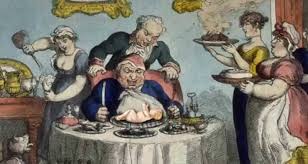
In 1729, the Anglo-Irish author Jonathan Swift (1667-1745), who was already widely known for his political polemics and satirical pamphlets and highly ironic letters to and about the literati of Georgian England, published “A Modest Proposal for preventing the Children of Poor People from being a Burden to their Parents or the Country.” Having observed how the English conquerors and (mostly absentee) landlords of Ireland had for close to five centuries been bleeding the island dry by confiscating its crops and taxing the Irish people unto starvation, Swift suggested in “A Modest Proposal” that the poor people (nearly everyone) sell their children to the rich to be used as food. Yes, the pamphlet is outrageous. (But students of English literature generally enjoy it. I know I did. It’s lots less boring than the poetry written during the reigns of the first three Georges.) It was widely discussed (an understatement) in London.

Jonathan Swift
Modest Proposal


Continue reading “A Modest Proposal by Barbara Ardinger”

Let’s Celebrate a God and a Goddess for February by Barbara Ardinger

Back around the turn of the century when I was writing Pagan Every Day, I did a lot of research. I had to. I had to write something for every day of the year, including leap year day and a second January 1, i.e., a year and a day. I used real books. I stacked them around the chair in front of my computer. I had to step over books. Step around books. Wind my way past books to other books that had somehow landed across the room. Just like nearly everybody else who writes for Feminism and Religion, I wrote and thought and deleted and wrote some more. (Y’all know how that goes.) We writers have always had interesting adventures with traditional publishers. That’s one reason self-publishing is so popular today: we can maintain more control over our work. Twenty years ago, when I modestly (hah!) submitted my year and a day of essays, the publisher said, “Oh, you wrote too much. We only want 300 words per day.” They hadn’t mentioned that before. So I began editing. I threw away nearly all my nifty daily epigraphs and edited every day down to (cross my heart) 301 words.

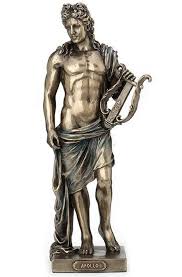
Who did I find for early February? A Greek god who had secrets. A Roman goddess who is special to me to this day.

Apollo

Continue reading “Let’s Celebrate a God and a Goddess for February by Barbara Ardinger”

Let’s Try Creativity This Year by Barbara Ardinger

As usual, I’m writing my post a couple weeks before you’ll be able to read it. I bet we’re all wondering in mid-December if 2020 is really gonna happen. Will we still be living in a civilization? Will there still be wild animals (outside of zoos)? Will trees and other plants still be growing? Well, my friends, if we all woke up last Wednesday and opened our eyes and it’s all still here……hooray!

Way back in 1998 I wrote a book called Goddess Meditations. It was the first-ever book devoted to guided meditations centered only on goddesses. No gods. No empty minds or asanas. Goddesses, some well known, others obscure, from many pantheons. One chapter in the book is “Chakra Goddesses,” in which I assigned a goddess to each of the seven major chakras. The goddess of the throat chakra—which rules clear communication, self-expression, and creativity—is Sarasvati. Here (with comments that pop out of my mind and into my fingers as I type) is part of what I wrote about communication.

Continue reading “Let’s Try Creativity This Year by Barbara Ardinger”