Now is the time of Beltane, the great festival celebrating life and fertility.
Last week, on April 24th, in my post The Dance of Memory I wrote about the centennial of the Armenian Genocide, and invited everyone to join in this worldwide day of remembrance through prayer, meditation, music and dance. Subsequently I received testimony from students and colleagues all over the world about dance events they had organised in response to my call.
Dancing friends from Europe, North America, South America, and Australia told how moved they felt to be part of a larger whole, connected through the wordless beauty of music and dance, and by our compassion and caring for all those affected by genocide. Many, including my sister Leslie, thanked me for my ‘call to include Turkish and other dances in the Armenian commemoration activities’. She wrote from New Zealand, ‘The world needs more of this kind of inclusiveness!’
In Germany, Sybille Kolaric danced Armenian dances and a Turkish dance with her group, saying, “I really liked the idea to combine in the dance circle what is so separated in reality.”
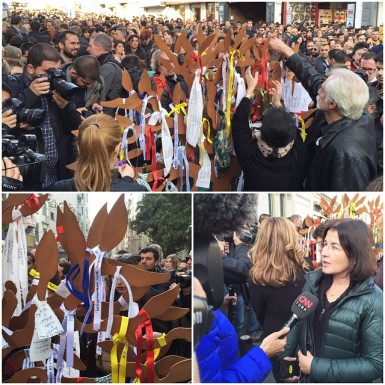
A beautiful coming together of Turks and Armenians took place in Istanbul, where my dear friend and colleague Shakeh Major Tchilingirian went with her family, along with many Armenians from all over the world, for the April 24th commemorative ceremonies. A few days before, Shakeh had been leading Armenian dances with Turkish university students there as a ritual of reconciliation (you can see the film, Circle of Life, about a similar event she led in London). Shakeh wrote that they attended a very emotional service in the Armenian Church, and then went to Taksim Square to tie cloths to the Wishing Tree.
Shakeh wrote from Istanbul, “Last night I read some of the messages on The Wishing Tree, messages remembering ALL victims of atrocities and genocide as well as the displaced. There were thousands, possibly tens of thousands, of people sitting silently in Taksim Square, many Turks and Kurds amongst us. There is a lesson to be learned here: we are all victims of the situation we find ourselves in and the longer these wounds bleed the more difficult it becomes to heal.”
The Wishing Tree in Taksim Square was created by Turkish artist Hale Tenger, specifically to mark the centennial of the Genocide. She invited participants to tie pieces of cloth to its branches in homage to the victims and survivors of the Armenian Genocide. Armenian-American Nancy Kricorian brought with her from New York a strip of fabric from one of her grandmother’s aprons, saying, “My grandmother Mariam Kodjababian Kricorian was a survivor of the 1915 Genocide, and tying this cloth to the Wishing Tree in Istanbul will be a tribute to her life.”
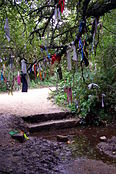
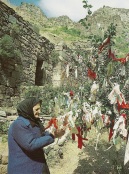 Coincidentally, my April 24 post on FAR included a photo of an Armenian grandmother tying an offering of cloth to just such a tree. The ancient folk custom of the wishing tree, where people (usually women) tie cloths with a special prayer for a loved one, can be found today in Armenia, Turkey, and Greece, in Asia and throughout Europe as far as the British Isles and in Asia as well. This ‘clootie tree’ by the ‘clootie well’ (cloth = clootie) in Madron, Cornwall, is almost identical to the Armenian one shown in my previous post.
Carol P. Christ’s comment on my last post described a similar tree on her Greek island of Lesvos which she tells me is near hot baths once sacred in antiquity. She also stated that brides in ancient Greece would leave articles of their unmarried clothing on a tree dedicated to the virgin Goddess Artemis, one of many tree-worshipping rituals which were well-known and widespread in the ancient world.
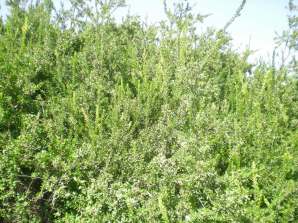
Women on Carol Christ’s Goddess Pilgrimage to Crete have all participated in such a practice, tying coloured ribbons onto the venerable myrtle tree already covered with ribbons and votive offerings called tamas, at the sacred monastery of Palianí. When I went there with Carol in 2012, my encounter with the tree led to a profound and lasting experience of healing, which Carol remembered in Giving Back to the Mother.
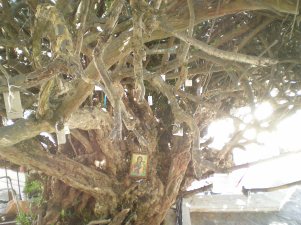
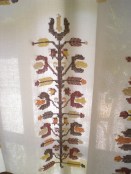 Sisters on Carol’s pilgrimage also get to encircle the 2,000-year-old plane tree at Krasi. Even today village festivals are held under the canopy created by the ancient tree. We know that tree worship on Crete has roots in Minoan times, as depicted in gold seal rings and other examples of Minoan art, and we know that tree worship is both ancient and widespread. My life’s work researching the Goddess in traditional Balkan dance has shown that the Tree is often associated with the Goddess, for instance in many Balkan embroideries This abstract but recognisable version comes from the curtains of the reception room in the Palianí monastery.
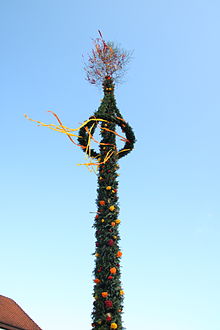
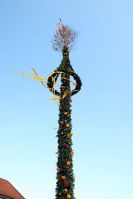 The sacred tree remains a living tradition in central, western and northern Europe in the form of the Maypole. I write this from Austria, where virtually every town and village honours May 1st (the ancient celebration of Beltane) with a May Tree, or Maibaum, a tall decorated pole with a wreath at the top. I love how this one from Germany resembles the Goddess. Can you see her too?
Once-universal practices revering trees, nature, and the Goddess may have changed, but the act of praying for others’ well-being remains common to us all. The longing to keep our loved ones safe transcends all religious, political and ethnic boundaries. Love for others is one of the strongest bridges to common ground, and here is where we find our meeting place once again.
As I read through the messages sent in response to my invitation to dance on April 24th, I feel that each dancing circle is like a votive offering hung on a sacred tree. Each one is a gift of love for humanity, unique, yet part of a shared desire to end suffering, to bring healing, and to ensure the safety and survival of every single being in creation.
Laura Shannon has been researching and teaching traditional women’s ritual dances since 1987. She is considered one of the ‘grandmothers’ of the worldwide Sacred / Circle Dance movement and gives workshops regularly in over twenty countries worldwide. Laura holds an honours degree in Intercultural Studies (1986) and a diploma in Dance Movement Therapy (1990). She has also dedicated much time to primary research in Balkan and Greek villages, learning songs, dances, rituals and textile patterns which have been passed down for many generations, and which embody an age-old worldview of sustainability, community, and reverence for the earth. Laura’s essay ‘Women’s Ritual Dances: An Ancient Source of Healing in Our Times’, was published in Dancing on the Earth. Laura lives partly in Greece and partly in the Findhorn ecological community in Scotland.


 A ‘Nicho‘, is a three-dimensional or recessed area used to honor an important figure, saint, or loved one. Nichos originated as an adaptation of the Roman Catholic ‘retablo‘, painting of a patron saint on wood or tin.



 Feminism and Religion