Blessed By Gratitude and Sharing by Xochitl Alvizo

Incarnation, Goddess spirituality, Xochitl Alvizo,  god became fleshCarol Christ’s post yesterday has gotten me thinking about the differences between Christianity and earth-based spiritualities. Of course, there are many differences, that goes without saying. However, being someone who comfortably stands at the intersection of them both I am usually more aware of the ways in which they seem to intersect in life-changing and inspiring ways for me. Nonetheless, Carol has me thinking…

Over the course of the last year here on Feminism and Religion, Carol has written a lot about the importance of ancestors – how when speaking about embodiment and interdependence it is crucial we acknowledge all the ways in which ancestors make us who we are. Mothers literally give us our bodies and our ancestors’ genes, connecting us to a long line of people both materially/biologically as well as historically. Ancestors give us a sense of connection to places and ground us to lands that were meaningful to them and thus become meaningful to us. And Carol also reminds us that our family and ancestors transmit to us memories that impact us psychically and in powerful ways. These emphases on connection, interdependence, rootedness, and embodiment flow from her earth-based Goddess practice and thealogy. Her spirituality leads her to a greater sense of appreciation and gratitude for the Source of Life and for all the sources of life, and she affirms that because of this deep awareness of interdependence and relationality people who practice earth-based spiritualities are “moved to share what has been given to [them] with others.” Continue reading “Blessed By Gratitude and Sharing by Xochitl Alvizo”

Sustaining Feminist Spiritualities in the Seeming Absence of Community by Elisabeth Schilling

LaChelle Schilling, Sustaining Feminist SpiritualitiesThe spirituality I cultivated during my teens through evangelistic Pentecostal Christianity was based on possession, hierarchy, and exclusivity, although I would not have said that at the time.

As I gradually moved away from that faith community in my mid-20s, no longer wanting to equate a rewarded closeness to God with being set apart from others, I began finding myself participating in quiet conversations with the readings of Thomas Merton, Elaine Pagels, and with poetry by writers such as Olga Broumas.  The words I was drawn to might not have been expressly or consistently religious, but they offered spiritual nourishment in their eroticism, earthiness, and sacred metaphor.

It was also around that time when I decided that feminist theologies were healing in their questions and re-visions of God and concepts of salvation and sin. To understand that being a spiritual and/or religious person could mean being aware of and pursuing my desires and connections to other people instead of being a gatekeeper was redemptive. Continue reading “Sustaining Feminist Spiritualities in the Seeming Absence of Community by Elisabeth Schilling”

Inspiration by Jassy Watson

Jassy_Agora1-150x150This “Mountain Mother” painting is an ode to women’s earth wisdom and is my prayer for reclaiming of that wisdom to heal the earth and all her beings.
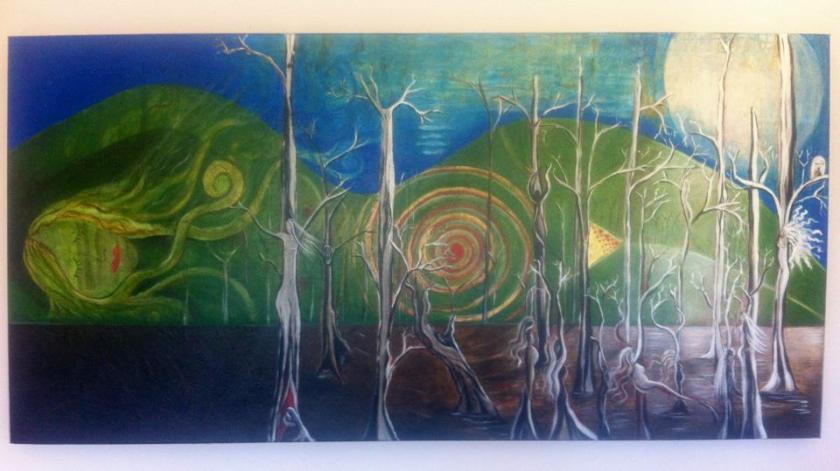

When I am inspired to paint I can think of nothing else, the desire to put brush to canvas takes over every ounce of my being, and it is difficult to be present in everyday life. There are other times where I’ve wanted to create but inspiration was lacking: I would start a painting and have no desire to finish it. I would often get quite frustrated at myself.  It’s only recently that I’ve had the realisation that down time is just as significant as the up time. Rather than get anxious about not creating a masterpiece, I have learnt to go with the flow, take pleasure in the time of rest, because I know it’s all part of the cycle.  My inspiration always returns with abundance. Presently I am bursting at the seams with creativity, and I can’t find enough hours in the day to let all this inspired energy out. I am overcome with a sense of urgency I can’t explain. I am committed to paint and write with the intention that my personal message becomes part of the global message for change as our sacred feminine wisdom is being called forth. I am determined and full of courage to be part of the movement that brings about a shift in all aspects of life.

My present state of inspiration can be attributed to my recent Goddess pilgrimage to Crete with Carol Christ. I am sure that anybody who has attended such pilgrimages will attest that these experiences are life-changing. Travel alone is profound, but to share the experience in a circle of twenty amazing women is even more so. We sang, danced, trekked through the Cretan countryside, delved deep into caves; the womb of our great mother, climbed mountains and cleansed in the sea. We prayed and communed with the goddess daily, participating in rituals that were meaningful, un-contrived and safe. While I have always known that the goddess is everywhere, within and without–encountering her ancient past in a present day context is a feeling I’m not sure I can adequately describe with words, hence my desire to express some of these feelings through my art.

 “Mountain Mother” Jassy Watson
“Mountain Mother” Jassy Watson

Continue reading “Inspiration by Jassy Watson”

Feminist Music By Gina Messina-Dysert

Last week Caroline Kline shared the article “Feminist Films” and discussed the Bechdel Test as a way to identify whether or not a film is feminist.  It left me wondering – can we identify music as feminist in the same way?  Music generally does not offer dialogue between two women.  But there are instances where we find two women singing together about feminist issues like the 80’s classic “Sisters are Doin’ it for Themselves.”   There are also women singing about or to women, like Juliana Hatfield’s “My Sister.” And there is music that acknowledges women’s struggles as women like Ani Difranco’s “I’m No Heroine,” No Doubt’s “I’m Just a Girl,” and Pink’s “Stupid Girls”.    But is this the only way to identify feminist music?   Continue reading “Feminist Music By Gina Messina-Dysert”

A Room of One’s Own: Sacred Women’s Space by Amy Levin

I normally don’t get too personal in my blog posts. I figure if I’m going to take up space on the blog I might as well offer up something other than me, my voice, my body, and instead some good old fashioned commentary on those categories of feminism and religion “out there.”

I’ve been thinking a lot about sacred space over the past year (occupy wall street, Durkheim, the public sphere, Park51) and only recently have I begun to really think about personal sacred space. This week, I haven’t been able to avoid it. My long-time boyfriend and I recently broke up not-so-amicably. In the past few days he has contacted all of my friends and relatives in order to say “goodbye.” I began receiving a swarm of confused questions from close friends, who informed me of the texts, messages, and phone calls they were receiving. While I won’t dwell on the details, as you can imagine, these acts have intruded on my mental and physical space to the point where space in my immediate world has been temporarily possessed by someone else. As dated as first wave feminism is, Virginia Woolf’s salient message in A Room of One’s Own is exactly what I need. I realize that though my affective, physical, emotional, and mental spaces are conjoined and cajoled by my cultural and material surroundings, it’s vital that I feel that, in some way, these spaces are mine. This is what agency is for me. And I would call it sacred. Continue reading “A Room of One’s Own: Sacred Women’s Space by Amy Levin”