
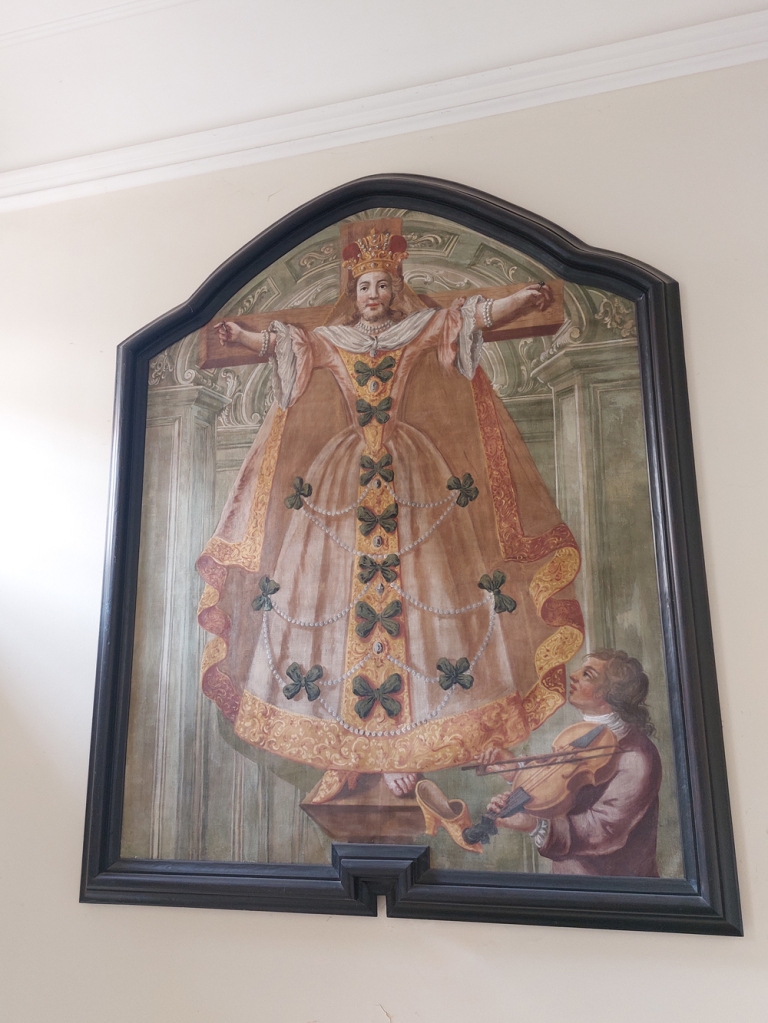
A Feminist Reading of Saint Wilgefortis by Sofia Meskhidze

The legend of Saint Wilgefortis tells the story of a Christian woman who was martyred for her faith. While there are numerous women martyrs in the Christian tradition, Wilgefortis is distinguished by her gender non-conformity. She is often referred to as female Christ[1] and is almost always depicted with a beard, in a dress, and nailed to a cross. According to the legend, she was a Christian princess from Portugal whose father had promised her to the pagan king of Sicily. Wilgefortis, refusing to marry, prayed all night for God to make her unmarriable and as a result miraculously grew a beard, causing her father’s rage, after which he had her tortured and crucified[2]. The origin of the legend is thought to be the Volto Santo sculpture in Lucca, Italy, one of the most well-known examples of a clothed crucifix[3]. Misinterpretation or not, it is without doubt that the legend spread wide and Wilgefortis was in medieval times venerated almost as much as the Virgin Mary. In fact, this popularity displeased the Catholic Church, who actively discouraged it and even removed Wilgefortis from the official list of saints in 1969[4]. Here I argue for the importance of Wilgefortis to feminist theology, feminist and queer Christians, and her potential as a non-binary/gender non-conforming icon.

Continue reading “A Feminist Reading of Saint Wilgefortis by Sofia Meskhidze”
Lucky by John M. Erickson

This past weekend, I was asked by an individual why I decided to get my Ph.D. in American Religious History focusing on LGBTQ spirituality and sexuality.  Now, I’ve been asked this before, and if you know anything about me, you know I like to shock people at times, so my usual response is: “I have always been fascinated with people tell me I was going to hell.” 

It’s almost the end of Pride Month and I wanted to take a moment to reflect on where we’ve come and where we must go.

This past weekend, I was asked by an individual why I decided to get my Ph.D. in American Religious History focusing on LGBTQ spirituality and sexuality.  Now, I’ve been asked this before, and if you know anything about me, you know I like to shock people at times, so my usual response is: “I have always been fascinated with people telling me I was going to hell.” 

Continue reading “Lucky by John M. Erickson”

Clerical Male Mess! by Janice L. Poss

“I am sorry!” “I am guilty of sex abuse” “I have hurt many young children!” “I have ruined lives!” “We are sorry for hiding sex abuse in the Church!” “We are criminals!” “We want to make amends!” We, in the pews, have yet to hear true contrition, instead we hear how the Church needs healing. True, but where is remorse from those who perpetrated and covered-up the crimes? To heal, we must hear from them.
Remorse, a contrite heart, admitting grave sin, deceitfulness, criminal behavior, the global Catholic Church has not yet confessed this loud enough. Why? Why is male clerical privilege so deeply ingrained in the construct of In Persona Christi that none of these guilty perpetrators of crime are able to directly tell Catholics worldwide that they truly, in their hearts grieve for our church and grieve for what they have done to our children? Where is their sensitivity for children? Continue reading “Clerical Male Mess! by Janice L. Poss”

Open Letter to the Pope and all the King’s Men by Natalie Weaver

Dear Sirs,

It breaks me down.  My anger, my revulsion, my powerlessness.   I have been searching for the way since I was a child old enough to remember my mind.  For a time, I thought Jesus was a white guy knocking on my door after having seen a religious pamphlet placed under our windshield wiper.  I’m not sure he has blond hair anymore, but I still feel him knocking.  I have been in love with him for as long as I have been a self, so much so that I baptized myself as a little girl.

Somewhere along the way, I figured my little, lonely way wasn’t good enough, and I wanted a church home.  I finished a doctoral dissertation trying to find some place I could hang my hat.  I picked the Roman Catholic Church, despite what I knew of it and what I had to defend about its patriarchy and history to family and friends.  I loved the conversation, the so-called “Catholic Intellectual Tradition.”  I always felt myself to be a covert, a conversa, a definitive outsider, and someone not to be trusted entirely as a cradle Catholic might be trusted, yet I tried to be family. I’ve been bringing up my kids in the Church, volunteering, working in Catholic education, paying the boys’ tuition.  I do work-arounds, making excuses for the exclusion of women, defying the Church’s stance on sexuality with a critical repertoire of cross-disciplinary scholarship.  Lord, I even had to help my Seventh-Day Adventist mom with a hostile annulment process that was dropped on her unsuspecting by a horrendously insensitive marriage tribunal.  It wounded us all. Yet, here I have sat, until this.

Continue reading “Open Letter to the Pope and all the King’s Men by Natalie Weaver”

Forgive Me, Mother, For I Have Sinned: Earth, Ancestors, and the Role of Confession by Tallessyn Zawn Grenfell-Lee

Ah, confession. I admit I never really much understood the Catholic practice of confession to a priest; as a United Methodist growing up, the idea of confession – while challenging – nonetheless seemed to belong squarely between myself and the (supposedly male) God that (apparently) loves and forgives us while still calling us to live into a more perfect vision of our individual selves and of the kin-dom. But to confess things to a minister? In a little booth? The very idea gave me the heebie-jeebies. Probably even more so since my father and/or stepmother were usually said minister. Well, that wasn’t a common Catholic thing either, I suppose.

I took confession very seriously, however. I firmly believed that we have all sinned and fallen short, and that we can and must do better – for our own lives and wellbeing, for our loved ones, for humanity, and for the whole Creation. Confession was like the first step toward healing – like a diagnosis; without admitting what was going wrong – or what was inadequate – how could we take steps toward what was right?

Continue reading “Forgive Me, Mother, For I Have Sinned: Earth, Ancestors, and the Role of Confession by Tallessyn Zawn Grenfell-Lee”

Honoring St. Mary of Magdala by Gina Messina

Gina Messina-Dysert profileWhile I am joining the conversation a bit late, I find it necessary to comment on the significance of the “upgrading” of the celebration of  St. Mary of Magdala to a feast – on par with the male apostles.  While such a day that honors her is quite overdue, I am grateful to Pope Francis for acknowledging this incredible woman and her leadership in the Christian movement.

As we know from the Gospels, it was Mary Magdalene who stood at the foot of the cross with Mary the mother of Jesus, during his crucifixion.  When the male apostles ran in fear – and rightfully so – Mary of Magdala stood with Jesus refusing to disavow him and was a face of love for him to see during his darkest moment.

It was Mary of Magdala who was the first witness of Christ’s resurrection.  The very first Easter began with her and she was commissioned by Jesus to go and share the good news – to tell the other apostles – and that is why she is known as the apostle to the apostles. Continue reading “Honoring St. Mary of Magdala by Gina Messina”

Wonder Bread by Natalie Weaver

Natalie Weaver editedIt is a difficult thing to wake up and realize you are living a life you do not recognize. This happens for all sorts of reasons. Sometimes, it happens dramatically as in the case of death, job loss, personal trauma, or illness. Other times it is a slow and insidious transition from what you knew to what you have become, as you find yourself looking at your workplace and recognizing no one or wondering who these people are in your home. Sometimes it is as simple as getting a haircut or a pair of contact lenses, when suddenly you see some wrinkle or skin mark you didn’t know had been forming while you slept. I find this experience shockingly regular now, and while I am no longer surprised that it happens, I am consistently surprised at what I discover.

For example, my son is now an altar server in the Roman Catholic Church. This has occurred concurrently with my very unexpected involvement in an annulment case, which has revealed an outrageous lack of pastoral sensitivity on the part of the Church. Witnessing the hurt this process causes, I could run from the Church. But then there is my son in the choir and serving at Mass, trying to understand this world that I both introduce him to and also roundly critique. I was chatting with a colleague at lunch over such matters and noticed her quieting after a time, eyes cast off into the distance. After a long pause, she murmured, “How did I get here again?” Continue reading “Wonder Bread by Natalie Weaver”

“Is that your wife or your girlfriend?” by Natalie Weaver

Natalie Weaver edited“Is that your wife or your girlfriend?”  These words were addressed to my husband a few weeks back as I walked up to a podium, where I was to sit on a panel and give my views on the relationship between the Church and Generation X.  The event was a well-attended and well-funded initiative by a well-known organization, celebrating its multi-decade long history of supporting progressive action and vision for the future the Roman Catholic Church.  After accolades, awards, and a stirring keynote, I and two others were to address in cross-generational perspective, the needs of changing populations of Catholics.

It was a slightly uncomfortable event for me because I was not sure who my audience was, but I was pretty certain early on in the night that everyone in the room had more or less acquiesced to the same set of ideas, framed in the same ways, and represented by the same heroic champions of women’s ecclesial vocations and same-sex unions.  I knew basically what this group was about, but I had not prepared remarks specifically aimed at women’s ordination or homosexuality. I focused on the issues of authority, ambiguity, and ambivalence as historical-situational markers for Gen X (that is, to the extent that I felt that I could say anything collectively about or for Gen X at all), and as a result I was not sure that my words, perhaps misaligned, would really add too much to the evening.

As it turned out, it did not matter what I had prepared to say because I didn’t have a chance to say it.  The accolades, awards, and stirring keynote went way too long, and the panel had fewer than fifteen minutes total, including Q & A, to address the perspectives of representatives of three different generations on the status of the Roman Catholic Church. Ah, the best laid plans, right…

So, it felt a little like a bust, but at least at first I thought it was still a nice enough night.  The location was a bit of a drive from my house, but it happened that my mom was visiting AND my husband was free.  This meant that my mom could watch the kids and William could drive with me – a rare thing for my speaking and even rarer on a random, unplanned weekday. As we were getting ready for bed, as I often do, I asked William to tell me a joke.  He hesitated for a moment, and then this exchanged followed: Continue reading ““Is that your wife or your girlfriend?” by Natalie Weaver”

The Francis Blindspot by Gina Messina-Dysert

Gina Messina-Dysert profileThe day Pope Francis was elected is a memorable one for many Catholics, myself included.  Watching our new pope walk out on to the balcony of the Vatican and bow to the crowd left me in tears.  It seemed in Pope Francis we would have a leader who recognized the full humanity of every person in the community; and in asking the people for their blessing, he acknowledged the role we all play in the ministry of Jesus.

Named Time Magazine’s Person of the Year, boasting an astronomical approval rating of 90% among American Catholics, and more than 12 million Twitter followers, Francis has taken the papacy to a new level. People around the world continue to be mesmerized by his acts of kindness and mercy.  His commitment to social justice for the poor, simplistic living, welcoming message to persons of all faiths, and proclamation “Who am I to judge?” is refreshing to say the least.  Nonetheless, this does not mean Pope Francis does not have blind spots, nor that we do not have a responsibility to remind him of them. Continue reading “The Francis Blindspot by Gina Messina-Dysert”

Movement Within the Catholic Church – Time for Receptive Ecumenism? by Michele Stopera Freyhauf

Michele Stopera When I originally learned about the concept of receptive ecumenism and the movement to more fully reach across lines of faith traditions as a means of ecclesiastical growth, my first reaction was to ask the question – what about women in the pews?  

Dr. Paul Murray from Durham University conceived of the idea of receptive ecumenism, which had three international conferences of church leaders and theologians working together in a way that looks to learn from each other. The focus is not that our religion is better than yours, rather what can we learn from your faith tradition that could enrich ours without compromising our tradition. With this final conference and after years of lectures, meetings, and publications, Dr. Murray sent this concept out into the world to see if it had legs – and it really does. Pope Francis embraced this concept, so has the Anglican Church. The movement is also thriving in Australia to the point that eighteen delegates were present at June’s meeting in Fairfield, Connecticut. For my part, I raised the question whether or not the Catholic Church was postured to engage fully in this dialogue. Essentially, it boils down to this, how can we have an inter-faith dialogue when we are unwilling, as a church, to have an intra-faith dialogue that includes all voices. The teachings of the Second Vatican Council laid the groundwork for ecumenical dialogue to occur at a multilateral levels. The council mandated us to look inward as well. Continue reading “Movement Within the Catholic Church – Time for Receptive Ecumenism? by Michele Stopera Freyhauf”