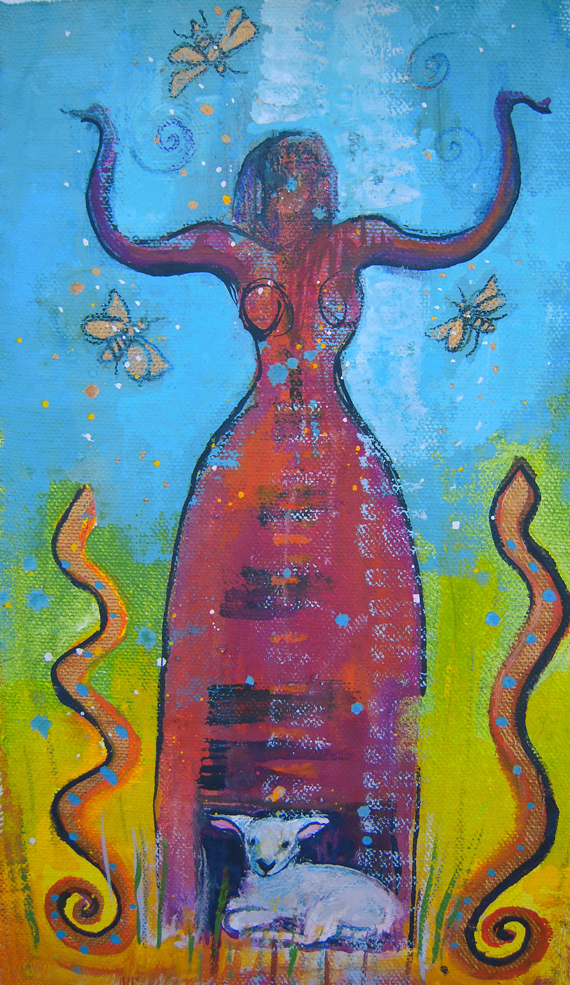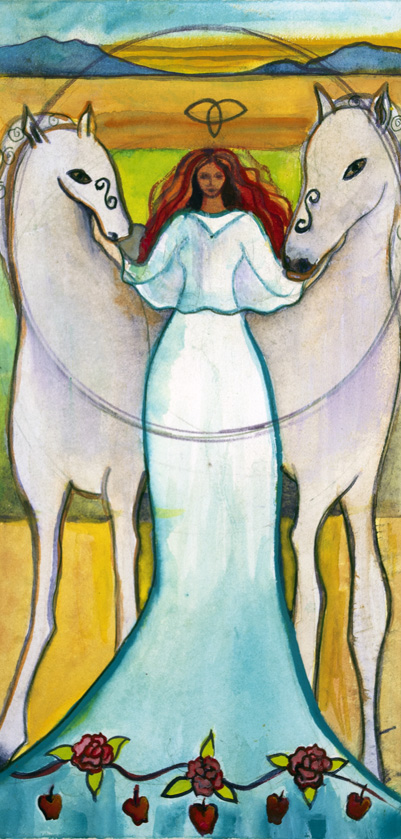
Fand – Goddess of the Sea – a Shapeshifter for Samhain by Judith Shaw

judith shaw photoFand is a Celtic Sea Goddess whom some scholars believe originated as a Manx sea deity (the original inhabitants of the Isle of Man).   With time She became the most loved of Ireland’s fairy queens, called “Queen of the Fairies.  Fand, meaning “Pearl of Beauty” or “Tear” was stunningly beautiful.  Though she was married to the Celtic Irish Sea God, Manannan Mac Lir, She, like other faery queens, fell in love with and then enchanted a mortal man, linking our world with Her Otherworld.  Being the Goddess/Faery Queen she was, Fand fell in love not with any common man but with Cuchulainn, the greatest Irish hero.

Continue reading “Fand – Goddess of the Sea – a Shapeshifter for Samhain by Judith Shaw”

Aine, Summer Goddess of Love, Light and Fertility by Judith Shaw

judith Shaw photoAine, (pronounced AW-neh), was originally worshipped as a Sun Goddess. Like so many goddesses and gods, Aine has assumed many other roles over the years, being seen as a Moon Goddess, a Goddess of Love, a Fertility Goddess, a Healing Goddess, and a Sovereignty Goddess. Aine is also known as a Faery Queen. She is often called Aine, Goddess of Love, Light, and Fertility.  Her name means “brightness, glow, joy, radiance; splendor, glory, fame” and she is associated with the abundance of summer.

Continue reading “Aine, Summer Goddess of Love, Light and Fertility by Judith Shaw”

Creiddylad, Welsh Goddess of Flowers and Love by Judith Shaw

judith Shaw photo

May Day/Beltane (Calan Mai to the ancient Celts) is almost here and our hearts turn to thoughts of love, flowers and the bounty of our Mother Earth. Both Beltane and Halloween/Samhain (Calan Gaeaf) were liminal or threshold days, considered to be outside of normal time. These sacred, mystic days were more important than the solstices in the Celtic world view.
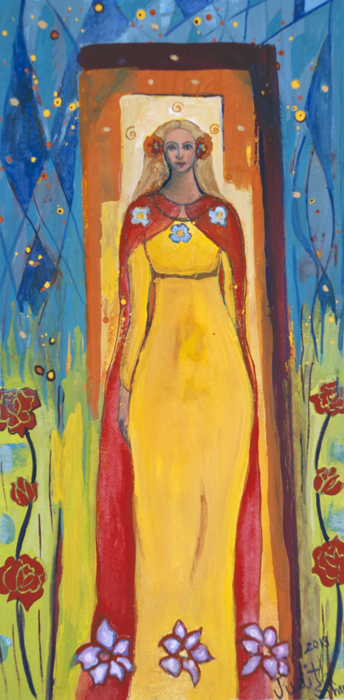
Creiddylad painting by Judith Shaw

Creiddylad, Welsh Goddess of Flowers and Love, is celebrated at this time. (Her name is pronounced cree-THIL-ahd)  She is the eternal May Queen, always seeking peace and stability.  She remains eternally constant in the face of all change.  She is the promise of love, golden glowing moon-flowing love, enduring through all hardship and despair.  Creiddylad also shows us the necessity of self-love. Only by truly loving ourselves can we love another.

Creiddylad is mentioned only briefly in The Mabinogion but her symbolism reveals that she is surely an ancient and important Goddess, whose original stories have been lost to the mists of time.

Creiddylad, the daughter of Lludd Silver-hand, was promised in marriage to her heart’s desire, Gwythyr ap Greidawl. But before the marriage could be consummated she was abducted by Gwyn ap Nudd, who possessed many dark aspects akin to the Lord of the Underworld.

Gwythyr gathered together his warriors and set out to rescue his love, Creiddylad, from Gwyn.  A fierce battle ensued, during which Gwyn, who emerged as the victor, committed horrendous acts of brutality and butchery.

Continue reading “Creiddylad, Welsh Goddess of Flowers and Love by Judith Shaw”

Rhiannon, Goddess of Birds and Horses by Judith Shaw

judith shaw photoRhiannon, Goddess of Birds and Horses, is also know as the Queen of  Fairies.  She is a Sovereignty Goddess who the king must wed to legitimate his rule.  A Goddess of Transformation, she uses her powers for love of others or self.  She shines in our hearts as an example of true love and beauty. She appears in both the first and third branches of the Medieval Welsh stories, The Mabinogion, a narrative which grew out of the ancient myths of the Celtic Gods and Goddesses.

Rhiannon is associated with Epona, the Gaulish Horse Goddess.  They are probably both derived from the ancient Celtic Goddess, Rigatona, whose name means “Great Queen”.  Unfortunately, Rigatona’s stories  and meaning are lost to us today.

Things sacred to Rhiannon are the moon, horses, horseshoes, songbirds, gates, the wind, and the number 7.

In the Mabinogion Rhiannon first appears to Pwyll, King of the new tribes of Dyved, as a beautiful  dream vision, riding a glowing white horse. Her hair shining in the sun, her birds twittering in circles around her head, She seems to be clothed by golden light.   Thus begins her journey to attain the man of her desires.  She possesses deep magic and can manifest her dreams and desires both for herself and for the good of all.

Rhiannon painting by Judith Shaw

Continue reading “Rhiannon, Goddess of Birds and Horses by Judith Shaw”

Arianrhod, Celtic Star Goddess

judith Shaw photoArianrhod, Celtic Welsh Star Goddess of Reincarnation, is known as “Silver Wheel”, “Silver Circle”, “High Fruitful Mother”, “Star Goddess”, and Sky Goddess. She is considered by many to be a Moon Goddess.  She is a primal figure of feminine power, a Celestial Mother Goddess who through her role as Goddess of Reincarnation, rules fertility and childbirth.

Arianrhod, the most powerful child of the great Mother Goddess, Don, was very beautiful, with extremely pale skin.  She was a virgin goddess in the ancient meaning of the word virgin – a woman who is complete unto herself; a woman who needs no protection from a man.   She enjoyed herself sexually, with a distinct preference for mermen.

Arianrhod painting Continue reading “Arianrhod, Celtic Star Goddess”

Brigid, Goddess of Healing, Poetry, and Smithcraft by Judith Shaw

judith Shaw photoBrigid, the Celtic Goddess of Healing, Poetry, and Smithcraft, begins her reign on Imbolic, February 2, the midpoint between winter solstice and spring equinox. On this day the ancient Celts held their Fire Festival in honor of Brigid and the growing light. In Scotland, as recently as the mid-twentieth century, houses were cleaned and the hearth fires rekindled on February 2, to welcome in  Brigid.  Remnants of this festival are found in America today on Groundhog Day.

Like the Cailleach, She existed in many places and  was known by many names.  The Irish called her Brighde; she was Bride in Scotland,  Brigantia in Northern Britain, and Brigandu in France.  Some called her Brid, Brig or Brighid.  Later she was transformed by Christianity into Saint Bridget.  Her older name was BREO SAIGHEAD.   Her name has various interpretations, many relating to fire – “Power,” “Renown” “Fiery Arrow of Power ” “Bright Arrow”, “The Bright One”, “The Powerful One”, “The High One” and “The Exalted One”.

Brigid, Celtic Goddess Continue reading “Brigid, Goddess of Healing, Poetry, and Smithcraft by Judith Shaw”

Epona, Celtic Horse Goddess by Judith Shaw

judith shaw photoEpona, Celtic Horse Goddess was worshipped by the Gauls (the Celtic French). Her worship spread to Britain and Rome from Western Europe. Hundreds of statues and shrines dating from between the first and third centuries CE have been found in France alone.

Today we can understand Epona mainly from her images, as few stories of her have survived.  She is often shown either riding a white horse side saddle or standing or sitting between two horses.  Many images show her feeding mares and foals from a cornucopia or a basket of fruit.

Epona, Celtic Horse Goddess Continue reading “Epona, Celtic Horse Goddess by Judith Shaw”