Uprising! by Beth Bartlett

“ . . . the uprising of [our] nature is but the effort to give to [our] whole being the opportunity to expand into all [our] essential nobility.” – Sarah Grimké [i]

It wasn’t the first time I had stood in protest on that street corner.  I’m sure it won’t be the last. But the gathered crowd was by far the largest I’d been a part of there, covering not just the plaza on the western corner of Lake Avenue and Superior Street, but all the other corners as well, and up and down the sidewalks for half a block.  We were a motley crew, from young people perhaps at their first protest to the many well-seasoned grey-haired. Though I met a few indigenous friends there, I was struck by the overwhelming perceived whiteness of the crowd.  I imagine Black and Brown people were more reluctant to join a street protest where they might be targeted. Indeed, on my way home I heard a report that the number of “driving while Black and Brown” traffic stops has increased in recent days.

Standing in the wet snow, chanting, “This is what democracy looks like!” and “What do we want? Democracy! When do we want it? Now!,” the atmosphere was more of a party than of a wake.[ii]  Yet, when the chants began, I found myself near tears, wanting to sob rather than shout.  As some report seeing their lives flash before their eyes when facing imminent death, I saw my protest life flashing before my eyes – all the anti-war marches – from Vietnam to Iraq to the recent Israeli attacks on Gaza, the marches for the ERA, the Take Back the Night marches, the MMIW marches, the Standing Rock and Line 3 protests, the Women’s Marches, the march for science, the vigils after school shootings and nightclub shootings and the murder of George Floyd, the rallies to protect trans rights,  . . . the list goes on and on. And I felt like weeping, for all these efforts to bring peace and justice and equality to this land were being trampled on and were under threat of being destroyed.

Continue reading “Uprising! by Beth Bartlett”

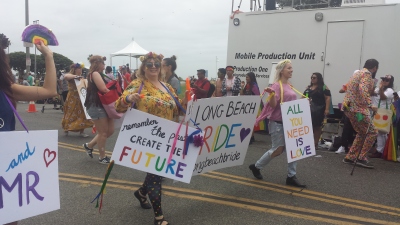
Photo Essay–Long Beach, California by Marie Cartier

Long Beach Pride 2019
50 YEARS OF PRIDE CELEBRATING
THE STONEWALL REBELLION of 1969!
**All photos by: Marie Cartier**
See the photo essay from last year’s Pride week-end here.
And the photo essay from Pride 2017 here.

Continue reading “Photo Essay–Long Beach, California by Marie Cartier”

Long Beach, California – 2018 Pride! by Marie Cartier

Photos by the author unless otherwise indicated

Last year I published a photo essay with pictures of Long Beach, CA’s Pride week-end. You can see last year’s photo essay here. I also published a photo essay of the Los Angeles Resist March from last year here.

It feels more important than ever to re-member/ re-attach ourselves to the normality of resistance, freedom, solidarity, courage and joy. I hope the pictures here help you FAR family to re-member your activist selves and re-invigorate them if they are in need of it. I know mine was before the past week-end. Here are photos from the Long Beach Dyke March on Friday night, and the Long Beach Gay Pride parade on Sunday morning.

Continue reading “Long Beach, California – 2018 Pride! by Marie Cartier”

Spouses for Life by Marie Cartier

Marie & friends at Long Beach, CA celebrations of the Obergefell decision

This essay is perhaps the last in an occasional series I have written since the New Year, which can be read here and here. Gay marriage as of June 26th is now legal in the United States. What has changed—and what has not?

If public opinion drives public policy, then the motivation for banning same-sex marriage was moral disapproval, religious disapproval—and the belief that God was not “on the side” of the homosexuals and had cast homosexuals as sinners in the faith choice of the person formulating the public policy critique. Public discourse —based on religious formulations such as “sinner” and what “God intended” had been the primary agents erected into state law to ban the LGBTIQ population from civil rights—such as marriage.

Religious sentiment, such as “you are a sinner” should not make the case for legal judgment. In fact, it was unconstitutional.

Love the Sinner. Hate the Sin. Continue reading “Spouses for Life by Marie Cartier”

Government “Apologies” for Historical Injustices: Why They Matter

“I rejoice in this most recent admission of institutional racism. I am not naïve enough to believe that this public acknowledgment, like previous ones to other racial-ethnic groups, was untainted by political calculations. But I am also not Kantian (so I reject the view that anything done out of mixed motives accordingly lacks moral merit).”

Continue reading “Government “Apologies” for Historical Injustices: Why They Matter”

“Passing” for White to Get Into Harvard? By Grace Yia-Hei Kao

“[G]rowing numbers of Asian Americans are not taking a ‘wait and see’ approach about whether elite colleges are discriminating against Asian Americans on account of their race, but have been acting under the assumption that they have been and still are.”

Asian Americans and Harvard University have been in the news and on my mind recently. The bigger story has been about the “Linsanity” surrounding (Harvard grad) New York Knicks player Jeremy Lin who continues to take the NBA by storm.

The smaller story, though one that also made national headlines in early February, is of the recent decision by the Education Department’s Office for Civil Rights to investigate a complaint that Harvard and Princeton Universities discriminate against Asian Americans in admissions. Continue reading ““Passing” for White to Get Into Harvard? By Grace Yia-Hei Kao”

Do We Need More “Ministerial Exceptions”? by Kile B. Jones

In a recent unanimous and precedent-setting Supreme Court ruling, a “ministerial exception” was given to Hosanna-Tabor Evangelical Lutheran Church and School regarding employment discrimination.  Cheryl Perich, a “called teacher” at Hosanna-Tabor, was fired after issues surrounding her narcolepsy developed.  As is well known in the United States, innumerable federal, state, and local laws exist to protect employees from discrimination based on race, sex, age, disability, and so forth.  Title VII of the Civil Rights Act (1964) prohibits employment discrimination based on race, color, sex, religion, or national origin.  In the Americans with Disabilities Act (ADA, signed in 1990), employers are also held liable for discrimination based on an employees’ disability.  The “ministerial exception” excludes religious institutions and ministers from the ADA.  It is important to note that the ADA protects employees hired by private companies as well as public ones.

In the slip opinion, the Supreme Court argues that, “The Establishment and Free Exercise Clauses of the First Amendment bar suits brought on behalf of ministers against their churches, claiming termination in violation of employment discrimination laws.”  The opinion sites other cases where it was ruled that religious institutions are their own arbiters of employment and termination and cannot be compelled by the State to comply with certain national laws (see Watson v. Jones, Kedroff v. Saint Nicholas Cathedral of Russian Orthodox Church in North America, and Serbian Eastern Orthodox Diocese for United States and Canada v. Milivojevich).  Justice Alito concurs by saying, “The “ministerial” exception gives concrete protection to the free “expression and dissemination of any religious doctrine.”  The Constitution leaves it to the collective conscience of each religious group to determine for itself who is qualified to serve as a teacher or messenger of its faith.” Continue reading “Do We Need More “Ministerial Exceptions”? by Kile B. Jones”

Telling the Truth By Ellen Blue

Ellen Blue, Ph.D., is the author of St. Mark’s and the Social Gospel: Methodist Women and Civil Rights in New Orleans, a story of white Southern women who worked for racial understanding in the early 20th century.  She teaches at Phillips Theological Seminary. 

In And the Gates Opened, a film about the first US women rabbis, one commented that women’s presence in the rabbinate has allowed questions to be raised that went unspoken before. One example was how miscarriage should be ritually observed. A colleague told her he had been in the rabbinate for many years, and no one had ever asked him that question.  She responded that although she had been a rabbi only a few years, she had already been asked several times. The presence of women makes space for the speaking of certain “unspeakable” things and questioning what God might have to do with them, precisely because it is women to whom such things happen.

Women willing to speak openly in other public forums also matter. When Betty Ford died, many voiced gratitude for her helping to dismantle the cultural norm that “nice” women didn’t talk about breast cancer or addiction.     Continue reading “Telling the Truth By Ellen Blue”