Dancing for Forgiveness and Reconciliation – Part Two By Laura Shannon

In Part One of this article, I described dancing Jewish, Romani, and Armenian dances for forgiveness and reconciliation with groups in Germany and all over the world. I also offered danced rituals of remembrance at former concentration camps and other places scarred by the atrocities of war.
I went to camps including Dachau and Auschwitz, to genocide memorials and sites of massacre throughout Eastern Europe, in Australia, and the Americas. At first, my prayers were private: I brought flowers, lit candles, danced my grief, and spent time in meditation. I tried to visualise the prisoners in those places, sending them my deep sorrow and regret back through time. I wanted to let them know that they are remembered and mourned by people from their future. My prayers contained a fervent apology as well as a soul commitment to do my part in this lifetime to overcome prejudice and stand for peace.
In time I invited others to dance with me for healing and peace. We danced at former camps in Germany, including Bad Gandersheim, a subcamp of Buchenwald, and on many occasions in Steyerberg, a former prison camp and forced-labour munitions factory which is now the site of an intentional community called Lebensgarten (‘Garden of Life’), a centre for permaculture, non-violent communication, and other ecologically and spiritually oriented ways of living.

Continue reading “Dancing for Forgiveness and Reconciliation – Part Two By Laura Shannon”

The Feast of Santo Tomas by Sara Wright

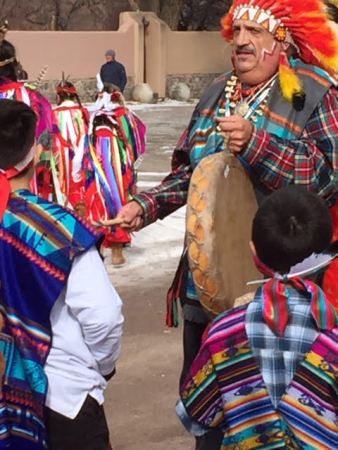
This morning I went up to the village plaza in Abiquiu to watch the dancers parade around the church with their saint who is also honored at this village festival held every year at the end of November.

This is one of the two Native American festivals that is honored each year by the genizaros who are mixed Spanish and American Indian people who embrace and practice the Catholicism that was once forced upon them.

This eclectic community is made up of descendants of Native American slaves. Those captured in warfare were brought here, converted to Catholicism, taught Spanish and held in servitude by New Mexican families. The young women and female children endured the usual atrocities perpetuated on captive females including rape at the hands of their captors. Some New Mexican male genizaros gained their freedom by serving as soldiers to defend frontier villages like Abiquiu from Indian raids. By the late 1700s, genizaros comprised one-third of the population of New Mexico. Ultimately these non – tribal peoples were assimilated into New Mexican culture.

The dances are beautiful to witness with the smallest female children dressed in predominantly white regalia some wearing a rainbow of ribbons, the young girls were dressed in red and white and had red circles of war paint inscribed on their cheeks, some of the older women also wore red, many carried turkey or eagle feathers in their hands. Most wore face paint.

Continue reading “The Feast of Santo Tomas by Sara Wright”

Generosity and Community: the Alternative Worldview of Women’s Ritual Dances, Part 2 by Laura Shannon

Dr. France LeJeune Milchberg taking her turn to lead the dance line, Lesvos 2007. Photo: Sheryl Ackerman

Starhawk describes the work of her Reclaiming collective as the creation of ‘spaces of refuge from a harsh and often hostile world, safe places where people can heal and regenerate, renew our energies and learn new skills.’[i] These words also apply to the women’s traditional dances. One participant on my courses expresses it thus: ‘In the circle no-one is left out, no-one is ignored, all are held and included, all have their place, all are connected.’[ii]

Crucially, women’s ritual dances empower everyone to develop leadership skills. Every woman must know how to lead the line at the appropriate time, and she must also know how to pass on the responsibility afterwards. Continue reading “Generosity and Community: the Alternative Worldview of Women’s Ritual Dances, Part 2 by Laura Shannon”

Generosity and Community: the Alternative Worldview of Women’s Ritual Dance, Part 1 by Laura Shannon

My life’s work with traditional women’s circle dances of Eastern Europe and the Near East has been a natural interweaving of feminism, activism and Goddess spirituality. In more than thirty years of experience, my students and I have gained valuable insight into their potential as tools for healing and transformation.

These simple and ancient dances connect us with women’s ritual practices from the past which are rooted in a Goddess-reverent paradigm honouring the earth, the body and the female face of the divine. In the present day, the practice of mindfully dancing traditional circle dances which embody this worldview can help us imagine and create a more equitable society in the future.

Continue reading “Generosity and Community: the Alternative Worldview of Women’s Ritual Dance, Part 1 by Laura Shannon”

Women’s Ritual Dances and the Nine Touchstones of Goddess Spirituality – Part Four by Laura Shannon

In Rebirth of the Goddess, Carol P Christ offered Nine Touchstones of Goddess Spirituality as an alternative to the Ten Commandments. The Nine Touchstones are intended to inform all our relationships, whether personal, communal, social, or political.[1] In this four-part blog (here are parts 1-3 Part 1, Part 2, Part 3) I am exploring ways in which these Nine Touchstones are inherently embodied in traditional women’s ritual dances of the Balkans, which has been my spiritual practice for over thirty years.

Carol’s Fourth Touchstone is: ‘Speak the truth about conflict, pain, and suffering.’ Many women’s dance songs which allow the women to speak and sing their grief and pain. When we bring that pain into the healing container of the circle, sharing simple steps, Dancers in the circle simultaneously give and receive support for their own and others’ sorrow. Ultimately, the sense of community  and solidarity in the circle transforms our grief so that the burden becomes manageable. Many historical songs, too, tell stories of women being abducted or abused, and how they fought back or got away – or not – so that they are remembered and honoured by future generations.

Continue reading “Women’s Ritual Dances and the Nine Touchstones of Goddess Spirituality – Part Four by Laura Shannon”

Women’s Ritual Dances and the Nine Touchstones of Goddess Spirituality-Part Three by Laura Shannon

Women’s apron from Pentalofos, Greek Thrace

In Rebirth of the Goddess, Carol P Christ offered Nine Touchstones of Goddess Spirituality as an alternative to the Ten Commandments. The Nine Touchstones are intended to inform all our relationships, whether personal, communal, social, or political.[1] In this series of blogs I am exploring ways in which these Nine Touchstones are embodied in the traditional women’s ritual dances of the Balkans, which I have studied as a spiritual practice for more than thirty years.

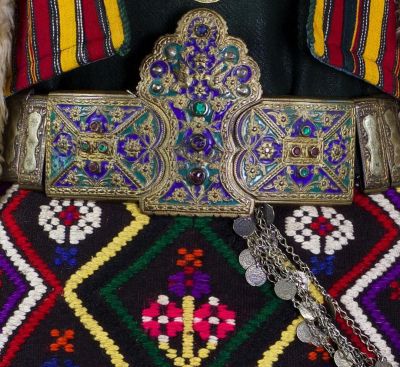
Carol P Christ’s Second Touchstone is: ‘Walk in love and beauty.’ As she says, ‘love and beauty are the great gifts of bounteous earth’.[2] Dancing women of the Balkans walk in love and beauty each time they put on their festive dress to dance together in the courtyard or the village square. Their ceremonial costumes are created from the bounty of the earth – just a couple of generations ago, this was literally the case, as the women tended the sheep, prepared and spun the wool, wove, sewed, embroidered and ornamented their garments with the work of their own hands. Even now, the cloth they buy is purchased with money they have earned from working and harvesting the land.

Continue reading “Women’s Ritual Dances and the Nine Touchstones of Goddess Spirituality-Part Three by Laura Shannon”

Women’s Ritual Dances and the Nine Touchstones of Goddess Spirituality-Part Two by Laura Shannon

In the first part of this article, I looked at how Carol P Christ’s Nine Touchstones of Goddess Spirituality from Rebirth of the Goddess are related to traditional women’s ritual dances of the Balkans. After more than thirty years of researching and teaching these dances and the way that they pass on information in encoded symbolic ways, I have come to see them as an educational system, a women’s mystery school.[1] The main message which the dances convey is an ethic of community, partnership, mutual support, and other life-enhancing values aligned with the Nine Touchstones, which can be directly experienced in the dance.

We know from the research of Marija Gimbutas that these values were central to the Old European civilizations which honoured the Goddess, while Yosef Garfinkel and Elizabeth Wayland Barber show that circle dances have their roots in these same early Neolithic cultures of Eastern Europe and the Near East. This leads me to suggest that Balkan women’s circle dances surviving today may have their origin in early egalitarian matriarchal cultures of Neolithic Europe. The Nine Touchstones of Goddess Spirituality provide an perfect template through which to explore the ethics of women’s ritual dances.

Continue reading “Women’s Ritual Dances and the Nine Touchstones of Goddess Spirituality-Part Two by Laura Shannon”

Women’s Ritual Dances and the Nine Touchstones of Goddess Spirituality-Part One by by Laura Shannon

In Rebirth of the Goddess, feminist theologian Carol P Christ offered a list of ‘Nine Touchstones of Goddess Spirituality’.[1] She revisited the Nine Touchstones in an interview with Karen Tate on Voices of the Sacred Feminine titled ‘Gratitude and Sharing: Principles of Goddess Spirituality‘, and in an inspiring series of blogs on this site recently exploring each touchstone in depth.

In her incisive analysis of the ethics of Goddess religion, Christ argues that Goddess spirituality can offer the ‘ethical guidance that we need to combat the forces of evil in our world’, and that this ethic is not imposed from a set of rational principles nor from a transcendent God known through the prophetic traditions of the Bible, as suggested by Rosemary Radford Ruether.[2] Rather, the ethics of Goddess spirituality are discerned through intuition and reflection on the world of which human beings are a part.[3]

Continue reading “Women’s Ritual Dances and the Nine Touchstones of Goddess Spirituality-Part One by by Laura Shannon”

A Question about “Egalitarian Matriarchy” in West Sumatra by Carol P. Christ

Following up on my recent blogs on the roles of women in the Neolithic revolution and on “egalitarian matriarchy,” I have been re-reading Peggy Reeves Sanday’s ground-breaking book, Women at the Center, about the survival of the “adat matriarchaat” (the principles of matriarchy) among the more than four million Minangkabau people of Indonesia.

According to Sanday, the customs of the matriarchaat (the Dutch word has been adopted by the Minangkabau people)—including matrilineal descent, matrilocal marriage, and ownership of the land by the mother clan—have survived accommodation with Islam. This is in no small part due to the fact that one of the principle values of the matriachaat is to conjugate (to come together) rather than to dominate. Rather than viewing Islam as an opposing force, the Minangkabau emphasize the aspects of Islam–such as love and compassion for the weak–that are compatible with their traditional worldview. Through this clever maneuver, the Minangkabau manage to practice Islam while maintaining their traditional egalitarian matriarchy. Continue reading “A Question about “Egalitarian Matriarchy” in West Sumatra by Carol P. Christ”

With Our Tears, Let Compassion Flow: Remembering the Armenian Genocide by Laura Shannon

Today, April 24, is the worldwide day of remembrance for the Armenian genocide of 1915. On this day three years ago, marking the centenary of the genocide, I wrote about dance as an expression of solidarity with the Armenians people, and with all victims of genocide throughout history and throughout the world. You can find that piece here.
Now as then, I am encouraging my students to dance Armenian dances with their groups this week, or even simply to light a candle, listen to Armenian music (some recommendations are listed at the end of this post), with an open heart. How better to heal the wounds of history than with such tiny and intimate acts of compassion?
The root of the word ‘compassion’ essentially means ‘to suffer with’, and I think that one of the gifts of our own suffering might be that we can begin to have sympathy for those who have suffered like us.
Through compassion, our own heartbreak helps our hearts to be broken open. Although suffering can cause us to feel terribly isolated and utterly alone, at the same time, our pain opens our hearts in sympathy for the pain that others feel. To paraphrase Tibetan Buddhist teacher Chogyam Trungpa, this enables us to ‘reach out to help others… to discover a greater universe and a fuller and fuller broken heart. This is not something to feel bad about; it is a cause for rejoicing.’

Continue reading “With Our Tears, Let Compassion Flow: Remembering the Armenian Genocide by Laura Shannon”