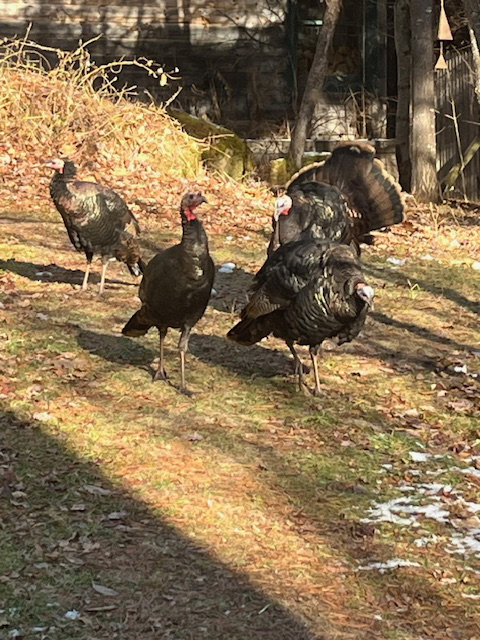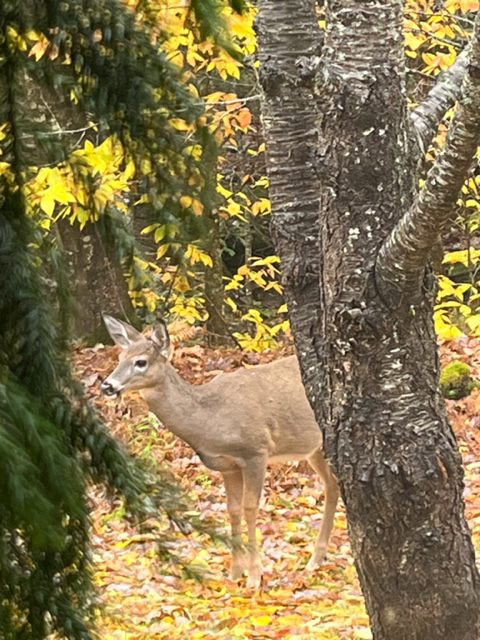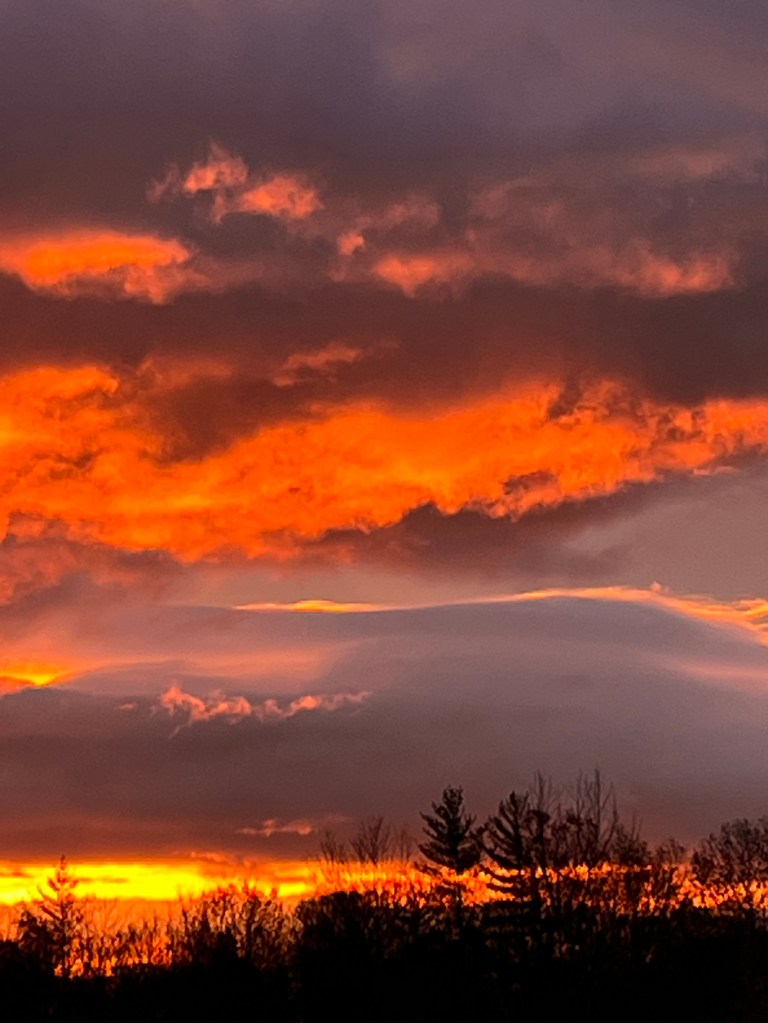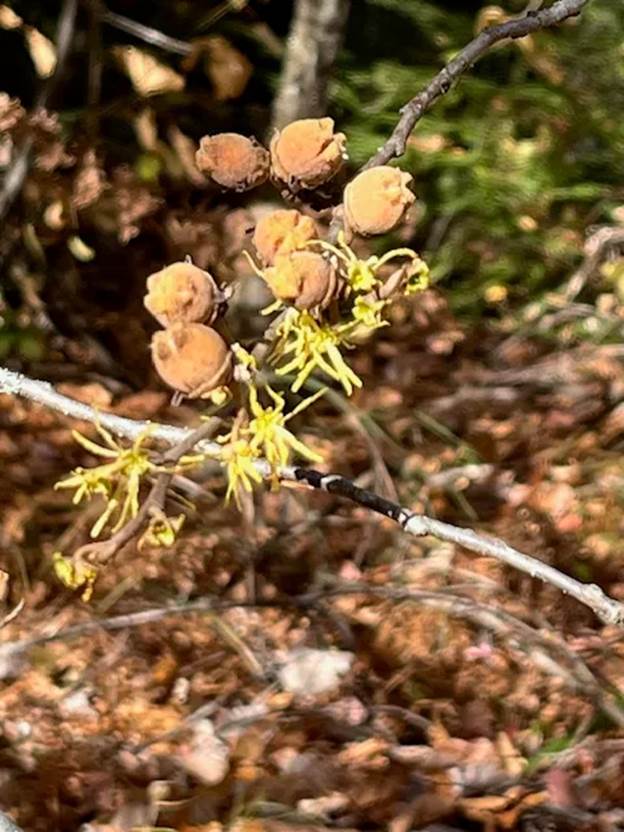
There is something very special about ‘the cutting away and gathering in’ … my very wild gardens are flattened, my wildflower field has just been mowed, trees are turning, and I am possessed by joy.
Near and Far Mountains
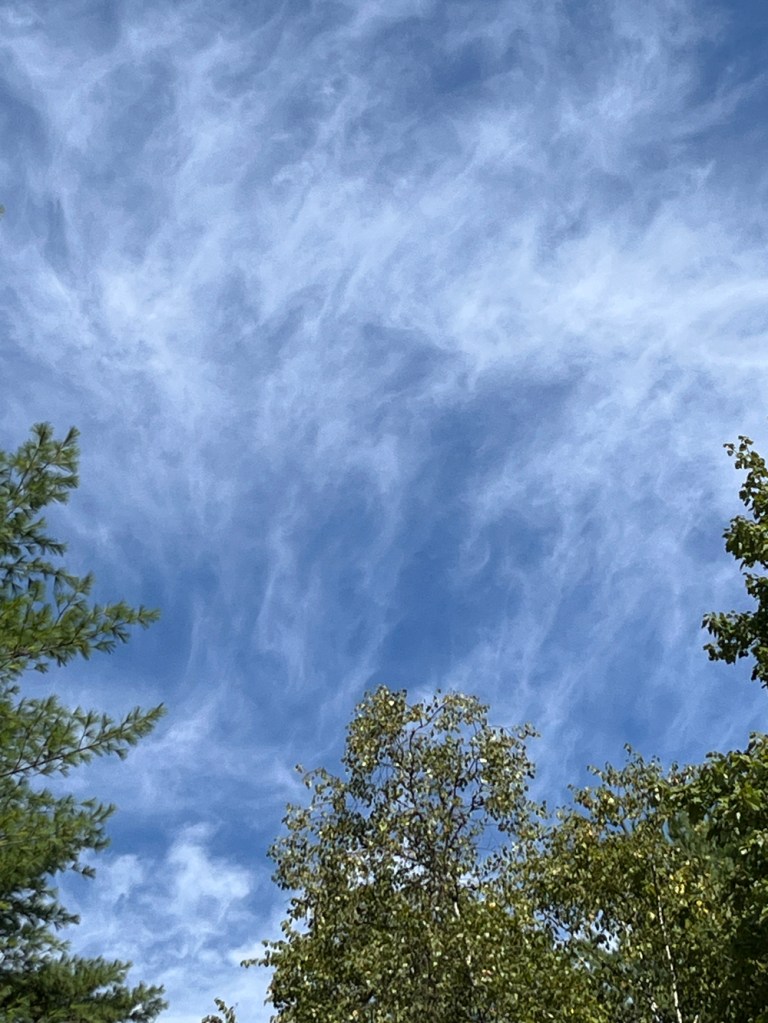
It’s at this time of year that the sky opens into a field of dreams. I walk down through the pines to watch the stars appear at dusk – the open field widens my vision. The Great Bear circumnavigates the sky and as other constellations crystalize, I can imagine that it’s possible to re- imagine, to re- weave the threads around the cross-cultural web that is broken. Ordinary perception fails.
I am also reminded that everything changes, and that the seasonal round is the foundation of life.
In this same field during daylight hours birds feast on thousands of scattered seeds that have been baked in summer heat.
When my ‘good neighbor’ sent me the photo yesterday morning I could see the outlines of the butterfly, so my little dog Coal and I walked up to see for ourselves. It was hot – very hot though only around 9:30 AM. The capsule was already twisted and turning though not even the lightest breeze was in evidence. The outlines of the monarch were clearly etched through the now blackened but still translucent chrysalis.
Standing under the porch overhang that the caterpillar had chosen for transforming, a miracle was in progress. Before our eyes the capsule split as the butterfly emerged head-first, feelers extended and waving from the bottom of a rapidly shrinking chrysalis that had so recently been lime green tipped in gold. The wings were still quite small, but the butterfly was already pumping fluid into them readying for first flight. As the wings expanded before our eyes I cried out like a child exclaiming in my joy and excitement – “oh a miracle, a miracle”, and of course it was, the birthing of new life.
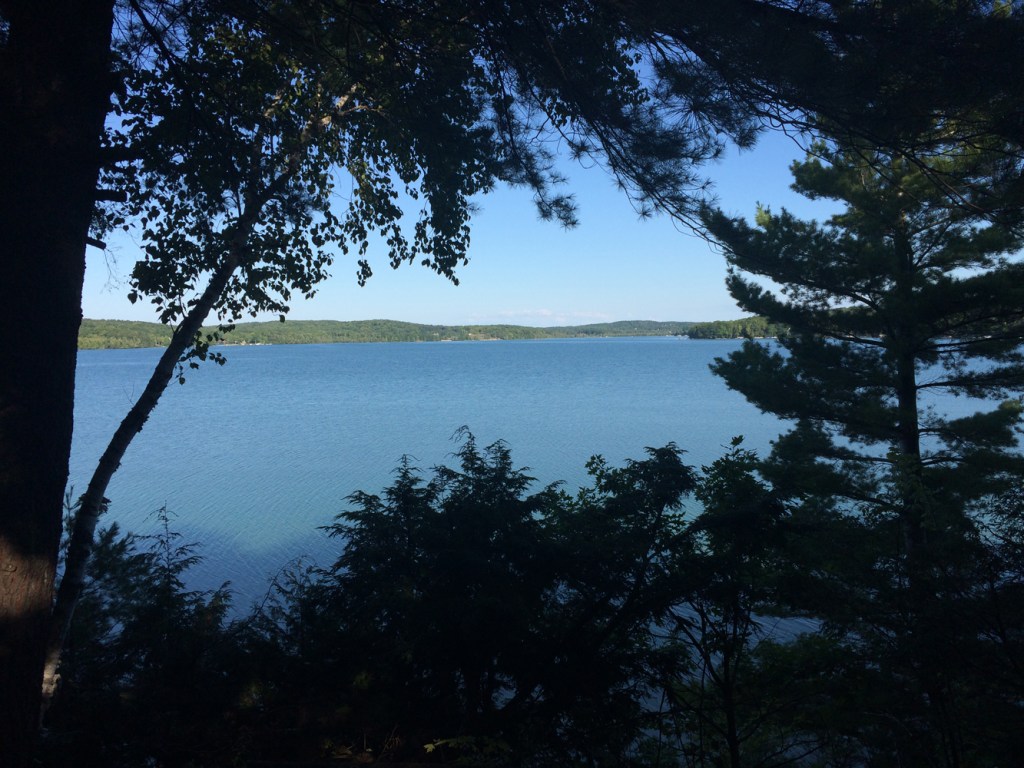
I went to the lake this morning, seeking the peace, sustenance, and perspective it so often provides. I had been particularly distressed and distraught the day before after watching the documentary on Christian Nationalism, “Bad Faith.” It was chilling to say the least. Among other things, the film demonstrates the longevity of Christian Nationalism in this country, dating back at least to the Ku Klux Klan, founded in 1865. However, the central theme of the documentary is the staggering influence of conservative political operative Paul Weyrich, who orchestrated the merger of conservative Evangelical Christians with the Republican Party in the 1980s. He founded the Moral Majority with Jerry Falwell, the Heritage Foundation which authored Project 2025, the American Legislative Exchange Council, and the Council for National Policy – all of which seek to undermine democracy in order to bring about what these organizations and their followers call a “Christian nation,” by force if necessary. But as former Republican strategist Steve Schmidt states in the film, there is nothing “Christian” about this movement. It is pure nationalism, a striving for power requiring the dismantling of the institutions of democratic government as we know them. These extremist Republican strategists found a powerful base of voters by tapping into Evangelical Christians and manipulating the messages they received to fill them with fear, and found just the puppet they needed in the charismatic and amoral figure of Donald Trump. As we’ve seen in recent years, they have been quite successful in the destruction of government. After filling the Supreme Court with their chosen nominees during Trump’s first term, getting Christian Nationalist Mike Johnson installed as Speaker of the House, and getting Trump elected a second time despite the January 6th insurrection, or perhaps because of it, they are now successfully dismantling or otherwise destroying the Departments of Education, Health and Human Services, Energy, Defense, Agriculture, Justice and more along with the Environmental Protection Agency, the Food and Drug Administration, the Social Security Administration, the Federal Regulatory Agency. . . the list goes on. It’s all part of the plan to fulfill the “Seven Mountain Mandate” of dominionism[i], which seeks to impose its beliefs in seven spheres of influence: religion, family, education, government, media, arts and entertainment, and business. As one of the Christian Nationalists interviewed in the film proudly said, “It’s the Christian Taliban.”
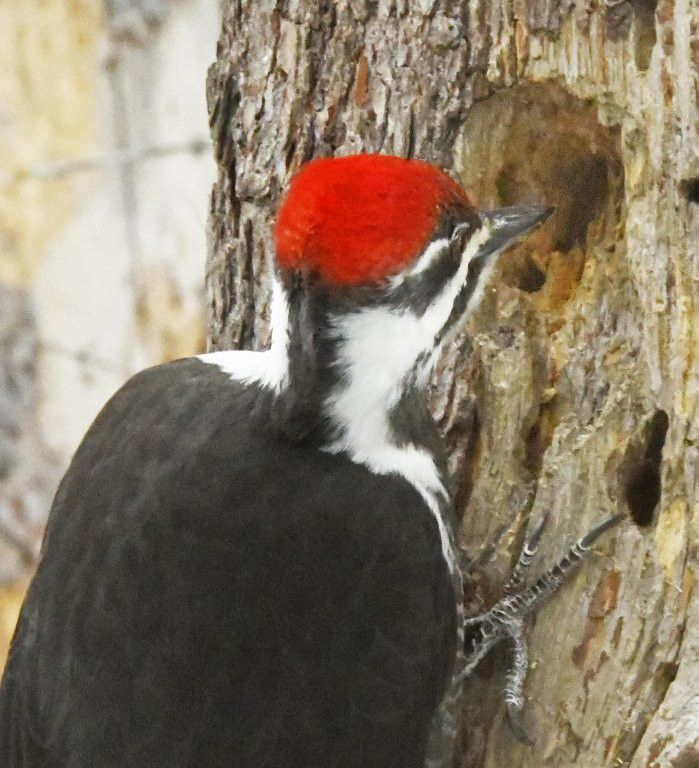
Hermit thrush’s trill and the bittern’s kerplunk are only two of the birds that mark this dawning with squawks or song. Red eyed vireo sings from the highest pine. My little Lucy (Lucia means Light in Italian, one of my mother tongues) and I bring in the day listening to bird symphonies as the sun star rises over the trees splashing verdant leaf tips in gold. First the ferns and then sparks of light sweep through the forest lighting patches of brook waters, lemony splotches appear here and there on deep humus, the rich soil that is conversing with the roots below the forest floor. Listen and you will hear that hum.
The phoebe family is fledging, and I feel privileged to be part of their story. Especially because they lost their first nest to a giant squirrel. Flicking their tails just like their parents the fledglings land on the little cherry growing just beyond my window before diving towards ground covers for tasty insect morsels.
Initially I wrote this article for publication at a plant site but was forcibly struck by the reality that what we are doing to plants is exactly the same thing we are doing to humans, women in particular. Separating, Othering, Judging, Dismissing, Eradicating. I could go on here. When you read this article about invasives think about how we are being treated as women. It alarms me that no matter I turn I see the same story played out with humans (women and children suffer most overall), trees, plants, and the animals we are so busy annihilating if not physically then in some other monstrous way. Fill in the blank with your own story. Then imagine yourself as a bird with wings who carries the seeds of new life into unexpected places.
When I first moved to this area many years ago, I used to spend most of the time in the forests that surrounded my house except in the spring. Then I walked along what used to be a country road to see the wild trilliums, arbutus, lady slippers, bunch berry, violets and columbine that peppered the road edges.
All the trees and flowers were so plentiful and so beautiful that it took me a few years to pay closer attention to the bushes like the various pussy willows and wild cherries, beaked hazelnut, witch hazel and hobblebush that I also came to love.
“A child’s world is fresh and new and beautiful, full of wonder . . . . If I had influence with the good fairy who is supposed to preside over the christening of all children I should ask that her gift to each child in the world be a sense of wonder so indestructible that it would last throughout life . . . .”[i] – Rachel Carson
When I flipped my wall calendar on May 1st, the accompanying photo was of a waterfall. My two-year-old grandson noticed it immediately, and said “waterfall!” I asked him if wanted to go see waterfalls, and ever since then we’ve been hiking local trails along rivers and streams in search of waterfalls. Fortunately, we live in a city and surrounding area with a wealth of waterfalls, many within a few minutes of our home. Each one is unique and changes with the volume of water as it varies from day to day.
I was lucky enough to be raised by parents with a love of waterfalls, so they were a staple of my childhood. We lived near waterfalls on the Cuyahoga River, where we would sometimes go for picnics and hikes, and our family vacations when I was young were often to visit waterfalls – Bridal Veil Falls in Yosemite, Tahquamenon Falls in the UP of Michigan, and of course, Niagara Falls.
“That move into mystery is not an abandonment of perception into a cloud of unknowing. It’s a move into a different form of knowing.”
Robert Macfarlane
I stepped outside when the sun was just rising over the horizon and low enough in the sky to create a play of shadow and light. This is my favorite time of the day to witness the astonishing beauty of the earth that is spreading her shimmering cloak around my feet… ‘oh, my grandmother’s hair, the words rose unbidden’. Chartreuse, plum, wine, lime, gold leaf and emerald canopies stretched across the brook blurring the leaves between birch, ash, beech and maples. The silvery water glistened, and I imagined myself flowing around those serpentine moss-covered banks listening to an ancient song that has been sung by water for more than 4 billion years. How I wish I understood what ‘ki’ was saying but I am no longer able to discern the language.
At age sixteen Beresford-Kroeger was graduated from her mentorship of the Lisheens and went on to become a scientist, learning medical biochemistry and botany. Eventually she saw that many of the things she learned from the Lisheens elders could be scientifically proven. This offered her delight and reassurance.
One of the first of these was the plant Chrondrus crispus or seaweed named Irish moss. Her Great-Aunt Nellie taught her that it cured tuberculosis and how to prepare and use the gel-like mucilage it released upon being boiled.
In the lab Beresford-Kroeger later discovered that this mucilage has antibiotic properties.
“The feeling this confirmation of Nellie’s teaching gave me is hard to describe. I loved my teachers in Lisheens, but I hadn’t completely ruled out the idea that the things I’d been taught there were just old superstitions. I needed to confirm them for myself. There was always the chance that there would turn out to be nothing of import in the plants they’d emphasized to me, and nothing more to the ancient knowledge than beautiful clouds of vapor”(96).
She began to understand that what she had been taught was an oral tradition and that it existed in no other format and that she was meant to be a bridge between “the ancient and the scientific”(97).
“My teachers in the valley might have indicated that a particular plant was good for poor circulation, which I’d taken to mean heart trouble. I would then know to keep a particular eye out for the presence of any chemical known to benefit the heart. “Well, Diana,” they might have begun, while cradling a small, five-pointed yellow flower in the crook of two fingers. “St. John’s Wort, as you see here, has a strong medicine for nervousness and mental problems.” I would later find out that St. John’s Wort contains phytochemicals such as hyperforin, which increase the effectiveness of dopamine and serotonin in the brain. The plant is as effective as many prescription anti-depressants, and may in some cases be more effective”(98).