

Part 1 was posted last Tuesday. You can read it here.
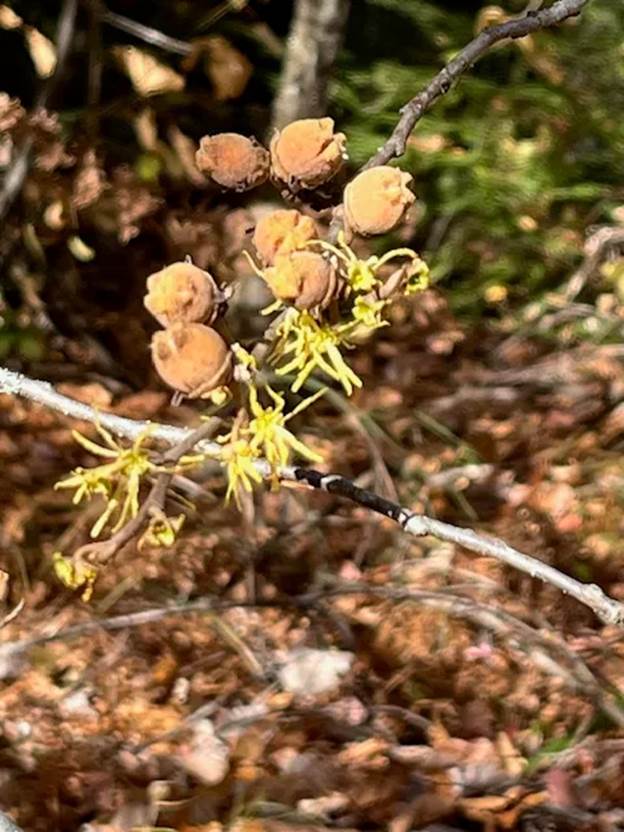
Like all flowering plants, witch hazel must be pollinated to produce fruit and seeds, and for this, it relies on insects. These include late-flying gnats and flies as well as forest-dwelling owlet moths, all drawn to the scented flowers and sweet nectar. On warm days like the few we have had this week while surrounded by an annoying cloud, I hoped these flying gnats were also busy pollinating lemony witch hazel ribbons.
The owlet moth is a nocturnal pollinator. These moths remain active after most other pollinators have died or are missing in action. Biologist and naturalist Bernd Heinrich first documented the relationship between witch hazel and owlet moths in 1987 in an article published in Scientific American.
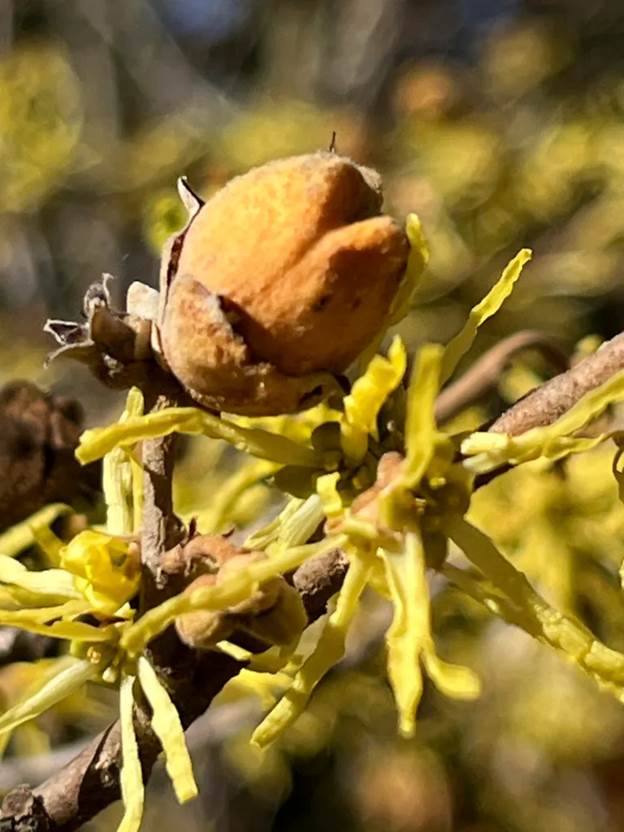
Pollinated witch hazel flowers produce fruit capsules, each containing two seeds. These capsules remain on the shrub for an entire year after pollination hardening in the process. Witch hazel’s genus name – Hamamelis, which translates to “fruit together” – speaks to the coexistence of flowers and seeds. In autumn, once a witch hazel seed capsule is fully developed, it ruptures, launching a pair of seeds into the air, sending them up to 30 – 45 feet from the parent shrub. Each seed is shiny, ebony in color and oval shaped – a perfect miniature missile.
After landing, the seeds settle into the detritus where they will remain for up to two years. Like many seeds, those of witch hazel must go through “stratification” – a series of warm and cold conditions – before germinating. Witch hazel can also reproduce from vegetative sprouts. But cross-pollination and seed production are what allow for diversifying the gene pool, and witch hazel that sprouts from seeds is important for long-term adaptation and survival of the species.
In the Northeast, witch hazel grows in hardwood or mixed hardwood and conifer forest understories.
There is some evidence based on genetic and fossil data that the ‘native’ North American species diverged from the Japanese species around eight million years ago by way of the Bering Land Bridge. Glaciers pushed the range of our ‘native’ species south, but the plants have mostly retained the same genes for hardiness which might be a plus.
The disturbing aspect of the witch hazel story is that successful seed set is highly dependent on pollinators. This plant co -evolved with certain insects which is easy to understand if you examine the flowers which are brightly colored, fragrant, have sticky pollen and sweet nectar. All these attributes create a food source for late autumn visitors. In addition to bees, moths, and various flies, the plants attract beetles, parasitic wasps, gnats, leafhoppers, and flower flies. Many of these insects are diminishing in numbers. As I said before this a cause for concern.
In addition to late flowering, witch hazel shows an unusual pattern of delayed fertilization. The ovules are not fertilized until the following May, roughly 5-7 months after pollination.
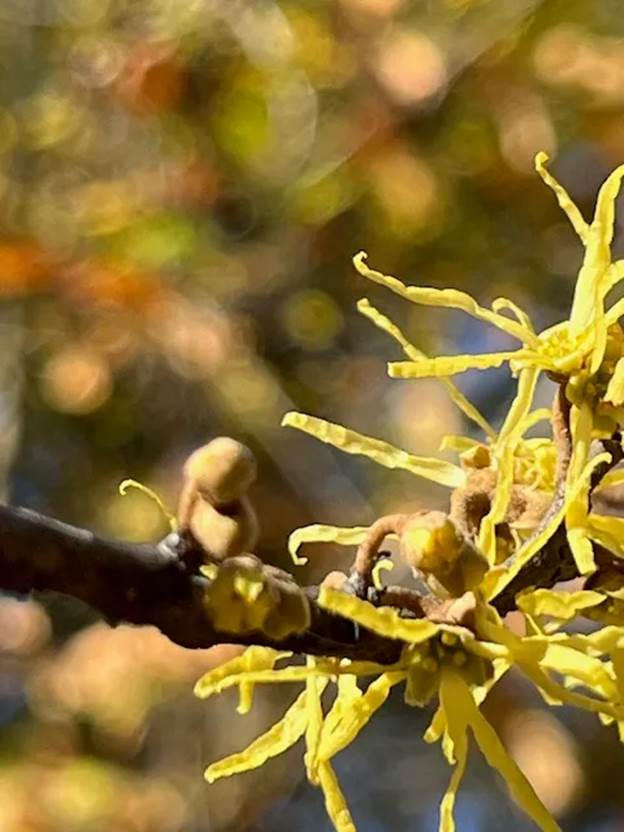
Once the weather warms the ovules mature and fruits are formed. But seed ripening is still a long way off. Odd as it seems, last year’s seed will ripen just as the current year’s flowers open. In Maine this occurs in September or October.
In my favorite forest there is an entire area that is covered by witch hazel trees that remain invisible until the forest edges open revealing what was hidden by deciduous trees that have dropped their leaves. Just yesterday I spent part of an afternoon visiting with these trees with a friend and our two dogs. A month ago, most of these bushes were invisible!
It doesn’t seem to matter how many times I spend time with these trees with their smooth soft gray bark and tangled branches. I am drawn back to them like some kind of magnet every fall.
In many traditions witch hazel is an ancient healing herb and when I was a child my grandmother used witch hazel to treat poison ivy, wounds and bites. I love the scent. Witch hazel can still be found in many stores. Curiously there is some mystery around why this herb works in so effectively though it is a natural astringent, containing tannins flavonoids and other therapeutic compounds. Witch hazel gravitates to wet places, so it is no surprise that Y shaped sprigs are used for dousing.
Discover more from Feminism and Religion
Subscribe to get the latest posts sent to your email.


Thank you for this post, Sara. I love knowing more about witch hazel and your experience of ki. Did you take the gorgeous photographs?
LikeLiked by 1 person
I take all the photographs unless I indicate otherwise – I have one witch hazel that stubbornly blooms on -wow
LikeLike
Wow indeed. So glad!
LikeLike