
Standing Rock: What Does Easter Look Like? by Elizabeth Cunningham

As I write, Bakken crude oil is moving through the Dakota Access Pipeline under the Missouri River at Lake Oahe Reservoir, crossing treaty lands and waters that the Sioux Nation never ceded to the United States Government.

This, after the Standing Rock Sioux Tribe has opposed the Dakota Access Pipeline since it was proposed in 2014, with hundreds of other tribes making formal declarations in support of the tribe’s opposition. This, despite ongoing lawsuits. This, after a prayer camp begun by a small group of indigenous youth in April, 2016 grew to several camps with a total population at one point of close to 20,000. This, after 4,000 United States military veterans came to stand with the water protectors in December, 2016. This, after the United States Army Corps of Engineers under the Obama administration denied the easement to cross the river and legally bound themselves to conducting an environmental impact study that the Trump administration aborted. This, after countless unarmed water protectors faced attack dogs, mace, rubber bullets, water hoses turned on them in sub-freezing weather, and noise cannons.  This, after the arrest of over seven hundred people (some charged with felonies and still awaiting trial) many of whom were strip-searched and held in kennels in an unheated parking garage. This, after hundreds of people camped all winter, surviving blizzards and bitter cold. This, after people remained standing in prayer until they were forcibly removed from the prayer camps on February 22nd, 2017. Continue reading “Standing Rock: What Does Easter Look Like? by Elizabeth Cunningham”
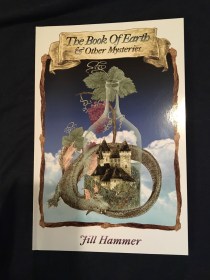
The Book of Earth & Other Mysteries: a book review by Elizabeth Cunningham

book-of-earth-photojpgWhen a poem shows me something in a strange and wonderful light and at the same time awakens some bone-deep knowing of my own, I feel more alive, I feel less alone. My soul is stirred and satisfied. The Book of Earth & Other Mysteries by Rabbi Jill Hammer, author, teacher, midrashist, mystic, poet, essayist, and priestess, is a whole collection of such poems.
Collection is not a vivid enough word. The structure of this book is more like a fairy palace, a sandcastle blazoned with shells, a dragon’s lair, a bold work of art in itself.  The book begins with a five part prose piece called “Intentions,” the first four invoking an element and the last one holding open the door for us to enter the world of the poems.  Here are a couple of sentences excerpted from each. Continue reading “The Book of Earth & Other Mysteries: a book review by Elizabeth Cunningham”

Murder at the Rummage Sale: Book Review by Judith Shaw

Judith Shaw photoMurder at the Rummage Sale (Albany, NY: Imagination Fury Arts, 2016) by Elizabeth Cunningham is a mystery novel with a style and depth of thought that offers not only the fun of figuring out “Who Dun It”  but also gorgeous prose and poetic phrasing which is not so commonly found in the mystery genre.
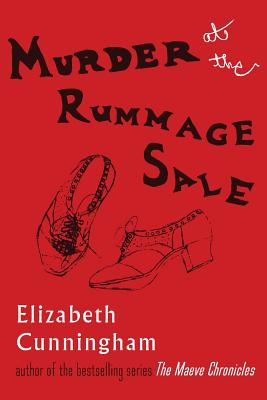
Set in 1960 small town America, the book transports us back to that era with a fine eye to detail. It 9781944190019takes place over a few days in the life of the Church of the Regeneration as the women prepare for their annual rummage sale. Charlotte Crowley, an over bearing kleptomaniac who wraps men around her little finger while antagonizing most of the women, has always led the effort. But with only a few days to go before the sale begins, Charlotte is found dead in the basement, smothered by a plastic dry cleaning bag full of coats.

Though the police declared the death to be accidental, Lucy Way, an older woman with a bit of faery blood and white curls she is very proud of, has her suspicions. Lucy sets out to solve the crime with the help of a cast of characters associated with the church: the Reverend Gerald Bradley, the church minister with a love of drink; Anne Bradley, his wife who doubts the existence of God; Katherine Bradley, their fanciful seven year old daughter; and Katherine’s sworn blood brother, Frankie Lomangino Jr., son of Frankie Lomangino an ex-con who becomes the prime suspect. Continue reading “Murder at the Rummage Sale: Book Review by Judith Shaw”

An Open Letter to President Obama about the Dakota Access Pipeline by Elizabeth Cunningham

Elizabeth_Author Photo 2I wrote this letter to President Obama on November 18, the morning after I returned from a few days at Standing Rock. I am not an activist by temperament. I went to Standing Rock to support a friend who felt strongly called to go, as well as, to support the cause. I did not participate in direct action, because I did not fully grasp till I was there the preparations I would need to make in terms of clearing my calendar for jail time and a return to North Dakota for a trial. Gratitude and respect for those who are taking this risk and dedicating their lives to this cause.
One thing this letter below does not address is how to donate to the Water Protectors at Standing Rock. Given the overwhelming donations of food and clothing that are still pouring in, financial donation is more practical now. Here’s a link to the donation page: http://standwithstandingrock.net/  You can also donate to the legal fund: https://fundrazr.com/campaigns/11B5z8 People are being arrested on a daily basis.  

I am still sorting through the experience of this journey and its connection to what lies ahead for this country. Unlike many people who have suffered privation and injustice for years and centuries, I have lived in a relatively comfortable, privileged bubble in the Northeast, surrounded by natural beauty and by friends, family, and community of like mind. After this presidential election, I don’t think it is possible or conscionable to live such an insular life, though I do intend to savor and celebrate all moments of joy. The President Elect is clearly bent on environmental depredation. We all have a great deal to learn from the Standing Rock Sioux Tribe. Continue reading “An Open Letter to President Obama about the Dakota Access Pipeline by Elizabeth Cunningham”

Nobody’s Disciple by Maeve Rhuad aka the Celtic Magdalen via Elizabeth Cunningham

Elizabeth Cunningham headshot jpegSince beginning her posts for FAR four years ago, Elizabeth has featured an excerpt from my chronicles each July in honor of my feast day on the 22nd.  At least I thought it was my Feast day. It has been brought to our attention that Pope Francis only recently elevated the 22nd to the status of a Feast. Before that, it was merely a Memorial of me as a saint, whether optional or obligatory I am not sure.  The only thing more elevated than a Feast day is a Solemnity.  (Needless to say my mother-in-law, aka the Blessed Virgin Mary, has one of those.)

You may not know me as Maeve, the Celtic Magdalen. Mary Magdalen, who she was (or is) should or could have been is a highly charged subject. Not very much is known about me, really, which is why  legends, novels, and films abound. I’m a storied woman, to borrow Natalie Weaver’s term. There are fourteen references to me in the Gospels. I am associated with the non-canonical Gospel of Mary (I believe the credit for that should go to Mary of Bethany whom many people conflate with me). Pope Gregory is largely responsible for my lugubrious image as a penitent prostitute. Continue reading “Nobody’s Disciple by Maeve Rhuad aka the Celtic Magdalen via Elizabeth Cunningham”

Celebrating National Poetry Month by Elizabeth Cunningham

Elizabeth Cunningham headshot jpegOne of my morning practices is Lectio Divina, divine reading. Instead of reading scriptures, I read poems. The practice calls on me to be alert and contemplative. Recently, I have been reading The Shambhala Anthology of Women’s Spiritual Poetry, an extraordinarily diverse selection of poems from 2300 BCE to the late 20th century. I won’t be quoting from the collection, but I do recommend it to FAR readers as a sample of our literary, religious and feminist legacy.

Writing has always been one of the more accessible forms of expression for women. You don’t need expensive paints or canvas, clay or stone. To complete your work, you don’t need access to a theatre or an orchestra. Just a scrap of paper, a writing implement, a stolen moment, and, yes, the opportunity to be literate, not easily come by in many times and places for women or men. If you are literate, the act of writing itself does not require even Virginia Woolf’s much-to-be-desired room of one’s own. Jane Austen is said to have written at the dining room table surrounded by the chaos of family life. Continue reading “Celebrating National Poetry Month by Elizabeth Cunningham”

And No Religion Too by Elizabeth Cunningham

Elizabeth Cunningham headshot jpegReligion. As a species we can’t seem to live with it or without it. There is dispute about the derivation of the word, but some scholars believe it has the same root as the word ligament, ligare, to bind or tie, to reinforce the bonds between human and divine, or perhaps the bonds between believers. The words bond and bind also have a variety of meanings and connotations. A bond can be used to tie someone up; it can be a bond of kinship, or bond given as surety.

Religion’s impulses and manifestations are just as ambiguous. Did religion arise because the world seemed so beyond human control (weather, health of crops, availability of game)? Perhaps there were gods or spirits to appeal to or propitiate? Or did it arise equally from a sense of gratitude for the earth and seas that feed us, for a sky that dazzles us, for the life that flows through us and surrounds us. Song, dance, storytelling, drama, art likely began as religious or ritual expression. No aspect of life was beyond the sacred. And so religion also went into the business of law, social control. Religion has a long, bloody, ongoing history of occasioning and/or justifying war, oppression, persecution, torture, genocide.

Was religious expression ever purely benign? Were humans? Perhaps when we were still small bands of hunter-gatherers or when we lived in matriarchal, matrilineal cultures where men did not feel obliged to control women (or each other) to ensure the perpetuation of their own DNA. There are benign tenets in most religions still—food as something to share, the stranger as someone to welcome. Birth and death and all the phases of life as a time to gather in community to celebrate or mourn. The call to respond to infirmity, grief and suffering with compassion and to injustice with bravery and truth.

lennonI titled this piece “And no religion, too” after a line from John Lennon’s song “Imagine.” Maybe I am struck by that line, because my life and work have been dominated by religion, literally since birth. My mother’s labor was induced to accommodate my curate father’s schedule. One of my earliest memories, age three, is of plotting to kill God and Jesus. Other childhood memories include being terrified that I would go to prison or hell for trespassing on the property next door. (From the Episcopal version of the Lord’s prayer, I knew trespass meant sin.) I also remember a skirmish with the Roman Catholic kids down the street who used to be my best friends until we went to different schools. A backyard holy war.

As I grew up, I repressed my deicidal tendencies and remained a creed-saying Christian until my mid-twenties when I began to participate in the silent worship of The Religious Society of Friends (Quakers). Later an encounter with the goddess called me to join with others in creating earth-centered ritual at High Valley, a center I directed for eighteen years. During that time, I also became an ordained interfaith minister and counselor. All my life I have been writing novels that ponder religious questions, starting with The Wild Mother, a reimagining of the Garden of Eden story. For twenty years I worked on The Maeve Chronicles, novels from the point of view of a Celtic Magdalen who remains an unconverted pagan. My latest novel, Murder at the Rummage Sale, is set in the church of my childhood. Clearly I am still working with my primary material.

Yet I don’t know that I have a religion any more. I am still friends with my co-celebrants. We meet in a variety of contexts. But for the first time in my life I am not part of a religious community. No doubt I have beliefs, but I have no belief system. As I struggle to write this post, it dawns on me that it is my own life without religion that I am trying to imagine.

Continue reading “And No Religion Too by Elizabeth Cunningham”

Not a Woman of the Cloth- an excerpt from Murder at the Rummage Sale by Elizabeth Cunningham

Elizabeth Cunningham headshot jpegWhen I finished writing The Maeve Chronicles, I returned to a mystery novel, abandoned thirty years earlier. I was finally ready to write about the small town Episcopal Church where I grew up in the 1950s and 60s and to explore the points of view of characters based on my late parents. When I began seeing through my mother’s eyes, the intensity of her suppressed fury took me by storm. Trapped in the role of minister’s wife, Anne Bradley strikes me as an embryonic feminist. In the scene below, Anne is hanging up laundry when she is approached by a pesky parishioner who makes a veiled reference to the death of Anne’s son.

*********

“Hello there, Mrs. Bradley,” Mildred Thomson said, adding some obligatory remarks about the weather. “I was hoping to find Father, I mean *Mr. Bradley in today. Do you know when he might be back?”

Anne did not. In fact, she realized she did not even know where he was. Hospital calls? A diocesan meeting? Surely she would have remembered if he’d gone all the way to New York. He had probably told her, and she had probably not listened. He was not there most of the time, or if he was, he was not available, not to her or the children. He stayed in his study in the parish house where no doubt Mrs. Thomson had hoped to ambush him.

“I’m afraid I don’t, Mrs. Thomson,” said Anne, feeling for her cigarettes in her apron pocket. Hell’s bells. She must have left them in the back hall on the shelf above the washer.

Anne turned back to the clothesline. Three children meant a lot of laundry, though in the summer the load was a little lighter, shorts and short sleeves, not so many filthy elbows and knees. There were always Gerald’s shirts. Short or long-sleeved, they had to be ironed, something she could not even contemplate till the cool of the evening.

“Did you have an appointment with him?” Anne asked, hoping the question did not sound too much like a reproof.

“No, no,” Mrs. Thomson said vaguely. “I just happened by. I suppose I ought to make an appointment. I never did with Father Roberts. He never minded my popping in.”

That was definitely a reproach. Anne felt almost sorry for her husband, almost. But it was part of his job to listen to parishioners maunder on, as much as holding services on Sunday and galvanizing his congregation to do good works in the community.

“Mrs. Bradley, may I ask you a personal question?”

Could she say no, Anne wondered? Or at least, excuse me while I get a cigarette? But Mrs. Thomson took her hesitation for consent.

“Do you ever struggle with your prayer life?”

Anne bit back a bitter laugh. She could hear it in her head, a sound a dog might make, something between a yelp and a snarl.

“I suppose you don’t,” Mrs. Thomson said wistfully.

Continue reading “Not a Woman of the Cloth- an excerpt from Murder at the Rummage Sale by Elizabeth Cunningham”

Mary Magdalen’s Cave by Elizabeth Cunningham

Elizabeth Cunningham headshot jpegMy first post for FAR appeared on July 22, 2012, the feast day of Mary Magdalen. I like to dedicate my July posts to her and include an excerpt from The Maeve Chronicles, the novels I spent 20 years writing, which feature a feisty Celtic Magdalen who is no one’s disciple. This year’s excerpt is from Bright Dark Madonna, the third in the series, which follows her (mis)adventures from Pentecostal Jerusalem, to the wilds of Turkey’s Taurus Mountains, the port city of Ephesus, and finally to her legendary cave in France.

While doing research for the novel, I made a pilgrimage to Le Grotte de Marie Madeleine in Southern France. A forty-five minute climb, past a spring leads to a high cliff wall where a spacious cave has been made into a chapel to the saint. There were no other people at the site except my husband and daughter who kindly gave me time alone in the cave—alone with her. As I wrote in FAR’s pages a while back, I have a longing for hermitage that I haven’t allowed myself to fully inhabit. Maeve, on the other hand, goes all out, or rather, in.   Here is what she has to say: Continue reading “Mary Magdalen’s Cave by Elizabeth Cunningham”

The Elements Are Us by Elizabeth Cunningham

Elizabeth Cunningham headshot jpeg

My late uncle, an atheist since age twelve when well-meaning Christians told him his youngest sister was “in a better place,” is now ashes in three red cloth bags. He was the last of my mother’s siblings to die, at the age of ninety-eight, the first being their little sister who died at age four. His children and grandchildren are taking his ashes to be scattered at sea where they will mingle with the bones the pirate Blackbeard, who met a violent end in these same waters almost three centuries earlier. Though most of this memorial weekend is a series of social occasions, and the guests on the boat continue chatting, I am moved by the sight of my cousins taking up spoons and scattering their father and grandfather’s ashes on the wind.

He is returning to the elements that sustained his life: fire, earth, air, water.  When we breathe, drink or eat, sweat or shed a tear, in every moment of our lives, we connect through the elements to all the life that has gone before us and all the life that is to come.  No belief system is necessary to know this truth in our bones.  May we learn to care for the elements—rivers and oceans, air, soil, fuel for light and heat—as we would care for our own bodies. When the elements are degraded, we are degraded; when they are vital, we are vital. The elements are our ancestors, our children. The elements are us. Continue reading “The Elements Are Us by Elizabeth Cunningham”