Of Cruelty and Compassion: Jane Goodall: Messenger of Hope by Beth Bartlett

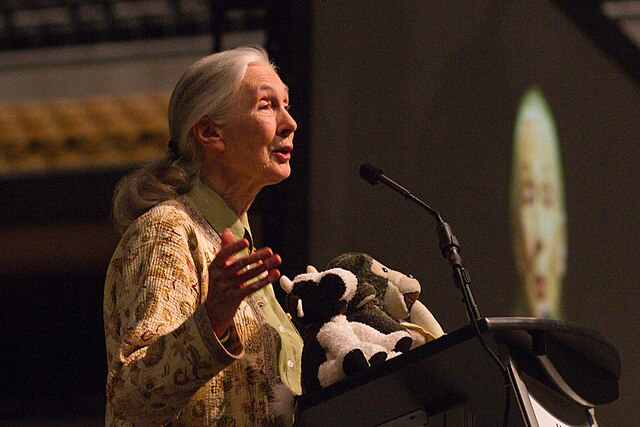
Mark Schierbecker, Wikimedia Commons

During the last week of September I had the opportunity to spend a few days in solitude in a place that is my soul’s home.  I spent part of my time reflecting on questions posed by ecotheologian Mary DeJong to mark the autumnal equinox.  The first question was “What is a desire you carry into the autumn season? What are you seeking?”  After much contemplation, the words that came were, “I wish for a change in government – to be rid of Trump and company – for freedom, equality, respect, for the dignity of all, for an end to the suffering in Gaza and the reign of terror of ICE in this country – the horrors of those being abducted and imprisoned – for an end to cruelty. Yes, for an end to cruelty everywhere.  Why is this country so cruel? I do not understand cruelty. Where does it come from? Why would anyone want to be cruel? How could anyone even stomach the suffering of another?  How does that happen? Yes, I desire an end to cruelty.”

A few days after writing those words, on October 1st, scientist, environmentalist, and humanitarian Jane Goodall passed away in her sleep, prompting me to re-read her book, Reason for Hope. There I found her words echoing my own, “To me, cruelty is the worst of human sins. . . “[i] And while she had not set out to study human cruelty, how we become cruel and how we might move beyond our worst impulses, her work with chimpanzees eventually would lead her to this.

Continue reading “Of Cruelty and Compassion: Jane Goodall: Messenger of Hope by Beth Bartlett”
Legacy of Carol P. Christ: In The News – Global Climate Change

This post was originally posted on Nov. 7th, 2012

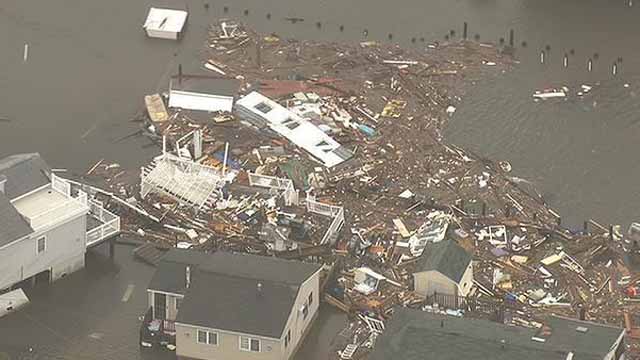
Climate change is in the news again due to the devasting storm known as Hurricane Sandy.  Scientists, activists, journalists, and politicians are telling us that Sandy is not just another “unpredictable event” brought to us by “Mother Nature.”  Will we listen this time?

Hurricane Sandy is a human-made and entirely predictable and sure to be repeated environmental consequence of the use of fossil fuels, especially oil and coal. Burning fossil fuels puts carbon dioxide into the atmosphere. This raises the global temperature in the air, land, and sea. Melting of polar ice caps is a result of the rise in global temperatures. This will cause a 3 foot or more rise in the seas, leading to the permanent flooding of the seacoasts and sea coast constructions, including homes, restaurants and shops, office buildings, and harbors and ports.

The warming of the seas is also producing extreme weather conditions, including high winds and hurricanes, along with colder winters and hotter summers.  Extreme weather conditions will lead to regular storm-related flooding of rivers and sea coasts, erosion of hills and mountains in winter, followed by catastrophic fires in summer.  Prolonged droughts and unseasonal rains will devastate farms and food production. Wildlife habitats will be destroyed. Places where people live will become too hot, too cold, too wet, and generally unfriendly to life.

Continue reading “Legacy of Carol P. Christ: In The News – Global Climate Change”

Legacy of Carol P. Christ: Bird Watching and Geology in the Body of Goddess

The notion of the earth as the body of Goddess has taken on deeper meaning for me in recent years.  I have felt connected to nature all of my life.  Yet often, though not always, I have related to nature in general rather than in specific ways. Some years ago, after reading Hartshorne’s essay “Do Birds Love Singing?” I stopped for the first time in the wetlands of Kalloni, Lesbos, to see the flamingoes that live in the salt pans there.

Flamingo's-Kalloni3-Saltpan
Continue reading “Legacy of Carol P. Christ: Bird Watching and Geology in the Body of Goddess”

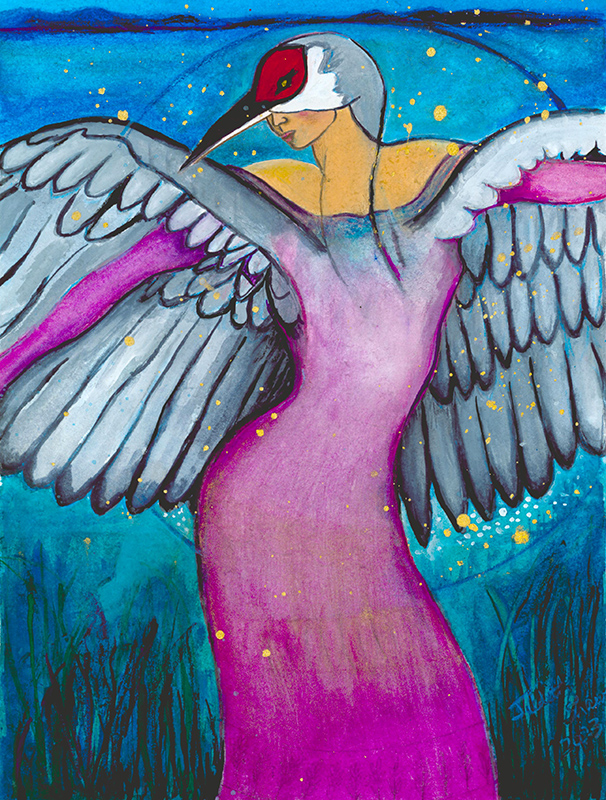
Aviana, 20th Century Crane Goddess by Judith Shaw

People think that goddesses only came into being long, long ago. People think goddesses are only found in ancient mythology. But people are wrong.  I know because I am Aviana, the Wetlands Crane Goddess who helped create the Bosque del Apache Wildlife Reserve of New Mexico. I first manifest on Earth as an Otherworldly force in the early 1900s. It was the migrating birds and waterfowl, in particular sandhill cranes, who called me into being.  

You see before Euro-Americans arrived in the land of the American Southwest, the Rio Grande was a mighty river which flooded every year bringing life and renewal to the land. These wetlands were a favorite wintering habitat of the Sandhill Cranes. They left their summer nesting grounds of Alaska, Canada and the northern United States and headed south for the winter.  Every year in November hundreds of thousand of cranes arrived in New Mexico. Here they fed on grasses and small animals throughout the short winter days. 

Continue reading “Aviana, 20th Century Crane Goddess by Judith Shaw”

A Womanist’s Perspective by Sara Wright

Last night I was listening to plant scientist Monica Gagliano who is pushing the boundaries of what we know about plants. She proved that plants respond to the sound of water by moving toward it and cannot be tricked. Bio-acoustics is the study of sound and Monica is researching other ways that plants communicate. We know they use chemical messengers to warn each other above ground and below through the mycelial network thanks to the work of Suzanne Simard who I shall discuss in a moment. We have learned that plants emit electrical impulses. But Monica is studying another way that plants communicate. She says they listen to all the plants around them and learn from each other so that they do not have to re-invent the wheel with each generation. In one amazing memory experiment mimosa plants taught her that plants remember what happened to them previously and don’t repeat their mistakes. The Mind of Plants was her first book. She also studied with Indigenous healers in the Amazon and discusses this mysterious and compelling journey in her latest book Thus Spoke the Plants.

Continue reading “A Womanist’s Perspective by Sara Wright”

Bird Watching and Geology in the Body of Goddess by Carol P. Christ

carol p. christ 2002 color

The notion of the earth as the body of Goddess has taken on deeper meaning for me in recent years.  I have felt connected to nature all of my life.  Yet often, though not always, I have related to nature in general rather than in specific ways. Some years ago, after reading Hartshorne’s essay “Do Birds Love Singing?” I stopped for the first time in the wetlands of Kalloni, Lesbos, to see the flamingoes that live in the salt pans there.

Flamingo's-Kalloni3-Saltpan

One thing led to another, and I met someone with whom I spent the next six weeks visiting every pool and puddle where birds were stopping in Lesbos that spring.  Continue reading “Bird Watching and Geology in the Body of Goddess by Carol P. Christ”

IN THE NEWS: Global Climate Change by Carol P. Christ

Climate change is in the news again due to the devasting storm known as Hurricane Sandy.  Scientists, activists, journalists, and politicians are telling us that Sandy is not just another “unpredictable event” brought to us by “Mother Nature.”  Will we listen this time?

Hurricane Sandy is a human-made and entirely predictable and sure to be repeated environmental consequence of the use of fossil fuels, especially oil and coal. Burning fossil fuels puts carbon dioxide into the atmosphere. This raises the global temperature in the air, land, and sea. Melting of polar ice caps is a result of the rise in global temperatures. This will cause a 3 foot or more rise in the seas, leading to the permanent flooding of the seacoasts and sea coast constructions, including homes, restaurants and shops, office buildings, and harbors and ports.

The warming of the seas is also producing extreme weather conditions, including high winds and hurricanes, along with colder winters and hotter summers.  Extreme weather conditions will lead to regular storm-related flooding of rivers and sea coasts, erosion of hills and mountains in winter, followed by catastrophic fires in summer.  Prolonged droughts and unseasonal rains will devastate farms and food production. Wildlife habitats will be destroyed. Places where people live will become too hot, too cold, too wet, and generally unfriendly to life.

Continue reading “IN THE NEWS: Global Climate Change by Carol P. Christ”