Calling All Biblical Wise Women by Rabbi Jill Hammer, PhD

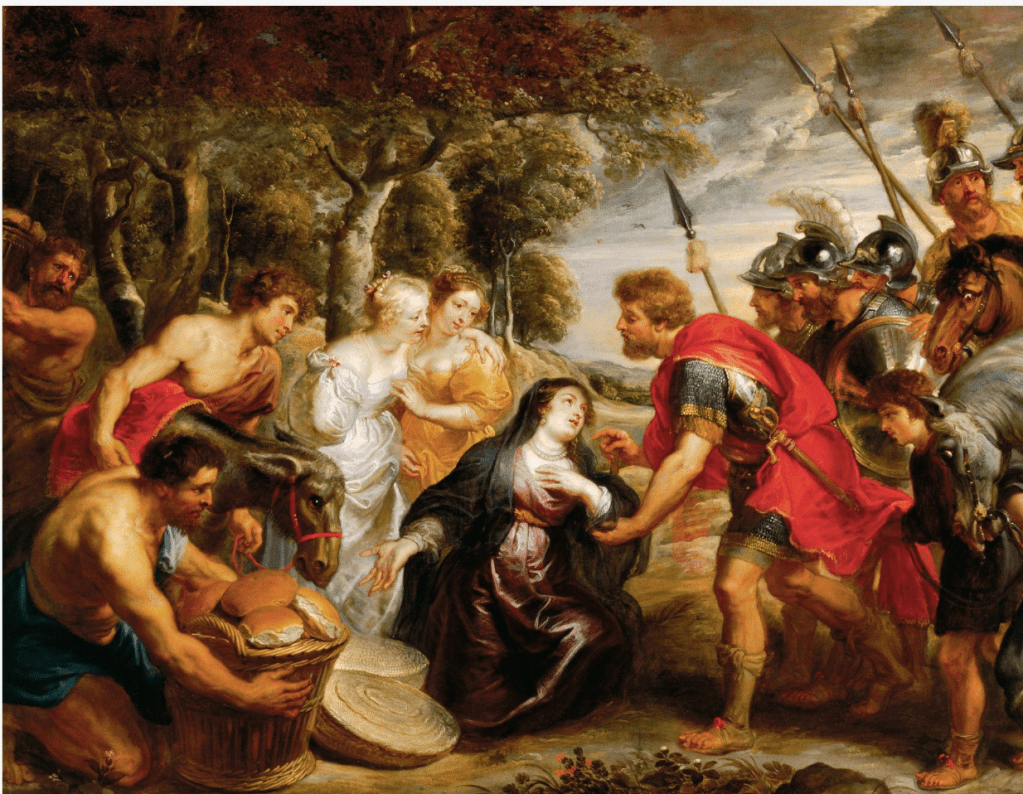
The meeting of David and Abigail by Peter Paul Rubens circa 1630

In these days when so many are afraid and aching for the people of Ukraine, and concerned about the lasting impacts of this war around the world, I cannot help thinking of the wise women of ancient Israel. These wise women, unafraid of confronting dangerous men, used their intelligence and storytelling skill to defuse violent situations between powerful adversaries and restore peace. May their wisdom be felt in the world now. 

The institution of “wise woman” appears several times in the Bible. In the Book of Samuel, a wise woman (chachamah in Hebrew, from chochmah, wisdom) steps in when there is a war, or political conflict, to promote peace. In II Samuel 14, after King David’s son Amnon rapes David’s daughter, Tamar, the king does nothing. Tamar’s full brother Absalom takes matters into his own hands and kills Amnon, then flees to another country.  David grieves for Absalom but won’t send for him. The wise woman of Tekoa appears before King David, pretending to be a woman whose sons fought, and one killed the other. The story she tells helps to reconcile King David with his son Absalom, at least temporarily.  

Continue reading “Calling All Biblical Wise Women by Rabbi Jill Hammer, PhD”
Carol P. Christ’s Legacy: Women Are Not Sluts, Rush, Douch-Bag Is Not Funny, Jon, And Sexism Is More Than “Inappropriate,” Mr. Whitehouse Spokesperson! by Carol P. Christ


Moderator’s Note: We here at FAR have been so fortunate to work along side Carol Christ for many years. She died from cancer in July, 2021. Her work continues through her non-profit foundation, the Ariadne Institute for the Study of Myth and Ritual and the Goddess Pilgrimage to Crete. To honor her legacy, as well as allow as many people as possible to read her thought-provoking and important blogs, we are pleased to offer this new column to highlight her work. We will be picking out special blogs for reposting.This blog was originally posted March 12, 2012. You can read it long with its original comments here.

Why is it OK to insult women, our bodies, and our sexuality in ways that it is no longer OK to insult other groups?

The recent controversy over Rush Limbaugh’s rant about Sandra Fluke would not be so important if Limbaugh were not the “voice” allowed to say things that Republican politicians cannot say in public. Republican politicians wish to appeal to men who would say exactly what Rush said, while watching Fox News or over a beer with their buddies.

The Virgin-Whore split is alive and well in our culture. Sandra Fluke  finally did get to testify in a hearing called by Nancy Pelosi.  She  assumed a woman’s right to choose when and with whom we have sex and whether and when we will have children, but she did not focus on sexual freedom. One of her examples was a married woman who could not afford birth control and another was a woman who needed birth control pills for reasons having nothing to do with sex or sexual activity. She did not appear in Congress in a mini-skirt (though she should have had every right to do so) but in a business suit. Yet she was called a slut and a prostitute and asked to post porno films of herself on the internet.

Continue reading “Carol P. Christ’s Legacy: Women Are Not Sluts, Rush, Douch-Bag Is Not Funny, Jon, And Sexism Is More Than “Inappropriate,” Mr. Whitehouse Spokesperson! by Carol P. Christ”

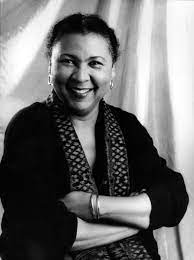
Honoring My Academic Mothers: Carol Christ and bell hooks by Anjeanette LeBoeuf

I started writing this post a day after news broke that beloved activist, poet, feminist, and academic, bell hooks had passed away. This news comes months after our FAR community lost Carol Christ; another academic, feminist, writer, and maker of history. This post was finished as almost three weeks into a new year has gone by. The advent of 2022 is filled with the last two years’ heavy, unbelievable, heartbreaking, and extraordinary experiences and events.  

Continue reading “Honoring My Academic Mothers: Carol Christ and bell hooks by Anjeanette LeBoeuf”

Why It Matters That Simone Biles Won Times Athlete of the Year Award by Janet Maika’i Rudolph

I remember my first feeling’s of disappointment when Simone Biles pulled out of so many events at the 2021 Olympics. But then I quickly realized that here I was falling for the patriarchal lines that are so much a part of our reality that they become unconscious. Simone Biles taught me. Winning isn’t about slaying your foes (although someone who watches politics here in the US would think so). When Biles withdrew, there were many angry tweets and letters that she wasn’t living up to her promises. Let’s review that. She has been called the GOAT (Greatest Of All Time) of her sport. She is the most decorated gymnast in history. She is only 24. What promise has she broken? To whom? And who are we (meaning the public) to even determine what her promise is?

Continue reading “Why It Matters That Simone Biles Won Times Athlete of the Year Award by Janet Maika’i Rudolph”

In Memoriam: bell hooks by Elizabeth Ann Bartlett

In a world where the words of black women writers, even our very names are often soon forgotten, it is essential and necessary that we live through writing and teaching the words of our great and good writers, whose voices must no longer be silenced, even by death.[i]

                                                                                    – bell hooks

On December 15, 2021, the world lost the great feminist theorist, teacher, activist, and writer bell hooks.  As a white feminist theorist, I valued immensely the ways her work widened my partial perspective, challenged my blind sports, and gave me important viewpoints on everything from sexism, racism, classism, pedagogy, militarism, work, and parenting.   Her piece on feminist solidarity is the best I know — examining not just the ways we are divided by classism and racism, but also by sexism, addressing the very real and destructive ways that women undermine, abuse, and disregard each other, and how important it is to unlearn this with each other. She used the term “feminist movement,” rather than the feminist movement, knowing it not to be one thing, but rather a verb, a process of moving, changing, and transforming. Championing the power of coming to voice, she spoke truth to power, engaging in honest exploration of often difficult and divisive topics. It was this honest, liberatory voice that spoke throughout her work and made her voice so compelling, and so valuable.

Continue reading “In Memoriam: bell hooks by Elizabeth Ann Bartlett”

Carol P. Christ’s Legacy: Why Don’t Feminists Express Anger At God? by Carol P. Christ

Moderator’s Note: We here at FAR have been so fortunate to work along side Carol Christ for many years. She died from cancer in July, 2021. Her work continues through her non-profit foundation, the Ariadne Institute for the Study of Myth and Ritual and the Goddess Pilgrimage to Crete. To honor her legacy, as well as allow as many people as possible to read her thought-provoking and important blogs, we are pleased to offer this new column to highlight her work. We will be picking out special blogs for reposting. This blog was originally posted July 9, 2012. You can read it long with its original comments here.

My relationship to God changed when I accused “Him” of everything I thought “He” had done or let be done to women—from allowing us to be beaten and raped and sold into slavery, to not sending us female prophets and saviors, to allowing “Himself” to be portrayed as a “man of war.”

In the silence that followed my outpouring of anger, I heard a still small voice within me say: In God is a woman like yourself. She too has been silenced and had her history stolen from her. Until that moment God had been an “Other” to me. “He” sometimes appeared as a dominating and judgmental Other, and at other times as a loving and supportive Other, but “He” was always an “Other.” I as a woman in my female mind-body definitely was not in “His” image. 

Continue reading “Carol P. Christ’s Legacy: Why Don’t Feminists Express Anger At God? by Carol P. Christ”

Moving to Ursula: Dream Wisdom and the Sacred Feminine by Rabbi Jill Hammer, PhD

For the last seven years, I have been conducting research for my book Undertorah: An Earth-Based Kabbalah of Dreams, which is about to appear courtesy of Ayin Press.  On this writing journey, I’ve interviewed seventy dreamers, and have studied pre-modern dreams from texts of ancient Israel and ancient Sumer to dream accounts of women kabbalists and Chasidic masters.  I’ve also sat with my own dreams and their odd truths. Many of the dreams I’ve encountered express powerful visions of the feminine. I find these often odd and eerie visions particularly useful in expressing “the multiplicity of experiences of [the feminine]… rather than an imposed definition of those experiences…”[i]

Continue reading “Moving to Ursula: Dream Wisdom and the Sacred Feminine by Rabbi Jill Hammer, PhD”

The Celtic Cross and the Compassing of the Divine Womb, Part 1 by Trelawney Grenfell-Muir

No one knows why Celtic Crosses have a circle. Guesses include pragmatic utilitarianism (to hold the arms up),1 the sun, Greek laurel wreath, Egyptian ankh, circle of creation,2 the Chi-Ro Greek monogram for Christ,3 the divine light that imbues all creation,4 the “Celestial Sphere” found in earlier Eastern Christianity,5 and a range of fanciful inventions based on modern imagination and pseudo-scholarship about Celtic “paganism.” [Leading scholars of pagan history agree that almost nothing is known about pre-Christian beliefs in Britain and Ireland. The few, conflicting descriptions we have, all come from highly tendentious, frequently incorrect foreigners (such as Julius Caesar, who also claimed that German forests were full of unicorns) or from Christian writers of later periods with strong agendas of their own (such as creating a native pagan history and mythology to rival their snobby Greek and Roman “Classical” neighbors).6] The circles on Celtic crosses remain a mystery.

With that in mind, I do not suggest an historical hypothesis here; rather, I offer a theological insight from a modern Feminist Christian perspective. I ask the invitational question: “What happens when modern Christians allow Celtic Crosses to symbolize the Compassing of the Divine Womb?” 

Continue reading “The Celtic Cross and the Compassing of the Divine Womb, Part 1 by Trelawney Grenfell-Muir”

100 Years After Women’s Right to Vote, Our Feminist Struggle Continues by Gina Messina

The first time I called myself a feminist, I think I was twelve years old. Growing up in a traditional Sicilian Catholic household, misogyny was ever-present. There were clear expectations of me and my brother based on our gender and these ideas were grounded in our religion. I didn’t realize how problematic this was until much later; but by age twelve I was asking questions and knew that it wasn’t fair that my brother could be an altar server and I couldn’t…because I was a girl. 

A few years ago, I experienced a shift in my life. I am not sure how to explain it. Some might call it a midlife crisis; but I’m inclined to define it as an awakening, at least a partial awakening. I won’t foolishly claim that I am suddenly enlightened; however I began to question my own identity as a feminist. Continue reading “100 Years After Women’s Right to Vote, Our Feminist Struggle Continues by Gina Messina”

Quaker Ancestor Buys 6 Year-Old Indian Captive by Carol P. Christ

When I wrote about Anne Hutchinson as America’s first feminist theologian a few years ago, I mentioned that I had a Sackett ancestor living in Boston at the time, who might well have been a follower of Hutchinson. That branch of my family tree has since been shown to be false. Recently, while looking into the branch that replaced it, I discovered that in 1637 my 9x great-grandfather William Wodell was required to turn in all of his guns and other weapons because he had been “seduced” and led into “dangerous errors” by a Mr. Wheelwright and Mrs. Hutchinson.

In 1643 William Wodell was charged with “heresy and sedition” in relation to “blasphemous errors.” He was convicted and banned from Boston. He retreated to property he had purchased in Portsmouth, Rhode Island, which had been founded by the Hutchinsons and others fleeing persecution in Boston. Wodell became a respected member of the Quaker community in Portsmouth, holding a number of important public offices before his death some 50 years later.

My happiness at finding an ancestor whose convictions I could admire, was to be short-lived. The next morning, I discovered that in 1677 the respected Quaker William Wodell bought a 6 year-old Indian girl who had been captured in King Phillip’s War. Indian women and children were captured and sold as slaves during both the Pequot War (1636-1638) and King Phillip’s War (1675-1676). Some of those captured were sent to the West Indies, while others were purchased by English colonists. Continue reading “Quaker Ancestor Buys 6 Year-Old Indian Captive by Carol P. Christ”