The Cuisine Cards by Laurie Goodhart

Suit of Tomatoes

With every wonderful, heart-wrenching, deeply researched, and inspiring  post I read on F.A.R., I feel less inclined to share my own somewhat out-of-step contributions to this world. Nevertheless, I keep reminding myself that they are the things that I do, and I do them because I feel compelled, and have consistently been compelled in those two specific directions — art and agriculture/wildcrafting — since childhood. Also, the paintings and prints are a product of my always thinking about and feeling into both feminism and spirituality, and the fruits of the intersection of the two. So here is another offering.

I’ve always had a fondness for the visual aspect of playing cards, and collect books on them. One image of an uncut sheet of cards printed in 1585 in Frankfurt, where the black and white cards were jammed in every which way on large sheets of paper, inspired the look of these four prints, The Cuisine Cards.

They are conceived as celebrating food and cultures from various parts of the world. The face cards are non-hierarchical in terms of rank and gender. The 10 is a Table of the suit’s food, then there are the Shaper, Mover, and Taster, who, although usually carrying on in a certain sequential order, each contribute equal value to the whole experience of eating food. Two suits have all female face cards and two all male.

Continue reading “The Cuisine Cards by Laurie Goodhart”

The Pomegranate by Sara Wright

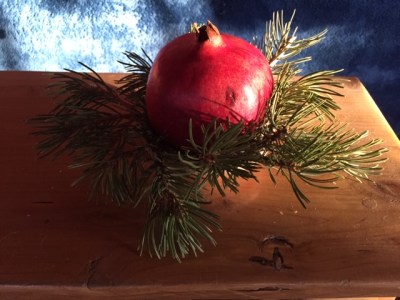
It is mid November and shiny crimson Pomegranates catch the discerning eye in food markets; even Walmart carries them!

Why do these beautiful and very ancient fruits appear during this dark time of the year?

One answer to this question is that in the northern hemisphere the fruit of this deciduous shrub ripens anywhere from September to February. The reverse is true in the southern hemisphere when the fruits ripen during March, April and May. It is important to remember that in the southern hemisphere the seasons are reversed, so in both northern and southern parts of the globe these fruits appear in the fall, during the darkest months of the year.

Pomegranates are native from Iran to northern India and have been cultivated throughout the Middle East, Asia and the Mediterranean region for millennia. (Today they are also grown in California and Arizona, so they no longer need to be imported). The shrub was domesticated as early as the 5th millennium BC. Pomegranates were the first trees to be domesticated in the Mediterranean.

Continue reading “The Pomegranate by Sara Wright”

Musings On My Recent Road Trip by Esther Nelson

I love a road trip.  It’s exciting to get behind the wheel of a car, get out on the highway (or bi-way), and just go.  The road seems to stretch out forever in front of me, full of possibilities, adventure, and fun.  Again, this summer I drove two thirds of the way across the United States from Virginia to New Mexico and back again.  I varied my route because why not?  The country is vast and diverse.  I want to see as much of it as I can.  The broad, open, colorful skies of Texas and New Mexico.  The wheat fields in Kansas.  The green, rolling hills of Kentucky and Tennessee.  On this particular trip back to Virginia, though, one of the sights disturbed me deeply.

The second day of my journey eastward, I drove from Amarillo, Texas, to Springfield, Missouri.  All along the panhandle of Texas and into Oklahoma, I encountered feedlots.  These are places where cattle live for several months in order to fatten up before slaughter.  The animals are fed grain (mainly corn), growth hormones, and antibiotics.  They live in crowded spaces and in the feedlots I saw, the cattle had difficulty walking due to the layers of muck, mire, and manure all over the ground.  I could smell a feedlot long before I saw one.  The stench nauseated me.

Continue reading “Musings On My Recent Road Trip by Esther Nelson”

Feeling it in Bones & Water: Practicing Somatic Spirituality

Kate BrunnerThere is a phrase I’ve heard here and there while living in Australia that I love for the sense that it evokes– “I can feel it in my water.” The usage is similar to the American phrase to “feel it in my bones.” It is that sense of knowing through the body that something is happening or about to happen. There are different explanations that posit to what “water” the phrase refers. I’ve been told it means urine in the bladder or it refers to the fact that the human body is truly mostly water. But, admittedly, my favorite explanation is that it points to the water of the womb. People of all shapes and sorts may use the phrase. But to date, I’ve only ever heard it from women, which gives some anecdotal credence to the womb theory. Any way you look at it, if you feel it in your water or your bones, you are connecting with the deep wisdom of the body.

I feel this somatic wisdom, this feeling of the bones & water, is something, as a group of modern Western cultures, we do not engage as often as we could. We have a tendency to see the body as a means to an end. It gets us from one place to another, yes. But it also seems so high maintenance some times. If only we didn’t have to sleep so much, or eat & drink at regular intervals, we could get more done. If only we didn’t get sick. If only we didn’t have to take time out of our busy lives to exercise & stay healthy. If only our bodies would get with the program, so our minds and spirits could achieve their lofty goals and be even more productive. For women, this is further compounded by layer after layer of patriarchal programming about what we should or should not do with said body. We have national debates in the public forum over and over again pertaining to this. We struggle in private with the intimate relationship between body & other parts of self. Continue reading “Feeling it in Bones & Water: Practicing Somatic Spirituality”

What I Learned (and Found) Dumpster Diving, Part II, by Grace Yia-Hei Kao

“I had known that dumpster diving is subversive….What I hadn’t considered previously is its arguable feminist and biblical precedents.”


The following is a continuation of a two-part blog. Read part I for what prompted me to go dumpster diving, what freeganism is, and what three things surprised me the most about dumpstering beyond the sad and shocking reality of tremendous waste. 

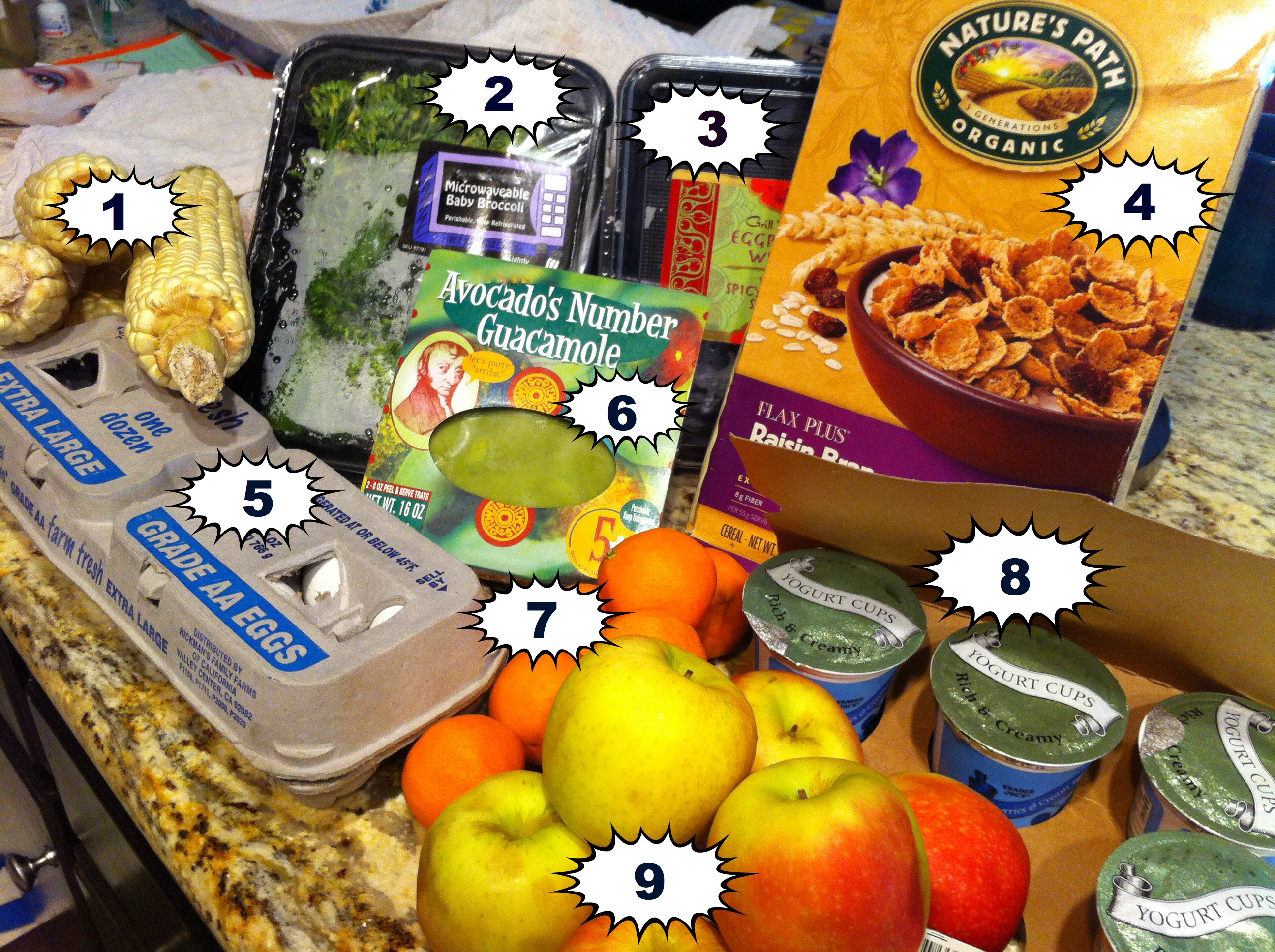
My Dumpster Dive Haul

After sorting through several trash bags of edible food in the approximately 10 minutes that we spent at one site in my first ever urban scavenging trip, this is what I ultimately brought home.


(Reminder: As explained in part I, I have intentionally photoshopped out the store’s name and the use-by/best by dates).

Continue reading “What I Learned (and Found) Dumpster Diving, Part II, by Grace Yia-Hei Kao”

What I Learned (and Found) Dumpster Diving, Part I, by Grace Yia-Hei Kao

“I get that consumers generally prefer to buy produce that looks a certain way, but can the routine act of trashing whole bags of clementines, apples, or tomatoes because of a few imperfections be justified in a world that is full of hungry and malnourished people?”


Renowned climate change activist and author Bill McKibben spoke at our graduation earlier this year. Among the charges he gave to all of us in attendance (i.e., not just the graduates) was for us older folks to be willing to bear more of the possible “costs” of political activism. His reasoning was that being a 20-something with an arrest record was not a particularly good thing for young job-seekers today.

I was inspired. I thought to myself, “I have tenure, I work with colleagues who champion prophetic civil disobedience, and my class privilege would allow me to post bail if arrested.”

When chatting with a graduate that afternoon, I told him that I’d like to make good on something we once discussed in class during a session on the ethics of consumption—I’d like to go dumpster diving with him.

Mind you, I don’t fit the stereotypical urban scavenger profile (although middle class dumpster diving is on the rise). I grew up in a gated community, once brought my portable curling iron on a junior high church group camping trip, and today am more bourgeois than Bohemian. So what interest did I have in electively digging through garbage?

Continue reading “What I Learned (and Found) Dumpster Diving, Part I, by Grace Yia-Hei Kao”

On Cooking and Eating by Ivy Helman

In patriarchal heterosexist societies women do most if not all of the cooking for their families.  Women are also usually assigned the tasks of cleaning, raising children, tending the family garden, gathering water and anything else that is considered part and parcel of caring for the family.  These feminine tasks are often devalued compared to the activities men spend their time doing.  I wholeheartedly support the reevaluation of the significance of these tasks and the movement toward shared responsibility for family life among heterosexual couples, however that is not what I want to discuss today.

I want to explore the religious and spiritual significance of the food cooked by our mothers, grandmothers, aunts, sisters and female friends, especially those dishes we would consider to be comfort food.  Every person, every family has their own idea of what meals are comfort foods.  Bubbe’s matzah ball soup on Shabbat maybe?  Aunt Betsy’s Easter ham?  Mom’s turkey, gravy and oyster stuffing on Thanksgiving?  Your sister’s famous mac and cheese?    Continue reading “On Cooking and Eating by Ivy Helman”