The Dinner Party by Judy Chicago: Donald Woodman, Wikimedia Commons
Knitting and other forms of needlework made a resurgence when Second Wave feminism reclaimed traditional “women’s work” as a form of feminist expression, promoting crafting as a tool of feminist empowerment. The most prominent example of this was Judy Chicago’s 1979 The Dinner Party that celebrated prominent female historical and mythical figures. A massive artwork, it consists of 539 quilted triangle pieces from all over the world, embroidered place banners, and ceramic plates arranged on a large triangular table.
Women form the vast majority of those engaged in knitting resistance,[i] and beyond the reclamation of women’s domestic arts, craftivism provides women a voice that is often usurped and talked over in masculine political spaces. As one of the participants in a resistance knitting circle that was studied by feminist scholars stated, “’Because politics is still very sexist and configured for men . . . I think women don’t get very far . . . I think craftivism is . . . something that’s accessible to women . . . and is an alternative form of expression.”[ii]
“All the women knitted. . . . So much was closing around the women who sat knitting, knitting, that they their very selves were closing in around a structure yet unbuilt, where they were to sit knitting, knitting, counting dropping heads.”[i] – A Tale of Two Cities
So does Charles Dickens tell the tale of perhaps the most infamous resistance knitter, the character of Madame DeFarge in his A Tale of Two Cities. Using a different pattern of knots for each letter of the alphabet, Madame DeFarge uses her knitting to encode the names of spies and traitors to be beheaded by guillotine in the French Revolution’s Reign of Terror.
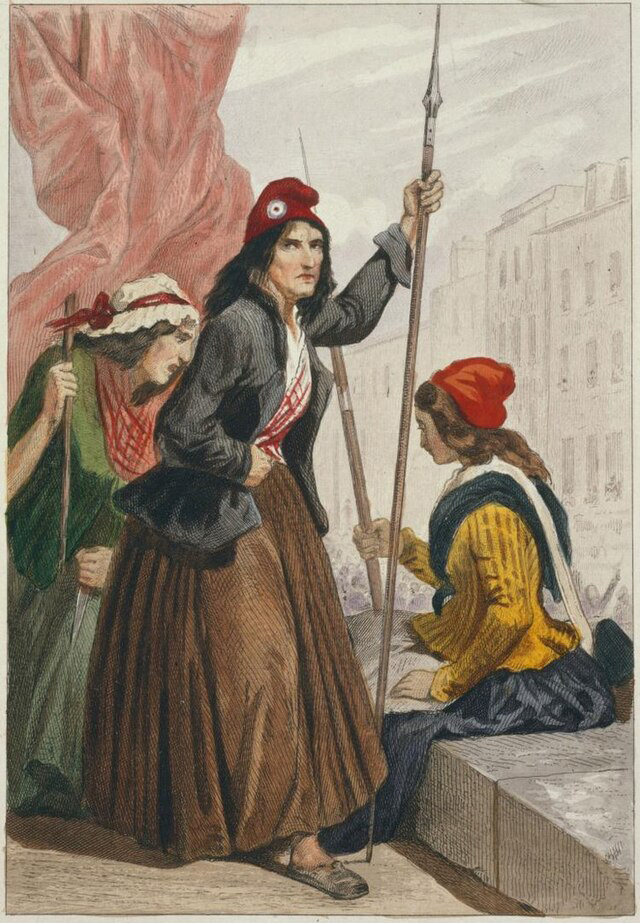
Tricoteuse
Her character is based on the true story of the tricoteuse – the women who notoriously knitted while sitting next to the guillotine. They undoubtedly took up this public position because just a few months before the Reign of Terror began they were banned from government proceedings and prohibited from forming any political assembly. Initially praised for their role in the resistance after successfully forcing Louis XVI to acquiesce to their demands following their march on the palace at Versailles protesting rising food prices, they had become too much of a threat to the aristocrats. It is said they were knitting liberty hats.
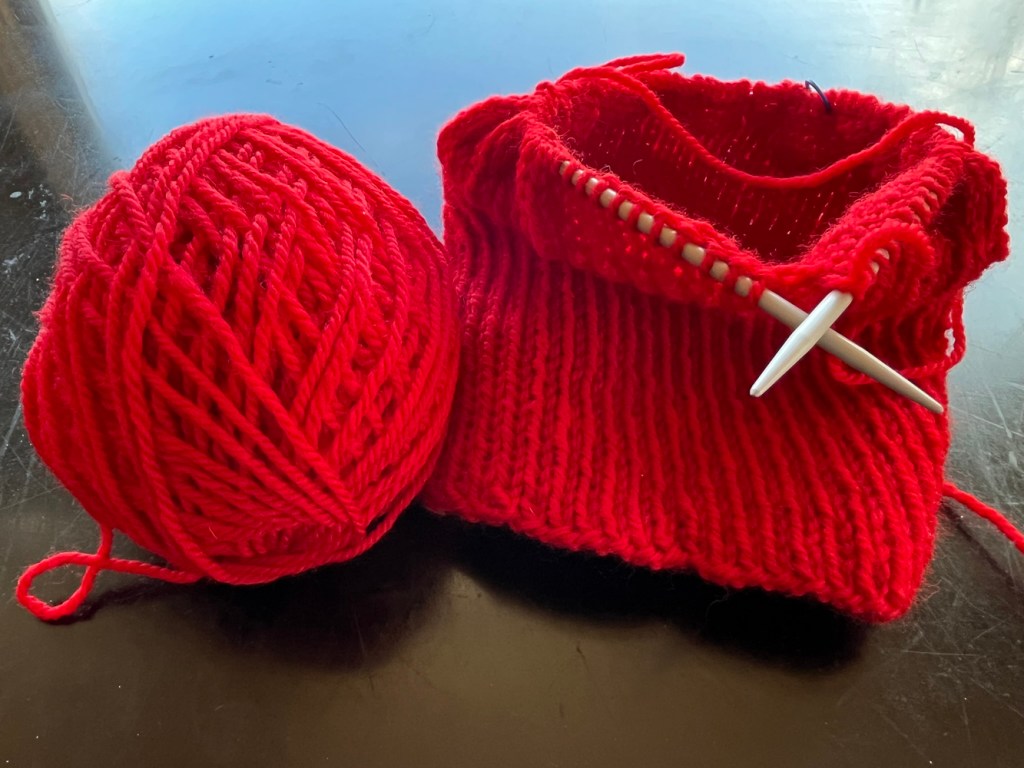
Fast forward to today. Begun with a simple “Melt the Ice” pattern designed by Paul Neary from the yarn shop in Minneapolis, Needle & Skein, women and men all over the world are once again knitting liberty hats. The red pointed hats are modeled after the nisselue — or “Santa hat”– that Norwegian women knit as a symbol of resistance to the Nazis who were occupying Norway during WW II. Needle & Skein made the pattern available for $5, with proceeds going to support rent and food assistance to those unable to leave their homes due to ICE’s ongoing presence in the Twin Cities. As of March 5th, they had already raised $705,000.
That the movement has become worldwide is extremely moving to those of us in Minnesota. It lets us know we are not alone. It has become a sisterhood of sorts, with a continual round of Facebook messages like this one from Elisabet Engström, “I am knitting the Melt the Ice hat right now. . . . It feels so good to be a part this. I live in Sweden. Happy knitting to all of you.” Another writes from Ibaraki, Japan, that has a cultural exchange program with Minneapolis, that she is knitting MTI hats “in solidarity and support.”[ii] I particularly loved this one, “I changed the pattern a bit, but I’m loving the resistance and how much it’s already earned for donation. I’m 82 and can no longer march, but I can do this.”[iii]
These days, at every protest I attend and just walking around town, I see people, mostly women, wearing the red Melt the Ice hats. There’s something particularly fortifying about wearing one’s convictions so visibly in solidarity with others doing the same. On the 84th anniversary of the Naz’s banning the wearing of the nisselue hats, people all around the world wore the red MTI hats they had inspired, proudly displaying their resistance to the occupation forces of ICE that have terrorized cities and immigrant communities throughout the US.
I first engaged in knitting resistance in 2009 when students in my course, “Women, Peace, and War” participated in CodePink’s Mother’s Day action against war, displaying a banner on the White House fence with the words, “We will not raise our children to kill another mother’s child.” CodePink sent out requests for 4X4 knit squares in pink yarn, and so we began to knit. Many of the students already knew how to knit. We taught those who did not. Most class sessions we were all busily knitting while discussing the readings on women’s roles in war and peace, and by the due date sent in a few dozen squares. It was a wonderful exercise in activist engagement that also brought us together as a community in the classroom and with other anti-war feminist activists throughout the country.
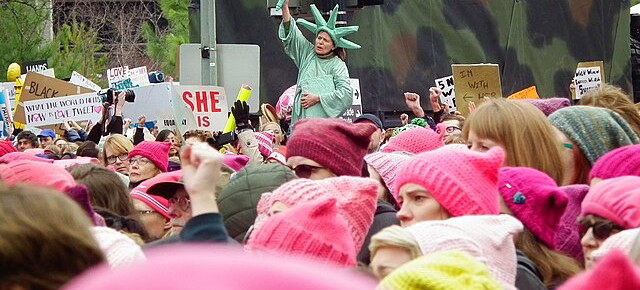
Many people first engaged in knitting resistance when Kat Coyle of Ravelry – the social group for knitters and crocheters – created a pattern for the “pussy hat”[iv] – a symbol of resistance to Donald Trump worn in the first Women’s March following his inauguration in 2017. The streets in Washington, DC and other cities across the country were filled with pink pussy hats.
Women’s March on Washington in 2017
These are just a few of the hundreds of ways knitting and other crafts have been used in resistance to oppression, tyranny, violence, and war. In 2003, Betsy Good coined “craftivism” – a combination of “craft” and “activism” – to describe this worldwide movement.[v] As one craftivist described it, craftivism is “a strategy for non-violent activism in the mode of do-it-yourself citizenship or do-it-together citizenship’.”[vi] Craftivist and author Sarah Corbette wrote, “To be a craftivist is not just to be someone who likes craft: it is to be someone who hones their craft to question injustice, encourage peace and show ways to achieve a better world for everybody involved.”[vii]
Craftivism includes all forms of fiber and needle arts – from knitting and crocheting to embroidery and quilting and more – from the use of quilts encoded with messages about the underground railroad and its resurgence as a medium for resistance during the Civil Rights movement to the AIDS memorial quilt,[viii] from suffragists’ embroidered banners for votes for women to the embroidered arpilleras of women in Chile to document human rights abuses during Pinochet’s regime. But the craft that is currently engaging so many is knitting. Knitting has featured prominently in anti-war resistance, such as the aforementioned CodePink banner. During WWI and II, knitting was central to resistance workers who knit secret messages into scarves and mittens and sweaters, using knit and purl stitches to represent dots and dashes in Morse Code, or dropping stitches in strategic places to represent German train activity. Women knit themselves into webs during anti-nuclear protests at Greenham Common in the 1980s and decorated the perimeter fence around the air base with ribbons and knit items. The British “Cast Off Knitting Club” knit grenade purses to protest the Iraq War and in the US Starhawk and fellow protestors created a yarn web around the Pentagon.
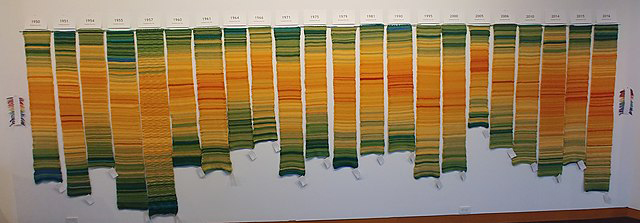
The Tempestry Project
Knitting has been used as a form of protest for countless other causes as well. Suffragists in the US knit, sewed, and embroidered banners with declarations of women’s right to vote. The “Tempestry” project was begun in 2016 in response to concerns that the incoming Trump administration would minimize climate data. Participants knit ‘temperature scarves’ with specific color-coding to record climate change data in various places in the US.[ix] The “Liberty Crochet Mural” – consisting of 40 individual crocheted squares assembled into a 17ft x 11ft yarn mural — celebrates women’s reproductive autonomy and freedom to choose. In the “Welcome Blanket” project — a response to the first Trump administration’s proposed 2,000-mile wall along the United States–Mexico border, Los Angeles artist Jayne Zweiman and dozens of other fiber artists knit, sewed, crocheted, and wove 3,500,640 yards of blankets to welcome immigrants.[x] And the Minnesota MTI hat is not the only anti-ICE knitting project. In Portland, Tracy Wright formed “Knitters Against Fascism,” which designed and promoted the Portland frog hat and conducts “knit-ins” outside the Portland ICE facility.[xi]
MTI hat in production
In Part II, more on knitting resistance and feminism, gentle protest, and community building – tomorrow
Laware, Margaret L. “Circling the Missiles and Staining Them Red: Feminist Rhetorical Invention and Strategies of Resistance at the Women’s Peace Camp at Greenham Common.” NWSAJournal, Vol. 16, No. 3 (Autumn, 2004), pp. 18-41.
[iv] The “pussy hat” was inspired as a protest against Trump’s infamous statement in a 2005 tape, “When you’re a star, they let you do it. Grab them by the pussy. You can do anything.”
[v] The term “craftivism” is usually attributed to Betsy Greer, but she actually coined the term when after she mentioned a connection between craft and activism, “Buzz,” one of the women in her knitting circle, said, “You could call it craftivism.” Greer then posted it on her online journal in 2000, and in 2003 bought domain named craftivism.com, which has become a worldwide network of craftivists.
[viii] Evidence suggests that quilt patterns such as the “Log Cabin” or “Flying Geese” may have been used in the Underground Railroad to provide coded messages to guide enslaved people to freedom. Women in the Civil Rights movement organized quilting circles as a form of resistance. The quilts made during the Civil Rights movement were often sold to raise funds for the movement. The AIDS memorial quilt originated in San Francisco in 1985 to memorialize those lost to AIDS. Gert McMullin, the ‘mother’ of the quilt, sewed the first stitch and since then 50,000 panels have been added, honoring more than 110,000 individuals. Weighing 54, it is thought to be the largest community art project ever created. It has raised more than $3 million dollars for AIDS services. Other famous resistance quilts include The Border Wall Quilt Project, a collection of 8” x 16” quilt pieces expressing concern about the border wall and the Broken Treaty quilts, created by Gina Adams, with texts taken from treaties to demonstrate the broken promises and injustices to indigenous peoples.
[x] The project quickly exceeded its goal and aims to encircle the globe in 36,521 handmade pieces. 8,000 have been collected so far. To learn more or participate, see Welcome Blanket.
[xi] The proceeds from the sale of the pattern have raised $500 for local food shelves.
On the eve of International Women’s Day 2026, the NCRI Women’s Committee presents its Annual Report 2026, offering a recap of events in 2025 as related to women’s rights in Iran.
Moderator’s Note: This post has been brought to you in cooperation with the NCRI women’s committee. NCRI stands for the National Council of Resistance of Iran. You can learn more information as well as see this original article by clicking by link below. A description of their Council can be found at the end of this post. As an introduction, a NCRI representative sent us the following statement about the war.
STATEMENT: I would like to mention that the Iranian Resistance — which established a government-in-exile years ago — has long advocated a clear position: no to war, no to appeasement of the mullahs, but a third option — regime change by the Iranian people and their organized resistance.
Mrs. Maryam Rajavi, the President-elect of the Resistance and an internationally recognized figure, has outlined this vision in her Ten-Point Plan. I am sharing the link below, as it reflects the roadmap of the Iranian Resistance. Maryam Rajavi’s Ten-Point Plan for the future of Iran
In any case, we are prepared to determine the future of our own country. We kindly ask you to help reflect the voice of the Iranian Resistance, a movement notably led by women ,so that this alternative can be more widely heard.
“ . . . when people no longer have the space to construct homeplace, . . .” Minnesotans mobilize – providing home wherever the need arises
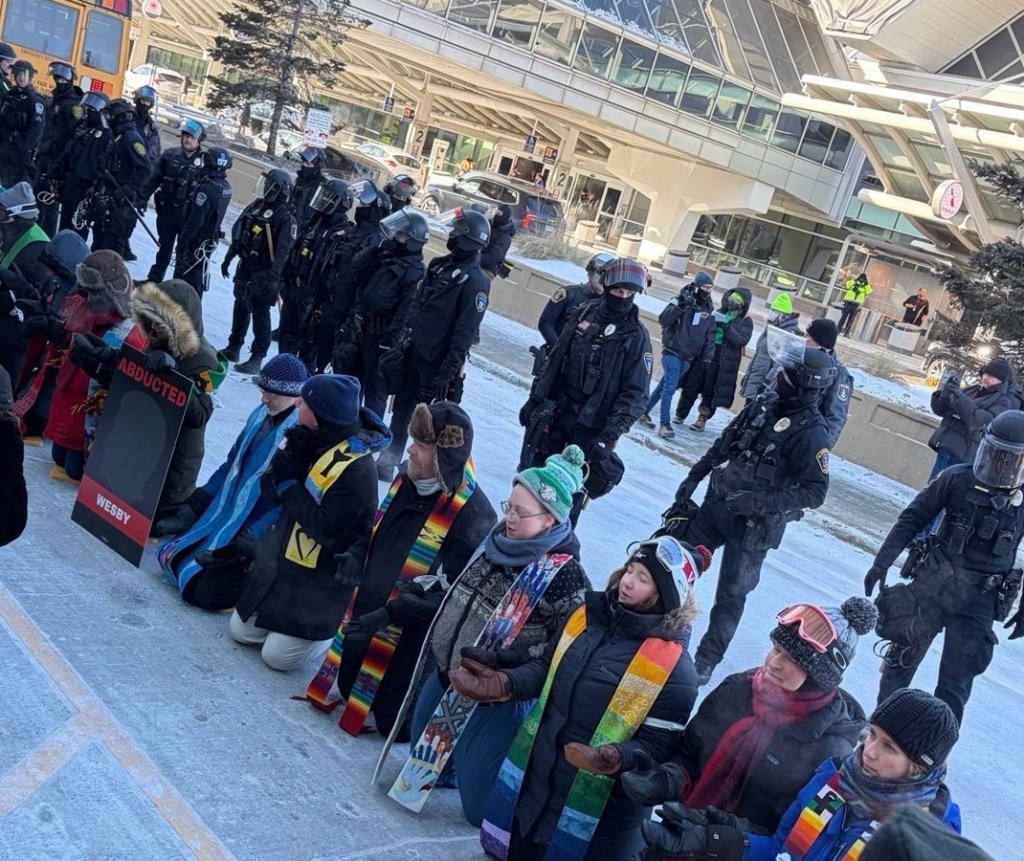
On Friday, January 23rd, seven hundred faith leaders from across the country heeded a call that had been put out just a few days before to come to Minneapolis to train, to observe, and to protest actions by ICE agents in the Twin Cities. Hundreds of them gathered in an interfaith service at Temple Israel. Others joined the National Prayer Call for Minnesota. And still others headed to the Minneapolis-St. Paul airport to engage in nonviolent direct action against the MSP airport authority, and Delta Airlines and Signature Aviation in particular, for their complicity with ICE in transporting those arrested either for deportation or for removal to other detention facilities.
While I was simultaneously livestreaming both the Temple Israel service and the National Prayer, Cal, my son, was among those headed to the airport. In the midst of my concern for his and others’ safety from both the bitter cold – it was -40 below windchill – and from the violence of ICE agents, came the words of Rabbi Marcia Zimmerman offering a prayer for all those engaging in the protests that morning. In that moment, my anxiety eased as I could feel them all being surrounded by the prayer shawl of protection. Then, in a stunning moment of synchronicity, the cantor at Temple Israel sang while a Buddhist priest on the National Prayer Call invoked the blessings of Kuan Yin, goddess of compassion – the compassion that moved the protestors to act, but also that which surrounded the protestors with care. For while thousands engaged in protests that day – 50,000 at the march in sub-zero weather, and thousands more daily participate in protests on the streets and outside the Whipple Building – the ICE detention center in St. Paul, or act as constitutional observers throughout the Twin Cities and greater Minnesota, even more are engaged in daily acts of sustenance and care to support the protestors and those afraid to leave their homes for fear of being detained and disappeared by ICE. These acts of care are at the very heart of the resistance.
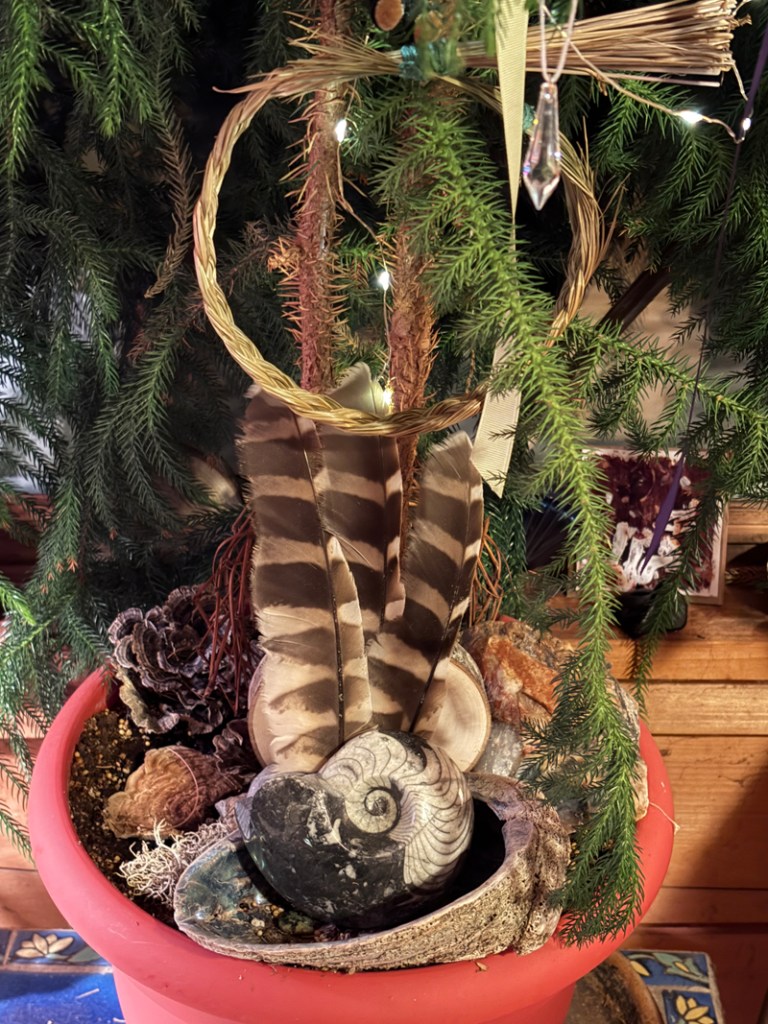
I was driving down the road when I noticed a dead owl. Sun glare blinded me, but I stopped to identify the bird.
It has been many years since I picked up dead owls on the road – thirty five years in all. I began this practice of bringing home the bodies of these creatures when I first moved to the mountains. Finding so many dead owls in a brief span of five years was frightening, but someone in me knew that I needed to honor these Harbingers of Night. Yet the last thing I wanted was to be identified or aligned with an owl, so my behavior rose out a body that never lies. Visions of my mother’s love of owls clouded my mind. Within months of this mountain move a Navajo Medicine woman informed me that I had Owl as a Familiar. Horrified, I resisted mightily. Yet despite what seemed like a curse, I was still compelled to sculpt owl pots out of clay for five years. The losses I endured during this time changed the course of my life.
I taught myself how to dismember owls. I burned owl remains in my woodstove as a symbol of deep respect and out of fear. I always kept feathers and wings in honor of these mysterious night beings not understanding why.
Every day another story of ICE agents randomly arresting and detaining immigrants – these are the chronicles of these times in the US. A few days ago, the news broke of ICE agents trapping two construction workers on the roof of a construction site in a suburb of Minneapolis for hours in frigid temperatures, while the thirty or so ICE agents took turns being inside their warm vehicles. They didn’t even know who the men were. They simply looked to be Latino. A day or two later, in Minneapolis, ICE agents tackled and arrested a Somali-American citizen who stepped outside during his lunch break simply because of the color of his skin. Yesterday brought the story of ICE agents forcibly arresting and separating suburban Minneapolis parents from their 7-year-old child when they came home from the grocery store. The story went on to talk about efforts being made to educate parents about preparing a DOPA – a Delegation of Parental Authority – that gives a designated caretaker temporary legal and physical custody of a child in the event parents are taken away from their children. This is the nightmare facing so many families in this country under the reign of terror inflicted by the Department of Homeland “Security.” One must ask, security for whom.
A few weeks ago, “This American Life” profiled a family trying to decide whether the husband and father of two should stay and risk arrest and detention or self-deport. Fidel, the dad, was married to an American citizen, but due to a technicality, could not get citizenship through his wife until he had lived outside the US for ten years. He had been living in the US “illegally” for thirty years, raised a family, had a good job, paid his taxes, had no criminal history. But the family had heard the stories of torture and abuse in the detention centers, and that possibility loomed over them now. When ICE agents started appearing near their small town in North Carolina, they faced the decision of whether to uproot the teenage girls and go together to Mexico or for Fidel to leave on his own. It was a painful decision. Ultimately, they decided Fidel would leave, and after working five years and getting her teacher’s pension, his wife would join him. The girls would come visit when they could. The family would be torn apart.
Before I go any farther, I want to clarify that I am not speaking of all men. There are a lot of good, strong, protector-type, kind, compassionate men out there.
But I am speaking of THE MAN – an archetypal dominator who has held the purse strings and the control the past few thousand years.
THE MAN who puts the almighty dollar above all else and doesn’t care who he has to step on in order to do so.
I’m sure you can think about quite a few. I would also include some women who behave like THE [DOMINATOR] MAN. The prevalence of this thinking has led to the spot we currently find ourselves in.
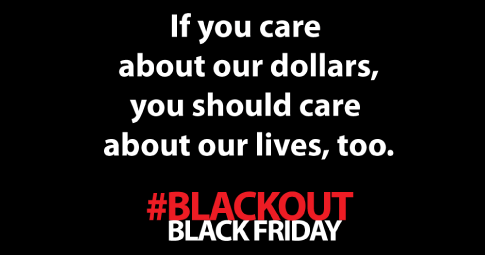
Black Friday is one of the most crucial sales periods for many retailers, with some earning a significant portion of their annual revenue during the holiday season. Black Friday and Cyber Monday 2024 alone generated billions of dollars in online sales.
Binding of the norse mythological wolf, Fenrir. From Guerber, H. A. (Hélène Adeline) (1909). Myths of the Norsemen from the Eddas and Sagas. London : Harrap. This illustration is on page 92. Digitized by the Internet Archive Wikimedia Commons
When I was a shamanic trainee, our group spent a lot of time and focus on the “beast within” This concept has had many expressions in different circumstances – the shadow side (Jung), the dark side (Star Wars), letting loose the “dogs of war” (William Shakespeare), reptilian instincts (psychology).
Mythology has many stories about this phenomenon. In our group, we studied the stories as a way to learn what we must do in our own lives to tame the beast so we had this energy available to use the energy without letting the crueler destructive aspects of the beast run rampant. Here are two of the stories as we discussed them.
Fenrir Wolf
Fenrir Wolf is a deity from the Norse tradition who was known and feared as a great monster. Tyr was the only God in Asgard brave enough to tend to Fenrir. For a long time, Tyr fed and cared for him. Eventually, though, Fenrir grew too large to handle and began running throughout the land called Midgard, killing both gods and people. Odin called a council to discuss how Fenrir could be slain.
I’ve often thought that we (in the USA) have been somewhat, albeit reluctantly, willing to discuss and perhaps even change our minds, behavior, policies, and laws when confronted about the long-lived presence of racism in our local and national institutions. However, when it comes to misogyny—not so much.
Shirley Anita ChisholmSt. Hill (1924 – 2005), was an American politician who, in 1968, became the first black woman to be elected to Congress. “Chisholm represented a district centered in Bedford-Stuyvesant, Brooklyn, for seven terms from 1969 to 1983. In 1972, she became the first black candidate for a major-party nomination for President of the U.S. and the first woman to run for the Democratic Party’s presidential nomination. Throughout her career, she was known for taking ‘a resolute stand against economic, social, and political injustices’ as well as being a strong supporter of black civil rights and women’s rights” (Wikipedia).
Chisholm noted that “…she had faced much more discrimination during her New York legislative career because she was a woman than for her race” (Wikipedia). Why are not more of us aware of Chisholm’s confession?
It’s been over a week now since I first heard the news on MPR that four people had been shot in their homes near a golf course in Brooklyn Park where my son once lived. My first thought was that I was glad my son was no longer living there. A little while later I learned that this was not a random act of violence, but rather political violence targeting two Minnesota lawmakers and their spouses. Gradually the details came in. The lawmakers were Democratic lawmakers, former Speaker of the House Melissa Hortman and State Senator John Hoffman and their spouses. And then came the tragic news that Hortman and her husband had been killed. As I drove to pick up a friend to attend the “No Kings” protest downtown, I listened to the news reports of warnings not to attend the protests out of an abundance of caution, with the shooter still at large, as well as the voices of protest leaders saying the tragic events of the morning only strengthened their resolve. In the first few moments of the protest, we observed a moment of silence for Hortman and her husband, and for the recovery of Hoffman and his wife. The entire rally felt like a strange mix of grief and rebellious revelry.
As the identification and eventual arrest of the suspected shooter became known, the tragic events took on an even more ominous tone. The suspect, Vance Boelter, is a far-right Christian nationalist extremist who had preached against abortion and gay rights. He was schooled in his religious beliefs at the Christ for Nations Institute in Dallas, Texas[i] and was aligned with a charismatic Christian movement whose leaders, in the words of The Atlantic columnist Stephanie McCrummen, “speak of spiritual warfare, an army of God, and demon-possessed politicians.”[ii]




 Feminism and Religion